US Treasury Secretary Heads to China to Talk Trade, Anti-Money Laundering and Chinese ‘Overproduction’ 

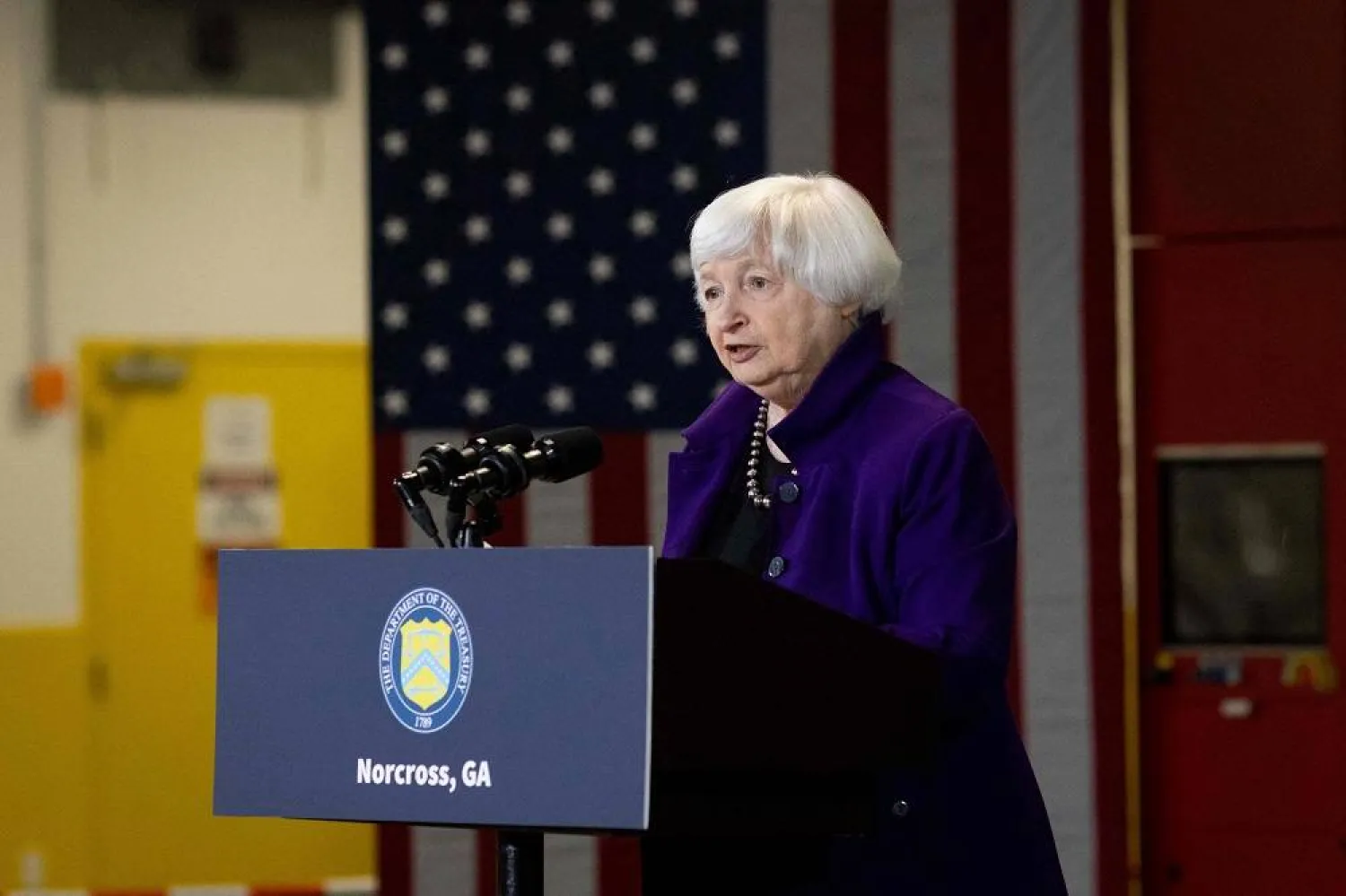
US Treasury Secretary Janet Yellen speaks during a visit to solar cell company Suniva in Norcross, Georgia, on March 27, 2024. (AFP)
TT

US Treasury Secretary Heads to China to Talk Trade, Anti-Money Laundering and Chinese ‘Overproduction’ 

US Treasury Secretary Janet Yellen speaks during a visit to solar cell company Suniva in Norcross, Georgia, on March 27, 2024. (AFP)

Treasury Secretary Janet Yellen is headed to a China determined to avoid open conflict with the United States, yet the world's two largest economies still appear to be hashing out the rules on how to compete against each other.

There are tensions over Chinese government support for the manufacturing of electric vehicles and solar panels, just as the US government ramps up its own aid for those tech sectors. There are differences in trade, ownership of TikTok, access to computer chips and national security — all of them a risk to what has become a carefully managed relationship.

The 77-year-old Yellen, a renowned economist and former Federal Reserve chair, laid out to reporters the issues that she intends to raise with her Chinese counterparts during her five-day visit. Yellen is headed to Guangzhou and Beijing for meetings with finance leaders and state officials. Her engagements will include Vice Premier He Lifeng, Chinese Central Bank Governor Pan Gongsheng, former Vice Premier Liu He, leaders of American businesses operating in China, university students and local leaders.

Yellen, speaking to reporters Wednesday during a refueling stop in Alaska en route to Asia, said her visit would be a “continuation of the dialogue that we have been engaged and deepening” ever since US President Joe Biden and Chinese President Xi Jinping met in 2022 in Indonesia. She noted that it would be her third meeting with China's vice premier.

Yellen recently accused China of flooding global markets with heavily subsidized green energy products, possibly undercutting the subsidies the US has provided to its own renewable energy and EV sector with funds provided by the Democrats’ Inflation Reduction Act. She said she intends to repeat her concerns to Chinese officials that they're flooding the global market with cheap solar panels and EVs that thwart the ability of other countries to develop those sectors.

“We need to have a level playing field,” Yellen told reporters. “We're concerned about a massive investment in China in a set of industries that's resulting in overcapacity.”

Yellen didn’t rule out taking additional steps to counter Chinese subsidies in the green energy sectors, adding: “It’s not just the United States but quite a few countries, including Mexico, Europe, Japan, that are feeling the pressure from massive investment, in these industries in China.”

The Treasury secretary’s travels come after Biden and Xi held their first call in five months on Tuesday, meant to demonstrate a return to regular leader-to-leader dialogue between the two powers. The leaders discussed Taiwan, artificial intelligence and security issues.

The call, described by the White House as “candid and constructive,” was the leaders’ first conversation since their November summit in California, which renewed ties between the two nations’ militaries and enhanced cooperation on stemming the flow of deadly fentanyl and its precursors from China.

Still, it appears to be difficult for the two countries to strike a balance between competition and antagonism.

For instance, Xi last week hosted American CEOs in Beijing to court them on investing in China. Meanwhile, Biden last August issued an executive order that instructed an inter-agency committee, chaired by Yellen, to closely monitor US investment in China related to high-tech manufacturing.

Jude Blanchette, a China expert at the Center for Strategic & International Studies, said: “The Biden administration’s efforts over the last year to stabilize the relationship are clearly working, but the main friction points all remain unresolved and will likely challenge the relationship for the foreseeable future.”

“For the time being, a ‘managed rivalry’ might be the best we can hope for, given the potentially catastrophic consequences of the relationship really going off the rails,” he said.

Yellen last week said China is flooding the market with green energy that “distorts global prices,” and plans to tell her counterparts that Beijing’s increased production of solar energy, electric vehicles and lithium-ion batteries poses risks to productivity and growth to the global economy.

China began to broaden its presence in the global economy more than two decades ago, exporting cheap goods that appealed to US consumers at the expense of factory jobs in many of those consumers' hometowns. Research by the economists David Autor, David Dorn and Gordon Hanson into what's known as the “China Shock” led to the steady demise of many factory towns, and in some cases led to greater political discontent.

Still, some experts see a benefit in an economic showdown to produce green products.

Shang-Jin Wei, a professor of Chinese business at Columbia University, says that a subsidy war could ultimately help consumers in both countries buy more climate-friendly products, which is an aim of the Biden administration.

“In contrast, a US tariff on EV imports could raise the price of EVs in the US and is therefore counterproductive for the purpose of inducing a green transition.”

Yellen's trip will run from April 4 to 9. It's intended as a follow-up to Yellen’s travel to China last July, which resulted in the launch of a pair of economic working groups between the two nations' finance departments to ease tensions and deepen ties.

But this visit falls in an election year, where tough talk on China has increased by Democrats and Republicans — who criticize Chinese ownership of popular social media app TikTok, the nation’s censorship and hold a deep mistrust over recent acts of espionage such as hacking and the use of a spy balloon.

Scheherazade S. Rehman, a professor of International Business and Finance and International Affairs at George Washington University, said while “it’s an election year, so all the rhetoric is going to be sharper, the USand China are in a symbiotic trading relationship and ultimately need each other.”

China is one of the United States’ biggest trading partners, and economic competition between the two nations has increased in recent years. Yellen stressed Wednesday that the United States has no interest in decoupling from China.

China’s support of Russia as it continues its invasion of neighboring Ukraine is another issue that will come up during the meetings. As the US and its allies sanction Russian officials and entire sectors of the Russian economy, like banking, oil production and manufacturing, trade between China and Russia has increased.


World Food Prices Dip in October, but Remain Higher Than a Year Ago

A worker carries loaves of bread for sale at a bakery in the capital city of Cairo, Egypt November 4, 2026. (Reuters)
TT

World Food Prices Dip in October, but Remain Higher Than a Year Ago

A worker carries loaves of bread for sale at a bakery in the capital city of Cairo, Egypt November 4, 2026. (Reuters)

World food prices edged lower in October as weaker import demand contributed to monthly declines in cereal, dairy and meat prices, but were still nearly 6% higher than a year earlier, the United Nations' Food and Agriculture Organization said on Friday.

The FAO Food Price Index, which tracks monthly changes in international prices for a basket of food commodities, ‌averaged 133.9 points ‌in October, down from a revised ‌135.6 ⁠in September.

The index ⁠was 5.9% higher than a year earlier, but remained 16.4% below its March 2022 peak.

FAO's cereal price index fell 4.5% from September and was 12.6% lower than a year ago, as wheat and maize quotations declined. Wheat prices eased on weak import demand ⁠and improved production prospects, especially in Argentina.

"Expectations of ‌easing constraints on Black ‌Sea export flows added to the downward pressure on prices, ‌although continued disruptions to Black Sea logistics limited the decline," ‌FAO said in a statement.

Maize prices also eased after reaching a three-year high in September, pressured by the US harvest, expectations of ample supplies in South America and renewed ‌prospects of easing tensions in the Black Sea region.

Vegetable oil prices edged up 0.3%, ⁠as ⁠higher soybean and sunflower oil prices more than offset a fall in rapeseed oil prices.

Sugar prices rose 6.6%, their fourth straight monthly increase, to the highest level since December 2024, after rainfall disrupted harvesting in Brazil. They were now 28.8% above a year ago.

The dairy index fell 1.1%, as lower butter and cheese prices linked to ample supplies and subdued demand outweighed gains in milk powder.

The meat index declined 1.2%, while still slightly above its year-earlier level, as ovine and bovine meat prices fell.


Copper Falls, Set for Worst Week Since March on AI Rout

Copper at the Aurubis copper smelting and refining plant in Hamburg, Germany. (Reuters)
TT

Copper Falls, Set for Worst Week Since March on AI Rout

Copper at the Aurubis copper smelting and refining plant in Hamburg, Germany. (Reuters)

Copper dropped on Friday and was set for its biggest weekly drop in London since March, as a rout in technology stocks battered markets.

Benchmark three-month copper on the London Metal Exchange was down 1.3% at $13,663 a metric ton by 0700 GMT. That placed it on track to fall 3.44% in the week, Reuters said.

The most-traded copper contract on the Shanghai Futures Exchange fell 1.08% to 106,830 yuan ($16,018.17) a ton.

The weakness reflects worries over AI investment, ‌with copper increasingly ‌influenced by "sentiment towards data center expansion," said ‌Craig ⁠Lang, principal analyst ⁠at CRU.

Technology shares were battered after Democratic wins in the US midterms fueled concerns that new regulatory oversight could cap the AI buildout.

On the other hand, supply constraints cushioned copper's decline.

"I would be cautious about calling this a sustained correction, given ongoing mine supply challenges and exceptionally tight ⁠metal availability outside the US," Lang said.

Copper stocks ‌in SHFE-monitored warehouses <CU-STX-SGH> fell by ‌over 24% this week to just 33,848 tons — the lowest ‌in almost three years. The closely watched Yangshan copper ‌premium <SMM-CUYP-CN>, a gauge of appetite for imports into key consumer China, increased to $210 a ton on Thursday, matching its record high.

Smelters in the country are facing a double squeeze of negative treatment ‌charges and lower sulfuric acid prices.

Meanwhile, warehouse inventories outside the US have been drawn ⁠down as ⁠material was pulled into the country ahead of a potential tariff on imports of refined copper.

"These physical constraints should provide some support against weaker investor sentiment," Lang said.

Among LME metals, aluminium lost 0.54%, zinc lost 1.42%, lead lost 0.45%, nickel dipped 0.23% and tin gained 0.83%.

On the SHFE, aluminium nudged down only 0.04%, zinc lost 1.35%, lead was little changed, down only 0.03%, nickel rose 2.14% and tin dropped 3.45%.

SHFE inventories were down across the board this week, led by sharp drops in aluminium <AL-STX-SGH> and lead <PB-STX-SGH>.


Emerging Economies Set to Match Advanced Nations’ Renewable Capacity Additions, IEA Says

Workers walk at Kalyon Karapinar solar power plant in Karapinar, Konya province, Türkiye, Oct. 14, 2026. (AP)
TT

Emerging Economies Set to Match Advanced Nations’ Renewable Capacity Additions, IEA Says

Workers walk at Kalyon Karapinar solar power plant in Karapinar, Konya province, Türkiye, Oct. 14, 2026. (AP)

Emerging ‌and developing economies outside China are expected to add as much new renewable energy capacity as advanced economies for the first time over the next five years, driven by the current energy crisis, the International Energy Agency said on Friday.

Gas and oil prices have soared this year as the US-Iran war disrupts traffic through the Strait of Hormuz, a key route for global oil and gas trade.

Global renewable energy ‌capacity is forecast ‌to increase by almost 4,800 gigawatts ‌between ⁠2026 and 2031, ⁠the IEA said in its annual outlook.

Emerging and developing economies are expected to add about 1,100 GW, roughly the same as advanced economies, with China adding around 2,550 GW, the agency said.

Capacity growth in Southeast Asia, Africa and the Middle East is ⁠expected to triple over the period, ‌led mainly by solar installations, ‌the IEA said.

China will remain the biggest contributor to ‌global renewable energy growth, although its share is ‌forecast to fall to 53% by 2031 from 60% in 2025.

India is emerging as the world's second-fastest deployer of renewables and is expected to more than double its contribution ‌to global growth by 2031 to nearly 8.5%.

Grid connection delays remain ⁠a major ⁠challenge, with projects awaiting connections worldwide rising 60% over the past year, equivalent to four times the wind and solar capacity connected to grids during the same period.

Grid constraints are expected to slow growth in advanced economies, with annual additions in Europe through 2031 forecast to remain broadly in line with 2025 levels.

Renewable energy is expected to meet 6% of global transport energy demand by 2031, while higher fuel-blending mandates prompted the IEA to raise its biofuels forecast by 40% from last year's report.