Senegal Tapestry Production Finds New Lease of Life

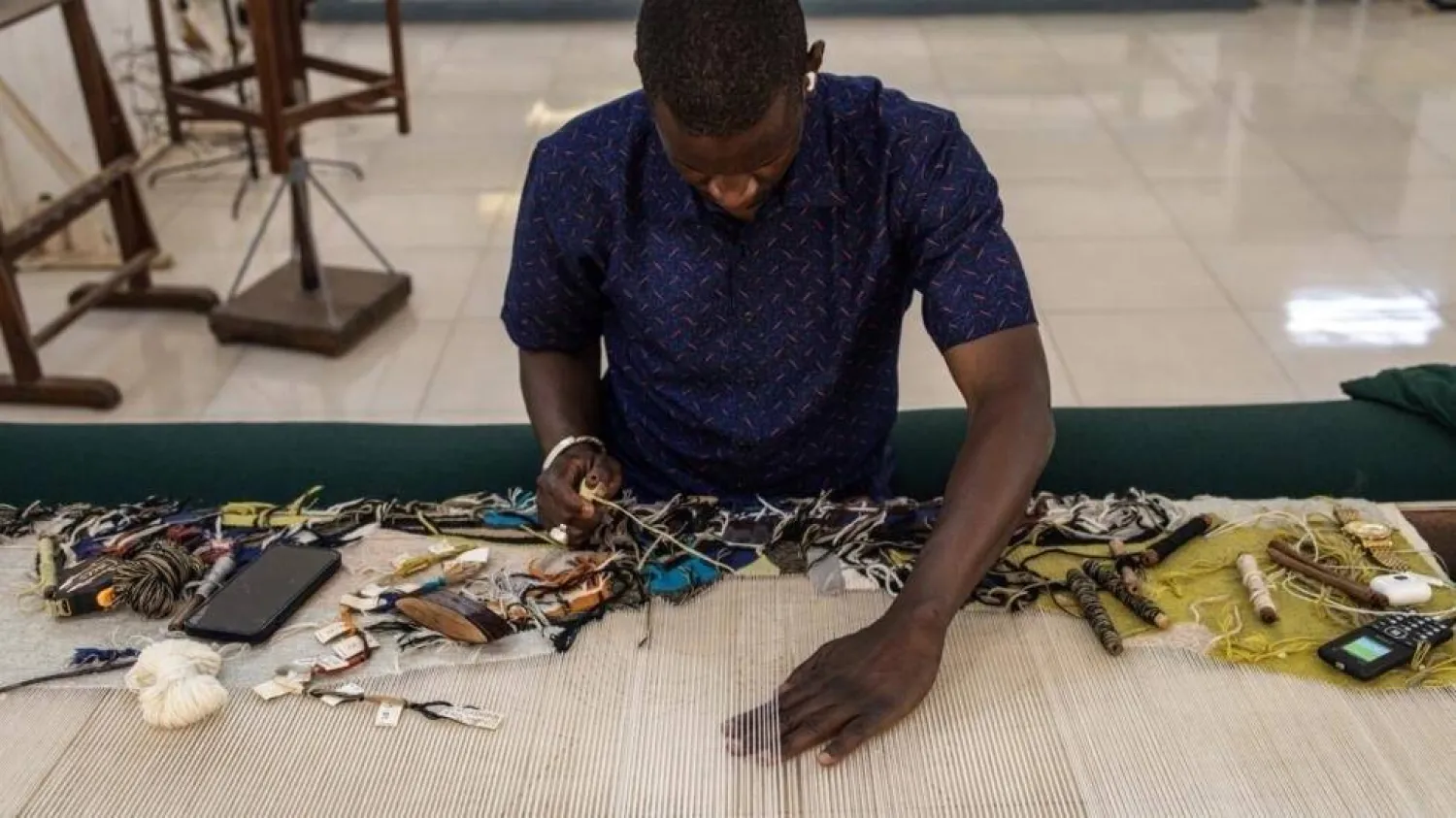
Senegalese tapestries adorn the walls of organizations the world over. JOHN WESSELS / AFP
TT

Senegal Tapestry Production Finds New Lease of Life

Senegalese tapestries adorn the walls of organizations the world over. JOHN WESSELS / AFP

After cutting away the loose woolen threads from his loom, 28-year-old Senegalese weaver Seydina Oumar Cisse turns the roll to watch the tapestry gradually take shape before his eyes.
Everything from the colors to the design is identical to the original work created by Senegalese artist Cheikh Diouf.
"It's very satisfying," Cisse said, seeing the result of six months' work for the first time.
Cisse is a weaver at the Senegalese manufacturers of decorative arts in the central city of Thies, a leading producer of high quality artistic goods on the African continent.
The establishment's creations adorn the walls of organizations the world over, from the UN headquarters in New York to the African Union in Addis Ababa, as well as the palaces of numerous heads of state.
Tapestry production in Thies was a flagship cultural policy of Senegal's first president, poet Leopold Sedar Senghor, with production now revitalized thanks to a broadening of operations and new partnerships, including with fashion giant Chanel.
The creations are "attracting renewed interest, driven locally by galleries with international stature and a resurgence of interest in textiles and tapestries" on the art market, said Coline Desportes, a researcher at the national institute of art history (INHA).
'Symbiosis of techniques'
Senghor established national tapestry production in Thies in 1966, six years after Senegal gained independence from France, with the goal of "creating a new art for a new nation".
While weaving techniques had previously proved popular in African clothing designs, the art of wall tapestries was little known in Senegal.
Two years before production got underway, four craftsmen headed to France for specialized training, with the new art form representing "the symbiosis of techniques imported from France and traditional culture," according to Senghor.
Over the years the former president's legacy has been kept alive, but not without difficulty.
The state reduced support after Senghor's departure and tapestries went out of fashion, leading production in Thies to almost disappear before orders picked up again in the 2000s.
In the weaving workshops, situated within the white and green walls of former army barracks, the weavers have no room for error.
Each meticulously follows the cardboard lines on their looms, using wool from Europe and cotton from Thies to trace their designs.
'Cultural powerhouse'
Not far away, a group of about 30 American school students listen to a talk given by the head of the cardboard workshop, where the models which guide the weaving process are produced.
The establishment now welcomes tourists and film crews onto the premises, evidencing its commitment to diversifying operations.
Fourteen rooms will soon be available for visitors, as well as an artists' residence, managing director Aloyse Diouf said.
"We want to turn the manufacturers into a cultural powerhouse, a link between art and tourism," he added, although government commissions remain essential to keeping production afloat.
"Tapestry is not necessarily linked to our history and has remained mainly elitist -- it is mainly the authorities who buy tapestries to contribute to Senegal's artistic influence," Diouf said.
"The ownership of this art form by the Senegalese is a long-term project that we are developing by inviting schools to visit the factories".
The establishment now also produces prayer rugs, batik and ceramics, which are slightly more affordable for the Senegalese than the wall tapestries, which cost 1.5 million CFA francs ($2,400) per square meter.



Saudi Arabia: Ship of Tolerance Initiative Promotes Cultural Dialogue in Jeddah

The Royal Institute of Traditional Arts (Wrth) will offer traditional craft workshops throughout Ramadan. SPA
TT

Saudi Arabia: Ship of Tolerance Initiative Promotes Cultural Dialogue in Jeddah

The Royal Institute of Traditional Arts (Wrth) will offer traditional craft workshops throughout Ramadan. SPA

The Saudi Ministry of Culture, in collaboration with the "Lenobadir" volunteer and community partnership program and the Athr Foundation, has launched the Ship of Tolerance initiative in Historic Jeddah during Ramadan.

The initiative aims to enhance shared human values through arts, and promote tolerance and coexistence among children and families. It provides an educational and cultural experience aligned with the area’s unique character as a UNESCO World Heritage site.

As part of this global art project, children will create artworks that represent acceptance and dialogue.

The Royal Institute of Traditional Arts (Wrth) will offer traditional craft workshops throughout Ramadan, linking the initiative's values with local heritage and enriching visitors' connection to the region's identity.

This effort supports cultural programs with educational and social dimensions in Historic Jeddah, activating local sites for experiences that combine art, crafts, and community participation. It aligns with the National Strategy for Culture under Saudi Vision 2030, focusing on heritage preservation and expanding culture's impact on daily life.


Oscar Contender ‘Hamnet’ Boosts Tourism at Shakespeare Heritage Sites 

A view of Shakespeare’s Birthplace, William Shakespeare's childhood home, in Stratford-upon-Avon, Britain, February 9, 2026. (Reuters)
TT

Oscar Contender ‘Hamnet’ Boosts Tourism at Shakespeare Heritage Sites 

A view of Shakespeare’s Birthplace, William Shakespeare's childhood home, in Stratford-upon-Avon, Britain, February 9, 2026. (Reuters)

On a cloudy winter's day, visitors stream into what was once William Shakespeare's childhood home in Stratford-upon-Avon and the nearby Anne Hathaway's cottage, family residence of the bard's wife.

Hathaway's cottage is one of the settings for the BAFTA and Oscar best film contender "Hamnet", and the movie's success is drawing a new wave of tourists to Shakespeare sites in the town in central England.

Shakespeare's Birthplace is the house the young William once lived in and where his father worked as a glove maker, while Hathaway's cottage is where he would have visited his future wife early in their relationship.

Typically, around 250,000 visitors, from the UK, Europe, the United States, China and elsewhere, walk through the locations each year, according to the Shakespeare Birthplace Trust. ‌The charity looks after ‌Shakespeare heritage sites, which also include Shakespeare's New Place, the site of ‌the ⁠Stratford home where the ⁠bard died in 1616.

Visitors are flocking in this year thanks to "Hamnet", the film based on Maggie O'Farrell's 2020 novel, which gives a fictional account of the relationship between Shakespeare and Hathaway, also known as Agnes, and the death of their 11-year-old son Hamnet in 1596.

"Visitor numbers have increased by about 15 to 20% across all sites since the film was released back in January. I think that will only continue as we go throughout the year," Richard Patterson, chief operating officer for the Shakespeare Birthplace Trust, said.

"They particularly want ⁠to look (at) Anne Hathaway's cottage and the specifics around how the family ‌engaged in the spaces and the landscape in and around ‌the cottage... you can see why he would have been inspired."

NEW ACCESS TO SHAKESPEARE

"Hamnet" has 11 nominations at ‌Sunday's British BAFTA awards, including best film and leading actress for Jessie Buckley, who plays Agnes. It ‌also has eight Oscar nominations, with Buckley seen as the frontrunner to win best actress.

"Hamnet" is set in Stratford-upon-Avon and London although it was not filmed in Stratford.

It sees Paul Mescal's young Shakespeare fall for Agnes while teaching Latin to pay off his father's debts. The drama, seen mainly through Agnes' eyes, focuses on their ‌life together and grief over Hamnet's death, leading Shakespeare to write "Hamlet".

"Shakespeare... is notoriously enigmatic. He writes about humanity, about feeling, about emotion, about conflict, ⁠but where do we understand ⁠who he is in that story?" said Charlotte Scott, a professor of Shakespeare studies and interim director of collections, learning and research at the Shakespeare Birthplace Trust.

"And that's driven people creative and otherwise for hundreds and hundreds of years. Where is Shakespeare's heart? And this is what the film I think has so beautifully opened up."

Little is known about how the couple met. Shakespeare was 18 and Hathaway 26 when they married in 1582. Daughter Susanna arrived in 1583 and twins Judith and Hamnet in 1585.

The film acknowledges the names Hamnet and Hamlet were interchangeable back then. While grief is a dominant theme, audiences also see Shakespeare in love and as a father.

"A lot of people will see this film not necessarily having... had any kind of relationship with Shakespeare," Scott said.

"So people will come to this film, I hope, and find a new way of accessing Shakespeare that is about creativity, that is about understanding storytelling as a constant process of regeneration, but also crucially, looking at it from that kind of emotive angle."


Culture Ministry Continues Preparations in Historic Jeddah to Welcome Visitors during Ramadan 

Historic Jeddah has emerged as a leading cultural tourism destination during Ramadan. (SPA)
TT

Culture Ministry Continues Preparations in Historic Jeddah to Welcome Visitors during Ramadan 

Historic Jeddah has emerged as a leading cultural tourism destination during Ramadan. (SPA)

The Saudi Ministry of Culture is continuing its efforts to revitalize Historic Jeddah in preparation for welcoming visitors during the holy month of Ramadan, offering cultural programs, events, and heritage experiences that reflect the authenticity of the past.

The district has emerged as a leading cultural tourism destination at this time of year as part of the “The Heart of Ramadan” campaign launched by the Saudi Tourism Authority.

Visitors are provided the opportunity to explore the district’s attractions, including archaeological sites located within the geographical boundaries of the UNESCO World Heritage-listed area, which represent a central component of the Kingdom’s urban and cultural heritage.

The area also features museums that serve as gateways to understanding the city’s rich heritage and cultural development, in addition to traditional markets that narrate historical stories through locally made products and Ramadan specialties that reflect authentic traditions.

These initiatives are part of the ministry’s ongoing efforts to revitalize Historic Jeddah in line with the objectives of Saudi Vision 2030 and aiming to transform it into a vibrant hub for arts, culture, and the creative economy, while preserving its tangible and intangible heritage.