

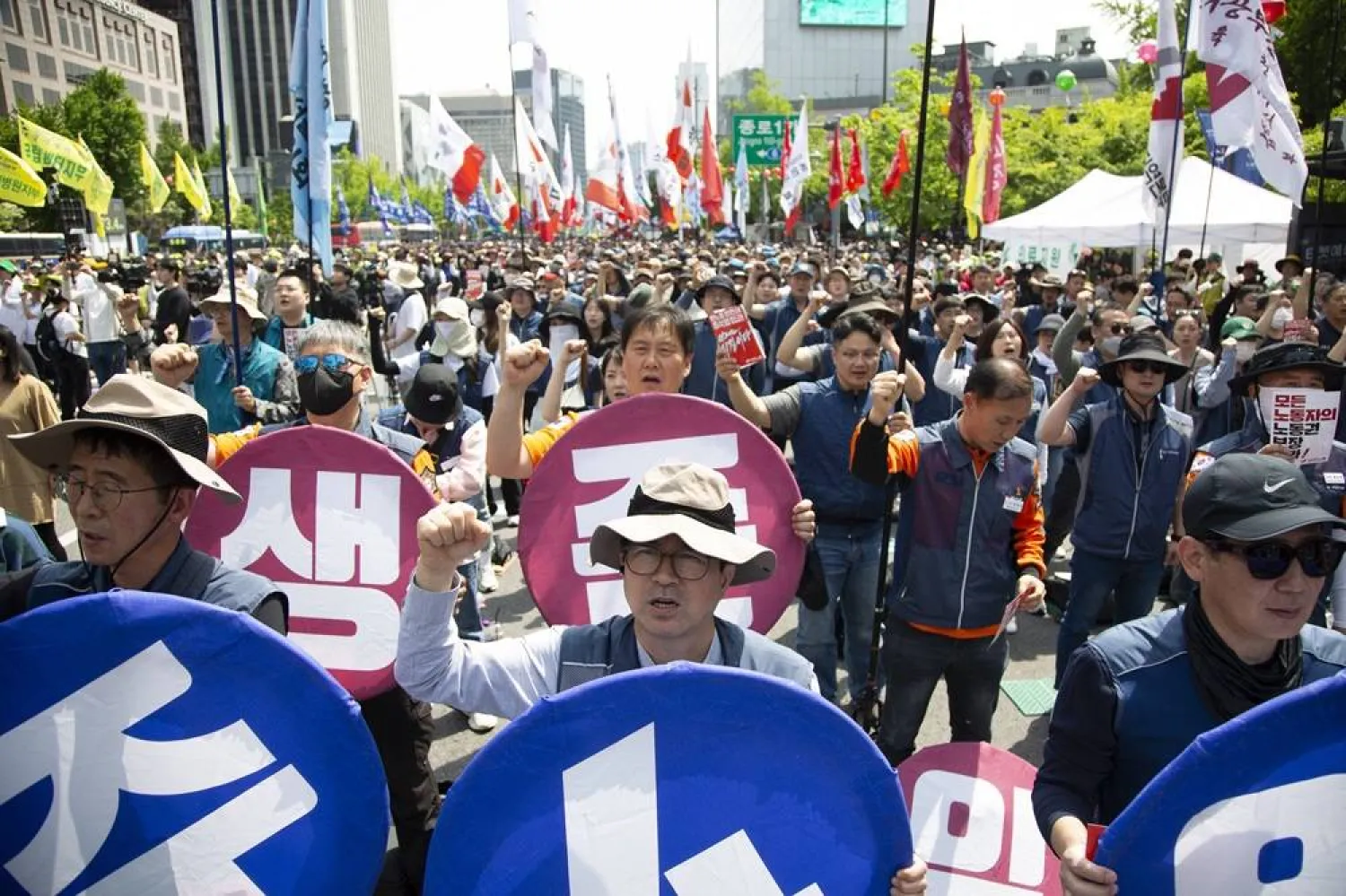

Workers and Activists across Asia and Europe Hold May Day Rallies to Call for Greater Labor Rights

Members of the South Korean Confederation of Trade Unions (KCTU) gather to protest against the government's labor policy during a rally marking Labor Day in Seoul, South Korea, 01 May 2024. (EPA)
TT

Workers and Activists across Asia and Europe Hold May Day Rallies to Call for Greater Labor Rights

Members of the South Korean Confederation of Trade Unions (KCTU) gather to protest against the government's labor policy during a rally marking Labor Day in Seoul, South Korea, 01 May 2024. (EPA)

Workers, activists and others in Asian capitals and European cities took to the streets on Wednesday to mark May Day with protests over rising prices and government labor polices and calls for greater labor rights.

May Day, which falls on May 1, is observed in many countries to celebrate workers’ rights. May Day events have also given many an opportunity to air general economic grievances or political demands.

Police in Istanbul detained dozens of people who tried to reach the central Taksim Square in defiance of a government ban on marking Labor Day at the landmark location.

President Recep Tayyip Erdogan’s government has long declared Taksim off-limits for rallies and demonstrations on security grounds, but some political parties and trade unions have vowed to march to the square, which holds symbolic value for labor unions.

In 1977, unidentified gunmen opened fire on a May Day celebration at Taksim, causing a stampede and killing 34 people.

On Wednesday, police erected barricades and sealed off all routes leading to the central Istanbul square. Public transport in the area was also restricted. Only a small group of trade union representatives was permitted to enter the square to lay a wreath at a monument in memory of victims of the 1977 incident.

Riot police apprehended some 30 members of the left-wing People’s Liberation Party who tried to break through the barriers.

In Indonesia, workers voiced anger at a new law they said violates their rights and hurts their welfare, and demanded protections for migrant workers abroad and a minimum wage raise.

About 50,000 workers from Jakarta’s satellite cities of Bogor, Depok, Tangerang and Bekasi were expected to join May Day marches in the capital, said Said Iqbal, the president of the Confederation of Indonesian Trade Unions.

They gathered amid a tight police presence near the National Monument park, waving the colorful flags of labor groups and chanting slogans against the Job Creation Law and loosened outsourcing rules during a march to Jakarta’s main sports stadium, Gelora Bung Karno.

“With the enactment of this law, our future is uncertain because many problems arise in wages, severance pay and the contract system,” said Isbandi Anggono, a protester.

Indonesia’s parliament last year ratified a government regulation that replaces a controversial law on job creation, but critics said it still benefits businesses. The law was intended to cut bureaucracy as part of President Joko Widodo’s efforts to attract more investment to the country, which is Southeast Asia's largest economy.

In Seoul, the South Korean capital, thousands of protesters sang, waved flags and shouted pro-labor slogans at the start of their rally on Wednesday. Organizers said their rally was primarily meant to step up their criticism of what they call anti-labor policies pursued by the conservative government led by President Yoon Suk Yeol.

“In the past two years under the Yoon Suk Yeol government, the lives of our laborers have plunged into despair,” Yang Kyung-soo, leader of the Korean Confederation of Trade Unions, which organized the rally, said in a speech. “We can't overlook the Yoon Suk Yeol government. We'll bring them down from power for ourselves.”

KCTU union members decried Yoon’s December veto of a bill aimed at limiting companies’ rights to seek compensation for damages caused by strikes by labor unions. They also accuse Yoon’s government of handling the 2022 strikes by truckers too aggressively and insulting construction sector workers whom authorities believed were involved in alleged irregular activities.

Since taking office in 2022, Yoon has pushed for labor reforms to support economic growth and job creation. His government has vowed to sternly deal with illegal strikes and demand more transparent accounting records from labor unions.

“The remarkable growth of the Republic of Korea was thanks to the sweat and efforts of our workers. I thank our 28.4 million workers,” Yoon said in a May Day message posted on Facebook. “My government and I will protect the precious value of labor.”

Seoul rally participants later marched through downtown streets. Similar May Day rallies were held in more than 10 locations across South Korea on Wednesday. Police said they had mobilized thousands of officers to maintain order, but there were no immediate reports of violence.

In Japan, more than 10,000 people gathered at Yoyogi park in downtown Tokyo for a May Day event, demanding salary increases that they said could sufficiently set off price increases. During the rally, Masako Obata, the leader of the left-leaning National Confederation of Trade Unions, said that dwindling wages have put many workers in Japan under severe living conditions and widened income disparities.

“On this May Day, we unite with our fellow workers around the world standing up for their rights,” she said, shouting “banzai!" or long life, to all workers.

In the Philippine capital, Manila, hundreds of workers and left-wing activists marched and held a rally in the scorching summer heat to demand wage increases and job security amid soaring food and oil prices.

Riot police stopped the protesting workers from getting close to the presidential palace. Waving red flags and holding up posters that read: “We work to live, not to die” and “Lower prices, increase salaries,” the protesters rallied in the street, where they chanted and delivered speeches about the difficulties faced by Filipino laborers.

Poor drivers joined the protest and called to end a government modernization program they fear would eventually lead to the removal of their dilapidated jeepneys, a main mode of public transport, from Manila’s streets.



Trump to Travel to China Next Month, with US Trade Policy in Focus

US President Donald Trump arrives at Joint Base Andrews in Maryland, US, February 19, 2026. (Reuters)
TT

Trump to Travel to China Next Month, with US Trade Policy in Focus

US President Donald Trump arrives at Joint Base Andrews in Maryland, US, February 19, 2026. (Reuters)

US President Donald Trump will travel to China from March 31 to April 2 for a highly anticipated meeting between the world's two biggest economies, following the Supreme Court's decision to overturn Trump's sweeping tariffs against imported goods.

A White House official confirmed the trip on Friday, just before the highest US court struck down many of the tariffs Trump has used to manage sometimes-tense relations with China.

Trump is expected to visit Beijing and meet Chinese President Xi Jinping as part of a lavish, extended visit. Trump was last in China in 2017, ‌the most ‌recent trip by a US president.

A key topic had been whether ‌to ⁠extend a trade ⁠truce that kept both countries from further hiking tariffs. After Friday's ruling, however, it was not immediately clear whether - and under what legal authority - Trump would restore tariffs on imports from China.

TRUMP SEES TRADE IMBALANCE AS NATIONAL EMERGENCY

The administration has said the tariffs were necessary because of national emergencies related to trade imbalances and China's role in producing illicit fentanyl-related chemicals.

"That's going to be a wild one," Trump told foreign leaders visiting Washington on Thursday ⁠about the trip. "We have to put on the biggest display you've ‌ever had in the history of China."

The Chinese ‌embassy in Washington did not immediately respond to a request for comment. Beijing has not ‌confirmed the trip.

The visit would be the leaders' first talks since February and their first ‌in-person visit since an October meeting in South Korea. At that October meeting, Trump agreed to trim tariffs on China in exchange for Beijing cracking down on the fentanyl trade, resuming US soybean purchases and keeping rare earth minerals flowing.

While the October meeting largely sidestepped the sensitive issue of ‌Taiwan, Xi raised US arms sales to the island in February.

Washington announced its largest-ever arms sales deal with Taiwan in December, ⁠including $11.1 billion in ⁠weapons that could ostensibly be used to defend against a Chinese attack. Taiwan expects more such sales.

China views Taiwan as its own territory, a position Taipei rejects. The United States has formal diplomatic ties with China, but it maintains unofficial ties with Taiwan and is the island's most important arms supplier. The United States is bound by law to provide Taiwan with the means to defend itself.

Xi also said during the February call that he would consider further increasing soybean purchases, according to Trump.

Struggling US farmers are a major political constituency for Trump, and China is the top soybean consumer.

Although Trump has justified several hawkish policy steps from Canada to Greenland and Venezuela as necessary to thwart China, he has eased policy toward Beijing in the past several months in key areas, from tariffs to advanced computer chips and drones.


Diplomacy Is Still the Only Viable Path to Peace in Ukraine, UN Refugee Chief Barham Salih Says

UNCHR High Commissioner Barham Salih talks during an interview with The Associated Press in Kyiv, Ukraine, Friday, Feb. 20, 2026. (AP)
TT

Diplomacy Is Still the Only Viable Path to Peace in Ukraine, UN Refugee Chief Barham Salih Says

UNCHR High Commissioner Barham Salih talks during an interview with The Associated Press in Kyiv, Ukraine, Friday, Feb. 20, 2026. (AP)

There are many obstacles to a peace deal in Ukraine, but a diplomatic solution remains the only viable option, the newly appointed head of the UN refugee agency said Friday, warning that humanitarian operations are increasingly overstretched because of multiple global crises.

Barham Salih, Iraq’s former president who was elected UNHCR high commissioner in December, made his first visit to Ukraine since taking office.

After traveling to Ukraine’s front-line cities, including Kharkiv and Zaporizhzhia, he met with President Volodymyr Zelenskyy and discussed the latest in efforts to secure a peace deal. He also discussed the future of UNHCR operations as Ukraine endures Russian attacks on its energy grid during a harsh winter.

“You have to be hopeful, but I do understand the difficulties in the situation, and it’s clear, of course, there are many, many impediments along the way, but at the end of the day, there is no military solution. There needs to be peace, a durable and just peace so that people can go back to their lives,” he said, speaking to The Associated Press in an interview in Kyiv.

“Things are not necessarily easy, definitely not easy, but let’s redouble the effort to make sure that diplomacy has a chance and really bring about a durable and just peace to this war that has been going on for far too long,” he added.

Of the agency’s $470 million appeal for Ukraine, only $150 million has been pledged. The shortfall reflects deep cuts across the humanitarian sector, making it increasingly difficult to deliver aid across multiple crises.

There are 3.7 million Ukrainians displaced within the country and nearly 6 million Ukrainians outside the country who have become refugees in Europe and elsewhere, he said.

“This tells you the gap between what is needed and what is available,” he said. “My appeal to the international community is, really, this is not the moment to walk away, this is not a moment to look the other way round. These vulnerable populations need support. We should deliver this help to them.”

The UN agency in Ukraine predicts 10.8 million Ukrainians will require humanitarian assistance in 2026, according to a report from the agency. The most critical needs are concentrated along the war’s front lines in the eastern and southern parts of Ukraine, as well as in the northern border region. Intensified hostilities produce fresh waves of displacement.

The agency’s Ukraine appeal competes with large-scale conflicts in Sudan and Gaza. Since his appointment, Salih has spent only one week in his Geneva office, traveling to Kenya, Chad, Türkiye and Jordan before visiting Ukraine.

Drastic cuts to US humanitarian funding under President Donald Trump has accelerated the erosion of global humanitarian infrastructure and severely undermined the ability of organizations to deliver aid.

There are 117 million displaced people worldwide, including at least 42 million refugees, Salih said. Two-thirds face protracted displacement and remain dependent on humanitarian assistance.

Deciding where to prioritize given shrinking resources is “difficult” he said.

“It’s really very difficult to prioritize given the scale of the problem. I was in Kenya and I was in Chad recently and I was in Türkiye and in Jordan talking to refugees from Syria. And of course, now in Ukraine, these are all pressing issues, pressing requirements,” he said.

“We need to be there to help people, but also I have to say we really need to look at durable solutions too as well. It’s not a matter of sustaining dependency or humanitarian assistance,” he added.

In his meeting with Zelenskyy, Salih said they discussed the need to focus on the “recovery phase and sustainable solutions and self reliance as we go forward,” he said.


Israel Army Says on ‘Defensive Alert’ Regarding Iran but No Change to Public Guidelines

Israeli air defense system fires to intercept missiles during an Iranian attack over Tel Aviv, Israel, Thursday, June 19, 2025. (AP)
TT

Israel Army Says on ‘Defensive Alert’ Regarding Iran but No Change to Public Guidelines

Israeli air defense system fires to intercept missiles during an Iranian attack over Tel Aviv, Israel, Thursday, June 19, 2025. (AP)

The Israeli army said it was on "defensive alert" as the United States threatens potential military action against Iran, but insisted there were no changes in its guidelines for the public.

"We are closely monitoring regional developments and are aware of the public discourse concerning Iran. The (Israeli military) is on defensive alert," army spokesman Brigadier General Effie Defrin said in a video statement published Friday.

"Our eyes are wide open in all directions, and our finger is more than ever on the trigger in response to any change in the operational reality," he added, but emphasized "there is no change in the instructions".