Illness Took Away Her Voice. AI Created a Replica She Carries in Her Phone

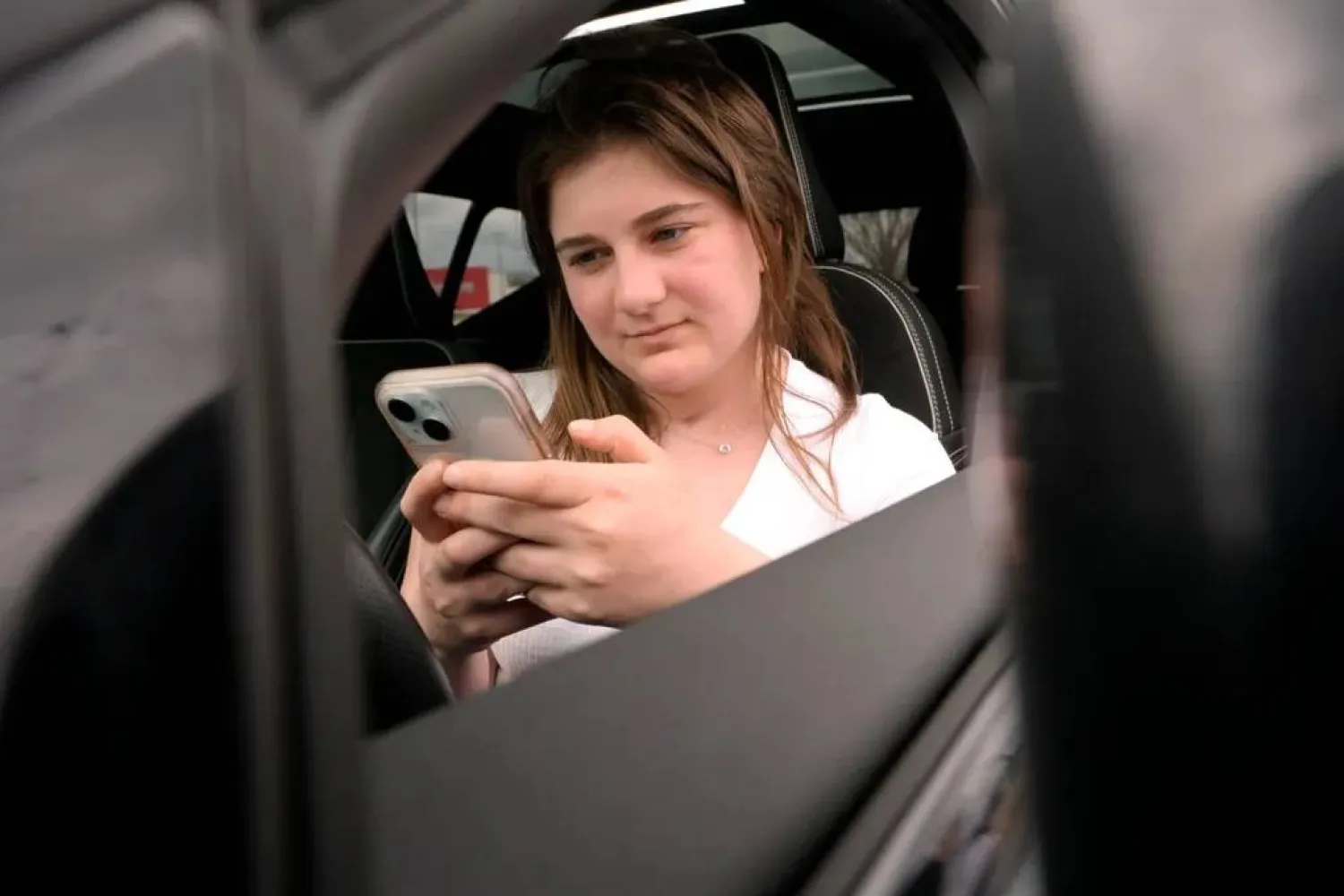
Alexis Bogan, whose speech was impaired by a brain tumor, uses an AI powered smartphone app to create a audible drink order at a Starbucks drive-thru on Monday, April 29, 2024, in Lincoln, R.I. (AP Photo/Steven Senne)
TT

Illness Took Away Her Voice. AI Created a Replica She Carries in Her Phone

Alexis Bogan, whose speech was impaired by a brain tumor, uses an AI powered smartphone app to create a audible drink order at a Starbucks drive-thru on Monday, April 29, 2024, in Lincoln, R.I. (AP Photo/Steven Senne)

The voice Alexis “Lexi” Bogan had before last summer was exuberant.
She loved to belt out Taylor Swift and Zach Bryan ballads in the car. She laughed all the time — even while corralling misbehaving preschoolers or debating politics with friends over a backyard fire pit. In high school, she was a soprano in the chorus.
Then that voice was gone.
Doctors in August removed a life-threatening tumor lodged near the back of her brain. When the breathing tube came out a month later, Bogan had trouble swallowing and strained to say “hi” to her parents. Months of rehabilitation aided her recovery, but her speech is still impaired. Friends, strangers and her own family members struggle to understand what she is trying to tell them.
In April, the 21-year-old got her old voice back. Not the real one, but a voice clone generated by artificial intelligence that she can summon from a phone app. Trained on a 15-second time capsule of her teenage voice — sourced from a cooking demonstration video she recorded for a high school project — her synthetic but remarkably real-sounding AI voice can now say almost anything she wants.
She types a few words or sentences into her phone and the app instantly reads it aloud.
“Hi, can I please get a grande iced brown sugar oat milk shaken espresso,” said Bogan’s AI voice as she held the phone out her car’s window at a Starbucks drive-thru.
Experts have warned that rapidly improving AI voice-cloning technology can amplify phone scams, disrupt democratic elections and violate the dignity of people — living or dead — who never consented to having their voice recreated to say things they never spoke.
It's been used to produce deepfake robocalls to New Hampshire voters mimicking President Joe Biden. In Maryland, authorities recently charged a high school athletic director with using AI to generate a fake audio clip of the school’s principal making racist remarks.
But Bogan and a team of doctors at Rhode Island's Lifespan hospital group believe they've found a use that justifies the risks. Bogan is one of the first people — the only one with her condition — who have been able to recreate a lost voice with OpenAI’s new Voice Engine. Some other AI providers, such as the startup ElevenLabs, have tested similar technology for people with speech impediments and loss — including a lawyer who now uses her voice clone in the courtroom.
“We’re hoping Lexi's a trailblazer as the technology develops,” said Dr. Rohaid Ali, a neurosurgery resident at Brown University's medical school and Rhode Island Hospital. Millions of people with debilitating strokes, throat cancer or neurogenerative diseases could benefit, he said.
“We should be conscious of the risks, but we can’t forget about the patient and the social good,” said Dr. Fatima Mirza, another resident working on the pilot. “We’re able to help give Lexi back her true voice and she’s able to speak in terms that are the most true to herself.”
Mirza and Ali, who are married, caught the attention of ChatGPT-maker OpenAI because of their previous research project at Lifespan using the AI chatbot to simplify medical consent forms for patients. The San Francisco company reached out while on the hunt earlier this year for promising medical applications for its new AI voice generator.
Bogan was still slowly recovering from surgery. The illness started last summer with headaches, blurry vision and a droopy face, alarming doctors at Hasbro Children's Hospital in Providence. They discovered a vascular tumor the size of a golf ball pressing on her brain stem and entangled in blood vessels and cranial nerves.
“It was a battle to get control of the bleeding and get the tumor out,” said pediatric neurosurgeon Dr. Konstantina Svokos.
The 10-hour length of the surgery coupled with the tumor's location and severity damaged Bogan's tongue muscles and vocal cords, impeding her ability to eat and talk, Svokos said.
“It’s almost like a part of my identity was taken when I lost my voice,” Bogan said.
The feeding tube came out this year. Speech therapy continues, enabling her to speak intelligibly in a quiet room but with no sign she will recover the full lucidity of her natural voice.
“At some point, I was starting to forget what I sounded like," Bogan said. “I’ve been getting so used to how I sound now.”
Whenever the phone rang at the family's home in the Providence suburb of North Smithfield, she would push it over to her mother to take her calls. She felt she was burdening her friends whenever they went to a noisy restaurant. Her dad, who has hearing loss, struggled to understand her.
Back at the hospital, doctors were looking for a pilot patient to experiment with OpenAI's technology.
“The first person that came to Dr. Svokos’ mind was Lexi,” Ali said. “We reached out to Lexi to see if she would be interested, not knowing what her response would be. She was game to try it out and see how it would work."
Bogan had to go back a few years to find a suitable recording of her voice to “train” the AI system on how she spoke. It was a video in which she explained how to make a pasta salad.
Her doctors intentionally fed the AI system just a 15-second clip. Cooking sounds make other parts of the video imperfect. It was also all that OpenAI needed — an improvement over previous technology requiring much lengthier samples.
They also knew that getting something useful out of 15 seconds could be vital for any future patients who have no trace of their voice on the internet. A brief voicemail left for a relative might have to suffice.
When they tested it for the first time, everyone was stunned by the quality of the voice clone. Occasional glitches — a mispronounced word, a missing intonation — were mostly imperceptible. In April, doctors equipped Bogan with a custom-built phone app that only she can use.
“I get so emotional every time I hear her voice,” said her mother, Pamela Bogan, tears in her eyes.
"I think it’s awesome that I can have that sound again,” added Lexi Bogan, saying it helped “boost my confidence to somewhat where it was before all this happened.”
She now uses the app about 40 times a day and sends feedback she hopes will help future patients. One of her first experiments was to speak to the kids at the preschool where she works as a teaching assistant. She typed in “ha ha ha ha” expecting a robotic response. To her surprise, it sounded like her old laugh.
She's used it at Target and Marshall's to ask where to find items. It's helped her reconnect with her dad. And it's made it easier for her to order fast food.
Bogan's doctors have started cloning the voices of other willing Rhode Island patients and hope to bring the technology to hospitals around the world. OpenAI said it is treading cautiously in expanding the use of Voice Engine, which is not yet publicly available.
A number of smaller AI startups already sell voice-cloning services to entertainment studios or make them more widely available. Most voice-generation vendors say they prohibit impersonation or abuse, but they vary in how they enforce their terms of use.
“We want to make sure that everyone whose voice is used in the service is consenting on an ongoing basis,” said Jeff Harris, OpenAI's lead on the product. “We want to make sure that it’s not used in political contexts. So we’ve taken an approach of being very limited in who we’re giving the technology to.”
Harris said OpenAI's next step involves developing a secure “voice authentication” tool so that users can replicate only their own voice. That might be “limiting for a patient like Lexi, who had sudden loss of her speech capabilities,” he said. "So we do think that we’ll need to have high-trust relationships, especially with medical providers, to give a little bit more unfettered access to the technology.”
Bogan has impressed her doctors with her focus on thinking about how the technology could help others with similar or more severe speech impediments.
“Part of what she has done throughout this entire process is think about ways to tweak and change this,” Mirza said. “She’s been a great inspiration for us.”
While for now she must fiddle with her phone to get the voice engine to talk, Bogan imagines an AI voice engine that improves upon older remedies for speech recovery — such as the robotic-sounding electrolarynx or a voice prosthesis — in melding with the human body or translating words in real time.
She's less sure about what will happen as she grows older and her AI voice continues to sound like she did as a teenager. Maybe the technology could “age” her AI voice, she said.
For now, "even though I don’t have my voice fully back, I have something that helps me find my voice again,” she said.



Microsoft Unveils $23 Billion in New AI Investments With Big Focus on India

Microsoft Chief Executive Satya Nadella speaks at the company's annual developer conference in Seattle, Washington, US, May 21, 2024. REUTERS/Max Cherney
TT

Microsoft Unveils $23 Billion in New AI Investments With Big Focus on India

Microsoft Chief Executive Satya Nadella speaks at the company's annual developer conference in Seattle, Washington, US, May 21, 2024. REUTERS/Max Cherney

Microsoft on Tuesday unveiled about $23 billion in new artificial intelligence investments, with the bulk earmarked for India as it deepens its bet on one of the world's fastest-growing digital markets.

As part of the move, Microsoft will spend $17.5 billion in India in its largest Asia investment to build out artificial intelligence infrastructure in the country, CEO Satya Nadella said.

The investment builds on the $3 billion investment Microsoft announced earlier this year. It would give the company the largest cloud presence in India, with the first new data center going live mid-2026.

Microsoft has pledged hefty investments worldwide this year, as the company races to secure more cloud computing capacity to meet the surging demand for AI workloads and compete better with rivals Amazon and Google-parent Alphabet.

Microsoft earlier in the day said it was investing more than C$7.5 billion ($5.42 billion) in Canada over the next two years.

New capacity under the investment will begin to come online in the second half of 2026, Microsoft said, adding that its total estimated investment in Canada amounts to C$19 billion between 2023 and 2027.

Microsoft also said it would expand its Azure Local cloud offering in Canada. It is also partnering with Canadian AI startup Cohere to offer the firm's advanced AI models on its Azure platform.

The company is also launching a dedicated "Threat Intelligence Hub" in Canada to focus on cybersecurity protection and AI security research, and work with the Canadian government and lawmakers to track threat actors and organized crime.

Microsoft currently has more than 5,300 employees across 11 cities in Canada.

Last month, Microsoft announced plans to invest $10 billion in AI infrastructure in Portugal as well as $15 billion in the United Arab Emirates.

Big Tech is under growing investor pressure to show that its hefty investments in AI are paying off, as surging valuations of companies and a web of circular investments fuel concerns of an AI bubble.

Microsoft reported a record capital expenditure of nearly $35 billion for its fiscal first quarter in October and warned that spending would further increase this year. It has predicted it would remain constrained on supply at least until the end of its current fiscal year in June 2026.


EU Launches Antitrust Probe into Google’s Use of Online Content for AI Purposes 

01 December 2025, Hamburg: The Google logo shines above the entrance to Google's German headquarters. (dpa)
TT

EU Launches Antitrust Probe into Google’s Use of Online Content for AI Purposes 

01 December 2025, Hamburg: The Google logo shines above the entrance to Google's German headquarters. (dpa)

The European Commission has opened an antitrust probe to assess whether Google is breaching EU competition rules in its use of online content from web publishers and YouTube for artificial intelligence purposes, it said on Tuesday.

"The investigation will notably examine whether Google is distorting competition by imposing unfair terms and conditions on publishers and content creators, or by granting itself privileged access to such content, thereby placing developers of rival AI models at a disadvantage," the Commission said.

It said it was concerned Google may have used content from web publishers to generate AI-powered services on its search results pages without appropriate compensation to publishers and without offering them the possibility to refuse such use of their content.

The Commission said it is also concerned whether Google has used content uploaded to YouTube to train its own generate AI models without offering creators compensation or the possibility to refuse.


US to Allow Nvidia H200 Chip Shipments to China, Trump Says 

A Nvidia logo appears in this illustration taken August 25, 2025. (Reuters) 
TT

US to Allow Nvidia H200 Chip Shipments to China, Trump Says 

A Nvidia logo appears in this illustration taken August 25, 2025. (Reuters) 

The United States will allow Nvidia's H200 processors, its second-best artificial intelligence chips, to be exported to China and collect a 25% fee on such sales, US President Donald Trump said on Monday.

The decision appears to settle a US debate about whether Nvidia and rivals should maintain their global lead in AI chips by selling to China or withhold the exports, though Beijing has told companies not to use US technology, leaving it unclear whether Trump's decision would lead to new sales.

Nvidia shares rose 2% in after-hours trading after Trump made the announcement on Truth Social, following a 3% rise during the day on a report by Semafor.

Trump said in his post that he had informed President Xi Jinping of China, where Nvidia's chips are under government scrutiny, about the move and that he "responded positively."

He said the US Commerce Department was finalizing details of the arrangement and the same approach would apply to other AI chip firms such as Advanced Micro Devices and Intel.

Trump's post said the fee to be paid to the US government was "$25%", and a White House official confirmed he meant 25%, higher than the 15% proposed in August.

"We will protect National Security, create American Jobs, and keep America’s lead in AI," Trump wrote on Truth Social. "NVIDIA’s US Customers are already moving forward with their incredible, highly advanced Blackwell chips, and soon, Rubin, neither of which are part of this deal."

Trump did not say how many H200 chips would be authorized for shipment or what conditions might apply, only that exports would occur "under conditions that allow for continued strong National Security."

Administration officials consider the move a compromise between sending Nvidia's latest Blackwell chips to China, which Trump has declined to allow, and sending China no US chips at all, which officials believe would bolster Huawei's efforts to sell AI chips in China, a person familiar with the matter said.

"Offering H200 to approved commercial customers, vetted by the Department of Commerce, strikes a thoughtful balance that is great for America," Nvidia said in a statement.

Intel declined to comment. The US Commerce Department, which oversees export controls, and AMD did not respond to requests for comment.

A White House official said that the 25% fee would be collected as an import tax from Taiwan, where the chips are made, to the United States, where the chips will undergo a security review by US officials before being exported to China.

FEARS OF CHIPS STRENGTHENING CHINA'S MILITARY

China hawks in Washington are concerned that selling more advanced AI chips to China could help Beijing supercharge its military, fears that had first prompted limits on such exports by the Biden administration.

The Trump administration had been considering greenlighting the sale, sources told Reuters last month. Trump said last week he met with Nvidia CEO Jensen Huang and that the executive was aware of where he stood on export controls.

"It’s a terrible mistake to trade off national security for advantages in trade," said Eric Hirschhorn, who was a senior Commerce Department official during the Obama administration. "It cuts against the consistent policies of Democratic and Republican administrations alike not to assist China’s military modernization."

According to a report released on Sunday by the non-partisan think tank, the Institute for Progress (IFP), the H200 would be almost six times as powerful as the H20, the most advanced AI semiconductor that can legally be exported to China, after the Trump administration reversed its short-lived ban on such sales this year.

The Blackwell chip now in use by US AI firms is about 1.5 times faster than H200 chips for training AI systems, the IFP said, and five times faster for inferencing work where AI models are put to use. Nvidia's own research has suggested Blackwell chips are 10 times faster than H200 chips for some tasks.

Several Democratic US senators in a statement described Trump's decision as a "colossal economic and national security failure" that would be a boon to China's industry and military.

Republican Representative John Moolenaar, who chairs the House China Select Committee, said in a statement to Reuters that China would use the chips to strengthen its military capabilities and surveillance.

"Nvidia should be under no illusions - China will rip off its technology, mass-produce it themselves and seek to end Nvidia as a competitor," he said.

CHINA EYES POTENTIAL SECURITY RISKS

The approval, however, comes as China is strengthening its resolve to wean the country off its reliance on Nvidia's chips. China's cyberspace regulator in July also accused Nvidia's H20 chips of potentially carrying backdoor security risks, an allegation Nvidia has denied.

In recent months, Beijing has cautioned Chinese tech companies against buying chips that Nvidia downgraded to sell to the Chinese market, which are the H20, RTX 6000D and L20, two sources said.

"Chinese firms want H200s, but the Chinese state is driven by paranoia and pride," said Craig Singleton, a senior fellow at the Washington think tank Foundation for Defense of Democracies. "Washington may approve the chips, but Beijing still has to let them in."

The H200 change of stance comes the same day that Trump's Justice Department announced it had cracked a China-linked chip smuggling ring that in late 2024 and early 2025 exported and attempted to export at least $160 million worth of controlled Nvidia H100 and H200 chips.

Chris McGuire, an expert on technology and national security who served at the US State Department until this summer, said Chinese firms would likely still buy H200s, given that the chip "is better than every chip the Chinese can make."

China's domestic AI chip companies now include tech giant Huawei Technologies, which in September released a three-year product roadmap, as well as smaller players such as Cambricon and Moore Threads.

China's SSE STAR Chip Index and the CSI Semiconductor Industry Index both dropped more than 1% at market open on Tuesday but soon recovered most of the losses.