

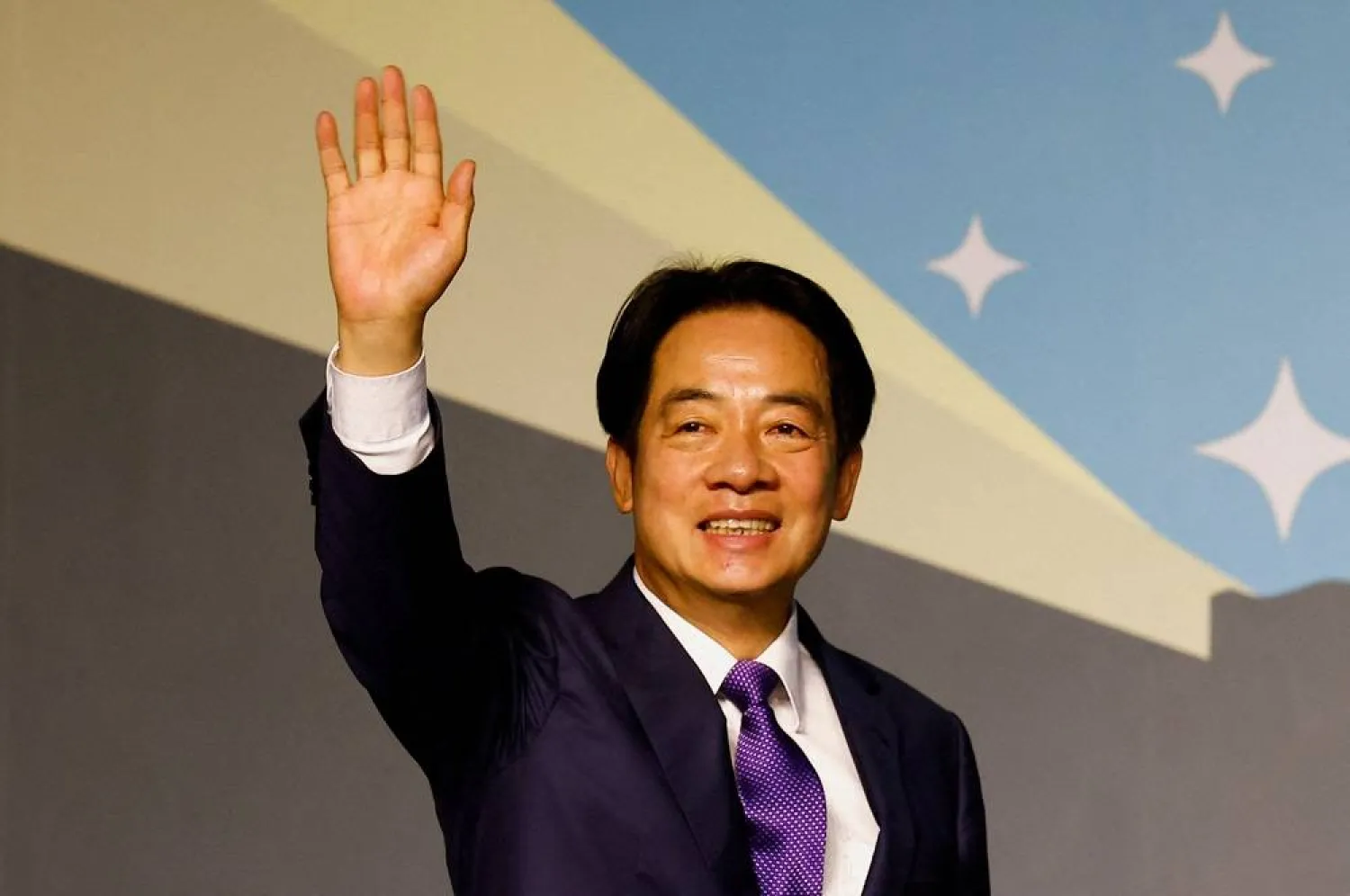

Taiwan President Takes Office Under Close Scrutiny

Taiwan President-elect Lai Ching-te, of Democratic Progressive Party's (DPP), holds a press conference, following the victory in the presidential elections, in Taipei, Taiwan January 13, 2024. (Reuters)
TT

Taiwan President Takes Office Under Close Scrutiny

Taiwan President-elect Lai Ching-te, of Democratic Progressive Party's (DPP), holds a press conference, following the victory in the presidential elections, in Taipei, Taiwan January 13, 2024. (Reuters)

Taiwan's president-elect Lai Ching-te, a staunch defender of the island's democracy, will be sworn into office Monday as Beijing ratchets up military and diplomatic pressure on Taipei.

China, which claims Taiwan as part of its territory, has branded Lai a "dangerous separatist" who will bring "war and decline" to the self-ruled island.

Lai will succeed President Tsai Ing-wen in a ceremony that will be closely watched by China and the United States, the island's key partner and weapons provider.

Taiwan, a vibrant democracy of 23 million people, is separated by a narrow 180-kilometer (110-mile) strait from communist-ruled China.

Beijing has intensified military and diplomatic pressure on Taiwan during Tsai's eight years in power over her Democratic Progressive Party's (DPP) rejection of China's claims on the island.

Lai, who hails from the same party, has previously described himself as a "pragmatic worker for independence".

In recent years, Lai and the DPP have toned down past rhetoric pushing for formal independence, arguing that since Taiwan is already self-ruled, there is no need for a declaration that would enrage Beijing.

Given the high stakes, Lai is expected to "maintain the responsible policies of his predecessor," Amanda Hsiao of the International Crisis Group said.

His inaugural speech will be scrutinized for clues of how he will handle the delicate relationship.

Lai has made repeated overtures to Beijing, indicating a wish for a resumption of high-level communications, which China severed after Tsai took office.

"We will work to safeguard the status quo on both sides," Lai told a democracy summit on May 14.

"I will not rule out dialogue with China on the principles of mutual respect, mutual benefits, and dignity, with no preconditions."

Eight heads of state and around 50 foreign delegations are expected to attend the inauguration, including from the United States and Canada, in a show of support for the island's democracy.

- 'Resolutely opposed' -

The dispute between Beijing and Taipei dates back to China's civil war, which ended in 1949 with Mao Zedong's communist forces defeating the nationalists of Chiang Kai-shek.

The nationalists fled to Taiwan and claimed rulership of all of China, while the mainland claimed Taiwan.

China's Taiwan Affairs Office, which handles cross-strait issues, said Wednesday it has always "resolutely opposed Taiwan independence".

"Taiwan independence and peace in the strait are incompatible like water and fire," spokesman Chen Binhua said.

China has for decades vowed to bring Taiwan under its control, by force if necessary, with President Xi Jinping upping the rhetoric in recent years of "unification" being "inevitable".

Chinese warplanes, drones and naval vessels maintain a near-daily presence around Taiwan.

China's growing assertiveness in pressing its claims on Taiwan, and over the South China Sea, have raised concerns of a potential military conflict that could draw in the United States and its allies.

Many fear that a regional war, while not thought to be imminent, would devastate the global economy.

Taiwan is located on a maritime gateway connecting the South China Sea and the Pacific Ocean -- a key route for international trade -- and is a major supplier of semiconductor chips, which have been called the "lifeblood" of the modern world.

Taiwan and China have engaged in a diplomatic tug-of-war to lure allies in the Pacific region, offering generous aid packages and assistance in agricultural and educational development.

Only 12 states, including the Vatican, fully recognize Taiwan, and China does not maintain relations with any country that recognizes Taipei.

After Lai's election win in January, the tiny South Pacific nation of Nauru severed diplomatic ties with Taiwan in favor of China.

Taipei has also seen daily cyber attacks targeting its government agencies increase from one million to 2.5 million since the polls.

- 'Dangerous' -

Lai will also have to contend with domestic challenges as he seeks to reverse growing disillusionment with the DPP.

While the party won an unprecedented third term in the last election, it lost its majority in parliament.

With wages stagnating and the cost of living rising, some voters are frustrated with the DPP's handling of relations with China.

"It's dangerous," retiree Chou-ta Chung, 66, told AFP of Lai's policy on China and the United States.

"The DPP focuses too much on the United States... you must strike a balance between the two sides."



US Fires on Iran Tankers as Talks Hang in Balance

US and Iran flags are seen in this illustration taken June 18, 2025. REUTERS/Dado Ruvic/Illustration/File Photo
TT

US Fires on Iran Tankers as Talks Hang in Balance

US and Iran flags are seen in this illustration taken June 18, 2025. REUTERS/Dado Ruvic/Illustration/File Photo

A US warplane disabled two Iranian tankers to enforce a port blockade on Friday, after Washington's top diplomat said he was awaiting Tehran's response to the latest proposed deal to end the Gulf conflict.

US Central Command said an F/A-18 Super Hornet had used precision munitions on the two ships to prevent them from continuing to Iran, as Iranian media reported "sporadic clashes" with US vessels in the Strait of Hormuz, AFP reported.

The latest incidents came after an overnight exchange of fire that triggered fears of a breakdown in the Gulf ceasefire, and after US Secretary of State Marco Rubio told reporters in Rome that Washington hoped to receive Tehran's answer to the US proposal later on Friday.

Rubio said Iran must not control the Strait of Hormuz, where the flare-ups took place, but added: "We're expecting a response from them today at some point... I hope it's a serious offer, I really do."

Washington has sent Iran, via Pakistani mediators, a proposal to extend the truce in the Gulf to allow talks on a final settlement of the conflict launched 10 weeks ago with US-Israeli strikes on Tehran.

Iran's foreign ministry spokesman Esmaeil Baqaei said Friday that the proposal was still "under review, and once a final decision is reached, it will certainly be announced", according to the ISNA news agency.


Iran Says Redirects US-sanctioned Oil Tanker to Its Shores

FILE PHOTO: An aerial view of the Iranian shores and the island of Qeshm in the strait of Hormuz, December 10, 2023. REUTERS/Stringer/File Photo
TT

Iran Says Redirects US-sanctioned Oil Tanker to Its Shores

FILE PHOTO: An aerial view of the Iranian shores and the island of Qeshm in the strait of Hormuz, December 10, 2023. REUTERS/Stringer/File Photo

Iran said on Friday it redirected a US-sanctioned oil tanker carrying Iranian oil back to its shores, though it was unclear from its statement why it would have returned it, reported AFP.

"The Islamic Republic of Iran's navy, through a specially planned operation in the Sea of Oman, seized the offending tanker Ocean Koi," the army said in a statement carried by state television, adding that the oil belonged to Iran.

It said the ship was redirected to Iran's southern shores after it sought "to damage and disrupt Iran's oil exports," without elaborating.


Meloni Meets Rubio as Iran War Strains Italy-US Ties

US Secretary of State Marco Rubio leaves the San Damaso courtyard after meeting Pope Leo XIV at the Vatican, May 7, 2026. REUTERS/Yara Nardi
TT

Meloni Meets Rubio as Iran War Strains Italy-US Ties

US Secretary of State Marco Rubio leaves the San Damaso courtyard after meeting Pope Leo XIV at the Vatican, May 7, 2026. REUTERS/Yara Nardi

Italian Prime Minister Giorgia Meloni met US Secretary of State Marco Rubio on Friday at a moment of unusual strain between her government and President Donald Trump's administration, driven largely by the war with Iran.

Rubio is in Italy for a two-day trip aimed at easing ties with Pope Leo after unprecedented attacks on the pontiff by Trump, while also addressing Washington's frustration over Italy's refusal to support the US-Israeli war on Iran.

Meloni had been one of Trump's firmest supporters in Europe, cultivating close ties with him and presenting herself as a natural ‌bridge between Washington ‌and other EU states that had no natural political ‌affinity ⁠with the Republican ⁠US leader.

But that alignment has come under increasing strain in recent months, as the Iran war has forced her to balance loyalty to the United States against Italian public animosity to the war and the growing economic cost of the conflict.

Before heading to the prime minister's office, Rubio met Italy's Foreign Minister Antonio Tajani, who said the talks had been positive.

"I am convinced ⁠that Europe needs America, Italy needs America, but the United ‌States also needs Europe and Italy," Tajani ‌told reporters.

Meloni and Rubio were expected to discuss the situation in the Gulf, as ‌well as Russia's war on Ukraine, US tariffs on European goods and ‌the outlook for Cuba, which Washington is seeking to isolate both diplomatically and economically.

TRUMP'S ATTACKS ON POPE

The Italians will also be keen for a readout on Rubio's meetings at the Vatican. Trump's recent attacks on Pope Leo crossed a sensitive ‌line in overwhelmingly Catholic Italy and prompted Meloni to call them "unacceptable."

Her criticism in turn drew a sharp rebuke ⁠from Trump, who said ⁠she lacked courage and had let Washington down. He subsequently threatened to withdraw US troops from Italy.

Meloni said on Monday she would not support such a move, but acknowledged that the decision "doesn't depend on me".

Italy last month refused to allow US aircraft to use the Sigonella air base in Sicily for combat operations linked to the Iran conflict. Italian officials have said Washington had not sought prior authorization from Rome for the use of the site.

Defense Minister Guido Crosetto, a close Meloni ally, later warned that the Iran war was putting US global leadership at risk and said he feared the "madness" of nuclear escalation.

Pollsters say Meloni's ties to Trump could prove a potential liability with voters ahead of national elections due next year.