
Palestinians in the West Bank Struggle to Get by as Israel Severely Limits Work Permits

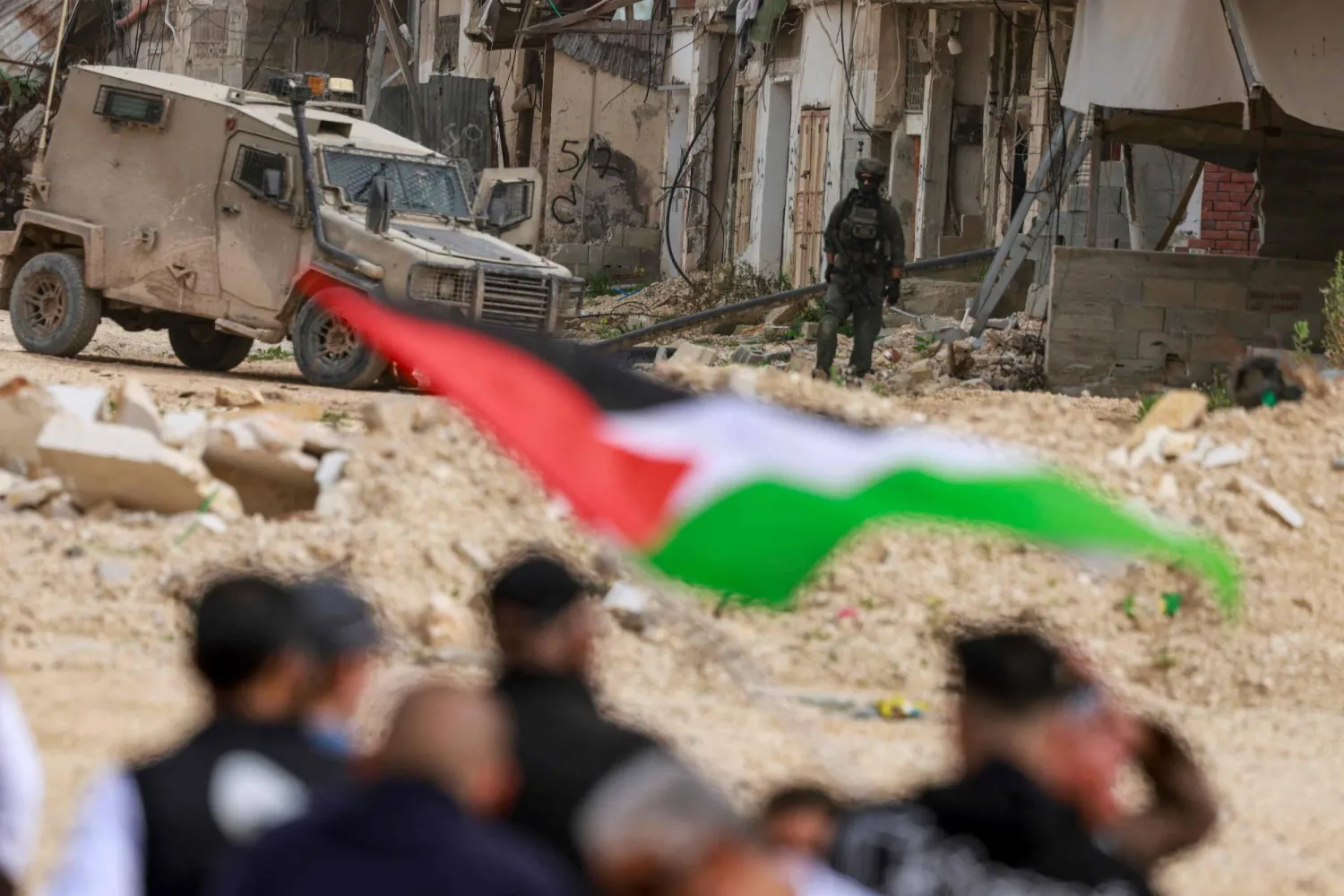
Palestinians protest after Israeli soldiers blocked the entrance of the Nur Shams Palestinian refugee camp in the occupied West Bank on February 9, 2026, demanding to be allowed to return to their homes from where they were expelled last year during an ongoing Israeli army operation. (Photo by Jaafar ASHTIYEH / AFP)
TT

Palestinians in the West Bank Struggle to Get by as Israel Severely Limits Work Permits

Palestinians protest after Israeli soldiers blocked the entrance of the Nur Shams Palestinian refugee camp in the occupied West Bank on February 9, 2026, demanding to be allowed to return to their homes from where they were expelled last year during an ongoing Israeli army operation. (Photo by Jaafar ASHTIYEH / AFP)

Hanadi Abu Zant hasn’t been able to pay rent on her apartment in the occupied West Bank for nearly a year after losing her permit to work inside Israel. When her landlord calls the police on her, she hides in a mosque.

“My biggest fear is being kicked out of my home. Where will we sleep, on the street?” she said, wiping tears from her cheeks.

She is among some 100,000 Palestinians whose work permits were revoked after Hamas’ Oct. 7, 2023, attack ignited the war in the Gaza Strip. Confined to the occupied territory, where jobs are scarce and wages far lower, they face dwindling and dangerous options as the economic crisis deepens, The Associated Press said.

Some have sold their belongings or gone into debt as they try to pay for food, electricity and school expenses for their children. Others have paid steep fees for black-market permits or tried to sneak into Israel, risking arrest or worse if they are mistaken for militants.

Israel, which has controlled the West Bank for nearly six decades, says it is under no obligation to allow Palestinians to enter for work and makes such decisions based on security considerations. Thousands of Palestinians are still allowed to work in scores of Jewish settlements across the West Bank, built on land they want for a future state.

Risk of collapse

The World Bank has warned that the West Bank economy is at risk of collapse because of Israel’s restrictions. By the end of last year, unemployment had surged to nearly 30% compared with around 12% before the war, according to the Palestinian Central Bureau of Statistics.

Before the war, tens of thousands of Palestinians worked inside Israel, mainly in construction and service jobs. Wages can be more than double those in the landlocked West Bank, where decades of Israeli checkpoints, land seizures and other restrictions have weighed heavily on the economy. Palestinians also blame the Palestinian Authority, which exercises limited self-rule in parts of the territory, for not doing enough to create jobs.

About 100,000 Palestinians had work permits that were revoked after the outbreak of the war. Israel has since reinstated fewer than 10,000, according to Gisha, an Israeli group advocating for Palestinian freedom of movement.

Wages earned in Israel injected some $4 billion into the Palestinian economy in 2022, according to the Institute for National Security Studies, an Israeli think tank. That’s equivalent to about two-thirds of the Palestinian Authority's budget that year.

An Israeli official said Palestinians do not have an inherent right to enter Israel, and that permits are subject to security considerations. The official spoke on condition of anonymity in line with regulations.

Israel seized the West Bank, Gaza and east Jerusalem in the 1967 Mideast war, territories the Palestinians want for a future state. Some 3 million Palestinians live in the West Bank, along with over 500,000 Israeli settlers who can come and go freely.

The war in Gaza has brought a spike in Palestinian attacks on Israelis as well as settler violence. Military operations that Israel says are aimed at dismantling militant groups have caused heavy damage in the West Bank and displaced tens of thousands of Palestinians.

‘My refrigerator, it’s empty’

After her husband left her five years ago, Abu Zant secured a job at a food-packing plant in Israel that paid around $1,400 a month, enough to support her four children. When the war erupted, she thought the ban would only last a few months. She baked pastries for friends to scrape by.

Hasan Joma, who ran a business in Tulkarem before the war helping people find work in Israel, said Palestinian brokers are charging more than triple the price for a permit.

While there are no definite figures, tens of thousands of Palestinians are believed to be working illegally in Israel, according to Esteban Klor, professor of economics at Israel's Hebrew University and a senior researcher at the INSS. Some risk their lives trying to cross Israel’s separation barrier, which consists of 9-meter high (30-foot) concrete walls, fences and closed military roads.

Shuhrat Barghouthi’s husband has spent five months in prison for trying to climb the barrier to enter Israel for work, she said. Before the war, the couple worked in Israel earning a combined $5,700 a month. Now they are both unemployed and around $14,000 in debt.

“Come and see my refrigerator, it’s empty, there’s nothing to feed my children,” she said. She can’t afford to heat her apartment, where she hasn’t paid rent in two years. She says her children are often sick and frequently go to bed hungry.

Sometimes she returns home to see her belongings strewn in the street by the landlord, who has been trying to evict them.

Forced to work in settlements

Of the roughly 48,000 Palestinians who worked in Israeli settlements before the war, more than 65% have kept their permits, according to Gisha. The Palestinians and most of the international community view the settlements, which have rapidly expanded in recent years, as illegal.

Israeli officials did not respond to questions about why more Palestinians are permitted to work in the settlements.

Palestinians employed in the settlements, speaking on condition of anonymity for fear of retribution, say their employers have beefed up security since the start of the war and are far more willing to fire anyone stepping out of line, knowing there are plenty more desperate for work.

Two Palestinians working in the Mishor Adumim settlement said security guards look through workers’ phones and revoke their permits arbitrarily.

Israelis have turned to foreign workers to fill jobs held by Palestinians, but some say it’s a poor substitute because they cost more and do not know the language. Palestinians speak Arabic, but those who work in Israel are often fluent in Hebrew.

Raphael Dadush, an Israeli developer, said the permit crackdown has resulted in costly delays.

Before the war, Palestinians made up more than half his workforce. He’s tried to replace them with Chinese workers but says it’s not exactly the same. He understands the government’s decision, but says it’s time to find a way for Palestinians to return that ensures Israel’s security.

Assaf Adiv, the executive director of an Israeli group advocating for Palestinian labor rights, says there has to be some economic integration or there will be “chaos.”

“The alternative to work in Israel is starvation and desperation,” he said.


Australia Bars Citizen Held in Syria’s Roj Camp from Returning Home

Members of Australian families believed to be linked to ISIS leave Roj camp near Derik, Syria February 16, 2026. REUTERS/Orhan Qereman
TT

Australia Bars Citizen Held in Syria’s Roj Camp from Returning Home

Members of Australian families believed to be linked to ISIS leave Roj camp near Derik, Syria February 16, 2026. REUTERS/Orhan Qereman

Australia has barred one of its citizens from returning home from a Syrian detention camp because of security concerns, the government said Wednesday.

The unidentified person is among a group of 34 Australian women and children at the Roj camp related to suspected members of ISIS.

"I can confirm that one individual in this cohort has been issued a temporary exclusion order, which was made on advice from security agencies," Home Affairs Minister Tony Burke said in a statement sent to AFP.

"At this stage security agencies have not provided advice that other members of the cohort meet the required legal thresholds for temporary exclusion orders."

The minister can make temporary exclusion orders lasting up to two years to prevent terrorist activities or politically motivated violence.

The Australians were released from the camp on Monday but failed to reach the capital Damascus on their way home, a Kurdish official told AFP in Syria.

The official said they were turned back to the detention camp, citing "poor coordination" with the Syrian authorities.

Prime Minister Anthony Albanese underscored his government's refusal to help repatriate the women and children.

"You make your bed, you lie in it," he said, accusing the group of aligning with an ideology that seeks to "undermine and destroy our way of life".

"We are doing nothing to repatriate or to assist these people," he told reporters Wednesday.

"I think it's unfortunate that children are caught up in this. That's not their decision but it's the decision of their parents or their mother."

The humanitarian organization Save the Children Australia filed a lawsuit in 2023 on behalf of 11 women and 20 children in Syria, seeking their repatriation.

But the Federal Court ruled against Save the Children, saying the Australian government did not control their detention in Syria.


Saudi Intervention Ends Socotra Power Crisis

Socotra power generators restarted after Saudi intervention (X)
TT

Saudi Intervention Ends Socotra Power Crisis

Socotra power generators restarted after Saudi intervention (X)

Electricity has returned to Yemen’s Socotra archipelago after urgent Saudi intervention ended days of outages that disrupted daily life and crippled vital institutions, including the general hospital, the university and the technical institute.

The breakthrough followed a sudden shutdown of the power plants after the operating company withdrew and disabled control systems, triggering widespread blackouts and deepening hardship for residents.

The Saudi Program for the Development and Reconstruction of Yemen said its engineering and technical teams moved immediately after receiving an appeal from local authorities. Specialists were dispatched to reactivate operating systems that had been encrypted before the company left the island.

Generators were brought back online in stages, restoring electricity across most of the governorate within a short time.

The restart eased intense pressure on the grid, which had faced rising demand in recent weeks after a complete halt in generation.

Health and education facilities were among the worst affected. Some medical departments scaled back services, while parts of the education sector were partially suspended as classrooms and laboratories were left without power.

Socotra’s electricity authority said the crisis began when the former operator installed shutdown timers and password protections on control systems, preventing local teams from restarting the stations. Officials noted that the archipelago faced a similar situation in 2018, which was resolved through official intervention.

Local sources said the return of electricity quickly stabilized basic services. Water networks resumed regular operations, telecommunications improved, and commercial activity began to recover after a period of economic disruption linked to the outages.

Health and education rebound

In the health sector, stable power, combined with operational support, secured the functioning of Socotra General Hospital, the archipelago’s main medical facility.

Funding helped provide fuel and medical supplies and support healthcare staff, strengthening the hospital’s ability to receive patients and reducing the need to transfer cases outside the governorate, a burden that had weighed heavily on residents.

Medical sources said critical departments, including intensive care units and operating rooms, resumed normal operations after relying on limited emergency measures.

In education, classes and academic activities resumed at Socotra University and the technical institute after weeks of disruption.

A support initiative covered operational costs, including academic staff salaries and essential expenses, helping curb absenteeism and restore the academic schedule.

Local authorities announced that studies at the technical institute would officially restart on Monday, a move seen as a sign of gradual stabilization in public services.

Observers say sustained technical and operational support will be key to safeguarding electricity supply and preventing a repeat of the crisis in a region that depends almost entirely on power to run its vital sectors.


Egypt’s Prime Minister and FM Head to Washington for Trump Peace Council Meeting

Egyptian Foreign Minister Badr Abdelatty speaks during a joint press conference with Kenyan Prime Cabinet Secretary/Cabinet Secretary for Foreign Diaspora Affairs Musalia Mudavadi in Nairobi, Kenya, Monday, Feb. 16, 2026. (AP)
TT

Egypt’s Prime Minister and FM Head to Washington for Trump Peace Council Meeting

Egyptian Foreign Minister Badr Abdelatty speaks during a joint press conference with Kenyan Prime Cabinet Secretary/Cabinet Secretary for Foreign Diaspora Affairs Musalia Mudavadi in Nairobi, Kenya, Monday, Feb. 16, 2026. (AP)

Egypt's Prime Minister Mostafa Madbouly headed to Washington on Tuesday ‌to ‌participate in ‌the inaugural ⁠meeting of a "Board of Peace" established by US President Donald ⁠Trump, the ‌cabinet ‌said.

Madbouly is ‌attending ‌on behalf of President Abdel ‌Fattah al-Sisi and is accompanied by ⁠Foreign ⁠Minister Badr Abdelatty.

Foreign Minister Gideon Saar will represent Israel at the inaugural meeting, his office said on Tuesday.

Hamas, meanwhile, called on the newly-formed board to pressure Israel to halt what it described as ongoing violations of the ceasefire in Gaza.

The Board of Peace, of which Trump is the chairman, was initially designed to oversee the Gaza truce and the territory's reconstruction after the war between Hamas and Israel.

But its purpose has since morphed into resolving all sorts of international conflicts, triggering fears the US president wants to create a rival to the United Nations.

Saar will first attend a ministerial level UN Security Council meeting in New York on Wednesday, and on Thursday he "will represent Israel at the inaugural session of the board, chaired by Trump in Washington DC, where he will present Israel's position", his office said in a statement.

It was initially reported that Prime Minister Benjamin Netanyahu might attend the gathering, but his office said last week that he would not.

Ahead of the meeting, Hamas spokesman Hazem Qassem told AFP that the Palestinian movement urged the board's members "to take serious action to compel the Israeli occupation to stop its violations in Gaza".

"The war of genocide against the Strip is still ongoing -- through killing, displacement, siege, and starvation -- which have not stopped until this very moment," he added.

He also called for the board to work to support the newly formed Palestinian technocratic committee meant to oversee the day-to-day governance of post-war Gaza "so that relief and reconstruction efforts in Gaza can commence".

Announcing the creation of the board in January, Trump also unveiled plans to establish a "Gaza Executive Board" operating under the body.

The executive board would include Turkish Foreign Minister Hakan Fidan and Qatari diplomat Ali Al-Thawadi.

Netanyahu has strongly objected to their inclusion.

Since Trump launched his "Board of Peace" at the World Economic Forum in Davos in January, at least 19 countries have signed its founding charter.