South Korea Unveils $19 Bln Package to Compete in Global Chip 'Warfare'

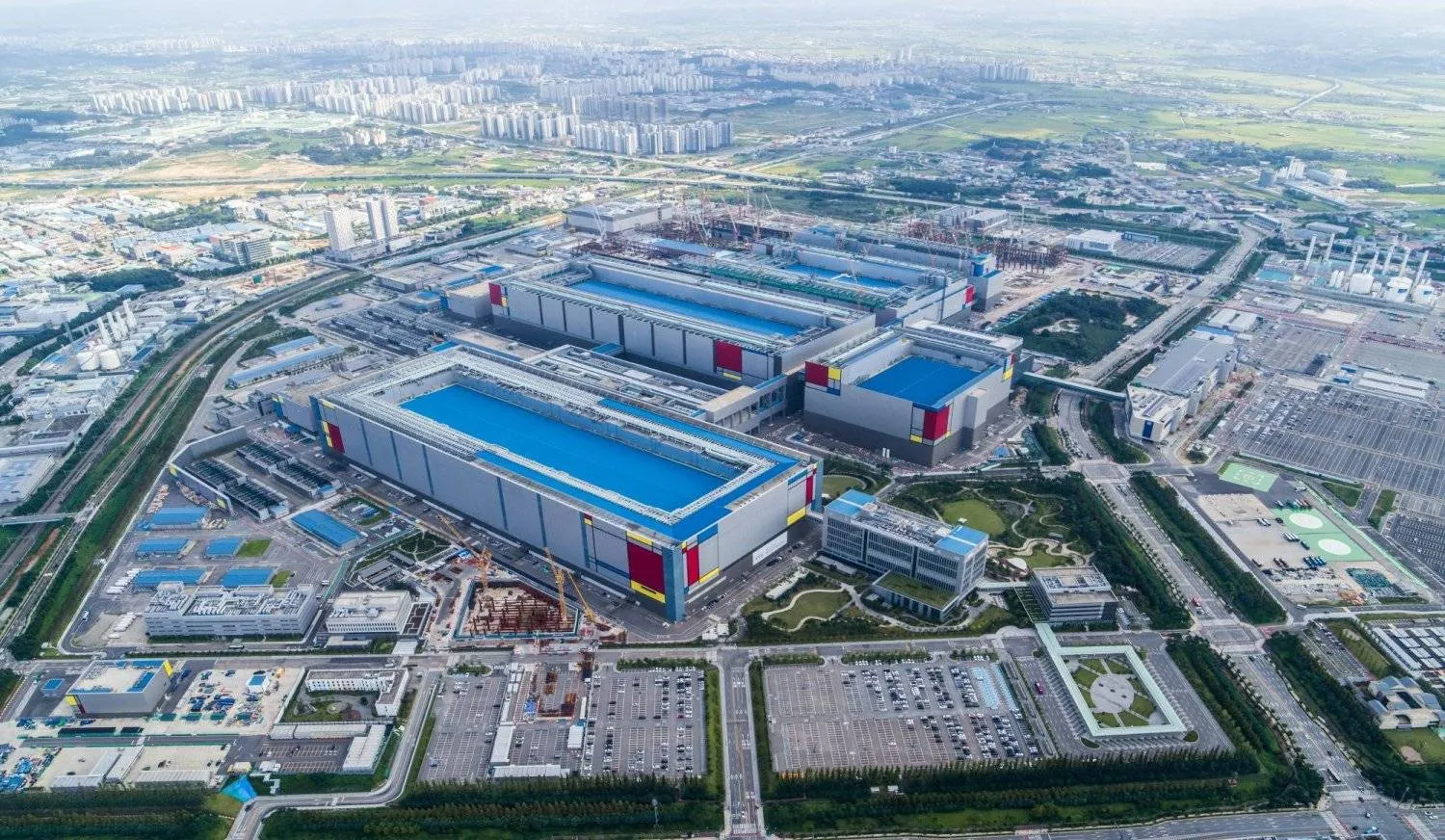
A view shows Samsung Electronics' chip production plant at Pyeongtaek, South Korea, in this handout picture obtained by Reuters on September 7, 2022. Samsung Electronics/Handout via REUTERS
TT

South Korea Unveils $19 Bln Package to Compete in Global Chip 'Warfare'

A view shows Samsung Electronics' chip production plant at Pyeongtaek, South Korea, in this handout picture obtained by Reuters on September 7, 2022. Samsung Electronics/Handout via REUTERS

South Korea announced on Thursday a 26 trillion won ($19 billion) support package for its chip businesses, citing a need to keep up in areas like chip design and contract manufacturing amid 'all-out warfare' in the global semiconductor market, Reuters said.
Under the package, President Yoon Suk Yeol said a financial support program worth about 17 trillion won was planned through state-run Korea Development Bank to back investments by semiconductor companies, according to the presidential office.
"As we all know, semiconductors are a field where all-out national warfare is underway. Win or lose, that depends on who can make cutting-edge semiconductors first," Yoon said at a meeting with top government officials.
South Korea, home to the world's top memory chip makers Samsung Electronics and SK Hynix, has fallen behind some rivals in areas such as chip design and contract chip manufacturing.
South Korea's share of the global fabless sector, which is dominated by companies like US giant Nvidia that design chips but outsource manufacturing, stood at about 1%, Yoon's office said. There was also a gap between local chipmakers and the leading contract chip makers like Taiwan's TSMC, it said.
Yoon said a 1 trillion won fund would be set up to support equipment makers and fabless companies.
Industry minister Ahn Duk-geun said the government aimed to help boost South Korea's global market share in non-memory chips, such as mobile processors, to 10% from the current 2%.
The package is bigger than plans flagged by the country's finance minister Choi Sang-mok earlier this month, when he said the government was targeting support for chip investments and research worth more than 10 trillion won.
In a press briefing, Choi described South Korea's chip support package "as good as" any other country.
Countries around the world ranging from China to the United States have been ploughing tens of billions of dollars via grants and other means to support their own chip sectors.
"The government is apparently trying to follow the trend where other countries are giving out subsidies for their own chip companies," said Greg Roh, head of research at Hyundai Motor Securities.
South Korea is building a mega chip cluster in Yongin, south of the capital Seoul, touted as the world's largest high-tech chipmaking complex to attract chip equipment and fabless companies.
Finance minister Choi said the government would streamline bureaucracy and cut red tape to help speed up construction of the chip cluster at twice the normal rate.
In January, Yoon, who has vowed to pour all possible resources into the country's chip industry, said he would extend tax credits on investments in the domestic semiconductor industry to boost employment and attract more talent.



US Won't Renew Trade Deal with Mexico and Canada

US Trade Representative Jamieson Greer talks with Mexico's Economy Minister Marcelo Ebrard, amid talks to review the US-Mexico-Canada trade pact, in Mexico City, Mexico, on April 20, 2026. RAQUEL CUNHA / REUTERS 
TT

US Won't Renew Trade Deal with Mexico and Canada

US Trade Representative Jamieson Greer talks with Mexico's Economy Minister Marcelo Ebrard, amid talks to review the US-Mexico-Canada trade pact, in Mexico City, Mexico, on April 20, 2026. RAQUEL CUNHA / REUTERS 

The US administration on Wednesday said it will not renew the expired trilateral trade pact with Canada and Mexico known as USMCA, reiterating its commitment to continue negotiations with its partners to reach a better deal.

The agreement, signed during President Donald Trump’s first term, should be renewed not later than July 1 for another 16-year period.

Although it wasn't extended by the Wednesday deadline, the deal remains in force for another 10 years and will instead be subject to annual reviews, unless a country decides to withdraw entirely, according to AFP.

Canada and Mexico had both called for a 16-year renewal of the USMCA.

Washington’s announcement came on Wednesday after a virtual meeting between representatives of the three concerned parties failed to reach its goals.

“The United States did not agree to renew the USMCA in its current form. As a result, the USMCA is not renewed,” US Trade Representative Jamieson Greer said in a statement.

He said the White House “will continue to engage with Mexico and Canada to address the agreement's shortcomings and our trade deficits with these countries.”

However, Greer added, “the agreement remains in force pending resolution of these issues or until the agreement's termination.”

Trump said in June that he was not “looking to renew” the agreement in its current form while the US held a series of bilateral trade negotiations with Mexico and Ottawa to get a better deal.

US officials are scheduled to meet with Mexico representatives the week of July 20 for another round of bilateral negotiations.

Greer did not unveil a schedule for formal talks with Canada.

Mexico and Canada are the United States' top two global trading partner. But the two countries were among the first to be hit by Trump’s tariffs imposed after the US President returned to the White House in January 2025.

Trump accused Mexico and Ottawa of not doing enough to contain the flow of the illegal drug fentanyl and immigrants into the United States.

In return, both nations confirm that over 80% of exports from Mexico and Canada enter the United States under the USMCA provisions, shielding them from universal tariffs.


Shell to Sell Gulf of America Assets to Two Companies for $1.7 billion

3D-printed oil pump jacks and the Shell plc logo appear in this illustration taken March 2, 2026. REUTERS/Dado Ruvic/Illustration 
TT

Shell to Sell Gulf of America Assets to Two Companies for $1.7 billion

3D-printed oil pump jacks and the Shell plc logo appear in this illustration taken March 2, 2026. REUTERS/Dado Ruvic/Illustration 

Shell said on Tuesday it had agreed to sell its interest in the Na Kika platform and associated fields in the Gulf of America, along ‌with the Coulomb tieback, to subsidiaries of Talos Energy and Ridgewood Energy for $1.7 billion.

The assets produced about 37,000 barrels of oil equivalent per day net to Shell in 2025.

The transaction has an effective date of July 1, 2025, and is expected to close by the end of 2026.

Talos said its share of the consideration is $850 million, with final net cash consideration expected at $450 million to $500 million after interim cash flow from the effective date.

It added that it will acquire a 50% working interest and operatorship in Coulomb and a 25% non-operated stake in the BP-operated Na Kika platform and ‌four ⁠associated fields -- Kepler, Ariel, Fourier and Herschel.

The assets produced about 16,000 barrels of oil equivalent per day in the first quarter of 2026, about 77% oil, and add roughly 23 million barrels of oil equivalent of proved reserves.

Na ⁠Kika, Shell's only non-operated Gulf of America platform, began producing in 2003, while Coulomb started production in 2005.

Shell will retain certain upside-linked payments, royalty interests on new ⁠Na Kika tiebacks, and offtake rights.

BP, operator of Na Kika, retains the other 50% stake and has a 30-day preferential purchase right.

Shell's proved ⁠reserves at the end of 2025 were 4.3 million boe for Na Kika and 7.2 million boe for Coulomb.


Saudi Arabia Retains ACAO Executive Council Seat for 2026-2028

President of the General Authority of Civil Aviation (GACA) Abdulaziz Al-Duailej. (SPA)
TT

Saudi Arabia Retains ACAO Executive Council Seat for 2026-2028

President of the General Authority of Civil Aviation (GACA) Abdulaziz Al-Duailej. (SPA)

The General Assembly of the Arab Civil Aviation Organization (ACAO) has renewed Saudi Arabia's membership on the ACAO Executive Council for the 2026–2028 term, reaffirming the Kingdom's prominent position in the civil aviation sector at both the Arab and international levels, the Saudi Press Agency reported on Thursday.

The newly elected Executive Council convened its inaugural meeting, during which President of the General Authority of Civil Aviation (GACA) Abdulaziz Al-Duailej was unanimously re-elected as president for a second consecutive term.

During its 29th General Assembly, the Arab Civil Aviation Organization (ACAO) also renewed Saudi Arabia's membership on six technical committees for the 2026–2028 term: the Air Transport Committee, Air Safety Committee, Aviation Security Committee, Air Navigation Commission, Environment Committee, and Media and Institutional Communication Committee. The decision was accompanied by broad recognition from Arab member states of the Kingdom's leadership and its significant contributions to advancing and developing the civil aviation sector at both the regional and international levels.

Al-Duailej said Saudi Arabia's renewed membership on the Executive Council reflects the Kingdom's leadership and sustained contributions to advancing the Arab civil aviation sector. He added that the council's next phase will focus on strengthening Arab cooperation, enhancing regional integration, and developing unified strategies to address the future challenges facing the air transport industry.