

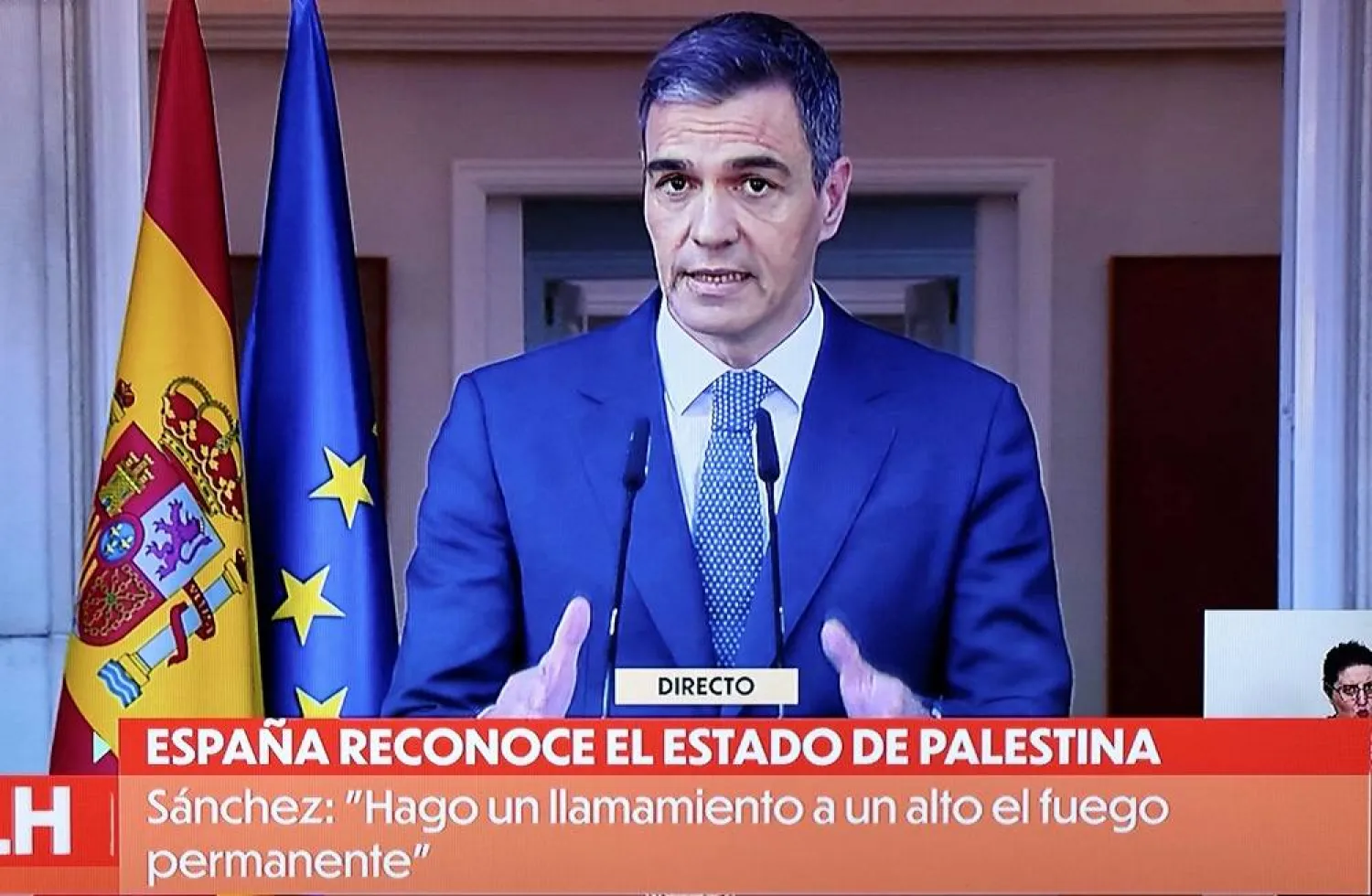

Spain, Ireland and Norway Officially Recognize Palestinian Statehood

Spain's Prime Minister Pedro Sánchez is pictured as he delivers a speech on TV over the recognition of Palestinian statehood by Spain, in Madrid on May 28, 2024. (AFP)
TT

Spain, Ireland and Norway Officially Recognize Palestinian Statehood

Spain's Prime Minister Pedro Sánchez is pictured as he delivers a speech on TV over the recognition of Palestinian statehood by Spain, in Madrid on May 28, 2024. (AFP)

 Spain, Ireland and Norway officially recognized a Palestinian state on Tuesday, prompting an angry reaction from Israel, which has found itself increasingly isolated after more than seven months of conflict in Gaza.
Madrid, Dublin and Oslo said they sought to accelerate efforts to secure a ceasefire in Israel's war with Hamas in Gaza. The three countries say they hope their decision will spur other European Union countries to follow suit.
"It's the only way of advancing toward what everyone recognizes as the only possible solution to achieve a peaceful future, one of a Palestinian state that lives side by side with the Israeli state in peace and security," Spanish Prime Minister Pedro Sanchez said in a televised address.
Spain is recognizing a unified Palestinian state, including the Gaza Strip and the West Bank, under the Palestinian National Authority with East Jerusalem as its capital, he said.
The move means 146 of the 193 member states of the United Nations now recognize a Palestinian state, Spanish Foreign Minister Jose Manuel Albares said.
The Palestinian Authority, which exercises limited self-rule in the West Bank under Israeli military occupation, has welcomed the decision.
Sanchez said Madrid would not recognize any changes to pre-1967 borders unless agreed to by both parties.
Ireland's Department of Foreign Affairs said last week it would upgrade its representative office in Ramallah in the West Bank to an embassy, appoint an ambassador there and upgrade the status of the Palestinian mission in Ireland to an embassy.
"We had wanted to recognize Palestine at the end of a peace process. However we have made this move alongside Spain and Norway to keep the miracle of peace alive," Irish Prime Minister Simon Harris said in a statement on Tuesday.
Israel has repeatedly condemned the decision, saying it bolsters Hamas.
"Sanchez, when you... recognize a Palestinian state, you are complicit in incitement to genocide against the Jewish people and in war crimes," Israeli Foreign Minister Israel Katz wrote on X on Tuesday.

Norwegian Foreign Minister Espen Barth Eide said in a statement that “for more than 30 years, Norway has been one of the strongest advocates for a Palestinian state. Today, when Norway officially recognizes Palestine as a state, is a milestone in the relationship between Norway and Palestine.” 

While dozens of countries have recognized a Palestinian state, none of the major Western powers has done so. Still, the adherence of three European countries to the group represents a victory for Palestinian efforts in the world of public opinion. 

Relations between the EU and Israel nosedived Monday, the eve of the diplomatic recognition EU members Ireland and Spain, with Madrid insisting that the EU should take measures against Israel for its continued deadly attacks in southern Gaza’s city of Rafah. 

After Monday’s meeting of EU foreign ministers, Irish Foreign Minister Micheál Martin said “for the first time at an EU meeting, in a real way, I have seen a significant discussion on sanctions” for Israel. 

Norway, which is not an EU member but often aligns its foreign policy with the bloc, handed diplomatic papers to the Palestinian government over the weekend ahead of its formal recognition. At the same time, the EU’s foreign policy chief Josep Borrell threw his weight behind the International Criminal Court, whose prosecutor is seeking an arrest warrant against Israeli Prime Minister Benjamin Netanyahu and others, including leaders of the Hamas militant group. 

The formal declaration and resulting diplomatic dispute come over seven months into a grinding war waged by Israel against Hamas in Gaza following the Oct. 7 Hamas-led attack in which militants stormed across the Gaza border into Israel, killing 1,200 people and taking some 250 hostage. Israel’s air and land attacks have killed 36,000 Palestinians, according to Gaza’s Health Ministry, which does not distinguish between combatants and civilians. 

Last week's joint announcement by Spain, Ireland and Norway triggered an angry response from Israeli authorities, which summoned the countries’ ambassadors in Tel Aviv to the Foreign Ministry, where they were filmed while being shown videos of the Oct. 7 Hamas attack and abductions. 

The United States and Britain, among others, back the idea of an independent Palestinian state alongside Israel but say it should come as part of a negotiated settlement. Netanyahu’s government says the conflict can only be resolved through direct negotiations. 

In his speech on Tuesday, Sánchez said that the recognition of a Palestinian state was “a decision that we do not adopt against anyone, least of all against Israel, a friendly people whom we respect, whom we appreciate and with whom we want to have the best possible relationship.” 

The Socialist leader, who announced his country’s decision before parliament last week, has spent months touring European and Middle Eastern countries to garner support for recognition and a ceasefire in Gaza. 

He called for a permanent ceasefire, for stepping up humanitarian aid into Gaza and for the release of hostages that Hamas has held since the Oct. 7 attack that triggered Israel’s response. 

Sánchez said that the move was to back the beleaguered Palestinian Authority, which lost effective political control of Gaza to Hamas. He laid out his vision for a state ruled by the Palestinian Authority that must connect the West Bank and Gaza via a corridor with east Jerusalem as its capital. 

Norway's Barth Eide added that “the recognition is a strong expression of support for moderate forces in both countries.” 

The Western-backed Palestinian Authority administers parts of the Israeli-occupied West Bank, cooperates with Israel on security matters and favors a negotiated two-state solution. Its forces were driven out of Gaza by Hamas when the movement seized power there in 2007. 

The Palestinians have long sought an independent state in Gaza, the West Bank and east Jerusalem, territories Israel captured in the 1967 Mideast war. The idea of a land corridor linking Gaza and the West Bank through Israel was discussed in previous rounds of peace talks, but no serious or substantive peace negotiations have been held in over 15 years. 

Israel is also under pressure from the International Criminal Court after its chief prosecutor said he would seek arrest warrants for Netanyahu and his defense minister. The ICJ is also considering allegations of genocide that Israel has strenuously denied. 


At Least 21 Drown in Nile Boat Sinking in Sudan

At least 21 people drowned when a boat sank in the Nile River in northern Sudan, according to the local state government and eyewitnesses interviewed by AFP. (REUTERS)
TT

At Least 21 Drown in Nile Boat Sinking in Sudan

At least 21 people drowned when a boat sank in the Nile River in northern Sudan, according to the local state government and eyewitnesses interviewed by AFP. (REUTERS)

At least 21 people drowned when a boat sank in the Nile River in northern Sudan, according to the local state government and eyewitnesses interviewed by AFP.

River Nile State said Thursday that 21 bodies had been recovered after the accident, listed their names and warned that some passengers were still missing.

The boat was crossing the river between the villages of Tayba al-Khawad and Deim al-Qarai, according to the local government's statement.

The statement did not explain the cause of the accident.

Eyewitnesses told AFP the boat was carrying 30 people.

The Sudanese Doctors Network said in a statement that six of the boat's passengers survived.

The group said the incident exposes "the fragility of river transport and the absence of basic safety requirements, as well as the complete absence of local authorities and civil defense rescue teams in the early hours of the incident".

Many Sudanese rely on river transport via single-engine boats captained by solo operators.

The country's infrastructure has been collapsing due to a war that has been ongoing for nearly three years.

The war has divided the country between the army and their enemy, the paramilitary Rapid Support Forces, with road closures and a severe deterioration in public services and medical and educational infrastructure.


Syria Affirms Deep Ties with Saudi Arabia

Saudi Ambassador to Damascus Dr. Faisal Al-Mujfel visits the Kingdom’s pavilion, guest of honor at the Damascus International Book Fair (Saudi Embassy account). 
TT

Syria Affirms Deep Ties with Saudi Arabia

Saudi Ambassador to Damascus Dr. Faisal Al-Mujfel visits the Kingdom’s pavilion, guest of honor at the Damascus International Book Fair (Saudi Embassy account). 

Syria has reaffirmed the strength of its relations with Saudi Arabia during a visit by the Saudi ambassador to Damascus, Dr. Faisal Al-Mujfel, to the Saudi pavilion, guest of honor at the 2026 Damascus International Book Fair.

Saudi Arabia’s participation in the fair, held from Feb. 6-16, is led by the Literature, Publishing and Translation Commission.

At the start of the visit, Al-Mujfel met Syria’s Minister of Culture, Mohammad Yassin Saleh, who welcomed the Kingdom’s designation as guest of honor as a clear affirmation of the depth of Saudi-Syrian cultural relations, based on partnership and mutual respect.

Saleh praised Saudi Arabia’s cultural efforts and commended the pavilion for showcasing activities that reflect the richness and diversity of Saudi cultural heritage.

He noted that the Saudi program highlights the Kingdom’s commitment to supporting culture and literature at both the Arab and international levels. The pavilion features a wide range of events, including seminars and poetry evenings, with the participation of leading Saudi writers and intellectuals.

During a guided tour, the Saudi ambassador was briefed on the creative diversity presented at the pavilion. Exhibits include a collection of manuscripts, a section dedicated to traditional Saudi attire, displays of archaeological replicas, and a selection of publications issued by the Literature, Publishing and Translation Commission.

Among the featured works are titles from the “Translate” initiative, the “Saudi Literature Comics” series, and short story collections from Saudi authors, offering visitors insight into the Kingdom’s contemporary literary scene.

The commission is overseeing Saudi Arabia’s participation as guest of honor at the 2026 book fair, presenting what it described as a vibrant cultural experience that celebrates Saudi creativity and promotes dialogue through books.

The program aligns with the Kingdom’s National Culture Strategy under Vision 2030, which emphasizes cultural exchange, knowledge sharing, and constructive dialogue among nations, while reinforcing Saudi Arabia’s role in the Arab and global cultural landscape.

The visit was attended by several Arab diplomats accompanying the Saudi ambassador, including the ambassadors of Bahrain, Oman and Lebanon, as well as the chargé d’affaires of the United Arab Emirates embassy in Damascus.


Al-Zindani to Asharq Al-Awsat: Govt to Move to Aden Soon, Foreign Ministry Retained to Complete Reforms

Yemen’s Prime Minister and Foreign Minister, Dr. Shaya Al-Zindani 
TT

Al-Zindani to Asharq Al-Awsat: Govt to Move to Aden Soon, Foreign Ministry Retained to Complete Reforms

Yemen’s Prime Minister and Foreign Minister, Dr. Shaya Al-Zindani 

Yemen’s Prime Minister and Foreign Minister, Dr. Shaya Al-Zindani, has signaled the first concrete move by his newly sworn-in government, announcing that it will relocate to Aden in the near future, just 24 hours after taking the constitutional oath.

In remarks to Asharq Al-Awsat, Al-Zindani said his decision to retain the foreign affairs portfolio was driven by the need “to complete the work already begun,” stressing that a return to Yemen is essential to restoring effective governance.

He noted that the move inside the country is a necessary step to activate performance, adding that a presence in Aden must be linked to a genuine ability to manage state files and restore regular institutional functioning.

The comments came during a special episode of the Asharq Al-Awsat Podcast, recorded at Asharq TV studios at the Saudi Research and Media Group headquarters in Riyadh’s King Abdullah Financial District.

Al-Zindani spoke at a time of acute economic pressure and heightened political expectations. He said the current phase does not allow for expansive rhetoric, but rather requires gradual, practical work to rebuild confidence, noting that stabilizing institutional rhythm must precede any expansion of objectives.

Addressing questions on the composition of his cabinet, Al-Zindani highlighted that ministers were selected on purely professional criteria, based on competence, specialization, and experience, away from partisan dictates. He emphasized that weak institutional foundations had been a central cause of past failures, underscoring the need to rebuild state structures and strengthen oversight.

He pointed to relative improvements in some public services, particularly electricity, with Saudi support, while noting that the real challenge lies in sustaining economic reforms and managing resources effectively. On accountability, he argued that unifying political decision-making has opened the door to enforcing the rule of law. When authority is unified, reward and punishment become possible, he underlined.

On economic policy, Al-Zindani avoided quick promises, instead focusing on resource management and reprioritization. Recovery, he said, cannot be achieved through piecemeal decisions but requires restructuring public finance, enhancing transparency, and activating oversight mechanisms. He stressed that financial stability is the foundation for any tangible improvement in citizens’ lives and for restoring domestic and international confidence.

He continued that working from within Yemen will enable the government to better understand societal priorities and reassert the state’s presence in public life, an influence eroded by years of conflict. He described taking the oath in Riyadh as a constitutional and security necessity dictated by circumstances, arguing that attention should focus on the substance of government action rather than symbolism.

On security, Al-Zindani adopted a cautious, realistic tone, acknowledging that years of accumulated challenges cannot be erased quickly. Still, he said coordination among security agencies and unified political leadership have led to relative improvements. While recognizing protests as part of transitional phases, he stressed the need for adherence to legal frameworks to preserve stability and avoid derailment of recovery efforts.

According to the Yemeni official, reorganizing the armed forces requires unified command and redeploying units outside cities to consolidate state authority and reduce overlap between military and security roles. He noted that multiple loyalties in previous phases weakened institutions and must be overcome to restore stability.

Internationally, he said unified political representation strengthens Yemen’s legal and diplomatic standing. He justified retaining the foreign ministry to complete reforms already underway, including restructuring the ministry and overseas missions, describing diplomatic normalization as integral to rebuilding the state.

He further described relations with Saudi Arabia as having evolved from traditional support into a multi-dimensional partnership impacting vital sectors, with scope to expand cooperation in development and economic stability.

On the Houthis, Al-Zindani said the government showed flexibility in peace efforts but faced repeated noncompliance, adding that recent military and economic developments have weakened the group’s position. Any future negotiations, he stressed, must rest on clear references, with unified anti-Houthi forces giving the government a stronger negotiating hand amid rapid regional and international shifts.
