


Russia and Ukraine Exchange POWs for the First Time in Three Months

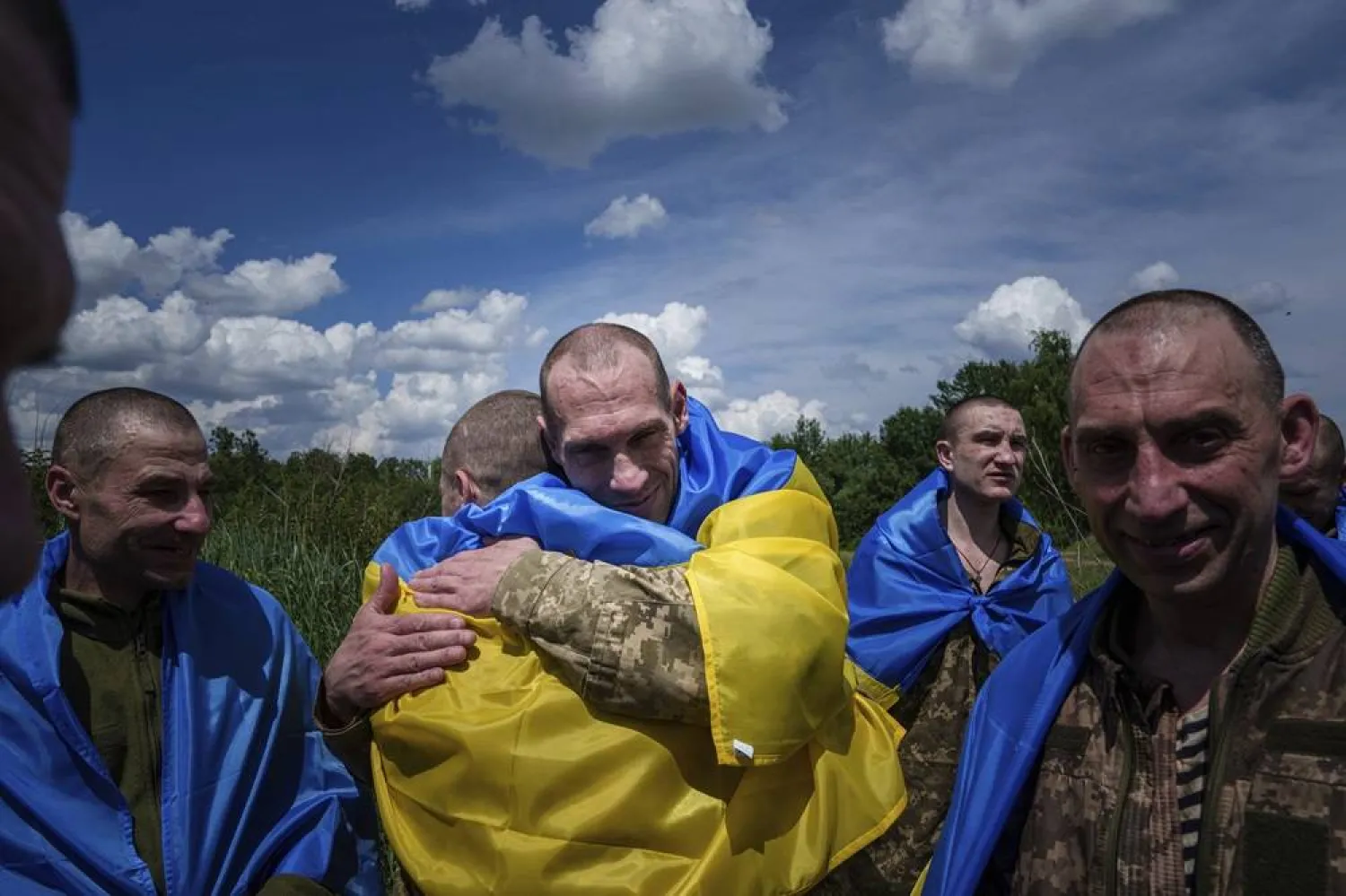
A Ukrainian serviceman hugs his comrade after returning from captivity during a POWs exchange in Sumy region, Ukraine, Friday, May 31, 2024. (AP)
TT

Russia and Ukraine Exchange POWs for the First Time in Three Months

A Ukrainian serviceman hugs his comrade after returning from captivity during a POWs exchange in Sumy region, Ukraine, Friday, May 31, 2024. (AP)

Ukraine and Russia exchanged prisoners of war on Friday, each sending back 75 POWs in the first such swap in the past three months, officials said.

The Ukrainian POWs, including four civilians, were returned on several buses that drove into the northern Sumy region. As they disembarked, they shouted joyfully and called their families to tell them they were home. Some knelt and kissed the ground, while many wrapped themselves in yellow-blue flags.

They hugged one another, breaking into tears. Many appeared emaciated and poorly dressed.

The exchange was the fourth prisoner swap this year and the 52nd since Russia invaded Ukraine in February 2022. It included a total of 150 POWs and the United Arab Emirates helped negotiate this latest exchange, the Foreign Ministry in Kyiv said.

The two sides have traded blame for what they say is a slowdown in the swaps.

Ukraine has in the past urged Russia to swap "all for all" and rallies calling for the release of POWs take place across Ukraine weekly. A Ukrainian official at the headquarters coordinating the exchanges, Vitalii Matviienko said that "Ukraine is always ready."

Tatyana Moskalkova, Russia’s human rights ombudsperson, said earlier this week that Kyiv was making "new artificial demands," without elaborating.

Among those who were returned home to Ukraine on Friday was Roman Onyschuk, an IT worker who joined Ukrainian forces as a volunteer at the start of the Russian invasion. He was captured in March 2022 in the Kharkiv region.

"I just want to hear my wife’s voice, my son’s voice. I missed his three birthdays," he said. In the more than 800 days he spent in captivity, he never communicated with his family and he doesn’t know what city they are in now, he said.

"It’s a little bit overwhelming," Onyschuk added.

With the exchanges, including Friday's, Ukraine has gotten back a total of 3,210 members of the Ukrainian military and civilians since the outbreak of the war, according to Ukraine's Coordination Headquarters for Treatment of POWs.

Neither Ukraine nor Russia disclosed how many POWs there are in all.

Dmytro Kantypenko was captured on Snake Island in the Black Sea in the first days of the war. He was among those freed Friday and said he called his mother to tell her he was back in Ukraine.

"I’ll be home soon," he said, wiping away his tears. He learned that his wife had fled to Lithuania with their son. The Kantypenko family is from Izium in the Kharkiv region, which survived Russian occupation.

Kantypenko said the Russians woke him up in the middle of the night without any explanation, giving him a short time to change his clothes before they were on their way.

UN reports based on post-release interviews have found that the majority of Ukrainian POWs are subject to routine medical neglect, severe and systematic mistreatment, and even torture. The same reports have found isolated reports of abuse of Russian soldiers, mostly during capture or transit to internment sites.

At least one-third of Ukrainians who returned home suffered "injuries, severe illnesses, and disabilities," according to the Coordination Headquarters for the Treatment of POWs.

Among those returned Friday were 19 Ukrainian fighters from Snake island, 14 people captured at Chernobyl Nuclear Power Plant, and 10 fighters from the city of Mariupol that was captured by Russia.

Five women were among the returned Ukrainian POWs, including Nataliia Manuilova, who was a cook in the Azov regiment and spent more than two years in captivity. The Russians took her from her home in Mariupol, pulling a bag over her head and tying her hands, she recounted.

"I hate them. They took away two years of my beautiful life," she said, hugging her son on Friday. "I can’t believe he’s grown up like this."

The POWs traveled through small villages before reaching Sumy, from where they would be taken to hospitals for two weeks of rehabilitation.

Ukrainians with blue and yellow flags took to the streets and loudly welcomed their defenders home.



Netanyahu Vows to Eliminate Iran Threat ‘Once and for All’

10 November 2026, Israel, Jerusalem: Caretaker Israeli Prime Minister Benjamin Netanyahu delivers a speech on the sidelines of the opening session of the new Knesset. (dpa)
TT

Netanyahu Vows to Eliminate Iran Threat ‘Once and for All’

10 November 2026, Israel, Jerusalem: Caretaker Israeli Prime Minister Benjamin Netanyahu delivers a speech on the sidelines of the opening session of the new Knesset. (dpa)

Israel's caretaker prime minister Benjamin Netanyahu on Saturday reiterated his calls for a national unity government with his opponent Gadi Eisenkot, as well as his vow to eliminate the threat from Iran.

A meeting with Eisenkot on Thursday "only strengthened the conviction that it is essential to form a national unity government" to guarantee Israel's security, Netanyahu said in a video statement, adding that such a government could "eliminate the Iranian threat once and for all".


Ukraine’s Zelenskiy Escalates Criticism of SpaceX Over Speed Caps

Ukraine's President Volodymyr Zelenskiy holds a press briefing in Copenhagen November 10, 2026. (AFP)
TT

Ukraine’s Zelenskiy Escalates Criticism of SpaceX Over Speed Caps

Ukraine's President Volodymyr Zelenskiy holds a press briefing in Copenhagen November 10, 2026. (AFP)

Ukraine's President Volodymyr Zelenskiy ‌escalated his criticism of SpaceX on Saturday, saying speed restrictions on its military-grade Starshield satellite terminals had dangerous political implications and undermined critical air defenses.

Zelenskiy said Starshield terminals operating in temporarily Russian-occupied territories of Ukraine had been limited to a maximum speed of 161 kph for the past five days, hampering Ukraine's military capabilities.

The Ukrainian Defense Ministry has raised the issue with SpaceX at the ‌institutional level, ‌Zelenskiy said.

"The restrictions have now ‌been ⁠in place for ⁠five days. They say it is some kind of technical issue. We do not believe that is the case," Zelenskiy told reporters in remarks released by his office on Saturday.

"If you impose restrictions there, you are already partially recognizing the temporarily ⁠occupied territories as not ours. And ‌that is why I ‌believe we have the right to raise this ‌issue and restore the speed – so that there ‌are no restrictions at all."

Zelenskiy said the speed restrictions made it more difficult for Ukrainian air defense units to intercept Russian jet-powered drones and made Ukrainian cities ‌more vulnerable. He said he had ordered his top military and foreign ministry ⁠officials ⁠to address the issue and seek clarification.

SpaceX has pushed back against the allegations, denying that it introduced new restrictions or made any changes to its satellite operations.

It is the second such outage in recent weeks. In mid-October, Ukrainian officials said that SpaceX limited the speed of Starlink and its Starshield communication systems to about 160 kph (100 mph) amid tensions with US President Donald Trump's administration over Ukrainian attacks on Russian oil refineries. Service was then restored on October 24.


UN Official Urges Iran, US to Let Fertilizers Through Hormuz Strait

Jorge Moreira da Silva, Executive Director of UNOPS (United Nations Office for Project Services), and coordinator of the UN Strait of Hormuz Task Force established by the UN Secretary-General, speaks during an interview with AFP on the sidelines of the 31st United Climate Change Conference (COP31), at the media center located on the Antalya Expo Center in Antalya on November 14, 2026. (AFP)
TT

UN Official Urges Iran, US to Let Fertilizers Through Hormuz Strait

Jorge Moreira da Silva, Executive Director of UNOPS (United Nations Office for Project Services), and coordinator of the UN Strait of Hormuz Task Force established by the UN Secretary-General, speaks during an interview with AFP on the sidelines of the 31st United Climate Change Conference (COP31), at the media center located on the Antalya Expo Center in Antalya on November 14, 2026. (AFP)

Iran and the United States should "immediately" allow fertilizer shipments through the Strait of Hormuz to ease the crisis in some of the most vulnerable countries, a senior UN official said Saturday.

Jorge Moreira da Silva, head of the UN Office for Project Services, told the COP31 climate talks in the Turkish resort city of Antalya that the lack of fertilizers could push millions into poverty.

The Iranian blockade of the vital waterway, which started after the joint US-Israeli attack against Iran in late February, has choked shipping in the region and beyond. The US blockade of Iranian ports has further complicated matters.

While Iran and the United States are still trying to negotiate an end to the conflict, Moreira da Silva said he had the same message for both countries.

"They should continue their negotiations about the comprehensive deal -- but that deal should not avoid an immediate, exceptional, limited, and time-bound solution for the fertilizers," he said.

"Basically, what we need is five vessels a day with fertilizers," he added.

- Millions at risk -

Moreira da Silva heads up the UN task force dedicated to facilitating the safe passage of fertilizers during the crisis.

Before the conflict, a third of the world's fertilizers passed through the Strait of Hormuz, and since the blockades, their prices had risen by 30 percent, he said.

"But what I think is not sufficiently recognized is the disproportionate impact on the most vulnerable countries," he added.

Sudan's finance minister recently told him that the price of food there had doubled in six months, he added. In Nepal, they had told him that farmers could no longer afford to buy fertilizers.

"So, it's very important that we are aware that countries such as Mozambique, Kenya, Sudan, Somalia, Nepal, Bangladesh, Sri Lanka are facing very significant impact."

The effects of this shortage could be catastrophic, he warned.

"If we continue missing the planting seasons in different parts of the world we may have 45 million people facing severe and acute food insecurity," he said.

"We may have 30 million people being forced into poverty."

The UN had a system ready to get fertilizer shipments moving within seven to 10 days, he said.