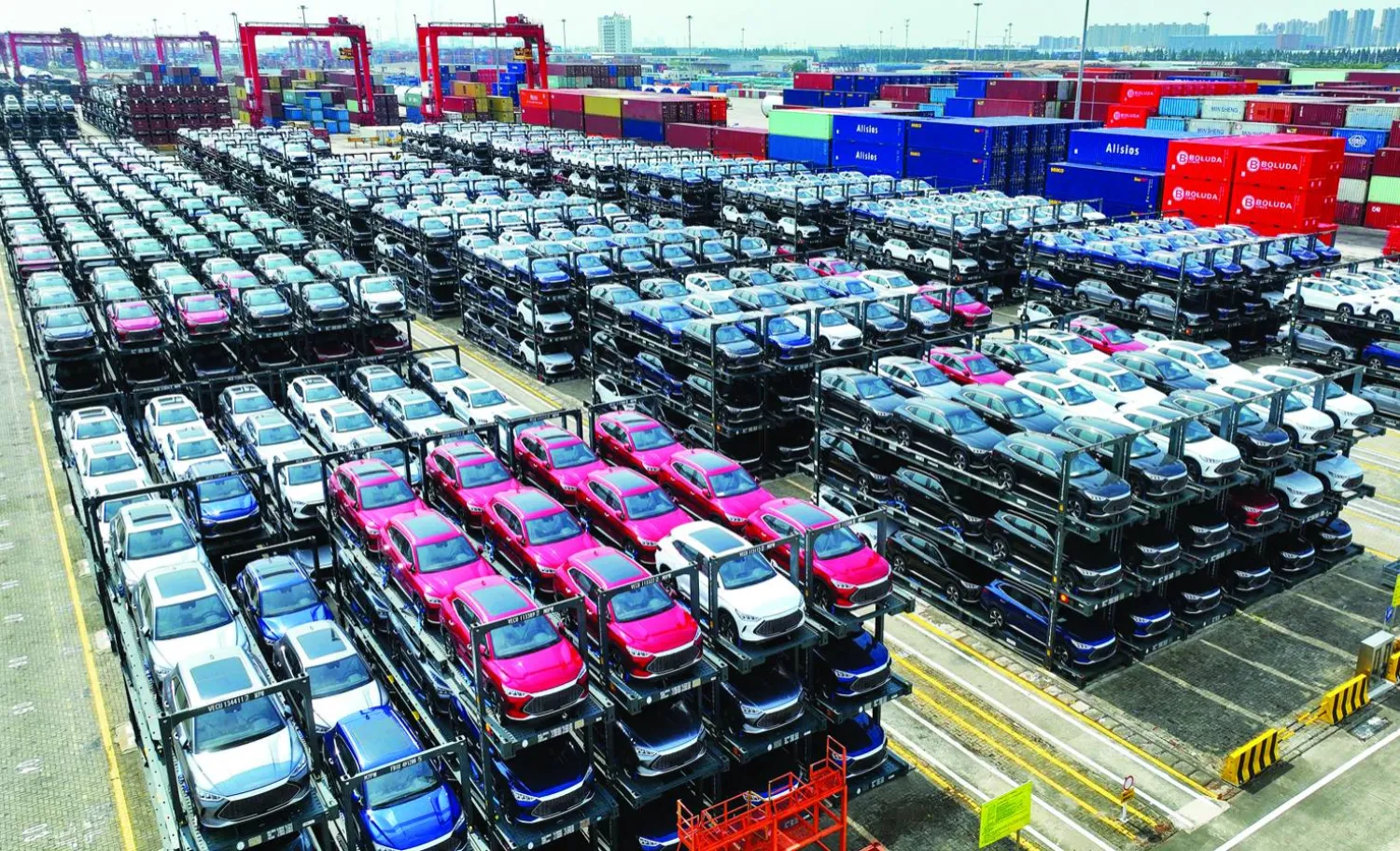
EU Hits Chinese EVs With Extra Duties of Up to 38.1%

(FILES) This photo taken on September 11, 2023, shows BYD electric cars awaiting to be loaded onto a ship at the international container terminal of Taicang Port at Suzhou Port, in China eastern Jiangsu Province. (Photo by AFP)
TT

EU Hits Chinese EVs With Extra Duties of Up to 38.1%

(FILES) This photo taken on September 11, 2023, shows BYD electric cars awaiting to be loaded onto a ship at the international container terminal of Taicang Port at Suzhou Port, in China eastern Jiangsu Province. (Photo by AFP)

The European Commission said it will impose extra duties of up to 38.1% on imported Chinese electric cars from July, risking retaliation from Beijing which said on Wednesday it would take measures to safeguard its interests.
Brussels said it would combat excessive subsidies with additional tariffs ranging from 17.4% for BYD to 38.1% for SAIC on top of the standard 10% car duty.
The Commission said it would apply an additional 21% for companies deemed to have cooperated with the investigation and 38.1% for those it said had not, according to Reuters.
In return, the Chinese Foreign Ministry said Beijing would take all necessary measures to “firmly safeguard” its legitimate rights and interests.
Chinese foreign ministry spokesperson Lin Jian said the EU's investigation was a “typical case of protectionism” and tariffs would damage China-EU economic cooperation and the stability of the global automobile production and supply chains.
“We urge the EU to act on its commitment to supporting free trade and opposing protectionism, and work with us to uphold the overall economic and trade cooperation between the two sides. China will take all measures necessary to firmly defend our lawful rights and interests,” Jian said.
Meanwhile, Chinese electric vehicle maker Nio strongly opposed the European Union's use of increased tariffs as a strategy to obstruct the normal global electric vehicle trade but its commitment to Europe's EV market is unwavering, it said on Wednesday.
Nio “will continue to serve our users and explore new opportunities within Europe despite protectionism,” it said in a statement.
The European Automobile Manufacturers’ Association (ACEA) said free and fair trade is essential in creating a globally competitive European automotive industry.
“Most important for global competitiveness however is a robust industrial strategy for electromobility,” ACEA added.
US Consumers Score $1 Billion in EV Tax Credits
In a related development, the Treasury Department announced Wednesday that there have been more than 125,000 new EVs purchased, along with about 25,000 used EVs, and buyers of EVs have saved more than $1 billion in upfront costs since the start of the year.
Starting on January 1st, 2024, taxpayers in the US have been able to take advantage of both the used and new clean vehicle tax credits when they purchase their vehicle at participating dealerships, thanks to new guidance from the administration of President Joe Biden.
Deputy Treasury Secretary Wally Adeyemo told reporters the $1 billion figure represents a “major milestone in the administration’s work to lower transportation costs for Americans.”
Adeyemo was asked about Republican criticism that the EV tax credit is flowing to relatively well-off Americans. GOP Sen. Thom Tillis of North Carolina, for example, said last month that it’s going to “people of means” and it doesn’t resonate with “the people growing up in the trailer park that I grew up in.”
Adeyemo said in response that the EV tax credit “provides hardworking Americans below a certain income threshold with an opportunity to buy a car for less money, and then to save money in terms of paying for gas.”
He said Americans have been telling him their No. 1 concern is reducing costs, and the credit “helps to reduce those costs,” and that “matters to Americans in all parts of the country.”
For a new EV, the annual-income limits for the credit are $150,000 for individuals and $300,000 for married couples, and for a used one, they’re at $75,000 for individuals and $150,000 for couples, according to the Internal Revenue Service. Median household income in the US was $74,580 in 2022, according to the Census Bureau.
Besides income, qualifying for credits also depends on the price of the vehicle, as well as its battery materials and whether it’s assembled in North America.
Republicans are expected to make an effort to roll back EV tax credits, which stem from the Democrats’ Inflation Reduction Act of 2022, if the GOP has sufficient gains in November’s elections.


World Food Prices Dip in October, but Remain Higher Than a Year Ago

A worker carries loaves of bread for sale at a bakery in the capital city of Cairo, Egypt November 4, 2026. (Reuters)
TT

World Food Prices Dip in October, but Remain Higher Than a Year Ago

A worker carries loaves of bread for sale at a bakery in the capital city of Cairo, Egypt November 4, 2026. (Reuters)

World food prices edged lower in October as weaker import demand contributed to monthly declines in cereal, dairy and meat prices, but were still nearly 6% higher than a year earlier, the United Nations' Food and Agriculture Organization said on Friday.

The FAO Food Price Index, which tracks monthly changes in international prices for a basket of food commodities, ‌averaged 133.9 points ‌in October, down from a revised ‌135.6 ⁠in September.

The index ⁠was 5.9% higher than a year earlier, but remained 16.4% below its March 2022 peak.

FAO's cereal price index fell 4.5% from September and was 12.6% lower than a year ago, as wheat and maize quotations declined. Wheat prices eased on weak import demand ⁠and improved production prospects, especially in Argentina.

"Expectations of ‌easing constraints on Black ‌Sea export flows added to the downward pressure on prices, ‌although continued disruptions to Black Sea logistics limited the decline," ‌FAO said in a statement.

Maize prices also eased after reaching a three-year high in September, pressured by the US harvest, expectations of ample supplies in South America and renewed ‌prospects of easing tensions in the Black Sea region.

Vegetable oil prices edged up 0.3%, ⁠as ⁠higher soybean and sunflower oil prices more than offset a fall in rapeseed oil prices.

Sugar prices rose 6.6%, their fourth straight monthly increase, to the highest level since December 2024, after rainfall disrupted harvesting in Brazil. They were now 28.8% above a year ago.

The dairy index fell 1.1%, as lower butter and cheese prices linked to ample supplies and subdued demand outweighed gains in milk powder.

The meat index declined 1.2%, while still slightly above its year-earlier level, as ovine and bovine meat prices fell.


Copper Falls, Set for Worst Week Since March on AI Rout

Copper at the Aurubis copper smelting and refining plant in Hamburg, Germany. (Reuters)
TT

Copper Falls, Set for Worst Week Since March on AI Rout

Copper at the Aurubis copper smelting and refining plant in Hamburg, Germany. (Reuters)

Copper dropped on Friday and was set for its biggest weekly drop in London since March, as a rout in technology stocks battered markets.

Benchmark three-month copper on the London Metal Exchange was down 1.3% at $13,663 a metric ton by 0700 GMT. That placed it on track to fall 3.44% in the week, Reuters said.

The most-traded copper contract on the Shanghai Futures Exchange fell 1.08% to 106,830 yuan ($16,018.17) a ton.

The weakness reflects worries over AI investment, ‌with copper increasingly ‌influenced by "sentiment towards data center expansion," said ‌Craig ⁠Lang, principal analyst ⁠at CRU.

Technology shares were battered after Democratic wins in the US midterms fueled concerns that new regulatory oversight could cap the AI buildout.

On the other hand, supply constraints cushioned copper's decline.

"I would be cautious about calling this a sustained correction, given ongoing mine supply challenges and exceptionally tight ⁠metal availability outside the US," Lang said.

Copper stocks ‌in SHFE-monitored warehouses <CU-STX-SGH> fell by ‌over 24% this week to just 33,848 tons — the lowest ‌in almost three years. The closely watched Yangshan copper ‌premium <SMM-CUYP-CN>, a gauge of appetite for imports into key consumer China, increased to $210 a ton on Thursday, matching its record high.

Smelters in the country are facing a double squeeze of negative treatment ‌charges and lower sulfuric acid prices.

Meanwhile, warehouse inventories outside the US have been drawn ⁠down as ⁠material was pulled into the country ahead of a potential tariff on imports of refined copper.

"These physical constraints should provide some support against weaker investor sentiment," Lang said.

Among LME metals, aluminium lost 0.54%, zinc lost 1.42%, lead lost 0.45%, nickel dipped 0.23% and tin gained 0.83%.

On the SHFE, aluminium nudged down only 0.04%, zinc lost 1.35%, lead was little changed, down only 0.03%, nickel rose 2.14% and tin dropped 3.45%.

SHFE inventories were down across the board this week, led by sharp drops in aluminium <AL-STX-SGH> and lead <PB-STX-SGH>.


Emerging Economies Set to Match Advanced Nations’ Renewable Capacity Additions, IEA Says

Workers walk at Kalyon Karapinar solar power plant in Karapinar, Konya province, Türkiye, Oct. 14, 2026. (AP)
TT

Emerging Economies Set to Match Advanced Nations’ Renewable Capacity Additions, IEA Says

Workers walk at Kalyon Karapinar solar power plant in Karapinar, Konya province, Türkiye, Oct. 14, 2026. (AP)

Emerging ‌and developing economies outside China are expected to add as much new renewable energy capacity as advanced economies for the first time over the next five years, driven by the current energy crisis, the International Energy Agency said on Friday.

Gas and oil prices have soared this year as the US-Iran war disrupts traffic through the Strait of Hormuz, a key route for global oil and gas trade.

Global renewable energy ‌capacity is forecast ‌to increase by almost 4,800 gigawatts ‌between ⁠2026 and 2031, ⁠the IEA said in its annual outlook.

Emerging and developing economies are expected to add about 1,100 GW, roughly the same as advanced economies, with China adding around 2,550 GW, the agency said.

Capacity growth in Southeast Asia, Africa and the Middle East is ⁠expected to triple over the period, ‌led mainly by solar installations, ‌the IEA said.

China will remain the biggest contributor to ‌global renewable energy growth, although its share is ‌forecast to fall to 53% by 2031 from 60% in 2025.

India is emerging as the world's second-fastest deployer of renewables and is expected to more than double its contribution ‌to global growth by 2031 to nearly 8.5%.

Grid connection delays remain ⁠a major ⁠challenge, with projects awaiting connections worldwide rising 60% over the past year, equivalent to four times the wind and solar capacity connected to grids during the same period.

Grid constraints are expected to slow growth in advanced economies, with annual additions in Europe through 2031 forecast to remain broadly in line with 2025 levels.

Renewable energy is expected to meet 6% of global transport energy demand by 2031, while higher fuel-blending mandates prompted the IEA to raise its biofuels forecast by 40% from last year's report.