


South Korea Slams North Korea’s Fresh Trash Balloon Launches, Threatens Loudspeaker Broadcasts 

Members of the Kora Peace Action, hold up signs reading "No War, Yes Peace" during a rally against policy toward North Korea while South Korea marks the 74th anniversary of the Korean War in Seoul, South Korea, 25 June 2024. (EPA)
TT

South Korea Slams North Korea’s Fresh Trash Balloon Launches, Threatens Loudspeaker Broadcasts 

Members of the Kora Peace Action, hold up signs reading "No War, Yes Peace" during a rally against policy toward North Korea while South Korea marks the 74th anniversary of the Korean War in Seoul, South Korea, 25 June 2024. (EPA)

South Korea threatened Tuesday to restart anti-Pyongyang frontline propaganda broadcasts in the latest bout of Cold War-style campaigns between the rivals after North Korea resumed its trash-carrying balloon launches.

On Monday night, North Korea floated huge balloons carrying plastic bags of rubbish across the border in its fifth such campaign since late May — an apparent response to South Korean activists flying political leaflets via balloons.

South Korean President Yoon Suk Yeol called North Korea’s balloon activities “a despicable and irrational provocation.”

In a speech marking the 74th anniversary of the start of the 1950-53 Korean War, Yoon said Tuesday that South Korea will maintain a firm military readiness to overwhelmingly respond to any provocations by North Korea.

South Korea’s military said North Korea floated about 350 balloons in its latest campaign, and about 100 of them eventually landed in South Korean soil, mostly in Seoul and nearby areas. Seoul is about 40-50 kilometers (25-30 miles) away from the border. The military said the trash carried by the North Korean balloons were mostly papers and that no hazardous items were found.

In its earlier balloon launches, North Korea dropped manure, cigarette butts and waste batteries along with cloth scraps and waste papers in various parts of South Korea. No major damage was reported. In response, South Korea redeployed gigantic loudspeakers June 9 along the border for the first time in six years and briefly resumed anti-North Korean propaganda broadcasts.

Joint Chiefs of Staff spokesperson Lee Sung Joon told reporters Tuesday that the South Korean military is ready to turn on its border loudspeakers again. A written Joint Chiefs of Staff statement said officials would examine unspecified strategic operational circumstances and that broadcasts’ resumption would depend on how North Korea acts.

Balloon launches and loudspeaker broadcasts were psychological campaigns that the two Koreas specialized in during the Cold War. The rivals have agreed to halt such activities in recent years, but occasionally resumed them when animosities rekindled.

North Korea is highly sensitive to South Korean border broadcasts and civilian leafletting campaigns as it bans most of its 26 million people official access to foreign news.

South Korean leafleting campaigns by civilian activists, mostly North Korean defectors, include leaflets critical of North Korea’s human rights violations and USB sticks containing South Korean TV dramas, while the past South Korean border broadcasts included K-pop songs, weather forecasts and outside news. In a statement Friday, Kim Yo Jong, the powerful sister of North Korean leader Kim Jong Un, called them “human scum” and “disgusting defectors.”

South Korean officials maintained they don’t restrict activists from flying leaflets to North Korea in line with a 2023 constitutional court ruling that struck down a law criminalizing such leafleting, calling it a violation of free speech.

Many experts say the North Korean balloon campaign is also likely designed to deepen a debate in South Korea over the civilian leafleting and trigger a broader internal divide.

Worries about North Korea intensified in mid-June, when North Korean leader Kim Jong Un and Russian President Vladimir Putin signed a deal requiring each country to provide aid if attacked and vowed to boost other cooperation. Observers say the accord represents the strongest connection between the two countries since the end of the Cold War.

The United States and its partners believe North Korea has been providing Russia with much-needed conventional arms for its war in Ukraine in return for military and economic assistance.

In his Korean War speech, Yoon described the Kim-Putin deal as “anachronistic.” South Korea, the US and Japan issued a joint statement Monday strongly condemning expanding military cooperation between Russia and North Korea.



Iran Warns Deal with US Not Yet Close, despite Some Progress

TOPSHOT - People cross a street past a billboard on the facade of a building depicting the Strait of Hormuz with a caption in Persian reading "Forever in Iran's Hand", at Vanak Square in Tehran on May 25, 2026.   (Photo by ATTA KENARE / AFP)
TOPSHOT - People cross a street past a billboard on the facade of a building depicting the Strait of Hormuz with a caption in Persian reading "Forever in Iran's Hand", at Vanak Square in Tehran on May 25, 2026. (Photo by ATTA KENARE / AFP)
TT

Iran Warns Deal with US Not Yet Close, despite Some Progress

TOPSHOT - People cross a street past a billboard on the facade of a building depicting the Strait of Hormuz with a caption in Persian reading "Forever in Iran's Hand", at Vanak Square in Tehran on May 25, 2026.   (Photo by ATTA KENARE / AFP)
TOPSHOT - People cross a street past a billboard on the facade of a building depicting the Strait of Hormuz with a caption in Persian reading "Forever in Iran's Hand", at Vanak Square in Tehran on May 25, 2026. (Photo by ATTA KENARE / AFP)

Iran warned Monday that, while some progress had been made, it was not yet close to striking a deal with the United States to end the Middle East war, after a weekend of mixed messages from Washington and Tehran.

World oil prices tumbled on renewed optimism about an agreement, after top US diplomat Marco Rubio suggested a deal could be reached within the day -- but Iran's foreign ministry spokesman responded: "No one can make such a claim."

Meanwhile, Pakistan's Prime Minister Shehbaz Sharif -- whose government is spearheading efforts to mediate a negotiated agreement between the United States and Iran -- met China's President Xi Jinping in Beijing.

US and Iranian forces have observed a ceasefire since April 8 while diplomats push for a negotiated settlement, although Iran has maintained controls on Gulf shipping through the Strait of Hormuz and the US Navy has sought to blockade Iran's ports.

"We thought we might have some news last night, maybe today," US Secretary of State Rubio told reporters during a visit to New Delhi, referring to hopes for a deal.

"We have what I think is a pretty solid thing on the table in terms of their ability to open up the straits, get the straits open," he said.

"We're either going to have a good agreement or we're going to have to deal with it another way. We'd prefer to have a good agreement," he said.

But in Tehran, foreign ministry spokesman Esmaeil Baqaei poured cold water on hopes for a quick final settlement.

- 'Certain fees' -

"It is correct to say that we have reached a conclusion on a large portion of the issues under discussion," he told a weekly news briefing.

"But to say that this means the signing of an agreement is imminent -- no one can make such a claim."

Baqaei stressed that Iran would continue to manage maritime traffic through the Strait of Hormuz by charging service fees -- arguing that this did not amount to Tehran "seeking to collect tolls".

"The services that are provided -- navigational services in addition to the measures necessary to protect the environment of the Strait of Hormuz”, the Arabian Gulf “and the Sea of Oman -- require the collection of certain fees," he said.

Earlier, President Donald Trump had said that he had told his negotiators "not to rush into a deal, in that time is on our side", and warned that the US naval blockade would remain in place until a deal was reached.

A post on Trump's Truth Social read: "If I make a deal with Iran, it will be a good and proper one," adding that: "It isn't even fully negotiated yet."

Israel's Prime Minister Benjamin Netanyahu said Sunday that he and Trump had agreed that "any final agreement with Iran must eliminate the nuclear threat entirely."

- 'Lasting peace' -

Iranian officials have stressed that, despite the long-standing US demand for an end to its uranium enrichment, talks on the issue of Iran's contested nuclear program have been deferred until after an initial agreement.

The war, which erupted after the United States and Israel attacked Iran on February 28 and saw Iran respond with missile and drone attacks across the region, drove energy prices higher.

Crude oil remains expensive by recent standards, but prices have see-sawed and Monday's mood of relative optimism caused prices to plunge by almost five percent.

The price of North Sea Brent crude and West Texas Intermediate slipped to $99.00 and $92.10 a barrel respectively.

On Saturday, leaders from Saudi Arabia, the United Arab Emirates, Qatar, Egypt, Jordan and Bahrain, as well as representatives from Türkiye and Pakistan, joined a call with Trump to discuss the deal.

The focus of international efforts moved to Beijing on Monday, where Pakistan's Sharif and army chief Asim Munir, who visited Tehran on Saturday, met senior leaders including Xi and Premier Li Qiang.

Speaking to Chinese leaders, Sharif said "the world is passing through a critical moment", Pakistan's state-run PTV channel showed.

"Things are moving in the right direction. I would like to thank China's support to promote peace."


Xi Hails ‘Unbreakable’ Pakistan Ties, Praises Role in Iran Peace Efforts

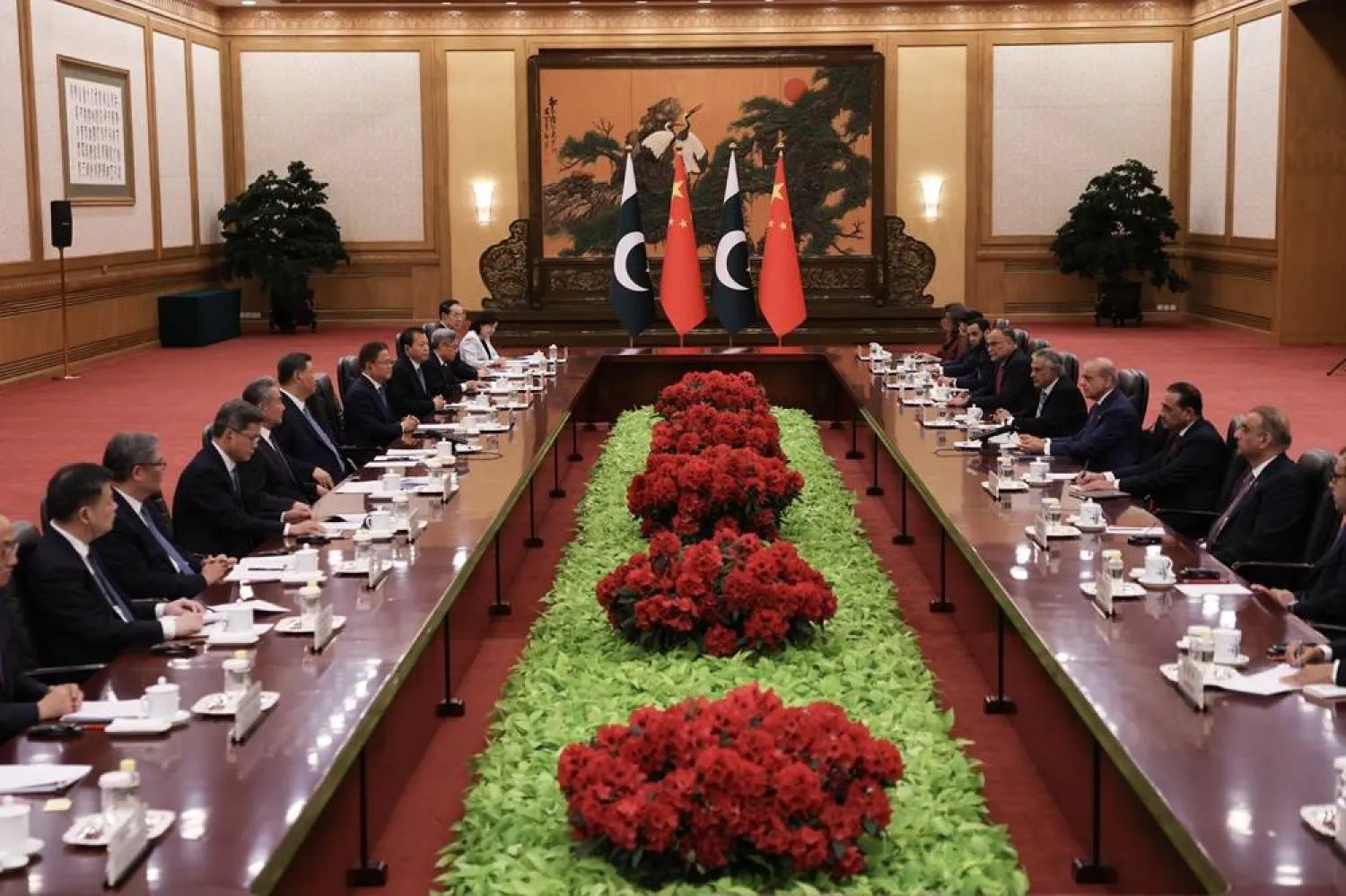
Chinese President Xi Jinping (6-L) and Pakistan's Prime Minister Shehbaz Sharif (4-R) attend a meeting at the Great Hall of the People in Beijing, China, 25 May 2026. (Pool/EPA)
TT

Xi Hails ‘Unbreakable’ Pakistan Ties, Praises Role in Iran Peace Efforts

Chinese President Xi Jinping (6-L) and Pakistan's Prime Minister Shehbaz Sharif (4-R) attend a meeting at the Great Hall of the People in Beijing, China, 25 May 2026. (Pool/EPA)

China's President Xi Jinping hailed Beijing's "unbreakable" friendship with Pakistan on Monday as he met visiting Prime Minister Shehbaz Sharif, seeking to deepen their "all-weather" partnership. 

Pakistan is among an exclusive group of countries China regards as an "all-weather strategic partner," with ties featuring close economic, trade and security cooperation. But repeated extremist attacks on Chinese nationals and projects in the South Asian country have emerged as ‌an irritant, while ‌Islamabad's warming ties with Washington have added complexity ‌to ⁠its ties with ⁠Beijing. 

Greeting Sharif at Beijing's Great Hall of the People, Xi called the Pakistani leader an "old friend" and said the two countries had "understood, trusted and supported each other" over decades, forging an "unbreakable traditional friendship." 

"No matter how the international situation changes, China always prioritises the development of China-Pakistan relations in its neighbourhood diplomacy," Xi said. 

LET'S WORK TOGETHER 

Beijing was ⁠willing to work with Islamabad to build a ‌more close-knit China-Pakistan community with a ‌shared future and achieve more in their "all-weather" cooperation, Xi added. 

Sharif, in turn, ‌called China and Pakistan two "iron brother" countries with a relationship that ‌is "next to none". 

He was accompanied at Monday's meeting by Pakistan's Army chief, Asim Munir, who was recently in Tehran for meetings with the Iranian leadership. 

Following a rickety ceasefire in the Iran conflict, achieved in April, Pakistan ‌hosted mediation talks in Islamabad between Washington and Tehran, relaying proposals and missives between the warring countries ⁠even when ⁠tensions escalated. 

Weeks into Islamabad's diplomatic efforts, Washington has reported progress in negotiations with Tehran. 

"I know that you have just returned from Iran and made positive efforts for the current peace. We still appreciate the constructive role played by Pakistan," Xi said. 

For Pakistan, engaging China in its mediation efforts is important given Beijing and Tehran's close ties. 

China and Pakistan issued a five-point initiative in March as their foreign ministers met in Beijing, calling for peace talks and restoration of normal navigation in the Strait of Hormuz, the vital waterway through which roughly a fifth of the world's oil and liquefied natural gas normally passes. 


Iran Executes Man Over Links to Nationwide Protests

A woman rides a bicycle as others cross a street in downtown Tehran, Iran, Sunday, May 24, 2026. (AP)
TT

Iran Executes Man Over Links to Nationwide Protests

A woman rides a bicycle as others cross a street in downtown Tehran, Iran, Sunday, May 24, 2026. (AP)

Iran on Monday executed a man convicted of carrying out armed attacks during the nationwide anti-government protests that peaked in January, the judiciary said.

Abbas Akbari's is the latest in a string of executions by the authorities after it ramped up hangings in security-related cases after the outbreak of war with Israel and the United States on February 28.

"Abbas Akbari... was hanged this morning," the judiciary's Mizan Online website reported, describing him as "one of the armed leaders" during protests in the central province of Isfahan.

According to the report, Akbari "opened fire in the street at security forces" and "was one of the armed leaders of the riots in Nain town in Isfahan province" while carrying a handgun.

He was also accused of attacking the governorate building, security establishments and health centers in Nain.

The judiciary said Akbari had been sentenced to death on charges including "moharebeh" -- waging war against God -- as well as deliberate destruction of public property "with the intent of confronting the system, disrupting public order and security, and assembly and collusion against national security".

The Supreme Court upheld the sentence following his appeal, and he was executed on Monday morning, Mizan said.

On Sunday, Iran executed a man convicted of espionage in the first reported execution linked to spying accusations during the war.

Iran carries out the second-highest number of executions in the world after China, according to rights groups including Amnesty International.