

With cease-fire talks faltering in Gaza and no clear offramp for the conflict on the Lebanon-Israel border, the daily exchanges of strikes between Hezbollah and Israeli forces have sparked fires that are tearing through forests and farmland on both sides of the frontline.
The blazes — exacerbated by supply shortages and security concerns — have consumed thousands of hectares of land in southern Lebanon and northern Israel, becoming one of the most visible signs of the escalating conflict, The Associated Press said.
There is an increasingly real possibility of a full-scale war — one that would have catastrophic consequences for people on both sides of the border. Some fear the fires sparked by a larger conflict would also cause irreversible damage to the land.
Charred remains in Lebanon and in Israel. Images of fires sparked by Hezbollah's rockets have driven public outrage and spurred Israel’s far-right national security minister, Itamar Ben-Gvir, to declare last month that it is “time for all of Lebanon to burn.”
Much of it was already burning.
Fires in Lebanon began in late April — earlier than the usual fire season — and have torn through the largely rural areas along the border.
The town of Shebaa, tucked in the mountains on Lebanon’s southeastern edge, has little Hezbollah presence, and the town hasn't been targeted as frequently as other border villages. But the sounds of shelling still boom regularly, and in the mountains above it, formerly oak-lined ridges are charred and bare.
In a cherry orchard on the outskirts of town, clumps of fruit hang among browned leaves after a fire sparked by an Israeli strike tore through. Firefighters and local men — some using their shirts to beat out flames — stopped the blaze from reaching houses and UN peacekeeper center nearby.
“Grass will come back next year, but the trees are gone,” said Moussa Saab, whose family owns the orchard. “We’ll have to get saplings and plant them, and you need five or seven years before you can start harvesting.”
Saab refuses to leave with his wife and 8-year-old daughter. They can't afford to live elsewhere, and they fear not being able to return, as happened to his parents when they left the disputed Shebaa Farms area.
In Israel, the slopes of Mount Meron, Israel’s second-highest mountain and home to an air base, were long covered in native oak trees, a dense grove providing shelter to wild pigs, gazelles, and rare species of flowers and fauna.
Now the green slopes are interrupted by three new burn scars — the largest a few hundred square meters — remnants of a Hezbollah explosive drone shot down a few weeks ago. Park rangers worry that devastation has just begun.
“The damage this year is worse a dozen times over this year,” said Shai Koren, of the northern district for Israel’s Nature and Parks Authority.
Looking over the slopes of Meron, Koren said he doesn’t expect this forest to survive the summer: “You can take a before and after picture.”
Numbers and weapons
Since the war began, the Israeli military has tracked 5,450 launches toward northern Israel. According to Israeli think tank the Alma Research and Education Center, most early launches were short-range anti-tank missiles, but Hezbollah's drone usage has increased.
In Lebanon, officials and human rights groups accuse Israel of firing white phosphorus incendiary shells at residential areas, in addition to regular artillery shelling and airstrikes.
The Israeli military says it uses white phosphorus only as a smokescreen, not to target populated areas. But even in open areas, the shells can spark fast-spreading fires.
The border clashes began Oct. 8, a day after the Hamas-led incursion into southern Israel that killed around 1,200 people and sparked the war in Gaza. There, more than 37,000 have been killed, according to Gaza's Health Ministry.
Hezbollah began launching rockets into northern Israel to open what it calls a “support front” for Hamas, to pull Israeli forces away from Gaza.
Israel responded, and attacks spread across the border region. In northern Israel, 16 soldiers and 11 civilians have been killed. In Lebanon, more than 450 people — mostly fighters, but also 80-plus civilians and noncombatants — have been killed.
Exchanges have intensified since early May, when Israel launched its incursion into the southern Gaza city of Rafah. That coincided with the beginning of the hot, dry wildfire season.
Since May, Hezbollah strikes have resulted in 8,700 hectares (about 21,500 acres) burned in northern Israel, according to Israel's Nature and Parks Authority.
Eli Mor, of Israel’s Fire and Rescue, said drones, which are much more accurate than rockets, often “come one after another, the first one with a camera and the second one will shoot.”
“Every launch is a real threat,” Mor added.
In southern Lebanon, about 4,000 hectares (10,000 acres) have burned due to Israeli strikes, said George Mitri, of the Land and Natural Resources program at the University of Balamand. In the two years before, he said, Lebanon's total area burned annually was 500 to 600 hectares (1,200 to 1,500 acres).
Fire response Security concerns hamper the response to a fire's first crucial hours. Firefighting planes are largely grounded over fears they'll be shot down. On the ground, firefighters often can't move without army escorts.
“If we lose half an hour or an hour, it might take us an extra day or two days to get the fire under control,” said Mohammad Saadeh, head of the Shebaa civil defense station. The station responded to 27 fires in three weeks last month — nearly as many as a normal year.
On the border's other side, Moran Arinovsky used to be a chef and is now deputy commander of the emergency squad at Kibbutz Manara. With about 10 others, he's fought more than 20 fires in the past two months.
Mor, of Israel’s Fire and Rescue, said firefighters often must triage.
“Sometimes we have to give up on open areas that are not endangering people or towns,” Mor said.
The border areas are largely depopulated. Israel's government evacuated a 4-kilometer strip early in the war, leaving only soldiers and emergency personnel. In Lebanon, there's no formal evacuation order, but large swathes have become virtually uninhabitable.
Some 95,000 people in Lebanon and 60,000 people in Israel have been displaced for nine months.
Kibbutz Sde Nehemia didn't evacuate, and Efrat Eldan Schechter said some days she watches helplessly as plumes of smoke grow closer to home.
“There's a psychological impact, the knowledge and feeling that we’re alone,” she said, because firefighters can't access certain areas.
Israeli Prime Minister Benjamin Netanyahu has said that as fighting in Gaza winds down, Israel will send more troops to its northern border. That could open a new front and raise the risk of more destructive fires.


Fires Have Become the Most Visible Sign of the Conflict Heating Up on the Lebanon-Israel Border
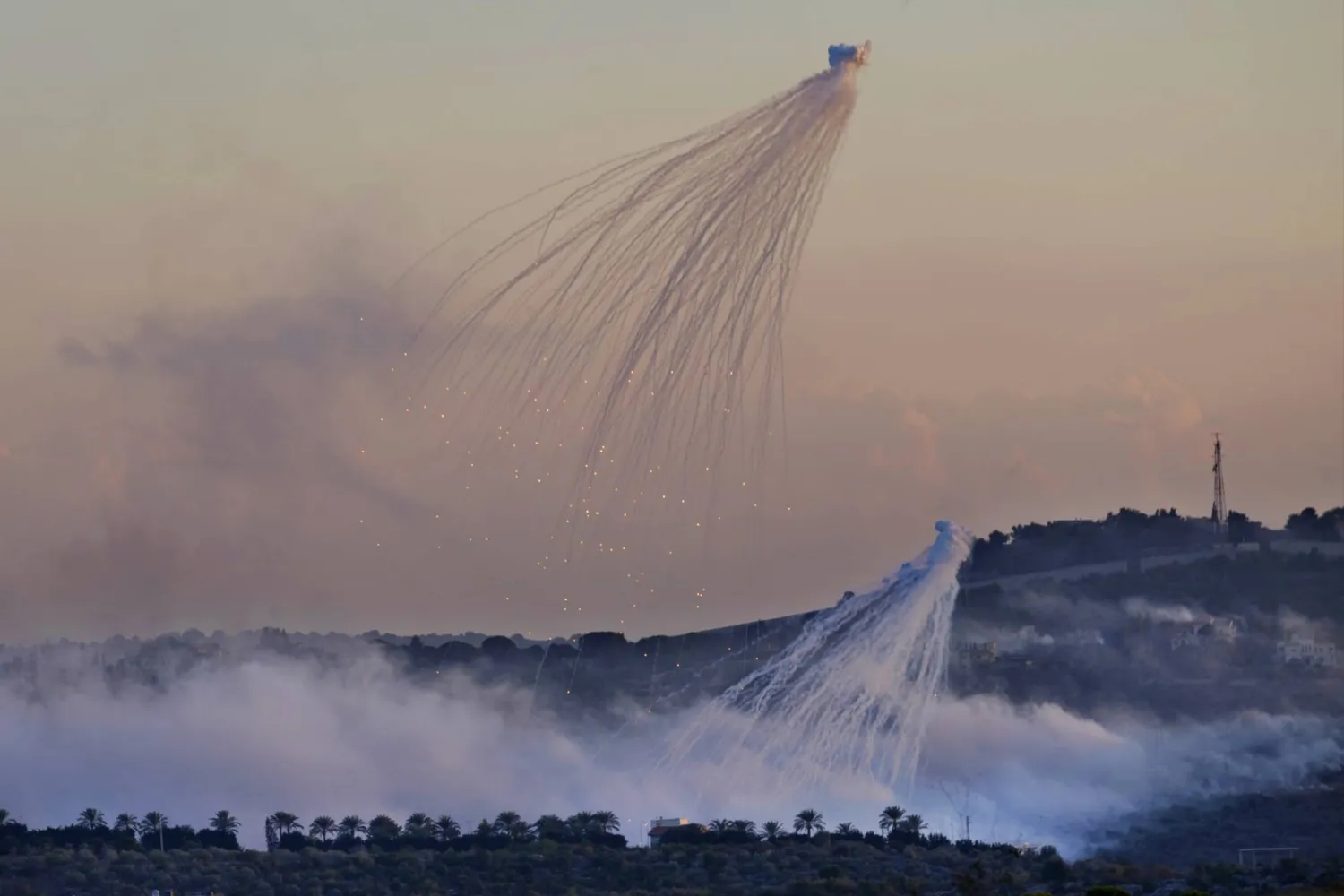
FILE - Shells that appear to be white phosphorus from Israeli artillery explode over Dahaira, a Lebanese border village with Israel, south Lebanon, on Oct. 16, 2023. (AP Photo/Hussein Malla, File)

Fires Have Become the Most Visible Sign of the Conflict Heating Up on the Lebanon-Israel Border
FILE - Shells that appear to be white phosphorus from Israeli artillery explode over Dahaira, a Lebanese border village with Israel, south Lebanon, on Oct. 16, 2023. (AP Photo/Hussein Malla, File)



لم تشترك بعد
انشئ حساباً خاصاً بك لتحصل على أخبار مخصصة لك ولتتمتع بخاصية حفظ المقالات وتتلقى نشراتنا البريدية المتنوعة
