


Reformist Faces Ultraconservative as Iran Votes for President

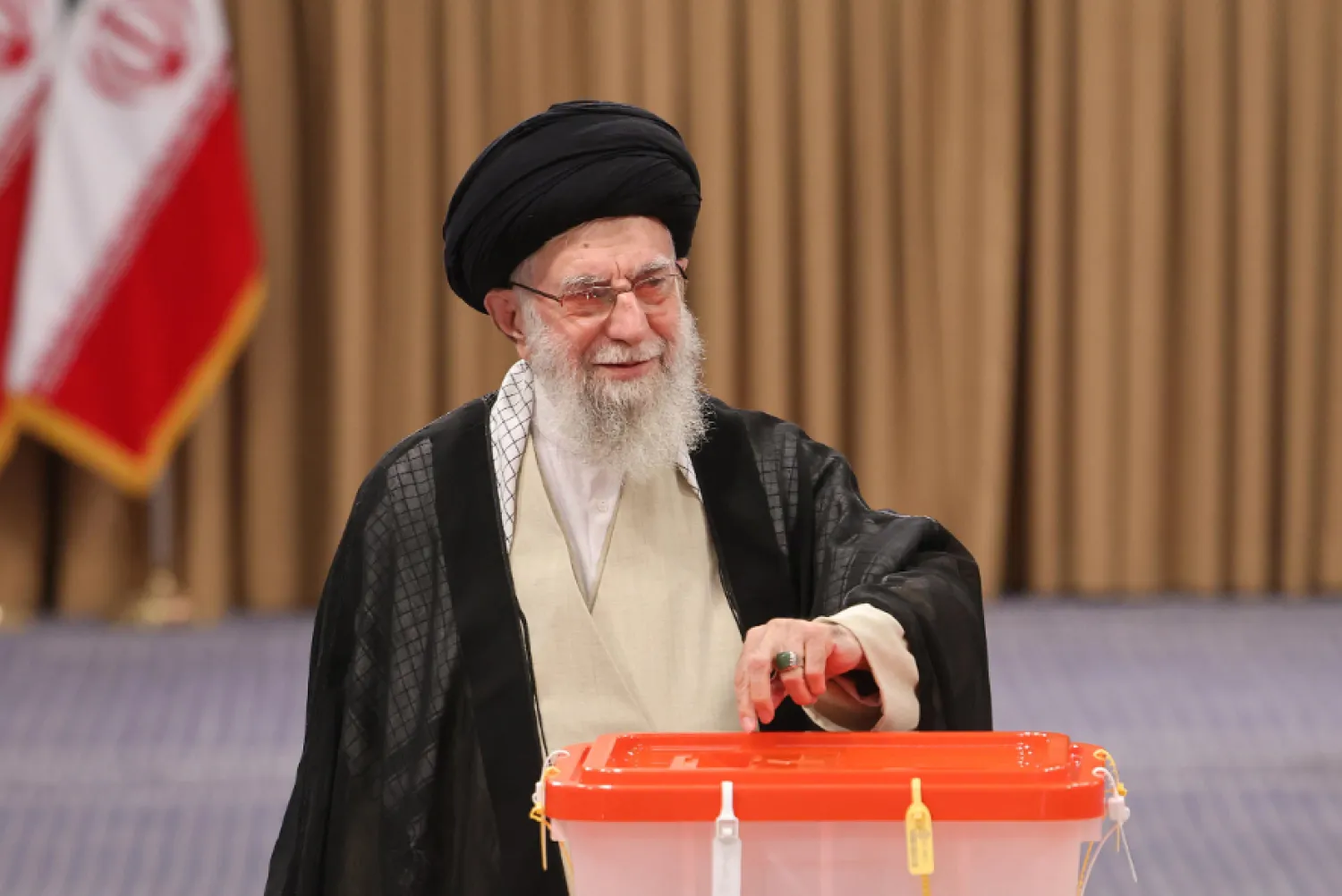
Iran's supreme leader Ayatollah Ali Khamenei casts his ballot during the runoff © ATTA KENARE / AFP
TT

Reformist Faces Ultraconservative as Iran Votes for President

Iran's supreme leader Ayatollah Ali Khamenei casts his ballot during the runoff © ATTA KENARE / AFP

Iranians voted Friday in a presidential election runoff between a reformist advocating improved ties with the West and an ultraconservative former nuclear negotiator.

The election, called early after the death of ultraconservative president Ebrahim Raisi in a helicopter crash, follows a first round marked by a historically low turnout last week.

The runoff between reformist Masoud Pezeshkian and ultraconservative Saeed Jalili comes amid heightened regional tensions over the Gaza war, Iran's nuclear standoff with the West and widespread economic discontent exacerbated by Western sanctions.

Supreme leader Ayatollah Ali Khamenei, who has the final say in all state matters in Iran, cast his ballot when polls opened.

"I heard that the enthusiasm and interest of the people is more than before, praise to God that it will be like this, and if it is like this, it will be gratifying," he said.

State television showed voters queueing in Saveh in central Iran and Kerman in the south, but AFP correspondents said polling stations appeared less busy in Tehran, AFP reported.

In last week's first round, Pezeshkian, who was the only reformist permitted to stand, won the largest number of votes, around 42 percent, while Jalili came second with 39 percent, according to figures from Iran's elections authority.

Only 40 percent of Iran's 61 million eligible voters took part -- the lowest turnout in any presidential election since the Islamic Revolution of 1979.

He said the first round turnout was lower than expected, but added that it was not an act "against the system".

Pezeshkian and Jalili have taken part in two televised debates during which they discussed the low turnout, as well as Iran's economic woes, international relations and internet restrictions.

Pezeshkian vowed to "fully" oppose police patrols enforcing the mandatory headscarf for women, a high-profile issue since the death in police custody in 2022 of Mahsa Amini.

The 22-year-old Iranian Kurd had been detained for an alleged breach of the dress code and her death sparked months of nationwide unrest.

Following the unrest, women increasingly flouted the code but police have again stepped up checks in recent months.

At a Tehran polling station, 48-year-old Fatemeh said she voted for the reformist whose "priorities include women and young people's rights."

The candidacy of Pezeshkian, a relative unknown until recently, has raised the hopes of Iran's reformists after years of dominance by the conservative and ultraconservative camps.

Jalili, noted for his uncompromising anti-Western position, mobilised a substantial base of hardline support and received backing from other ultraconservative candidates.

While campaigning, the 58-year-old criticised moderates for having signed the 2015 deal which promised Iran sanctions relief in return for curbs on its nuclear program.

Jalili said the accord, which the United States withdrew from in 2018 under then-president Donald Trump, "did not benefit Iran at all".

"I voted for Jalili because the next president should not repeat the previous mistake and sign a new agreement with the West," said Ali, a 38-year-old university professor, at a polling station in central Tehran.

"They deceived us once and that's enough. Their promises cannot be trusted," said Ali, who gave only his first name.

Pezeshkian, a 69-year-old heart surgeon, has called for "constructive relations" with Western countries to revive the nuclear deal in order to "get Iran out of its isolation".

Pezeshkian voted at a school west of Tehran where he was accompanied by former foreign minister Mohammad Javad Zarif, who helped clinch the 2015 deal.

A member of parliament representing the northwestern city of Tabriz since 2008, he has earned the support of Iran's reformists, with former presidents Mohammad Khatami and Hassan Rouhani backing his candidacy.

Casting his ballot on Friday, Khatami urged Iranians to vote "for the future and good of the country".

Pezeshkian said people were "fed up with their living conditions... and dissatisfied with the government's management of affairs."

Jalili has held several senior positions, including in Khamenei's office in the early 2000s.

He is currently one of Khamenei's representatives in the Supreme National Security Council, Iran's highest security body.



Trump to Attend Ceremony to Witness Return of US Personnel Killed in Syria

US President Donald Trump speaks to the media - Reuters
TT

Trump to Attend Ceremony to Witness Return of US Personnel Killed in Syria

US President Donald Trump speaks to the media - Reuters

US President Donald Trump and first lady Melania Trump will attend a ceremony on Wednesday to honor US personnel killed in Syria over the weekend by a suspected ISIS attacker.

Trump and his wife will travel to Dover Air Force Base in Delaware to be present for what the Air Force calls the "dignified transfer" of the bodies from overseas back into the United States in the presence of their families. The ceremony is scheduled to take place at 1:15 p.m. EST (1815 GMT), Reuters reported.

Two US Army soldiers and a civilian interpreter were killed on Saturday in the central Syrian town of Palmyra by an attacker who targeted a convoy of American and Syrian forces before being shot dead, according to the U.S. military.

Trump called the incident terrible, vowed retaliation and referred to the three that were slain as "great patriots."

Three US soldiers were also wounded in the attack.

US presidents, vice presidents and dignitaries regularly attend the solemn transfer ceremonies at Dover during times of war or conflict that result in the deaths of US troops. Flag-draped transfer cases are brought off of a military plane with the bodies of the fallen and put with precision in an awaiting vehicle as officials and family members watch and often weep.


Putin Says Russia will Achieve War Goals, Keep Expanding 'Buffer Zone'

Russian President Vladimir Putin attends a meeting with Kazbek Kokov, head of the North Caucasus region of Kabardino-Balkaria, in Moscow, Russia December 16, 2025. Sputnik/Mikhail Metzel/Pool via REUTERS
TT

Putin Says Russia will Achieve War Goals, Keep Expanding 'Buffer Zone'

Russian President Vladimir Putin attends a meeting with Kazbek Kokov, head of the North Caucasus region of Kabardino-Balkaria, in Moscow, Russia December 16, 2025. Sputnik/Mikhail Metzel/Pool via REUTERS

President Vladimir Putin said on Wednesday that Russia would achieve its goals in Ukraine by diplomatic or military means, and would seek to expand a "security buffer zone" there.

"First, the goals of the special military operation will undoubtedly be achieved. We would prefer to do this and address the root causes of the conflict through diplomacy," Putin said.

"If the opposing side and their foreign patrons refuse to engage in substantive discussions, Russia will achieve the liberation of its historical lands by military means. The task of creating and expanding a security buffer zone will also be consistently addressed."

Of the regions of Ukraine that Russia has claimed as its own territory, it currently controls Crimea, around 90% of the Donbas region and 75% of Kherson and Zaporizhzhia, Reuters reported.

In addition, Russia holds some territory in the adjoining regions of Kharkiv, Sumy, Dnipropetrovsk and Mykolaiv. Putin's comments signalled that Moscow would seek further gains on some of these fronts.

With the war at a key juncture as US President Donald Trump pushes hard for a quick peace agreement, Putin said Russia was advancing on all fronts.

But his defense minister, Andrei Belousov, acknowledged that Ukrainian forces were trying to take back control of the northeastern town of Kupiansk - an effort he said was not succeeding.

Ukraine said on Wednesday it had taken 90% of the town, which Russia said it had captured in November.

Putin said people in Europe were being indoctrinated with fears of a war with Russia, and accused their leaders of whipping up hysteria.

"I have repeatedly stated: this is a lie, nonsense, pure nonsense about some imaginary Russian threat to European countries. But this is being done quite deliberately," he said.

Putin has said Russia is not seeking war with Europe, but is ready for war if that is Europe's choice.


Pakistan Says ‘Hostile Countries’ behind False Online Claims Linking it to Australia Shootings

A man waves Pakistan's flag as he along with others gather in support of Pakistan Army, day after the ceasefire announcement between India and Pakistan, in Islamabad, Pakistan, May 11, 2025. REUTERS/Akhtar Soomro
TT

Pakistan Says ‘Hostile Countries’ behind False Online Claims Linking it to Australia Shootings

A man waves Pakistan's flag as he along with others gather in support of Pakistan Army, day after the ceasefire announcement between India and Pakistan, in Islamabad, Pakistan, May 11, 2025. REUTERS/Akhtar Soomro

Pakistan’s information minister said Wednesday that his country has been the victim of a coordinated online disinformation campaign following the mass shooting at Australia’s Bondi Beach.

Attaullah Tarar accused “hostile countries,” including India, of spreading false claims that one of the two attackers was a Pakistani national.

Speaking at a news conference in Islamabad, Tara said Pakistan's leadership strongly condemned Sunday's attack, which killed 15 people in an antisemitic shooting targeting Jews celebrating Hanukkah, The AP news reported.

The minister said misleading information began circulating almost immediately after the attack, with social media posts falsely identifying one of the suspects as a Pakistani national named Naveed Akram. He said the claims spread rapidly across digital platforms and were repeated by some media outlets without verification.

Tarar said subsequent findings, including confirmation by Indian police, established that one of the attackers, Sajid Akram, was from India, while his 24-year-old son, Naveed Akram — who was also involved — was born in Australia.

The minister said the misinformation appeared to stem from a case of mistaken identity, as a Pakistani man living in Sydney shares the same name as one of the two suspects.

“How do we restore the situation to where it was before the Bondi Beach attack?” Tarar asked, adding that the Pakistani man — also named Naveed Akram — had released a video denying any involvement and urging the public not to associate him with the attack.

Tara said the Pakistani man was “a victim of a malicious and organized campaign” and that the disinformation effort originated in India.

There was no immediate response from Indian officials.

Tarar called on media outlets that published the false reports to issue apologies and said Pakistan had not yet decided whether to pursue legal action.

Pakistan and India, nuclear-armed rivals, have a long history of strained relations and have fought three wars since gaining independence from British rule in 1947, most of them over the disputed Himalayan region of Kashmir. The two sides came close to war in May before US President Donald Trump brokered a ceasefire.