Crew of NASA's Earthbound Simulated Mars Habitat Emerge after a Year

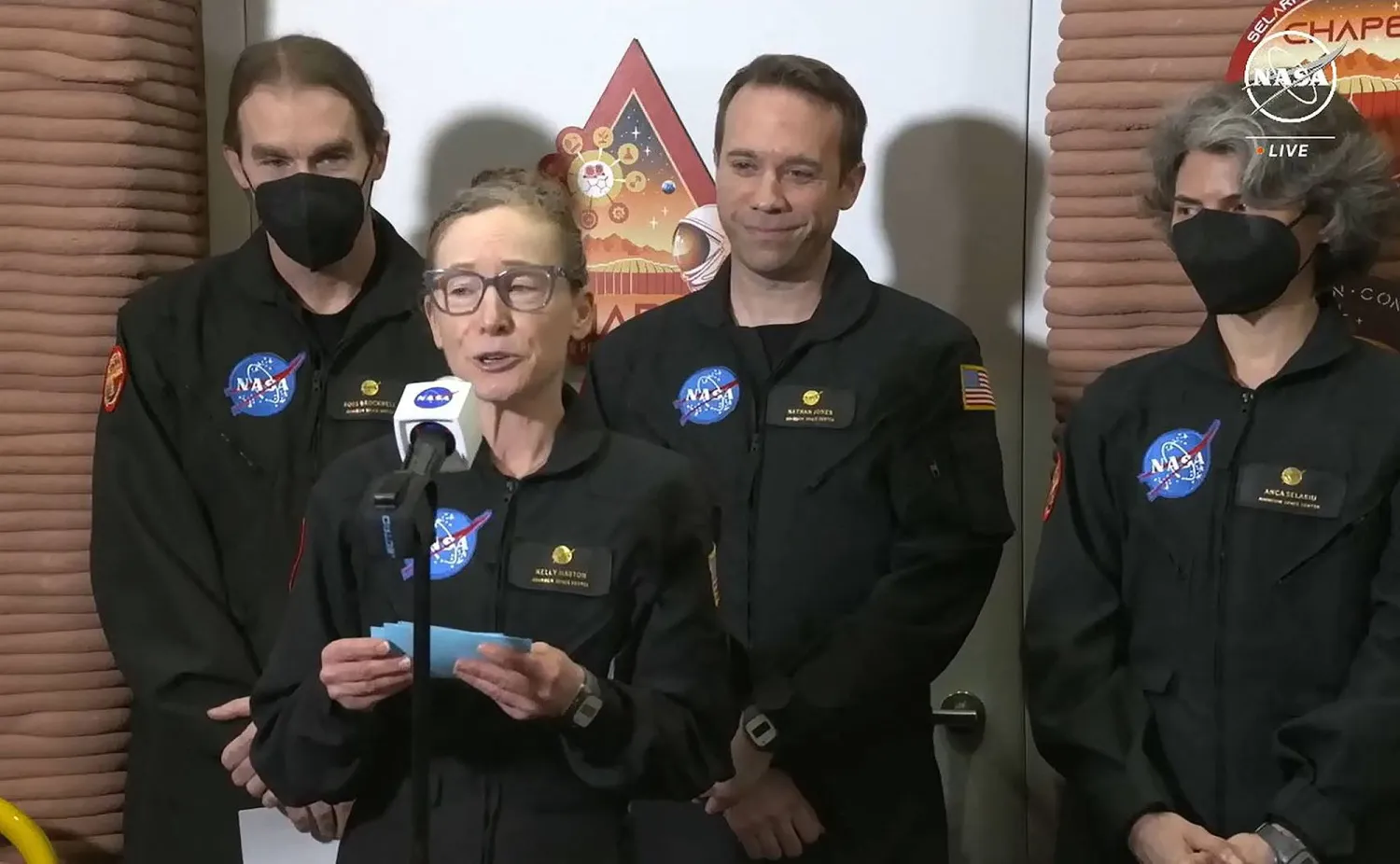
In this still image taken from a July 6, 2024, NASA TV broadcast, volunteer crew commander Kelly Haston speaks alongside crewmates (L-R) Ross Brockwell, Nathan Jones and Anca Selariu, as they exit the first simulated yearlong Mars habitat mission at Johnson Space Center in Houston, Texas. (Photo by Jose ROMERO / NASA TV / AFP)
TT

Crew of NASA's Earthbound Simulated Mars Habitat Emerge after a Year

In this still image taken from a July 6, 2024, NASA TV broadcast, volunteer crew commander Kelly Haston speaks alongside crewmates (L-R) Ross Brockwell, Nathan Jones and Anca Selariu, as they exit the first simulated yearlong Mars habitat mission at Johnson Space Center in Houston, Texas. (Photo by Jose ROMERO / NASA TV / AFP)

The crew of a NASA mission to Mars emerged from their craft after a yearlong voyage that never left Earth.
The four volunteer crew members spent more than 12 months inside NASA's first simulated Mars environment at Johnson Space Center in Houston, coming out of the artificial alien environment Saturday around 5 p.m, The Associated Press reported.
Kelly Haston, Anca Selariu, Ross Brockwell and Nathan Jones entered the 3D-printed habitat on June 25, 2023, as the maiden crew of the space agency's Crew Health and Performance Exploration Analog project.
Haston, the mission commander, began with a simple, “Hello.”
“It’s actually just so wonderful to be able to say ‘hello’ to you all,” she said.
Jones, a physician and the mission medical officer, said their 378 days in confinement “went by quickly.”
The quartet lived and worked inside the space of 17,000 square feet (1,579 square meters) to simulate a mission to the red planet, the fourth from the sun and a frequent focus of discussion among scientists and sci-fi fans alike concerning a possible voyage taking humans beyond our moon.
The first CHAPEA crew focused on establishing possible conditions for future Mars operations through simulated spacewalks, dubbed “Marswalks,” as well as growing and harvesting vegetables to supplement their provisions and maintaining the habitat and their equipment.
They also worked through challenges a real Mars crew would be expected to experience including limited resources, isolation and delays in communication of up to 22 minutes with their home planet on the other side of the habitat's walls, NASA said.
Two additional CHAPEA missions are planned and crews will continue conducting simulated spacewalks and gathering data on factors related to physical and behavioral health and performance, NASA said.
Steve Koerner, deputy director of Johnson Space Center, said most of the first crew's experimentation focused on nutrition and how that affected their performance. The work was “crucial science as we prepare to send people on to the red planet,” he said.
“They've been separated from their families, placed on a carefully prescribed meal plan and undergone a lot of observation,” Koerner said.
“Mars is our goal,” he said, calling the project an important step in America's intent to be a leader in the global space exploration effort.
Emerging after a knock on the habitat's door by Kjell Lindgren, an astronaut and the deputy director of flight operations, the four volunteers spoke of the gratitude they had for each other and those who waited patiently outside, as well as lessons learned about a prospective manned mission to Mars and life on Earth.
Brockwell, the crew's flight engineer, said the mission showed him the importance of living sustainably for the benefit of everyone on Earth.
“I’m very grateful to have had this incredible opportunity to live for a year within the spirit of planetary adventure towards an exciting future, and I’m grateful for the chance to live the idea that we must utilize resources no faster than they can be replenished and produce waste no faster than they can be processed back into resources," Brockwell said.
“We cannot live, dream, create or explore on any significant timeframe if we don’t live these principles, but if we do, we can achieve and sustain amazing and inspiring things like exploring other worlds," he said.
Science officer Anca Selariu said she had been asked many times why there is a fixation on Mars.
“Why go to Mars? Because it’s possible,” she said. "Because space can unite and bring out the best in us. Because it’s one defining step that ‘Earthlings’ will take to light the way into the next centuries.”



PIF Forum Yields $16 Bn in MoUs

Raid Ismail, head of direct investments for the Middle East and North Africa at the Public Investment Fund, speaks during a session (X)
TT

PIF Forum Yields $16 Bn in MoUs

Raid Ismail, head of direct investments for the Middle East and North Africa at the Public Investment Fund, speaks during a session (X)

Saudi Arabia’s Public Investment Fund (PIF) closed the fourth edition of its Private Sector Forum with a slate of deals that underscored its growing pull with investors, announcing the signing of more than 135 memorandums of understanding worth over 60 billion riyals (about $16 billion).

The agreements reflect rising confidence in the Saudi business climate and the fund’s ability to generate high-quality investment opportunities that attract both local and foreign capital.

The forum’s final day opened with a discussion on flexibility, risk reduction, and innovative financing, focusing on how to turn strategies into bankable projects and investment opportunities that can draw in the private sector and deepen its role in the economy.

Speakers highlighted the fund’s central role in enabling and developing strategic sectors, investing in large-scale projects that help create a more attractive business environment.

These efforts aim to strengthen participation by the domestic private sector, including small and medium-sized enterprises, while also drawing foreign investment.

In a session on the Saudi sovereign approach to value creation, Raid Ismail, head of direct investments for the Middle East and North Africa at PIF, outlined the “Fund Way” methodology launched in 2019 to boost economic value across portfolio companies.

The approach is built on independent governance and a clear operating framework.

Ismail said the fund remains focused on delivering economic and social impact and sustainable growth across all its investments.

He traced PIF’s investment journey, from selecting priority sectors and forming partnerships with the private sector, to establishing companies, strengthening their governance and operational efficiency, and ultimately exiting investments.

Artificial intelligence featured prominently in the discussions. Tareq Amin, chief executive of Humain, said the company’s approach to AI applications is rooted in rethinking how problems are solved and how organizations prepare for the future.

He noted that Saudi Arabia has strong AI infrastructure, suitable human capital, and ample energy resources, and highlighted the generative AI operating systems and applications the company is developing.

Another panel focused on local content and its impact on the private sector, stressing the importance of building high-quality local content to support a strong national economy, accelerate diversification, and sustain growth.

The discussion also highlighted Saudi Arabia’s efforts to develop policies and regulations that encourage higher local content.

Panelists said increasing local content helps raise the private sector’s contribution to gross domestic product, reduce reliance on foreign supply chains, develop national industries and products, improve competitiveness, expand into new markets, and create jobs.

The session also highlighted PIF’s role in boosting local content through a range of programs and initiatives, including the Musahama local content development program, contractor financing, the industrial accelerator, supplier development, the private sector platform, and the Musahama design competition.

Spending by the fund and its portfolio companies on local content exceeded 590 billion riyals between 2020 and 2024.

Financing solutions were another key theme, with discussions on how to develop funding tools aligned with Saudi Arabia’s economic growth and ensure access to finance for large projects, small and medium-sized enterprises, and entrepreneurs.

Over the past five years, PIF has helped unlock priority strategic sectors across the kingdom.

It invested about 750 billion riyals domestically in new projects between 2021 and 2025. It contributed a cumulative 910 billion riyals ($242.6 billion) to Saudi Arabia’s real non-oil GDP between 2021 and 2024, accounting for around 10% of non-oil GDP in 2024.

The fourth edition of the forum builds on the momentum of previous years. Attendance has tripled since 2023, rising from 4,000 participants to 12,000 in 2025, while the number of exhibition booths by PIF portfolio companies more than doubled to over 100.


Iraq Seeks Saudi Firm List to Streamline Iraqi Exports

Jadidat Arar border crossing, the logistics gateway between Saudi Arabia and Iraq (SPA)
TT

Iraq Seeks Saudi Firm List to Streamline Iraqi Exports

Jadidat Arar border crossing, the logistics gateway between Saudi Arabia and Iraq (SPA)

The Iraqi government is moving to tighten the framework for exporting its goods to Saudi Arabia by compiling a list of Saudi companies interested in importing Iraqi products, a step aimed at streamlining trade procedures and boosting shipments to the kingdom.

The list will be circulated to all relevant Iraqi authorities and used as a reference in the export process, according to the information.

Trade between the two countries remains heavily tilted in Saudi Arabia’s favor. In 2024, Saudi exports to Iraq reached 6.5 billion riyals ($1.7 billion), while imports from Iraq totaled 180.4 million riyals ($48.1 million), resulting in a trade surplus of 6.3 billion riyals ($1.6 billion).

Saudi Arabia’s General Authority for Foreign Trade has informed the Saudi private sector of a request from Iraqi authorities to provide a list of companies willing to import goods from Iraq.

Push to raise Iraqi exports

The Iraqi government has also asked for details on Saudi market requirements and standards, seeking clarity that would allow it to set specifications for products, goods, and services and, in turn, increase its exports to the kingdom.

Fuel products, oils, and mineral waxes accounted for the largest share of Iraqi exports to Saudi Arabia at 49.1%. Aluminum and aluminum products accounted for 32.7%, while pulp from wood or other fibrous cellulosic materials accounted for 7.3%. The remaining share was spread across other goods and services.

Overall trade between Saudi Arabia and Iraq continues to expand in both volume and diversity, with Saudi exports clearly dominant. Both sides have stepped up efforts to ease trade flows and improve infrastructure to support more sustainable growth.

Border bottleneck eased

As part of its efforts to smooth access for Saudi products to regional markets, the General Authority for Foreign Trade recently stepped in to resolve a technical and logistical issue that had been hampering Saudi exporters at the Jadidat Arar border crossing with Iraq.

The intervention was aimed at safeguarding export flows through the only land route linking the two countries, which has grown in importance after an 81.3% rise in truck traffic in the first half of 2024.

The authority resolved a dispute over the Iraqi side’s refusal to accept electronic authentication of documents, reaffirming its commitment to strengthening trade ties with Baghdad.

The issue had been flagged as a recurring obstacle for Saudi companies exporting to Iraq via the crossing, prompting swift action by the authority to clear the backlog and ease private sector access to the Iraqi market.

Strategic gateway

Opened in 2020, the Jadidat Arar crossing is the sole economic and logistics gateway between Saudi Arabia and Iraq. It has played a key role in cutting export costs by 15% and reducing shipping times to less than 48 hours.

The Arar Chamber of Commerce said in a recent statistical report that total truck movements, arrivals, and departures combined reached about 33,300 in the first half of 2024.

By comparison, the number of trucks stood at about 4,084 in the first half of 2021, rose to 12,954 in the same period of 2022, and increased further to 18,729 in the first half of 2023.


US Response Muted on New Israeli West Bank Measures

Israeli machinery levels land ahead of settlement construction near Jenin in the occupied West Bank, Dec. 23, 2025 (EPA)
TT

US Response Muted on New Israeli West Bank Measures

Israeli machinery levels land ahead of settlement construction near Jenin in the occupied West Bank, Dec. 23, 2025 (EPA)

Days ahead of Israeli Prime Minister Benjamin Netanyahu’s visit to Washington, his government moved on measures framed as procedural but laden with far-reaching sovereign implications.

Decisions by Israel’s security cabinet have made it easier for Israelis to purchase land in the West Bank and expanded Israeli enforcement tools in areas formally administered by the Palestinian Authority under the Oslo Accords.

A White House official reiterated President Donald Trump’s opposition to annexing the West Bank, but Washington’s response stopped short of any concrete measures.

The position, attributed to an unnamed official and unaccompanied by deterrent action, prompted speculation that the US stance amounted to tacit acquiescence rather than active opposition.

On the eve of Netanyahu’s arrival, Reuters cited a White House source as saying Trump continues to oppose Israeli annexation of the West Bank and views “stability” there as consistent with the goals of peace and Israel’s security.

The manner in which the position was conveyed, however, left room for interpretation. The issue, analysts say, is less whether Washington rejects annexation in principle than whether it opposes the cumulative steps that could lead to it.

Israeli officials have framed the measures as administrative, but critics view them as part of a broader pattern aimed at gradually altering conditions in the West Bank. Such steps, they argue, create facts on the ground that are later treated as irreversible.

In this reading, formal opposition to annexation does not preclude policies that effectively advance it without an explicit declaration, a process some observers describe as incremental annexation.

Limited US response

Restricting the US reaction to an unattributed statement suggests an effort to balance competing priorities: signaling continuity in Washington’s stated position while avoiding a confrontation with Netanyahu ahead of his visit.

Diplomats note that this approach indicates US objections are being managed through messaging rather than through policy leverage.

Even when the US language is explicit, its impact is limited unless it is accompanied by political cost. Governments typically adjust behavior in response to incentives or penalties, not statements alone.

In this context, the absence of measures reduces the deterrent effect of US opposition, leaving Israel with room to maneuver.

The timing of the Israeli decisions sends parallel messages. Domestically, they signal continued commitment to policies favored by right-wing constituencies and settler groups. Internationally, they suggest that reversing on-the-ground changes is becoming increasingly complex.

The approach reflects a familiar strategy of establishing new realities ahead of any renewed political process.

The moves also highlight the influence of Finance Minister Bezalel Smotrich within the governing coalition and his stated objective of undermining the practical foundations of a Palestinian state, even if the concept remains part of official rhetoric.

Measures described as technical adjustments thus take on broader political significance.

Impact on the two-state framework

The West Bank remains central to any viable Palestinian state. Steps that weaken Palestinian administrative authority or alter control over land are therefore assessed primarily by their effect on the feasibility of statehood.

Critics argue the latest measures move in the opposite direction, further blurring the distinction between Israeli control and Palestinian self-governance.

From Washington’s perspective, the situation underscores a broader contradiction. An administration that has shown limited engagement with the international consensus on a two-state solution is, in practice, also narrowing the range of alternative outcomes.

As prospects for two states diminish, analysts warn that other scenarios become more likely, including prolonged security control or recurring instability, complicating the US's assertions that current policies promote stability.

Reports in the US press citing Arab and Islamic condemnation, as well as concern at the United Nations, indicate that the West Bank remains a sensitive issue for many governments, including those maintaining ties with Israel.

Any perception of US leniency risks weakening those partners’ positions domestically.

At the United Nations, repeated warnings from international bodies have reaffirmed legal frameworks that Israel views as restrictive, but which others consider essential to any settlement.

While this divide is longstanding, critics note that developments on the ground are advancing faster than diplomatic efforts to address them.

As Washington emphasizes the importance of stability in the West Bank, the debate increasingly centers on what that stability entails: a temporary calm sustained by existing realities, or one underpinned by a credible political horizon.

For now, analysts say, each new Israeli step is being viewed less as an isolated decision than as a test of the credibility of the US's stated opposition.