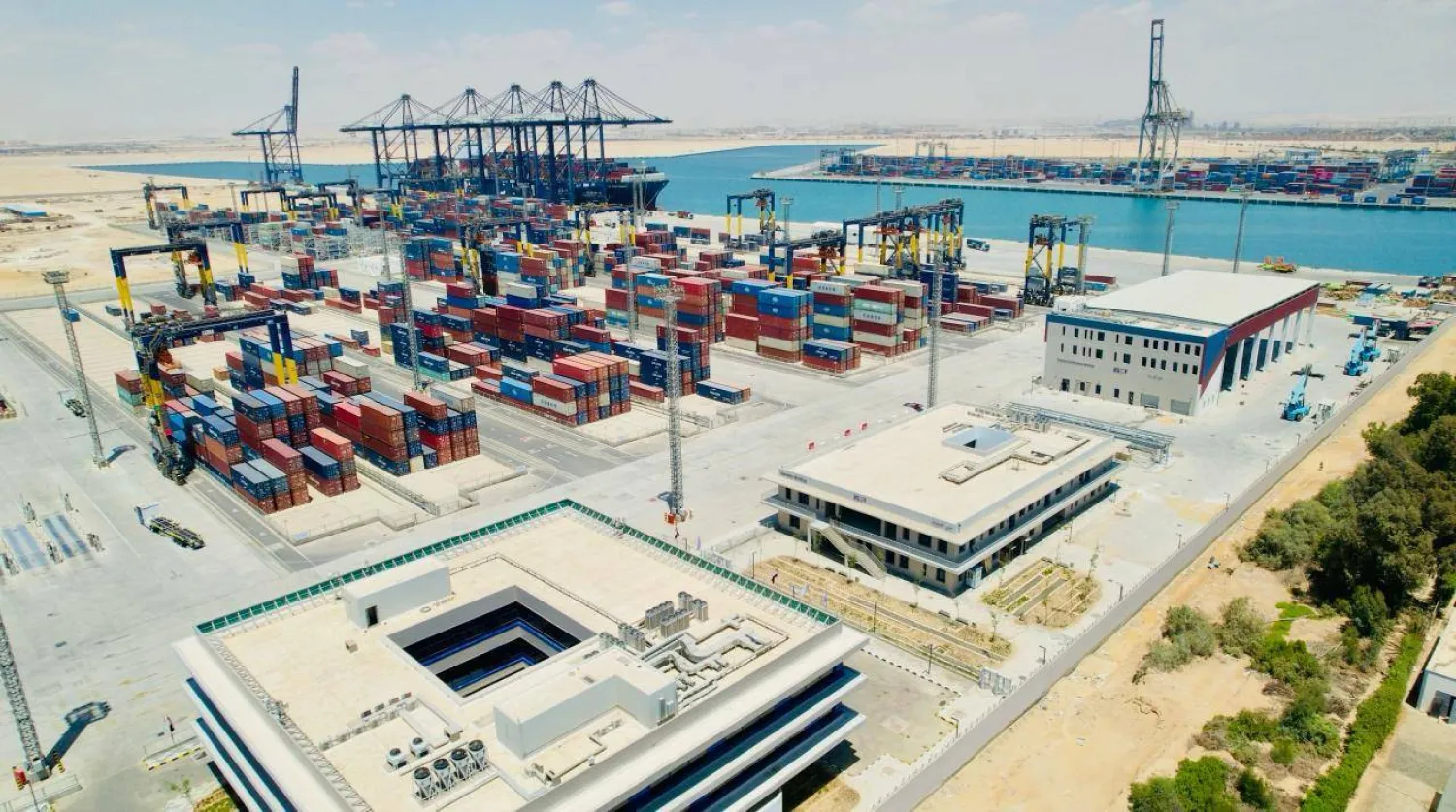
The Suez Canal may have incurred heavy losses due to regional tensions and instability in recent years — from the war in Gaza to the conflict involving Iran — those same disruptions have contributed to a significant surge in activity at Egyptian ports and in transit trade.
However, Egyptian economists said the strong increase in container traffic at the country’s ports is not enough to compensate for the canal’s losses.
They stressed that government initiatives, including efforts to expand transit trade, may only help reduce part of the revenue shortfall.
At the end of April, Egyptian President Abdel Fattah al-Sisi said Egypt had lost nearly $10 billion in Suez Canal revenues because of attacks on ships in the Bab el-Mandeb Strait.
Egyptian ports have experienced increased activity in recent months amid supply-chain disruptions linked to the Iran conflict. Maritime connections with regional countries have expanded, including the launch of the NEOM–Safaga multimodal logistics corridor linking Gulf Cooperation Council countries with Europe.
The Egyptian government has also reinforced trade links between the Gulf and Europe through the “Ro-Ro” shipping line connecting Damietta Port with Italy’s Port of Trieste to increase trade volumes.
In the energy sector, oil flows through Egypt’s SUMED pipeline rose following disruptions in global energy supply chains caused by the closure of the Strait of Hormuz.
Amr El-Samadouni, secretary-general of the International Transport and Logistics Division at the Cairo Chamber of Commerce, said the recent tensions in the Strait of Hormuz have “strengthened Egypt’s position as a regional hub for logistics services and supply-chain management.”
In a statement, El-Samadouni said the developments provide Egypt with “an important opportunity to offset part of the decline in Suez Canal revenues by attracting a share of urgent shipments that cannot tolerate long delays, especially in sectors linked to fast-moving trade and time-sensitive supply chains.”
According to a statement by Egypt’s Ministry of Transport on Thursday, the country’s port sector recorded a major increase in cargo and container handling. Egyptian ports handled 11.1 million twenty-foot equivalent units (TEUs) in 2025, compared with 8.9 million in 2024, representing growth of 24.3 percent.
Transit container traffic also increased sharply, reaching 6.7 million containers in 2025, a rise of 36 percent. The number of ships calling at Egyptian ports climbed to 17,288 voyages in 2025, up 6.6 percent, according to the ministry.
Egypt has an extensive network of seaports along both the Red Sea and the Mediterranean and is investing heavily in upgrades to strengthen its role in regional and international trade.
The Ministry of Transport said the modernization program aims to transform Egypt into a regional hub for transport, logistics, and transit trade while boosting the ports’ ability to attract investment and handle growing trade volumes.
Despite the improvements in port activity, “they cannot compensate for the losses of the Suez Canal,” said Walid Gaballah, a member of the Egyptian Association for Political Economy, Statistics and Legislation.
He noted that revenues from trade and container handling “may reduce the losses but cannot fully replace them,” adding that shipping traffic through the canal has yet to return to pre-Gaza war levels.
Gaballah told Asharq Al-Awsat that continued regional instability makes recovery in Suez Canal traffic increasingly difficult.
Egyptian economist Mostafa Badra also said there can be no direct comparison between canal revenues and port trade income. “There is no substitute for the canal as a major source of foreign currency,” he told Asharq Al-Awsat, noting that revenues generated by port trade remain far below the canal’s earnings under normal conditions.
Badra added that the government’s port-development strategy is intended to strengthen Egypt’s logistics capabilities and reinforce the Suez Canal’s role as a global trade corridor while primarily supporting domestic trade. By contrast, he said, the canal itself remains a vital artery in global supply chains.
Egypt recently rose three places in the UNCTAD Liner Shipping Connectivity Index, ranking 19th globally, first in Africa, and second in the Arab world, according to the Ministry of Transport.