Iranian Brothers Charged in Alleged Smuggling Operation that Led to Deaths of 2 Navy Seals

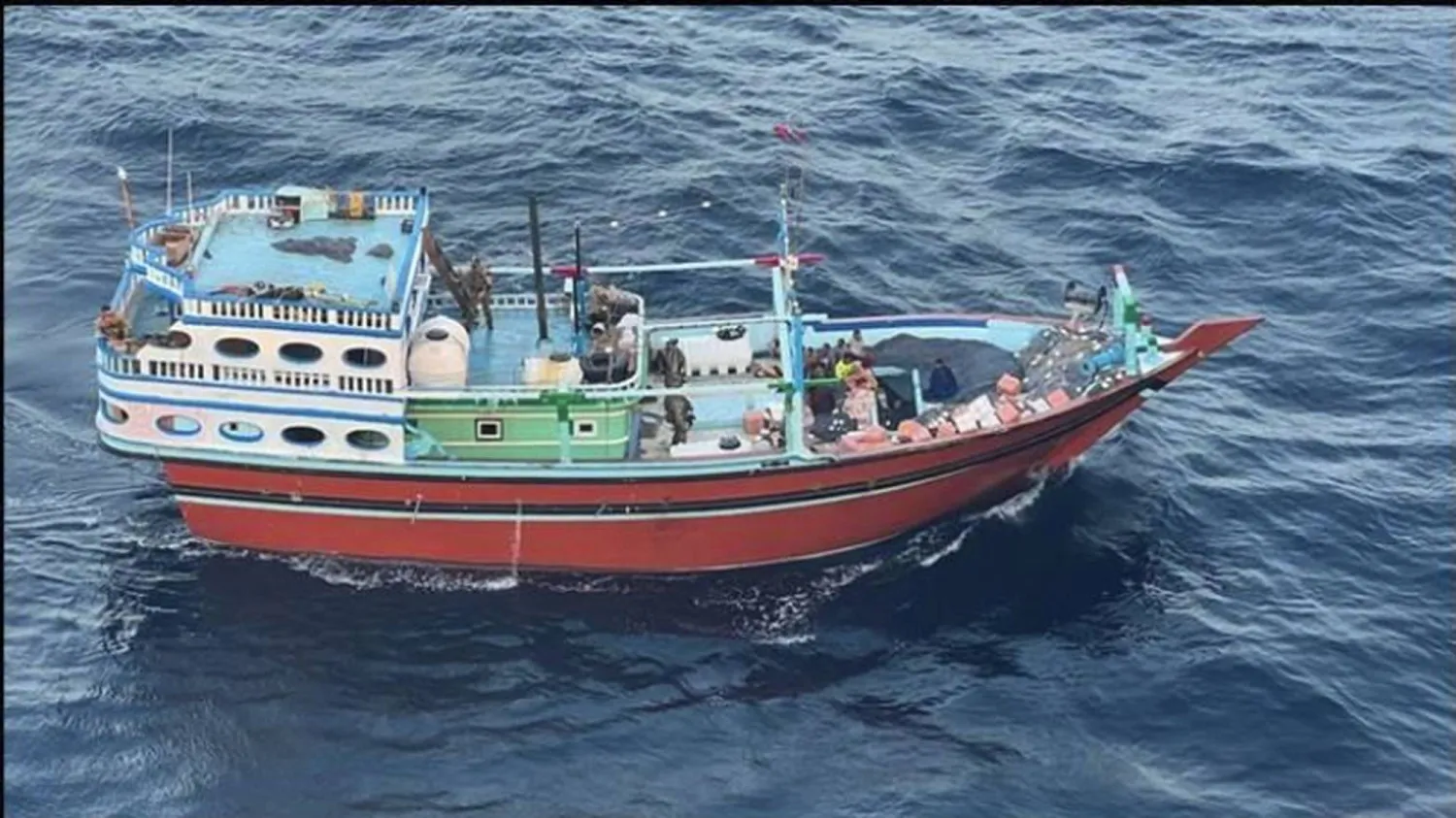
FILE - This undated image released by the US military's Central Command shows what it is described as the vessel in the Arabian Sea that carried Iranian-made missile components bound for Yemen's Houthi. (US Central Command via AP, File)
TT

Iranian Brothers Charged in Alleged Smuggling Operation that Led to Deaths of 2 Navy Seals

FILE - This undated image released by the US military's Central Command shows what it is described as the vessel in the Arabian Sea that carried Iranian-made missile components bound for Yemen's Houthi. (US Central Command via AP, File)

Two men linked to Iran’s Revolutionary Guard are now facing terrorism charges in the US in connection with the interception of a vessel in the Arabian Sea that resulted in the deaths of two Navy SEALs earlier this year.
The new indictment announced Thursday by federal prosecutors in Richmond, Virginia, charges two Iranian brothers, Shahab Mir’kazei and Yunus Mir’kazei, as well as a Pakistani boat captain, Muhammad Pahlawan, with providing material support to Iran’s weapons-of-mass-destruction program, among other charges, The Associated Press reported.
The brothers are at large. Pahlawan and three of his crew members have been in custody since the Navy SEAL team intercepted their small vessel, described as a dhow, in January.
While boarding the dhow, US officials say Navy Special Warfare Operator 1st Class Christopher J. Chambers fell overboard as high waves created a gap between the two boats.
As Chambers fell, Navy Special Warfare Operator 2nd Class Nathan Gage Ingram jumped in to try to save him, according to US officials familiar with what happened.
Both Chambers and Ingram were declared dead after an 11-day search failed to find either man.
The search of the dhow turned up a variety of Iranian-made weaponry, including cruise and ballistic missile components, according to court documents.
US officials say the dhow was part of an effort to supply weapons to Houthi militants in Yemen, and that Houthis have stepped up attacks on merchant ships and US military ships in the Red Sea and Gulf of Aden in the wake of the Israel-Hamas war.
The Houthis have been designated as a terrorist group by the State Department since February, according to the indictment. The Revolutionary Guard Corps has been designated a terrorist group by the State Department since 2019.
The new indictment contains additional details linking the dhow to Iran. It alleges the two brothers who work for the Revolutionary Guard Corps paid Pahlawan 1.7 billion rials — about $40,000 in US dollars — to carry out multiple smuggling operations from Iran to the Somali coast near Yemen.
The federal public defender's office, which was appointed to represent Pahlawan, declined comment Thursday. The two Iranians, who are not in custody, do not have attorneys listed. Arrest warrants for both brothers were issued Wednesday.



South Korea to Investigate Ship Debris from Hormuz Attack

 This undated handout photograph released by South Korea's Foreign Ministry on May 10, 2026, shows a damaged part of the South Korean cargo ship HMM Namu docked at a port in Dubai. (Handout / South Korean Foreign Ministry / AFP)
This undated handout photograph released by South Korea's Foreign Ministry on May 10, 2026, shows a damaged part of the South Korean cargo ship HMM Namu docked at a port in Dubai. (Handout / South Korean Foreign Ministry / AFP)
TT

South Korea to Investigate Ship Debris from Hormuz Attack

 This undated handout photograph released by South Korea's Foreign Ministry on May 10, 2026, shows a damaged part of the South Korean cargo ship HMM Namu docked at a port in Dubai. (Handout / South Korean Foreign Ministry / AFP)
This undated handout photograph released by South Korea's Foreign Ministry on May 10, 2026, shows a damaged part of the South Korean cargo ship HMM Namu docked at a port in Dubai. (Handout / South Korean Foreign Ministry / AFP)

Debris from a fire-damaged cargo ship said to have been attacked by unidentified aircraft in the Strait of Hormuz arrived in South Korea on Friday for investigation, the foreign ministry said.

Iran has largely blocked shipping through the vital strait since conflict broke out with the United States and Israel on February 28 and Washington blockaded Tehran's ports.

HMM Namu was struck by "two unidentified aircraft" on May 4, hitting the outer plate of the vessel's port-side ballast tank near the stern and causing a fire in the engine room, Seoul, a US ally, said at a press briefing on Sunday.

The Panama-flagged cargo vessel, operated by South Korean shipping firm HMM Co., had arrived in Dubai last week for investigation.

Its debris "arrived in South Korea by air following consultations with the UAE government" on Friday, Seoul's foreign ministry said in a statement.

The vessel debris is "scheduled to undergo detailed analysis by a specialized institution", it added without providing further detail.

Seoul said the aircraft involved in the attack "were captured on CCTV footage, but there are limitations in identifying the exact type, launch origin and physical size of the objects".

A senior government official told local media this week that the "likelihood that the (attacking) entity was someone other than Iran is low."

Tehran has denied responsibility, with its embassy in Seoul posting a statement on its website in the days following the attack, saying it "firmly rejects and categorically denies any allegations regarding the involvement" of its forces.

Seoul strongly condemned the attack and said it hopes to identify those behind it through a thorough investigation.

South Korea, Asia's fourth-largest economy, relies heavily on Middle Eastern fuel imports, most of which transited through the Strait of Hormuz during peacetime.

As a major petrochemicals producer and refiner, the closure has forced South Korea to impose a fuel price cap for the first time in nearly 30 years.


Ministers Adopt New Interpretation of Migrants’ Rights in European Legal System

Participants attend the opening session of the 135th Ministerial Session of the Committee of Ministers of the Council of Europe in Chisinau, Moldova, Friday, May 15, 2026. (AP)
TT

Ministers Adopt New Interpretation of Migrants’ Rights in European Legal System

Participants attend the opening session of the 135th Ministerial Session of the Committee of Ministers of the Council of Europe in Chisinau, Moldova, Friday, May 15, 2026. (AP)

European ministers adopted ‌a new interpretation of the European Convention on Human Rights on Friday that could facilitate some migrant deportations, including to third country "return hubs", but which critics say will weaken human rights protections.

The declaration comes amid complaints from member states in recent years that the European Court of Human Rights has prevented governments from forcibly removing foreign nationals convicted of crimes or refused asylum seekers.

The declaration adopted at the annual session of the Council of Europe's Committee of ministers in Moldova qualifies the rights under article 3 and article 8 of the convention, which relate to protection ‌from torture and ‌inhuman and degrading treatment and the right to ‌a ⁠private and family ⁠life.

It approves cooperation with third countries on immigration, including on "return hubs", provided that the countries respect the human rights convention.

It states that prohibition from torture and inhuman or degrading treatment is absolute, but that "the assessment of the minimum level of severity of the ill-treatment that constitutes inhuman or degrading treatment or punishment is relative and depends on all the circumstances ⁠of the case".

Veronika Fikfak, Professor of Human Rights ‌and International Law at University College London, ‌said that the declaration's interpretation of article 3 was a significant development and would ‌dilute protections from torture.

"It says (prohibition of torture and inhuman or ‌degrading treatment) is absolute, but then they use words to balance and offer a relative interpretation, but this is inconsistent with the heart of Article 3 - an absolute right cannot contain any element of relativity or balance," she said.

On ‌article 8, the declaration said states can expel foreign nationals in spite of their right to a ⁠private and ⁠family life so long as it is balanced with a legitimate aim, such as national security, and that the European Court of Human Rights would require "strong reasons" to override a state's decision.

The 46-member Council of Europe was set up after World War Two to uphold human rights and the rule of law.

Council of Europe Secretary General Alain Berset welcomed the declaration and said it would guide the work of the council and of national authorities and domestic courts.

"We have been able to bring together countries across Europe, with different views and experiences to agree a common position on how the system should work best, notably in the challenging context of migration," he said in a statement.


Araghchi Says Iran Has 'No Trust' in the US, Will Negotiate Only If it is Serious

Iranian Foreign Minister Abbas Araghchi arrives for a meeting during the two-day BRICS summit in New Delhi, India, Thursday, May 14, 2026. (AP Photo/Manish Swarup)
TT

Araghchi Says Iran Has 'No Trust' in the US, Will Negotiate Only If it is Serious

Iranian Foreign Minister Abbas Araghchi arrives for a meeting during the two-day BRICS summit in New Delhi, India, Thursday, May 14, 2026. (AP Photo/Manish Swarup)

Tehran ‌has "no trust" in the US and is interested in negotiating with Washington only if it is serious, Iran's Foreign Minister Abbas Araghchi said on Friday, as talks on ending the war remained on hold. All vessels can pass through the Strait of Hormuz except those at war with Tehran, Araghchi told reporters in New Delhi during a visit to attend the BRICS foreign ministers' ‌meeting, adding that vessels ‌wanting to transit should coordinate ‌with ⁠its navy. 

The situation ⁠around the key conduit was "very complicated", he said. 

Iran effectively shut the strait, which earlier handled about one-fifth of the world's oil and gas supply, to most shipping traffic after its war with the US and Israel erupted in February. 

Washington and ⁠Tehran announced a ceasefire last month ‌but have been struggling ‌to thrash out a permanent peace pact. Talks, mediated by ‌Pakistan, have been suspended since Iran and the ‌US each rejected the other's most recent proposals last week. 

"Contradictory messages" have made us reluctant about the real intention of the Americans on negotiations, Araghchi said, adding ‌that the mediation process by Pakistan has not failed but is in "difficulty". 

Iran is ⁠trying ⁠to keep the ceasefire to give diplomacy a chance but is also prepared to go back to fighting, he said. 

The issues holding up negotiations between the two sides include Iran's nuclear ambitions and its control of the Hormuz. Araghchi’s statement on Friday came hours after US President Donald Trump said his patience with Iran was running out and agreed in talks with Chinese President Xi Jinping that Tehran must reopen the strait.