Israel’s Western Allies Slam Israeli Minister’s Remark That Gaza Starvation May Be Justifiedhttps://english.aawsat.com/arab-world/5048920-israel%E2%80%99s-western-allies-slam-israeli-minister%E2%80%99s-remark-gaza-starvation-may-be
Israel’s Western Allies Slam Israeli Minister’s Remark That Gaza Starvation May Be Justified
Displaced Palestinian children look on, as displaced Palestinians flee the eastern part of Khan Younis following an Israeli army evacuation order, amid the Israel-Hamas conflict, in Khan Younis in the southern Gaza Strip August 8, 2024. (Reuters)
TT
TT
Israel’s Western Allies Slam Israeli Minister’s Remark That Gaza Starvation May Be Justified
Displaced Palestinian children look on, as displaced Palestinians flee the eastern part of Khan Younis following an Israeli army evacuation order, amid the Israel-Hamas conflict, in Khan Younis in the southern Gaza Strip August 8, 2024. (Reuters)
Israel's Western allies have condemned remarks by the country's far-right finance minister who suggested that the starvation of Gaza's population of more than 2 million Palestinians "might be just and moral" until hostages captured in Hamas' Oct. 7 attack on southern Israel are returned home.
Finance Minister Bezalel Smotrich said in a speech on Monday that Israel had no choice but to send humanitarian aid into Gaza.
"It’s not possible in today’s global reality to manage a war — no one will allow us to starve 2 million people, even though that might be just and moral until they return the hostages," he said at a conference in support of Jewish settlements.
Smotrich, a key partner in Prime Minister Benjamin Netanyahu's governing coalition, supports the reoccupation of Gaza, the rebuilding of Jewish settlements that were removed in 2005, and what he describes as the voluntary migration of large numbers of Palestinians out of the territory.
The European Union on Wednesday condemned his remarks, noting that the "deliberate starvation of civilians is a war crime."
EU foreign policy chief Josep Borrell called the remarks "beyond ignominious," saying "it demonstrates, once again, his contempt for international law and for basic principles of humanity."
David Lammy, Britain's new foreign secretary, said "there can be no justification for Minister Smotrich’s remarks."
"We expect the wider Israeli government to retract and condemn them," he wrote on the social media platform X.
Germany's ambassador to Israel, Steffen Siebert, called the remarks "unacceptable and appalling."
"It is a principle of international law and of humanity to protect civilians in a war and to give them access to water and food," he wrote on X.
Egypt's foreign ministry on Thursday also condemned Smotrich's remarks, describing them as "shameful statements unacceptable in form and substance" and a violation of international humanitarian law. Such "irresponsible statements" create incitement against Palestinians in the Gaza Strip, the ministry added.
The ongoing war sparked by Hamas' attack has plunged Gaza into a humanitarian catastrophe. The vast majority of its population has been displaced within the blockaded territory, often multiple times, and hundreds of thousands are packed into squalid tent camps.
The leading international authority on the severity of hunger crises, the Integrated Food Security Phase Classification, said in June that Gaza was at "high risk" of famine.
Aid organizations say efforts to deliver food and other assistance have been hindered by Israeli restrictions, ongoing fighting and the breakdown of law and order. Israel says it allows unlimited humanitarian aid to enter and blames UN agencies for failing to promptly deliver it.
Hamas-led fighters killed about 1,200 people in the surprise attack into Israel that triggered the war and took around 250 hostages. Some 110 hostages are still being held in Gaza, though Israel believes that about a third of them are dead. Most of the rest were released during a weeklong November cease-fire.
Israel's ongoing offensive has killed nearly 40,000 Palestinians, according to Gaza's Health Ministry, and has caused widespread devastation.
US Forces Killed ISIS Leader in Syria Airstrike, Central Command Sayshttps://english.aawsat.com/arab-world/5288022-us-forces-killed-isis-leader-syria-airstrike-central-command-says
A still from a video released by US Central Command on Friday showing US Air Force F-16 fighter jets refueling mid-air during a patrol mission over the Middle East (CENTCOM)
US Forces Killed ISIS Leader in Syria Airstrike, Central Command Says
A still from a video released by US Central Command on Friday showing US Air Force F-16 fighter jets refueling mid-air during a patrol mission over the Middle East (CENTCOM)
The US military conducted an airstrike in northwestern Syria last week that killed a senior ISIS leader, US Central Command said on Wednesday.
The strike, carried out on Friday, was part "of ongoing US efforts to disrupt and eliminate terrorists seeking to attack Americans abroad or the US homeland" and killed Ali Husayn al-Ulaywi, it said in a statement on X.
ISIS has declared a new phase of operations in Syria against the government of President Ahmed al-Sharaa, carrying out a spate of attacks since February. Last year, Sharaa's government joined the US-led coalition fighting ISIS.
On Saturday, the militant group claimed responsibility for an attack near the city of Manbij in Syria's northeastern Aleppo province.
ISIS controlled around a quarter or more of Syria at the peak of its power during the Syrian civil war a decade ago, before being driven out of the territory by a US-led coalition and other foes.
Barrack Pushes Baghdad and Erbil Toward Oil Dispute Settlementhttps://english.aawsat.com/arab-world/5288002-barrack-pushes-baghdad-and-erbil-toward-oil-dispute-settlement
Barrack Pushes Baghdad and Erbil Toward Oil Dispute Settlement
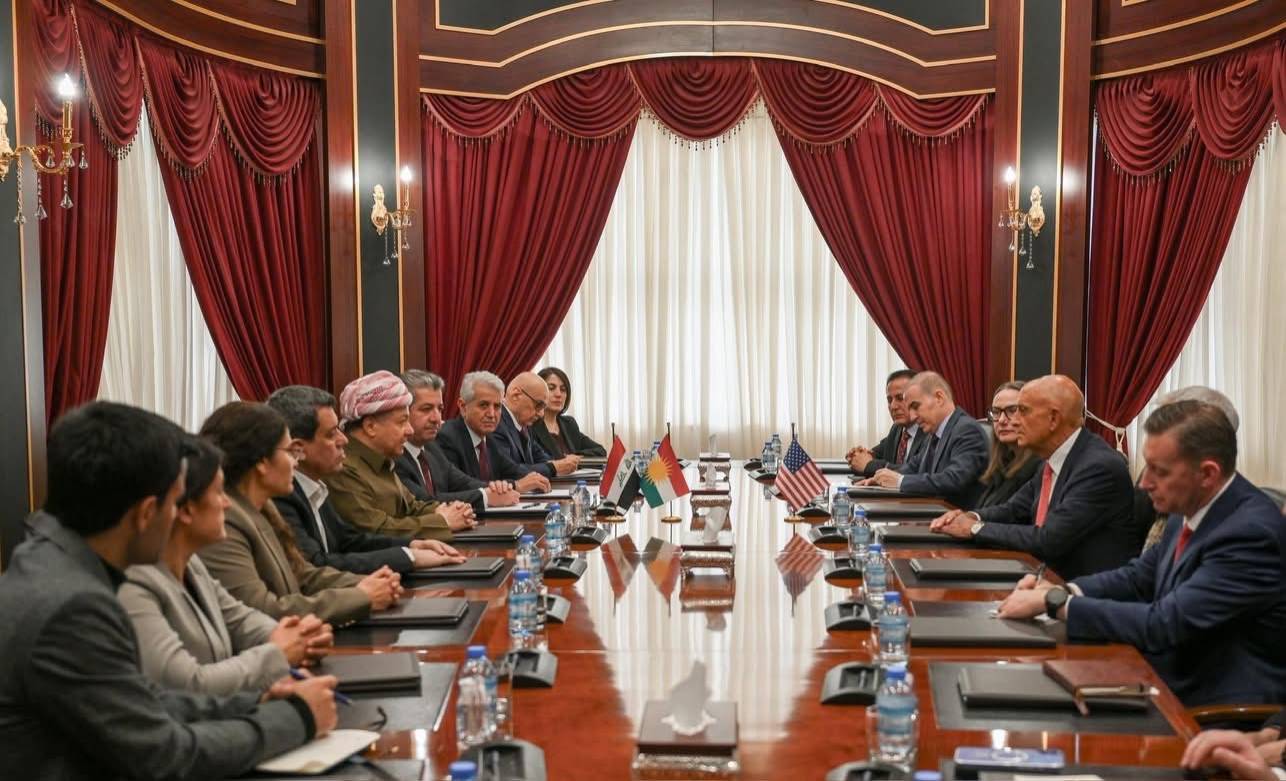
Kurdistan Region Prime Minister Masrour Barzani receives US envoy Tom Barrack in Erbil on June 16, 2026 (Government Media)
Kurdish politicians say US envoy Tom Barrack discussed possible ways to resolve the long-running oil dispute with Baghdad during his visit to Erbil, the capital of Iraq's Kurdistan Region, last week. However, they ruled out the possibility that the country's severe financial crisis would lead to the passage of a permanent federal law regulating natural resources.
Since March 2007, when the federal government led by Nouri al-Maliki submitted the first draft of the legislation, successive parliamentary terms have failed to pass a law that was intended to define how natural resources are produced and revenues distributed. Instead, political forces have relied on fragile political understandings to manage the issue.
Discussion over the law resurfaced following Barrack's visit to Erbil on June 16, 2026, during which he held meetings with regional government officials and leaders of the two main Kurdish parties. Local platforms circulated reports suggesting that the US envoy was "optimistic about Prime Minister Ali Al-Zaidi's ability to resolve the traditional disputes with Erbil."
Former Kurdish member of the Iraqi parliament Majid Shankali told Asharq Al-Awsat that Barrack discussed strengthening US-Iraqi cooperation in the energy sector, both with Baghdad and Erbil, as well as modernizing the Kirkuk-Baniyas pipeline, through which Iraqi oil is transported to Syria and onward to the Mediterranean
Former lawmaker Mayada Al-Najjar said the oil dispute between Baghdad and Erbil has moved "from a stage of stagnation to one of serious negotiations."
Speaking to Asharq Al-Awsat, Al-Najjar said that "communications between Baghdad and Erbil have gained clear momentum in recent weeks, with exchanges of visits and meetings among senior officials focused on resuming oil exports, settling financial issues, and preparing the ground for the passage of an oil and gas law."
What Is the Root of the Dispute?
Observers tend to believe that political disagreements have always been the primary obstacle to passing the law. At the same time, disputes over the interpretation of constitutional provisions, including the powers of the Kurdistan Region, have remained unresolved in most political settlements.
The dispute continues over whether the Kurdistan Region has the right to contract directly with foreign companies and pursue independent oil projects, or whether the federal government is the sole authority empowered to do so under the constitution and existing laws. Sharp differences also persist regarding discovered oil fields and the nature of contracts signed, whether under service agreements or production-sharing arrangements.
The Kurdistan Region attempted to address the legal vacuumwhen its parliament passed a regional oil and gas law in August 2007. However, Iraq's Federal Supreme Court effectively nullified the legislation when it issued a ruling in February 2022 challenging its legal basis.
"There is no hope in the foreseeable future of passing an oil and gas law," Shankali said, citing "Baghdad's strong tendency to consolidate full centralized control over the region's oil resources."
Shankali, a member of the Kurdistan Democratic Party, said Prime Minister Ali Al-Zaidi "will not be able to pass an oil and gas law through the Iraqi parliament without an agreement among the political blocs represented in parliament." He expressed regret that "the current parliament has yet to reach a formula acceptable to Erbil, Baghdad, and the oil-producing provinces that would allow the law to be passed and finally end disputes that have persisted for more than 20 years."
He predicted that political forces would continue "managing the crisis, as before, through temporary agreements between the federal government and the regional government." That would mean maintaining the latest arrangement that led to the adoption of the three-year federal budget law during the government of Mohammed Shia Al-Sudani.
In June 2023, political forces in Baghdad, led by the Coordination Framework and the Kurdistan Democratic Party, agreed on a financial settlement under which the Kurdistan Region would deliver 250,000 barrels of oil per day after deducting the region's share for domestic consumption. The agreement also allowed Kirkuk crude to be transported through the Kurdistan pipeline to Türkiye's Ceyhan port, in exchange for the federal government's commitment to pay the region's share of the state budget.
"In the coming phase, this agreement could be further developed between Baghdad and Erbil, given all sides' desire to confront the severe financial crisis," Shankali said.
Masoud Barzani, with Mazloum Abdi beside him, during talks with US envoy Tom Barrack in Erbil (File photo: Kurdistan Democratic Party)
Positive Signs
Sobhi Al-Mandalawi, a member of the Kurdistan Democratic Party, pointed to what he described as "positive indicators" since Al-Zaidi assumed office as prime minister.
Speaking to Asharq Al-Awsat, Al-Mandalawi said that "the new Iraqi government moved early in its tenure to engage positively with the national and domestic environment, including contentious issues such as relations with Erbil." He added that "the Kurdistan Regional Government, led by Masrour Barzani, views these indicators positively."
However, Al-Mandalawi suggested that efforts to resolve disputes between the two governments may gather momentum under pressure from the international community, particularly the United States.
He stressed that the Kurdistan Democratic Party has consistently partnered with every new government in Baghdad in seeking the passage of an oil and gas law. Although he hopes the legislation can be approved during the current parliamentary term, he argued that "the same political forces that opposed a legislative settlement in the past will continue to use every means available to prevent the law from being passed."
Former lawmaker Mayada Al-Najjar said there are "encouraging signs" that the disputes could be resolved, reflected in growing cooperation between the two sides in both security and economic coordination.
In mid-June 2026, an Iraqi military delegation headed by Army Chief of Staff Lt. Gen. Abdul Amir Rashid Yarallah conducted meetings and field visits in Erbil, including inspections of several oil fields, to assess security conditions and discuss measures aimed at protecting facilities and personnel.
Despite political indicators suggesting Baghdad and Erbil are moving closer to resolving the oil dispute, Al-Najjar said any definitive progress should be measured by an official announcement of a final or comprehensive agreement between Kurdistan Democratic Party leader Masoud Barzani and Prime Minister Ali Al-Zaidi that would fully settle the oil and gas crisis.
Iran’s Top Diplomat Speaks with Hamashttps://english.aawsat.com/arab-world/5287894-iran%E2%80%99s-top-diplomat-speaks-hamas
Iran's Foreign Minister Abbas Araghchi arrives for a bilateral meeting with Switzerland's counterpart at the Burgenstock luxury hotel complex overlooking Lake Lucerne, Switzerland, on June 21, 2026, ahead of high-level talks aimed at advancing a deal to end the Middle East conflict. (AFP)
TT
TT
Iran’s Top Diplomat Speaks with Hamas
Iran's Foreign Minister Abbas Araghchi arrives for a bilateral meeting with Switzerland's counterpart at the Burgenstock luxury hotel complex overlooking Lake Lucerne, Switzerland, on June 21, 2026, ahead of high-level talks aimed at advancing a deal to end the Middle East conflict. (AFP)
Iran's top diplomat spoke with a senior official from the Palestinian group Hamas regarding talks between Iran and the United States, state television reported on Wednesday.
Abbas Araghchi discussed the "latest developments" in the region with Basem Naeem, a member of Hamas's political bureau, Iranian television said.
The call follows the signing last week of a memorandum of understanding between Iran and the United States aimed at bringing a lasting end to hostilities in the Middle East.
The text does not mention Gaza but stipulates "an immediate and permanent cessation of military operations on all fronts, including in Lebanon".
Hamas has welcomed the agreement and expressed hope that it would also help end the violence in the Gaza Strip, which has been devastated by over two years of war with Israel.
Iran is a staunch supporter of the Palestinian cause, making it a cornerstone of its foreign policy since the 1979 revolution.
During the call, Araghchi "reaffirmed Iran's continued support for Palestinians and their just cause until their legitimate national rights are fully realized", according to a transcript reported by Iranian television.
On Tuesday, the Iranian foreign minister accompanied President Masoud Pezeshkian on a visit to neighboring Pakistan, which has been acting as a mediator in the talks between Tehran and Washington.
لم تشترك بعد
انشئ حساباً خاصاً بك لتحصل على أخبار مخصصة لك ولتتمتع بخاصية حفظ المقالات وتتلقى نشراتنا البريدية المتنوعة