Turkish Gold Demand Lifts Italian Jewellery Exports as Leather Goods Suffer

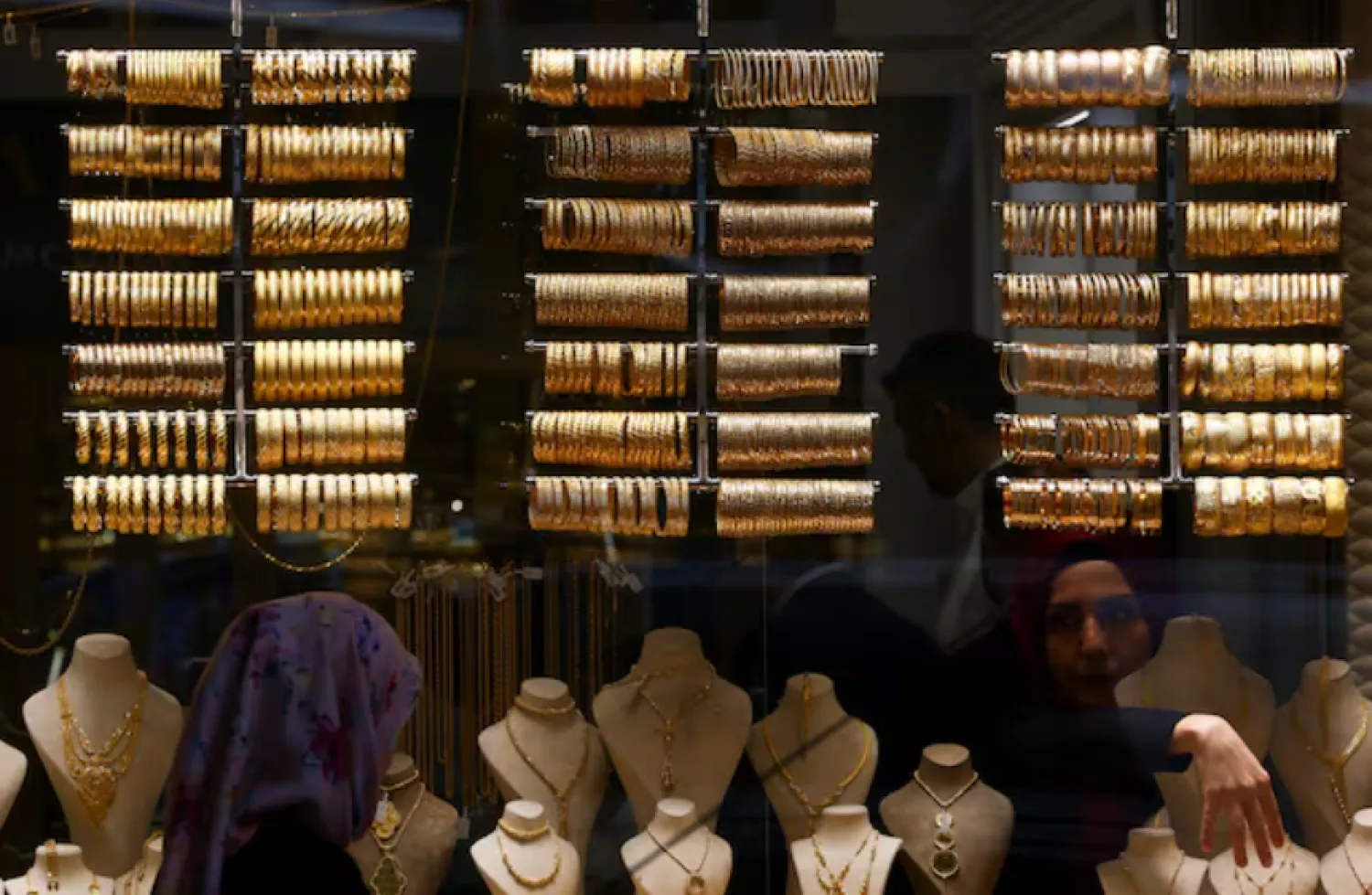
A person passes by a gold shop in Ankara, Türkiye May 29, 2023. REUTERS/Yves Herman/File Photo Purchase Licensing Rights
TT

Turkish Gold Demand Lifts Italian Jewellery Exports as Leather Goods Suffer

A person passes by a gold shop in Ankara, Türkiye May 29, 2023. REUTERS/Yves Herman/File Photo Purchase Licensing Rights

A surge in demand for gold from inflation-stricken Türkiye boosted exports of jewellery from Italy's industrial district of Arezzo in Tuscany, data showed on Monday, offsetting a drop in leather goods sales from the nearby Florence area.

Demand from Türkiye, where inflation was running at 61.8% in July, drove jewellery exports from the Arezzo area up 133% in the first quarter of the year versus 2023, an Intesa Sanpaolo report on Italy's industrial districts showed.

Exports from the other two Italian jewellery districts, the northeastern Vicenza area and Valenza Po, in Piedmont, also rose.

Gold is considered a hedge against higher inflation and a safe store of value in times of uncertainty, Reuters reported.

Exports from the Arezzo jewellery district totalled 1.8 billion euros ($2 billion) in the first quarter, from 800 million a year before, Intesa said.

That is welcome news for the Tuscan economy, which has been hit hard by the global slowdown in luxury goods demand, with exports of leather goods from the Florence district down 23% in the first quarter to 1.35 billion euros.

Tuscany is home to hundreds of small suppliers of the luxury goods industry and a cooling in demand led by China, which has dealt a blow to brands like Kering's Gucci, prompted companies to put thousands of local workers on furlough.

"Districts that supply the fashion industry have suffered from a drop in consumer spending, but also a normalisation of stock levels after two years of strong increase, and the reorganisation of logistics by distributors," the report said.

Meanwhile, Tuscan olive oil exports jumped 72% year-on-year to 382 million euros in the first quarter.

Overall, exports from Italy's industrial districts - small hyper-specialised production areas - fell 1.1%, Intesa said, adding slowing world trade had been driving a decline since spring 2023 - though from high levels.

The districts' exports hit a record high in 2022 above 150 billion euros and remained broadly stable in 2023. Exports are above pre-pandemic levels by nearly 20% overall.

The only exception are intermediate goods exports in the fashion industry which are 10% lower than in the first quarter of 2019.


Saudi Industry Minister Discusses Automotive Manufacturing Cooperation with China's BYD

The Saudi and Chinese delegations meet in Riyadh on Tuesday. (SPA)
TT

Saudi Industry Minister Discusses Automotive Manufacturing Cooperation with China's BYD

The Saudi and Chinese delegations meet in Riyadh on Tuesday. (SPA)

Saudi Minister of Industry and Mineral Resources Bandar Alkhorayef held talks in Riyadh on Tuesday with Chinese company BYD Founder and Chairman Wang Chuanfu to discuss cooperation in automotive manufacturing and the transfer of advanced vehicle technologies to the Kingdom.

They explored ways to strengthen industrial cooperation and expand promising investment opportunities to localize the automotive industry in the Kingdom, with particular focus on electric vehicle manufacturing to meet growing domestic demand and reinforce Saudi Arabia’s position as a leading regional and global hub for automotive production.

Discussions tackled the incentives and enablers offered to investors in high-value industries, including the automotive sector, as well as the Kingdom’s significant investments in electric vehicle charging infrastructure.

The meeting highlighted the objectives of the comprehensive strategy for the mining and mineral industries, which emphasizes support for the electric vehicle ecosystem and the development of local supply chains for battery manufacturing and advanced materials.

These efforts help in localizing the automotive industry and advancing the goals of Saudi Vision 2030 to diversify the national economy.


International Mining Conference Opens in Riyadh on Tuesday 

People attend the fourth edition of the International Mining Conference in Riyadh. (SPA)
TT

International Mining Conference Opens in Riyadh on Tuesday 

People attend the fourth edition of the International Mining Conference in Riyadh. (SPA)

Under the patronage of Custodian of the Two Holy Mosques King Salman bin Abdulaziz Al Saud, the fifth edition of the International Mining Conference will open in Riyadh on Tuesday under the theme “Minerals: Meeting the Challenges of a New Era of Development.”

Around 200 exhibiting and sponsoring entities are expected to participate, paving the way for the signing of approximately 150 memoranda of understanding and strategic agreements.

Organized by the Ministry of Industry and Mineral Resources, the three-day conference aims to bring together governments, mining companies, financial institutions, and governmental and non-governmental organizations to strengthen global dialogue on the future of the minerals sector.

Strategic pillars

This year’s conference is built around three strategic pillars designed to transform challenges into regional and international opportunities. The first focuses on developing innovative financing models for infrastructure, enabling the activation of seven major mineral corridors in Africa and South America, with the potential for expansion to other regions.

The second pillar centers on capacity-building in mineral-producing countries through the establishment of a global network of centers of excellence specializing in geology, innovation, sustainability, workforce development, and regulatory frameworks.

The third pillar aims to boost transparency across manufacturing value chains through the launch of a pilot system for tracking mineral supply chains, which could later be scaled globally.

International ministerial meeting

As in previous editions, the conference will open with an international ministerial meeting for ministers responsible for mining, reinforcing its position as the largest multilateral governmental platform in the sector.

Participation this year is expected from 100 countries, up from 90 in the previous edition, including 16 G20 members and around 50 international organizations, among them the United Nations, the World Bank, the International Council on Mining and Metals, the UN Industrial Development Organization, and the International Organization for Standardization.

Last year’s meeting produced several landmark initiatives, including agreement on an international framework for critical minerals to strengthen global supply chains and the launch of a network of centers of excellence spanning Africa, West Asia, and Central Asia.

Saudi Minister of Industry and Mineral Resources Bandar Alkhorayef said the fifth edition of the conference would further consolidate the Kingdom’s role as a global leader in shaping the future of mining and minerals, attracting investment, and ensuring responsible and secure mineral supplies.

He described the event as a call for collective action and a platform for building new partnerships.

The previous edition witnessed the signing of 126 agreements and memoranda of understanding worth SR107 billion ($28.5 billion), alongside four strategic projects. These included a joint venture between Saudi Aramco and Maaden to explore critical minerals for the energy transition, a potential expansion of the Mansourah–Massarah mine, new discoveries at Wadi al-Jaw and the Shiban deposits, the acquisition of Al Rajhi Steel Industries by Hadeed, and plans to build the first fully integrated steel plant outside China in partnership with Baosteel, Aramco, and the Saudi Public Investment Fund.

Outlook for the minerals sector

Coinciding with the conference, organizers released the Future Minerals Indicators Report, offering a comprehensive assessment of the global minerals sector amid surging demand driven by the energy transition, advanced manufacturing, and mounting supply-chain pressures.

The report stressed that minerals have become a strategic pillar of energy security and long-term industrial development, calling for a shift from diagnosis to implementation through clear policies, targeted investment, and broader international cooperation.


Saudi Arabia’s Maaden Adds 7.8 Million Ounces of Gold to Its Resources

The Mahd Ad Dhahab mine operated by Maaden (SPA). 
TT

Saudi Arabia’s Maaden Adds 7.8 Million Ounces of Gold to Its Resources

The Mahd Ad Dhahab mine operated by Maaden (SPA). 

The Saudi Arabian Mining Company (Maaden) has recorded a major milestone in its drive toward global leadership, announcing the addition of 7.8 million ounces of gold to its mineral resources.

The announcement came on the eve of the International Mining Conference, which opens Tuesday in Riyadh. Saudi Minister of Industry and Mineral Resources Bandar Alkhorayef said the Kingdom’s mining sector is now the fastest growing in the world.

The increase is the result of intensive exploration and resource development programs carried out at four strategic sites across Saudi Arabia. These include the Mansourah–Massarah mine - the Kingdom’s newest and largest - along with Umm al-Salam, Uruq 20/21, a new discovery at Wadi al-Jaw, additional sites within the Central Arabian Gold Region, and the historic Mahd Ad Dhahab mine.

The achievement reinforces Maaden’s strategy of positioning mining as the third pillar of Saudi industry and a key driver of economic diversification under Vision 2030.

In January last year, Maaden announced the discovery of several gold- and copper-bearing sites at Wadi al-Jaw and Jabal Shayban, as well as evidence of strong gold mineralization beneath its main open-pit operations at Mansourah–Massarah, though data at the time was insufficient to estimate scale and grade.

Strategy Bearing Fruit

Commenting on the latest results, Maaden Chief Executive Officer Bob Wilt said in a statement published on the Saudi Exchange (Tadawul) that the discoveries provide clear proof the company’s long-term strategy is delivering tangible results. He added that continued investment in Saudi Arabia’s gold potential would strengthen future cash flows and bolster Maaden’s global financial standing.

Wilt noted that the company is still at an early stage in unlocking the vast potential of the Arabian Shield, stressing that the depth and breadth of Maaden’s resource portfolio - from operating mines to early-stage discoveries - highlight the scale of opportunity. Strong drilling results, he said, demonstrate sustainable growth and the ability to convert geological prospects into high-value mineral assets.

Beyond gold, Wilt pointed to promising early indicators for base metals at sites such as Jabal Shayban and Jabal al-Wakil, including copper, nickel, and platinum, minerals central to advanced global industries.

Mansourah–Massarah Expansion

Updated resource estimates at Mansourah–Massarah underscore the scale of expansion underway. Resources now stand at 116 million tons with an average grade of 2.8 grams of gold per ton, equivalent to 10.4 million ounces. Expansion and conversion drilling identified an additional 4.2 million ounces, translating into a net annual increase of 3 million ounces after technical adjustments.

Integrated Discoveries

At Umm al-Salam and Uruq 20/21, total resources reached 50.6 million tons at an average grade of 2.1 grams per ton, adding 3.41 million ounces. These discoveries directly support plans to expand the Mansourah–Massarah processing hub, improving efficiency and lowering costs.

At Wadi al-Jaw, Maaden announced an initial estimate of 3.08 million ounces of gold from 76.8 million tons, identified in just over a year following extensive drilling across 55 kilometers. Exploration continues in surrounding areas, including Jabal Wa’lah.

In the Central Arabian Gold Region, Maaden also confirmed a new discovery at Al-Rajum North mine, while drilling at Mahd Ad Dhahab has successfully expanded mineralization beyond existing models, extending the mine’s operational life.