Iran Police Shot a Woman While Trying to Seize Her Car Over Hijab Law Violation

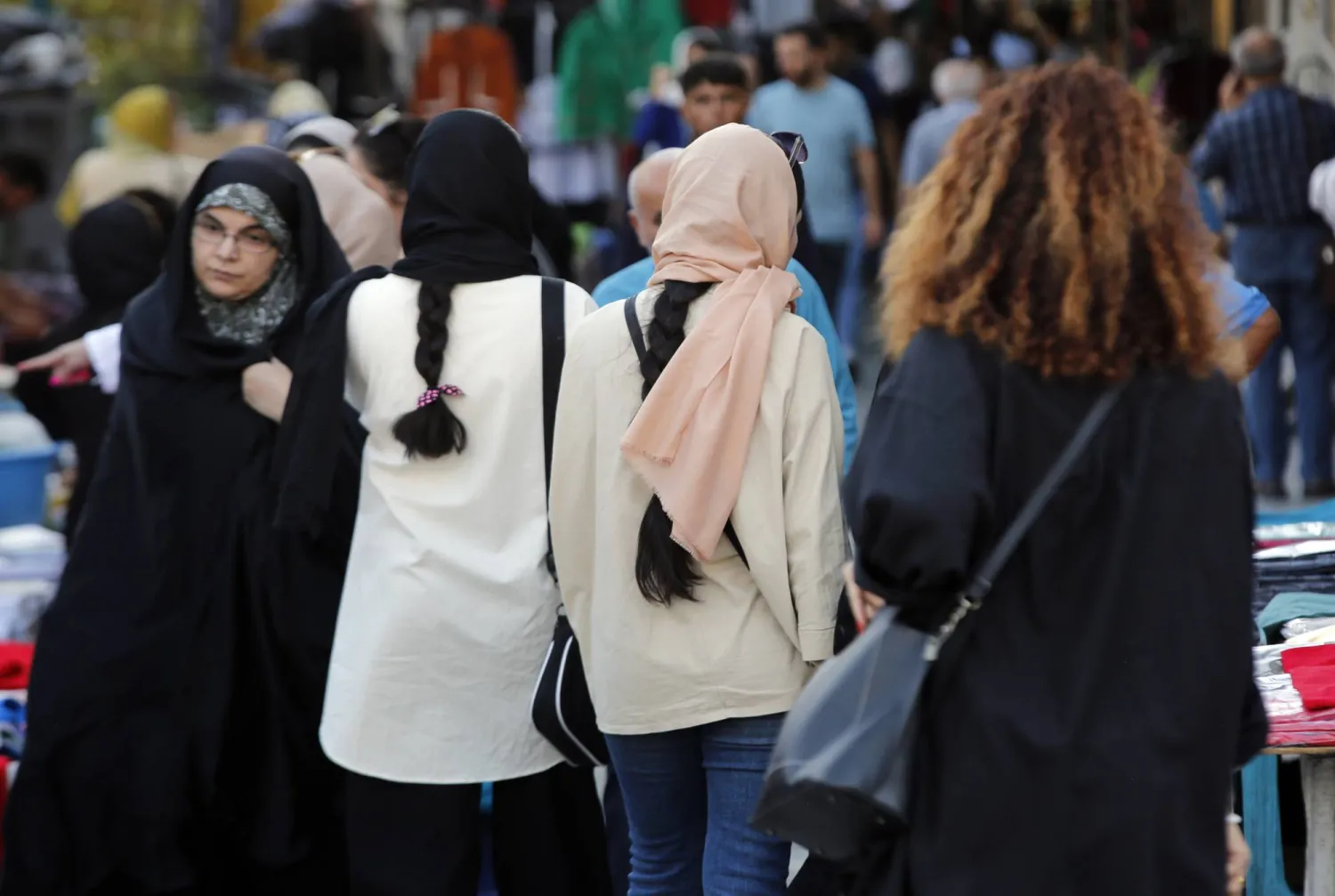
Iranian women, some without the mandatory headscarf, walk in a street in Tehran, Iran, 13 September 2023. EPA/ABEDIN TAHERKENAREH
TT

Iran Police Shot a Woman While Trying to Seize Her Car Over Hijab Law Violation

Iranian women, some without the mandatory headscarf, walk in a street in Tehran, Iran, 13 September 2023. EPA/ABEDIN TAHERKENAREH

On a darkened road beside the Caspian Sea, Iranian police officers opened fire last month on a 31-year-old woman who had tried to speed away, likely knowing they wanted to seize her vehicle.
Police had been ordered to impound her car, activists say, because of an earlier violation of Iran's headscarf law for showing her hair in public while driving.
Now unable to walk and confined to a bed at a police hospital, Arezou Badri — a mother of two — is the latest casualty of Iran's renewed crackdown over headscarves, or hijabs. Her shooting occurred nearly two years after 22-year-old Mahsa Amini died while in police custody over an alleged headscarf violation, sparking nationwide protests over women's rights and against the country's theocracy.
As the Sept. 16 anniversary of Amini's death approaches, Iran's new reformist President Masoud Pezeshkian has promised to ease enforcement of the headscarf law. But the murky details of Badri's shooting and a recent video of a girl being manhandled in the streets of Tehran show the dangers still lurking for those willing to disobey it.
“They have elevated it to the most serious crime, where the police is allowed basically to shoot to kill,” said Hadi Ghaemi, executive director of the New York-based Center for Human Rights in Iran. “That's really a war on women.”
Badri's shooting occurred around 11 p.m. on July 22 along a coastal road in Iran's northern Mazandaran province as she drove home from a friend's house with her sister, activists say. A brief account published by Iran's state-run IRNA news agency quoted police Col. Ahmad Amini as saying patrol officers had ordered a vehicle with tinted windows to stop, but that it didn't. It made no mention of the hijab violation or impound notice.
Officers appear to have first fired at Badri's car's tires, according to the group Human Rights Activists in Iran, which spoke to people with knowledge of the shooting. As Badri continued driving, officers fired into the vehicle, the group said; the gunfire pierced her lung and damaged her spine.
Under Iranian law, police must fire a warning shot, then aim to wound below the waist before taking a potentially fatal shot at a suspect’s head or chest. If the suspect is driving, officers typically aim first for the tires.
Why police initially stopped Badri's car remains unclear, though activists blame it on the impound alert over the hijab violation. It's also unknown whether any police vehicle at the scene had a camera that recorded the shooting or if any officer there wore a body camera.
There are no public statistics of fatal police shootings in Iran. Police firearms training and tactics vary widely, as some officers face more paramilitary duties in areas like Iran's restive Sistan and Baluchestan provinces.
Iran's Interior Ministry, which oversees the country's police, did not respond to questions about the shooting from The Associated Press.
Authorities are holding Badri at a police hospital in Tehran under tight security, restricting her family's visits and stopping them from taking photographs of her, activists say. Despite that, an image of Badri was published by the BBC this week, highlighting her case.
“She has no sensation from the waist down and doctors have said that it will be clear in the coming months whether she is completely paralyzed," said one activist in Iran, who requested anonymity for fear of reprisal.
The hijab became a focal point of demonstrations after the death of Amini in 2022. She died after being arrested for not wearing her headscarf to the liking of police. A United Nations panel has found that Amini died as a result of “physical violence” used against her by the state.
Amini's death sparked months of protests and a security crackdown that killed more than 500 people and led to the detention of more than 22,000. After the mass demonstrations, police dialed down enforcement of hijab laws, but it ramped up again in April under what authorities called the Noor — or “Light” — Plan.
The hijab crackdown remains widely discussed in Iran, even as police and state media rarely report on it. Many women continue to wear their hijabs loosely or leave them draped around their shoulders while walking in Tehran. Women driving without wearing hijabs are believed to have been tracked via surveillance camera technology provided by Chinese firms, matching their faces against a government-maintained photo database, Ghaemi said.
If they are stopped, that can lead to physical altercations between women and the police.
Surveillance footage published last week by the Iranian reformist news website Ensaf showed a 14-year-old girl manhandled by the morality police in Tehran. Her mother described her daughter's head as being rammed into an electrical box, a female officer pulling her hair and another putting their foot on her neck. Police described the officers' behavior as unprofessional, but also accused the girl of using bad language.
“I saw my daughter with a wounded face, swollen lips, a bruised neck, torn clothes and she couldn’t even speak," her mother, Maryam Abbasi, told the website. "Her eyes were so swollen from crying that they wouldn’t open.”



Top Trump Iran Negotiator Says Visits US Aircraft Carrier in Middle East

US Special Envoy Steve Witkoff delivers a press conference upon the signing of the declaration on deploying post-ceasefire force in Ukraine, during the so-called "Coalition of the Willing" summit, at the Elysee Palace in Paris, France, January 6, 2026. (Reuters)
TT

Top Trump Iran Negotiator Says Visits US Aircraft Carrier in Middle East

US Special Envoy Steve Witkoff delivers a press conference upon the signing of the declaration on deploying post-ceasefire force in Ukraine, during the so-called "Coalition of the Willing" summit, at the Elysee Palace in Paris, France, January 6, 2026. (Reuters)

US President Donald Trump's lead Iran negotiator Steve Witkoff on Saturday said he visited the USS Abraham Lincoln aircraft carrier currently in the Arabian Sea, with Washington and Tehran due to hold further talks soon.

"Today, Adm. Brad Cooper, Commander of US Naval Forces Central Command, Jared Kushner, and I met with the brave sailors and Marines aboard the USS Abraham Lincoln, her strike group, and Carrier Air Wing 9 who are keeping us safe and upholding President Trump's message of peace through strength," said Witkoff in a social media post.

Iranian Foreign Minister Abbas Araghchi said on Saturday he hoped talks with the United States would resume soon, while reiterating Tehran's red lines and warning against any American attack.


Israel’s Netanyahu Expected to Meet Trump in US on Wednesday and Discuss Iran

Israeli Prime Minister Benjamin Netanyahu delivers a speech during a special session to mark the 77th anniversary of the Knesset's establishment and the 60th anniversary of the dedication of the current building at the Knesset, the Israeli parliament, in Jerusalem, 02 February 2026. (EPA)
TT

Israel’s Netanyahu Expected to Meet Trump in US on Wednesday and Discuss Iran

Israeli Prime Minister Benjamin Netanyahu delivers a speech during a special session to mark the 77th anniversary of the Knesset's establishment and the 60th anniversary of the dedication of the current building at the Knesset, the Israeli parliament, in Jerusalem, 02 February 2026. (EPA)

Israeli Prime Minister Benjamin Netanyahu is expected to meet US President Donald Trump on Wednesday in Washington, where they will discuss negotiations with Iran, Netanyahu's office said on Saturday.

Iranian and US officials held indirect nuclear ‌talks in the ‌Omani capital ‌Muscat ⁠on Friday. ‌Both sides said more talks were expected to be held again soon.

A regional diplomat briefed by Tehran on the talks told Reuters Iran insisted ⁠on its "right to enrich uranium" ‌during the negotiations with ‍the US, ‍and that Tehran's missile capabilities ‍were not raised in the discussions.

Iranian officials have ruled out putting Iran's missiles - one of the largest such arsenals in the region - up ⁠for discussion, and have said Tehran wants recognition of its right to enrich uranium.

"The Prime Minister believes that any negotiations must include limiting ballistic missiles and halting support for the Iranian axis," Netanyahu's office said in a ‌statement.


Italy FM Rules Out Joining Trump’s ‘Board of Peace’

Italy's Minister for Foreign Affairs Antonio Tajani speaks to the press during the EPP Leaders’ meeting, in Zagreb, Croatia, 30 January 2026. (EPA)
TT

Italy FM Rules Out Joining Trump’s ‘Board of Peace’

Italy's Minister for Foreign Affairs Antonio Tajani speaks to the press during the EPP Leaders’ meeting, in Zagreb, Croatia, 30 January 2026. (EPA)

Italy will not take part in US President Donald Trump's "Board of Peace", Italian Foreign Minister Antonio Tajani said Saturday, citing "insurmountable" constitutional issues.

Trump launched his "Board of Peace" at the World Economic Forum in Davos in January and some 19 countries have signed its founding charter.

But Italy's constitution bars the country from joining an organization led by a single foreign leader.

Prime Minister Giorgia Meloni, a Trump ally, last month noted "constitutional problems" with joining, but suggested Trump could perhaps reopen the framework "to meet the needs not only of Italy, but also of other European countries".

Tajani appeared Saturday to rule that out.

"We cannot participate in the Board of Peace because there is a constitutional limit," he told the ANSA news agency.

"This is insurmountable from a legal standpoint," he said, the day after meeting US Secretary of State Marco Rubio and US Vice President JD Vance at the Olympics in Milan.

Although originally meant to oversee Gaza's rebuilding, the board's charter does not limit its role to the Palestinian territory and appears to want to rival the United Nations.