


Iran’s Supreme Leader Opens Door to Negotiations with US over Tehran’s Nuclear Program

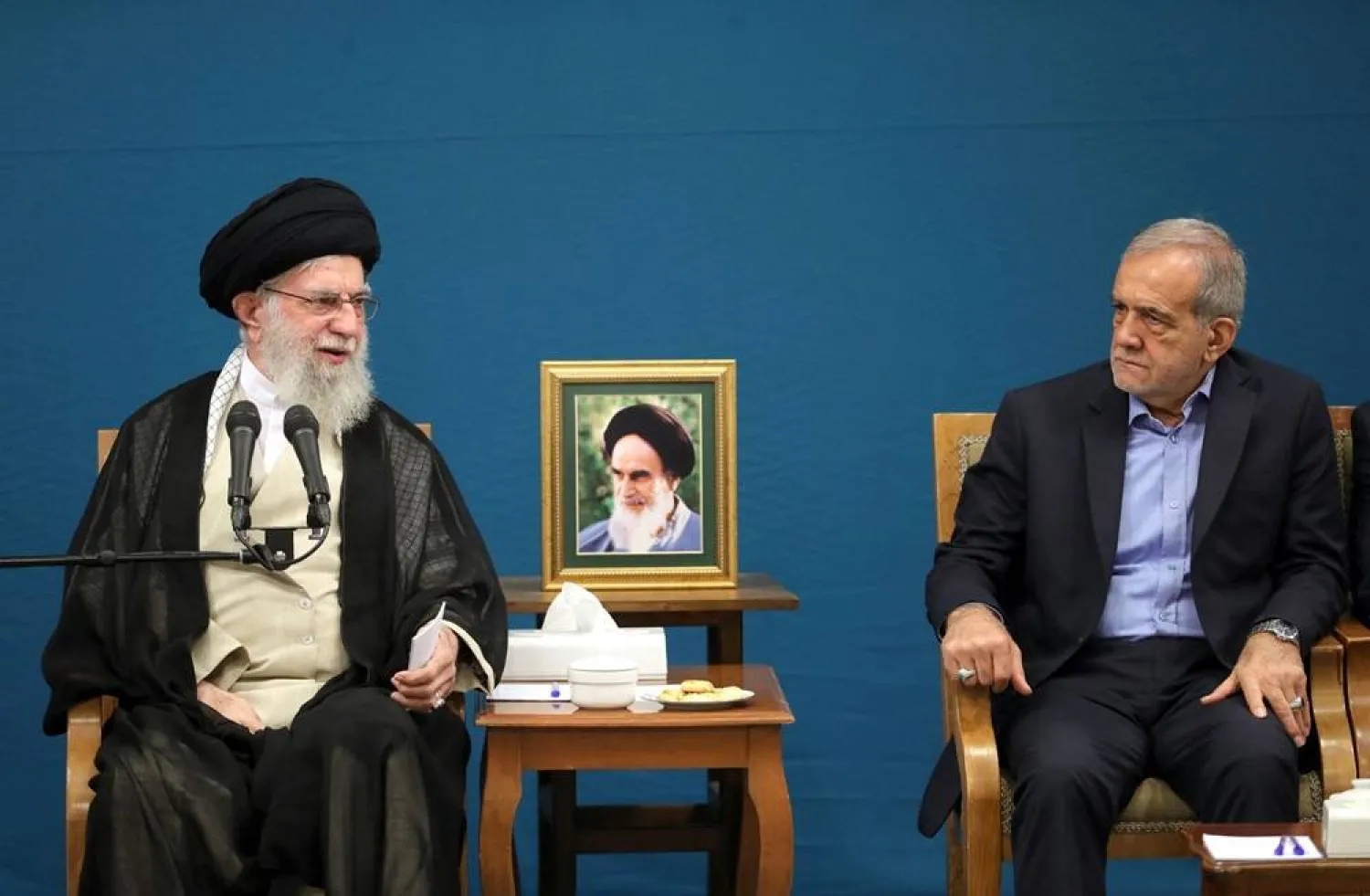
A handout photo made available by the supreme leader office shows Iranian Supreme Leader Ali Khamenei (L) speaking as Iranian President Masoud Pezeshkian looks on, during a meeting with the new Iranian government in Tehran, Iran, 27 August 2024. (EPA/Iranian Supreme Leader Office Handout)
TT

Iran’s Supreme Leader Opens Door to Negotiations with US over Tehran’s Nuclear Program

A handout photo made available by the supreme leader office shows Iranian Supreme Leader Ali Khamenei (L) speaking as Iranian President Masoud Pezeshkian looks on, during a meeting with the new Iranian government in Tehran, Iran, 27 August 2024. (EPA/Iranian Supreme Leader Office Handout)

Iran's supreme leader opened the door Tuesday to renewed negotiations with the United States over his country's rapidly advancing nuclear program, telling its civilian government there was “no harm" in engaging with its “enemy.”

Ali Khamenei's remarks set clear red lines for any talks taking place under the government of reformist President Masoud Pezeshkian and renewed his warnings that Washington wasn't to be trusted.

But his comments mirror those around the time of Iran's 2015 nuclear deal with world powers, which saw Tehran's nuclear program greatly curtailed in exchange for the lifting of economic sanctions. Yet it remains unclear just how much room Pezeshkian will have to maneuver, particularly as tensions remain high in the wider Middle East over the Israel-Hamas war and as the US prepares for a presidential election in November.

“This does not mean that we cannot interact with the same enemy in certain situations,” Khamenei said, according to a transcript on his official website. "There is no harm in that, but do not place your hopes in them.”

Khamenei, who has the final say on all state matters, also warned Pezeshkian's Cabinet, “Do not trust the enemy.”

Khamenei, 85, has occasionally urged talks or dismissed them with Washington after then-President Donald Trump unilaterally withdrew the United States from the deal in 2018.

There have been indirect talks between Iran and the US in recent years mediated by Oman and Qatar, two of the United States' Middle East interlocutors when it comes to Iran. Khamenei's remarks came a day after Qatar's prime minister visited the country.

Asked for comment, the US State Department told The Associated Press: “We will judge Iran’s leadership by their actions, not their words.”

“We have long said that we ultimately view diplomacy as the best way to achieve an effective, sustainable solution with regard to Iran’s nuclear program,” it said. “However, we are far away from anything like that right now given Iran’s escalations across the board, including its nuclear escalations and its failure to cooperate" with the International Atomic Energy Agency, the United Nations nuclear watchdog.

“If Iran wants to demonstrate seriousness or a new approach, they should stop nuclear escalations and start meaningfully cooperating with the IAEA,” it said.

Since the deal's collapse, Iran has abandoned all limits that the deal put on its program, and enriches uranium to up to 60% purity — near weapons-grade levels of 90%.

Surveillance cameras installed by the IAEA have been disrupted, while Iran has barred some of the Vienna-based agency’s most experienced inspectors. Iranian officials also have increasingly threatened that they could pursue atomic weapons.

Meanwhile, tensions between Iran and Israel have hit a new high during the Israel-Hamas war in the Gaza Strip. Tehran launched an unprecedented drone-and-missile attack on Israel in April after years of a shadow war between the two countries reached a climax with Israel’s apparent attack on an Iranian consular building in Syria that killed two Iranian generals and others.

The assassination in Tehran of Hamas leader Ismail Haniyeh also prompted Iran to threaten to retaliate against Israel.

Pezeshkian, a former lawmaker who won the presidency after a May helicopter crash killed hard-line President Ebrahim Raisi, campaigned in part on a promise to reengage the West with negotiations.

Khamenei's remarks as Iran's paramount leader could provide him with the political cover to do so. Pezeshkian's new foreign minister, Abbas Araghchi, was deeply involved in negotiations on the 2015 deal.

“After doing everything we can, a tactical retreat might sometimes be necessary, but we should not abandon our goals or opinions at the first sign of difficulty,” Khameini also said Tuesday, the second time in recent days he's referred to a “tactical retreat” amid the tensions.

However, it's not just Iran that's facing a new presidency. The US will hold a presidential election on Nov. 5, with Vice President Kamala Harris and Trump as the leading candidates. Iran has been concerned about Trump’s return to power.

While the US engaged in indirect talks with Iran under President Joe Biden, it remains unclear how that would carry over to a possible Harris administration. Harris, in a speech to the Democratic National Convention last week, said: “I will never hesitate to take whatever action is necessary to defend our forces and our interests against Iran and Iran-backed terrorists.”

The RANE Network, a risk-intelligence firm, said if Harris wins, “the likelihood of a deal will rise as the Israel-Hamas war winds down.”

“Once negotiations begin, Iran will likely demand more protections regarding a potential US withdrawal from a new deal after the United States walked away from the previous deal in 2018,” RANE said in an analysis Tuesday.

“Because of concerns about the sustainability of any new deal, Iran is also less likely to offer as many nuclear concessions, like the dismantling of more advanced centrifuges, since Iran would want to be able to spin up its nuclear program as fast as possible in the event of another US exit from the new deal.”

Tuesday's meeting between Khamenei and Pezeshkian's Cabinet included an appearance by former Foreign Minister Mohammad Javad Zarif, who helped Iran reach the 2015 deal. After the meeting, Zarif said in an online message that he would continue to serve as a vice president in Pezeshkian's administration after earlier publicly resigning over the makeup of the Cabinet.



Top Trump Iran Negotiator Says Visits US Aircraft Carrier in Middle East

US Special Envoy Steve Witkoff delivers a press conference upon the signing of the declaration on deploying post-ceasefire force in Ukraine, during the so-called "Coalition of the Willing" summit, at the Elysee Palace in Paris, France, January 6, 2026. (Reuters)
TT

Top Trump Iran Negotiator Says Visits US Aircraft Carrier in Middle East

US Special Envoy Steve Witkoff delivers a press conference upon the signing of the declaration on deploying post-ceasefire force in Ukraine, during the so-called "Coalition of the Willing" summit, at the Elysee Palace in Paris, France, January 6, 2026. (Reuters)

US President Donald Trump's lead Iran negotiator Steve Witkoff on Saturday said he visited the USS Abraham Lincoln aircraft carrier currently in the Arabian Sea, with Washington and Tehran due to hold further talks soon.

"Today, Adm. Brad Cooper, Commander of US Naval Forces Central Command, Jared Kushner, and I met with the brave sailors and Marines aboard the USS Abraham Lincoln, her strike group, and Carrier Air Wing 9 who are keeping us safe and upholding President Trump's message of peace through strength," said Witkoff in a social media post.

Iranian Foreign Minister Abbas Araghchi said on Saturday he hoped talks with the United States would resume soon, while reiterating Tehran's red lines and warning against any American attack.


Israel’s Netanyahu Expected to Meet Trump in US on Wednesday and Discuss Iran

Israeli Prime Minister Benjamin Netanyahu delivers a speech during a special session to mark the 77th anniversary of the Knesset's establishment and the 60th anniversary of the dedication of the current building at the Knesset, the Israeli parliament, in Jerusalem, 02 February 2026. (EPA)
TT

Israel’s Netanyahu Expected to Meet Trump in US on Wednesday and Discuss Iran

Israeli Prime Minister Benjamin Netanyahu delivers a speech during a special session to mark the 77th anniversary of the Knesset's establishment and the 60th anniversary of the dedication of the current building at the Knesset, the Israeli parliament, in Jerusalem, 02 February 2026. (EPA)

Israeli Prime Minister Benjamin Netanyahu is expected to meet US President Donald Trump on Wednesday in Washington, where they will discuss negotiations with Iran, Netanyahu's office said on Saturday.

Iranian and US officials held indirect nuclear ‌talks in the ‌Omani capital ‌Muscat ⁠on Friday. ‌Both sides said more talks were expected to be held again soon.

A regional diplomat briefed by Tehran on the talks told Reuters Iran insisted ⁠on its "right to enrich uranium" ‌during the negotiations with ‍the US, ‍and that Tehran's missile capabilities ‍were not raised in the discussions.

Iranian officials have ruled out putting Iran's missiles - one of the largest such arsenals in the region - up ⁠for discussion, and have said Tehran wants recognition of its right to enrich uranium.

"The Prime Minister believes that any negotiations must include limiting ballistic missiles and halting support for the Iranian axis," Netanyahu's office said in a ‌statement.


Italy FM Rules Out Joining Trump’s ‘Board of Peace’

Italy's Minister for Foreign Affairs Antonio Tajani speaks to the press during the EPP Leaders’ meeting, in Zagreb, Croatia, 30 January 2026. (EPA)
TT

Italy FM Rules Out Joining Trump’s ‘Board of Peace’

Italy's Minister for Foreign Affairs Antonio Tajani speaks to the press during the EPP Leaders’ meeting, in Zagreb, Croatia, 30 January 2026. (EPA)

Italy will not take part in US President Donald Trump's "Board of Peace", Italian Foreign Minister Antonio Tajani said Saturday, citing "insurmountable" constitutional issues.

Trump launched his "Board of Peace" at the World Economic Forum in Davos in January and some 19 countries have signed its founding charter.

But Italy's constitution bars the country from joining an organization led by a single foreign leader.

Prime Minister Giorgia Meloni, a Trump ally, last month noted "constitutional problems" with joining, but suggested Trump could perhaps reopen the framework "to meet the needs not only of Italy, but also of other European countries".

Tajani appeared Saturday to rule that out.

"We cannot participate in the Board of Peace because there is a constitutional limit," he told the ANSA news agency.

"This is insurmountable from a legal standpoint," he said, the day after meeting US Secretary of State Marco Rubio and US Vice President JD Vance at the Olympics in Milan.

Although originally meant to oversee Gaza's rebuilding, the board's charter does not limit its role to the Palestinian territory and appears to want to rival the United Nations.