


Libya’s Oilfield Closures Spread in Standoff Over Central Bank 

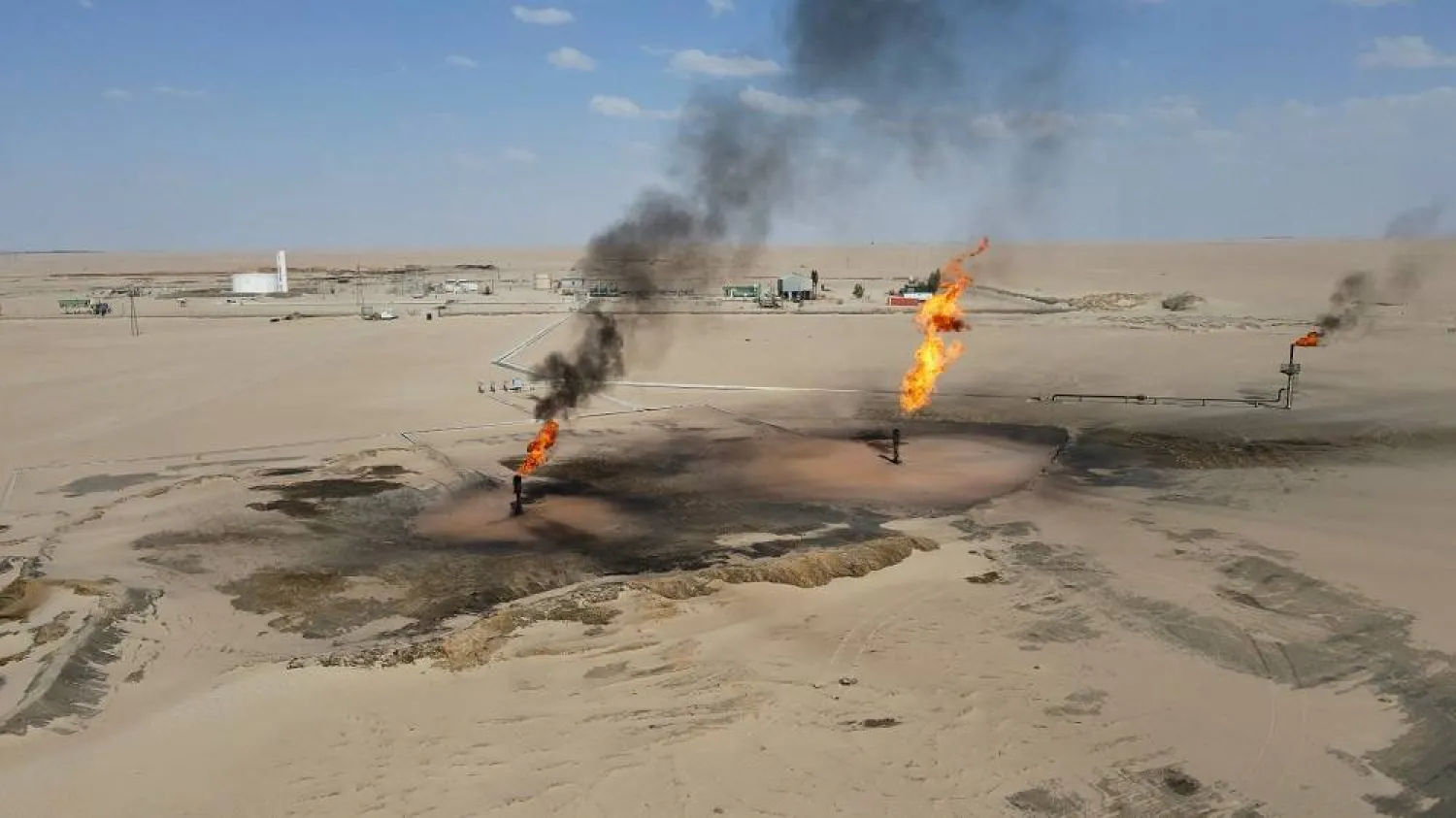
A general drone view shows the Nafoora oilfield in Jakharrah, Libya, August 27, 2024. (Reuters)
TT

Libya’s Oilfield Closures Spread in Standoff Over Central Bank 

A general drone view shows the Nafoora oilfield in Jakharrah, Libya, August 27, 2024. (Reuters)

Libya's oilfield closures escalated on Wednesday as the Sarir field almost completely halted output, two field engineers told Reuters, as a result of a political dispute over control of the central bank and oil revenue.

Authorities in the east, home to most of Libya's oilfields, said on Monday that all production and exports would be halted, though some ports under eastern control operated normally on Wednesday.

Sarir was producing about 209,000 barrels per day (bpd) before output was reduced, the engineers said.

Force majeure had already been announced earlier this month on exports at the 300,000 bpd Sharara oilfield and this week Reuters has reported disruptions at El Feel, Amal, Nafoora and Abu Attifel.

Rapidan Energy Group estimated production disruptions of between 900,000 and 1 million bpd for several weeks.

Analysts, however, said even that might not drive up oil prices.

Benchmark Brent oil prices were down about 1.6% to $78.28 per barrel as of 1440 GMT.

Despite the scale and length, "I'm not sure it's enough to break through this over-powering macro bearish sentiment that continues to shape the market," Rapidan's Geopolitical Risk Service Director Fernando Ferreira told Reuters.

In July, Libya, a member of the Organization of the Petroleum Exporting Countries, was producing about 1.18 million barrels of oil per day.

Ports in the country's hydrocarbon-rich Oil Crescent operated normally on Wednesday and had not received orders to halt exports, five engineers told Reuters.

Four vessels were at ports in the central region to load 600,000 barrels each, they said - two at Es Sidra, one at Brega and one at Zueitina.

The efforts to shut off Libya's main source of revenue are in response to the Tripoli-based Presidency Council's sacking Central Bank of Libya (CBL) chief Sadiq al-Kabir earlier this month, prompting rival armed factions to mobilize.

Abdulhamid al-Dbeibah, head of the Tripoli-based Government of National Unity, repeated on Wednesday previous comment that oilfields should not be allowed to be shut "under flimsy pretexts" and said it was necessary to hold accountable those responsible for shutting oilfields.

On Tuesday, US Africa Command General Michael Langley and Chargé d'Affaires Jeremy Berndt met Khalifa Haftar, head of the Libyan National Army that controls the country's east and south.

"The United States urges all Libyan stakeholders to engage constructively in dialogue," with support from the United Nations Support Mission in Libya and the international community, the US Embassy in Libya said on social media platform X.



US Increases its Pressure on Iran in Iraq

Coordination Framework leaders during a meeting in Baghdad. Iraqi News Agency
TT

US Increases its Pressure on Iran in Iraq

Coordination Framework leaders during a meeting in Baghdad. Iraqi News Agency

US pressure over Iranian influence in Iraq is increasing amid consultations to form a new government and messages from Washington affirming its willingness to use “the full range of tools” to counter what it describes as “Iran’s destabilizing activities.”

US Chargé d’Affaires Joshua Harris confirmed during a meeting on Thursday with Abdul Hussein Al-Mousawi, head of the National Approach Alliance, that any Iraqi government “should remain fully independent and focused on advancing the national interests of all Iraqis.”

A US embassy statement said the meeting addressed the importance of a strong partnership between the United States and Iraq that delivers “tangible benefits” for both sides within the framework of safeguarding Iraqi sovereignty, bolstering regional stability, and strengthening economic ties.

Harris stressed his country’s readiness “to use the full range of tools to counter Iran’s destabilizing activities in Iraq,” a statement seen as a dual message directed at forces linked to Tehran and at blocs engaged in government formation negotiations.

The media office of the National Approach Alliance, which is part of the Coordination Framework, stated that the meeting discussed the latest developments in Iraq and the region, and ways to strengthen bilateral relations “in line with the principle of mutual sovereign respect and shared interests.”

It also addressed consultations among political parties to abide by constitutional mechanisms and the results of elections.

Both sides stressed the importance of ensuring the success of negotiations between the US and Iran in a way that contributes to de-escalation and the adoption of dialogue.

Last month, US President Donald Trump warned Iraq over a reinstatement of Nouri al-Maliki as prime minister, saying that the country “descended into poverty and total chaos” under his previous leadership.

“That should not be allowed to happen again” Trump wrote on social media.

Al-Maliki, who has long-standing ties to Iran, dismissed Trump’s threat as “blatant American interference in Iraq’s internal affairs,” and vowed to “continue to work until we reach the end.”

The Coordination Framework, which holds a parliamentary majority, has named al-Maliki to serve again as Iraq’s prime minister, citing his “political and administrative experience and role in managing the state.”


German Parliament Speaker Visits Gaza

Displaced Palestinians fleeing Israeli military operations in Beit Lahia in the northern Gaza strip walk along the Salah al-Din main road in eastern Gaza City making their way to the city center, on October 22, 2024, amid the ongoing war in the Palestinian territory between Israel and Hamas. (AFP)
TT

German Parliament Speaker Visits Gaza

Displaced Palestinians fleeing Israeli military operations in Beit Lahia in the northern Gaza strip walk along the Salah al-Din main road in eastern Gaza City making their way to the city center, on October 22, 2024, amid the ongoing war in the Palestinian territory between Israel and Hamas. (AFP)

The speaker of Germany's lower house of parliament briefly visited the Israeli-controlled part of the Gaza Strip on Thursday, the body told AFP.

Julia Kloeckner spent "about an hour in the part of Gaza controlled by Israeli army forces", parliament said, becoming the first German official to visit the territory since Hamas's attack on Israel in October 2023 that sparked the devastating war.

Since the start of the conflict, Israel has drastically restricted access to the densely populated coastal strip.

In a statement shared by her office, Kloeckner said it was essential for politicians to have access to "reliable assessments of the situation" in Gaza.

"I expressly welcome the fact that Israel has now, for the first time, granted me, a parliamentary observer, access to the Gaza Strip," she said.

However, she was only able to gain a "limited insight" into the situation on the ground during her trip, she said.

Kloeckner appealed to Israel to "continue on this path of openness" and emphasised that the so-called yellow line, which designates Israeli military zones inside the Gaza Strip, must "not become a permanent barrier".

Contacted by AFP, the German foreign ministry said it would "not comment on travel plans or trips by other constitutional bodies that wish to assess the situation on the ground".

Germany has been one of Israel's staunchest supporters as the European power seeks to atone for the legacy of the Holocaust.

But in recent months, Chancellor Friedrich Merz has occasionally delivered sharp critiques of Israeli policy as German public opinion turns against Israel's actions in Gaza.

In August, Germany imposed a partial arms embargo on Israel, which was lifted in November after the announcement of what has proved to be a fragile ceasefire for Gaza.

Merz visited Israel in December and reaffirmed Germany's support.

But in a sign of lingering tension, Germany's foreign ministry on Wednesday criticized Israeli plans to tighten control over the occupied West Bank as a step toward "de facto annexation".


Syria Says its Forces Have Taken over al-Tanf Base after a Handover from the US

FILE: Members of the Maghawir al-Thawra Syrian opposition group receive firearms training from US Army Special Forces soldiers at the al-Tanf military outpost in southern Syria in 2018. (AP/Lolita Baldor)
TT

Syria Says its Forces Have Taken over al-Tanf Base after a Handover from the US

FILE: Members of the Maghawir al-Thawra Syrian opposition group receive firearms training from US Army Special Forces soldiers at the al-Tanf military outpost in southern Syria in 2018. (AP/Lolita Baldor)

Syrian government forces have taken control of a base in the east of the country that was run for years by US troops as part of the war against the ISIS group, the Defense Ministry said in a statement Thursday.

The al-Tanf base sits on a strategic location, close to the borders with Jordan and Iraq. In a terse statement, the Syrian Defense Ministry said the handover of the base took place in coordination with the US military and Syrian forces are now “securing the base and its perimeters.”

The US military did not immediately respond to an email from The Associated Press regarding the Syrian statement.

The Syrian Defense Ministry also said that Syrian troops are now in place in the desert area around the al-Tanf garrison, with border guards to deploy in the coming days.

The deployment of Syrian troops at al-Tanf and in the surrounding areas comes after last month’s deal between the government and the US-backed and Kurdish-led Syrian Democratic Forces, or SDF, to merge into the military.

Al-Tanf garrison was repeatedly attacked over the past years with drones by Iran-backed groups but such attacks have dropped sharply following the fall of Bashar Assad’s government in Syria in December 2024.

Syria’s interim President Ahmad al-Sharaa has been expanding his control of the country, and last month government forces captured wide parts of northeast Syria after deadly clashes with the SDF. A ceasefire was later reached between the two sides.

Al-Tanf base played a major role in the fight against the ISIS group that declared a caliphate in large parts of Syria and Iraq in 2014. ISIS was defeated in Iraq in 2017 and in Syria two years later.

Over the past weeks, the US military began transferring thousands of ISIS prisoners from prisons run by the SDF in northeastern Syria to Iraq, where they will be prosecuted.

The number of US troops posted in Syria has changed over the years.

The number of US troops increased to more than 2,000 after the Oct. 7, 2023, attack by Hamas in Israel, as Iranian-backed militants targeted American troops and interests in the region in response to Israel’s bombardment of Gaza.

The force has since been drawn back down to around 900.