Algerian Court Certifies Tebboune's Landslide Reelection Win

People walk past posters of Algerian President Abdelmadjid Tebboune outside his election campaign headquarters in Algiers (AFP)
TT

Algerian Court Certifies Tebboune's Landslide Reelection Win

People walk past posters of Algerian President Abdelmadjid Tebboune outside his election campaign headquarters in Algiers (AFP)

Algeria's constitutional court on Saturday certified the landslide victory of President Abdelmadjid Tebboune in last weekend's election after retabulating vote counts that he and his two opponents had called into question.

The court said that it had reviewed local voting data to settle questions about irregularities that Tebboune’s opponents had alleged in two appeals on Monday, according to The AP.

“After verification of the minutes of the regions and correction of the errors noted in the counting of the votes," it had lowered Tebboune's vote share and determined that his two opponents had won hundreds of thousands more votes than previously reported, said Omar Belhadj, the constitutional court's president.

The court's decision makes Tebboune the official winner of the Sept. 7 election. His government will next decide when to inaugurate him for a second term.

The court's retabulated figures showed Tebboune leading Abdellali Hassan Cherif by around 75 percentage points. With 7.7 million votes, the first-term president won 84.3% of the vote, surpassing 2019 win by millions of votes and a double-digit margin.

Cherif, running with the Movement of Society for Peace, won nearly 950,000 votes, or roughly 9.6%. The Socialist Forces Front's Youcef Aouchiche won more than 580,000 votes, or roughly 6.1%.

Notably, both challengers surpassed the threshold required to receive reimbursement for campaign expenses. Under its election laws, Algeria pays for political campaigns that receive more than a 5% vote share. The results announced by the election authority last week showed Cherif and Aouchiche with 3.2% and 2.2% of the vote, respectively. Both were criticized for participating in an election that government critics denounced as a way for Algeria's political elite to make a show of democracy amid broader political repression.

Throughout the campaign, each of the three campaigns emphasized participation, calling on voters and youth to participate and defy calls to boycott the ballot. The court announced nationwide turnout was 46.1%, surpassing the 2019 presidential election when 39.9% of the electorate participated.


Israeli Airstrikes Kill Four in Gaza

UN vehicles escort ambulances and a bus carrying Palestinian patients in Khan Younis as they travel to the Rafah crossing to leave the Gaza Strip for medical treatment abroad, Thursday, Mar, 19, 2026.(AP Photo/Abdel Kareem Hana)
TT

Israeli Airstrikes Kill Four in Gaza

UN vehicles escort ambulances and a bus carrying Palestinian patients in Khan Younis as they travel to the Rafah crossing to leave the Gaza Strip for medical treatment abroad, Thursday, Mar, 19, 2026.(AP Photo/Abdel Kareem Hana)

An Israeli airstrike on a police vehicle on Sunday killed three people in the middle of the Nuseirat camp in the central Gaza Strip, health officials said, hours after another person was killed in a strike on northern Gaza.

According to Reuters, medics and police sources said the three men killed in Nuseirat were members of the Hamas-led police force.

Ten people were also wounded in the attack, medics said.

Earlier on Sunday ⁠a separate airstrike ⁠killed one person - identified as a leader of one of Fatah's armed groups - and injured an unknown number of others in the Sheikh Radwan neighborhood in northern Gaza.

The Israeli military said it was checking on ⁠the two incidents.

While Israeli attacks in Gaza declined in the days after the US and Israel launched attacks on Iran on February 28, according to residents, medics and analysts, they have since begun to rise again. Israeli fire has killed dozens of Palestinians since the outbreak of the Iran war, Gaza health officials say.

In Gaza there have been regular outbreaks of ⁠violence ⁠since a ceasefire went into effect in October following two years of devastating war triggered by Hamas-led attacks in Israel in October 2023.

The territory's health ministry says that at least 680 people have been killed by Israeli fire since the October ceasefire. Israel said four soldiers were killed by militants in Gaza in the same period.

Israel and Hamas have traded blame for truce violations.


Lebanon President Calls Israeli Bridge Strikes 'Prelude to Ground Invasion'

Lebanese President Joseph Aoun (AFP)
TT

Lebanon President Calls Israeli Bridge Strikes 'Prelude to Ground Invasion'

Lebanese President Joseph Aoun (AFP)

Lebanese President Joseph Aoun on Sunday slammed Israeli strikes on bridges and other infrastructure in the country's south, calling such attacks a "prelude to a ground invasion".

Aoun "condemned Israel's targeting and destruction of infrastructure and vital facilities in southern Lebanon, particularly the Qasmiyeh bridge over the Litani River and other bridges", a presidency statement said, AFP reported.

"These attacks represent a dangerous escalation and flagrant violation of Lebanon's sovereignty, and are considered a prelude to a ground invasion," Aoun said, hours after Israel's defense minister said the army had been ordered to destroy more bridges allegedly being used by Hezbollah.


Ceasefire Efforts Enter an 'Open-Ended Pause,' Alarming Lebanese

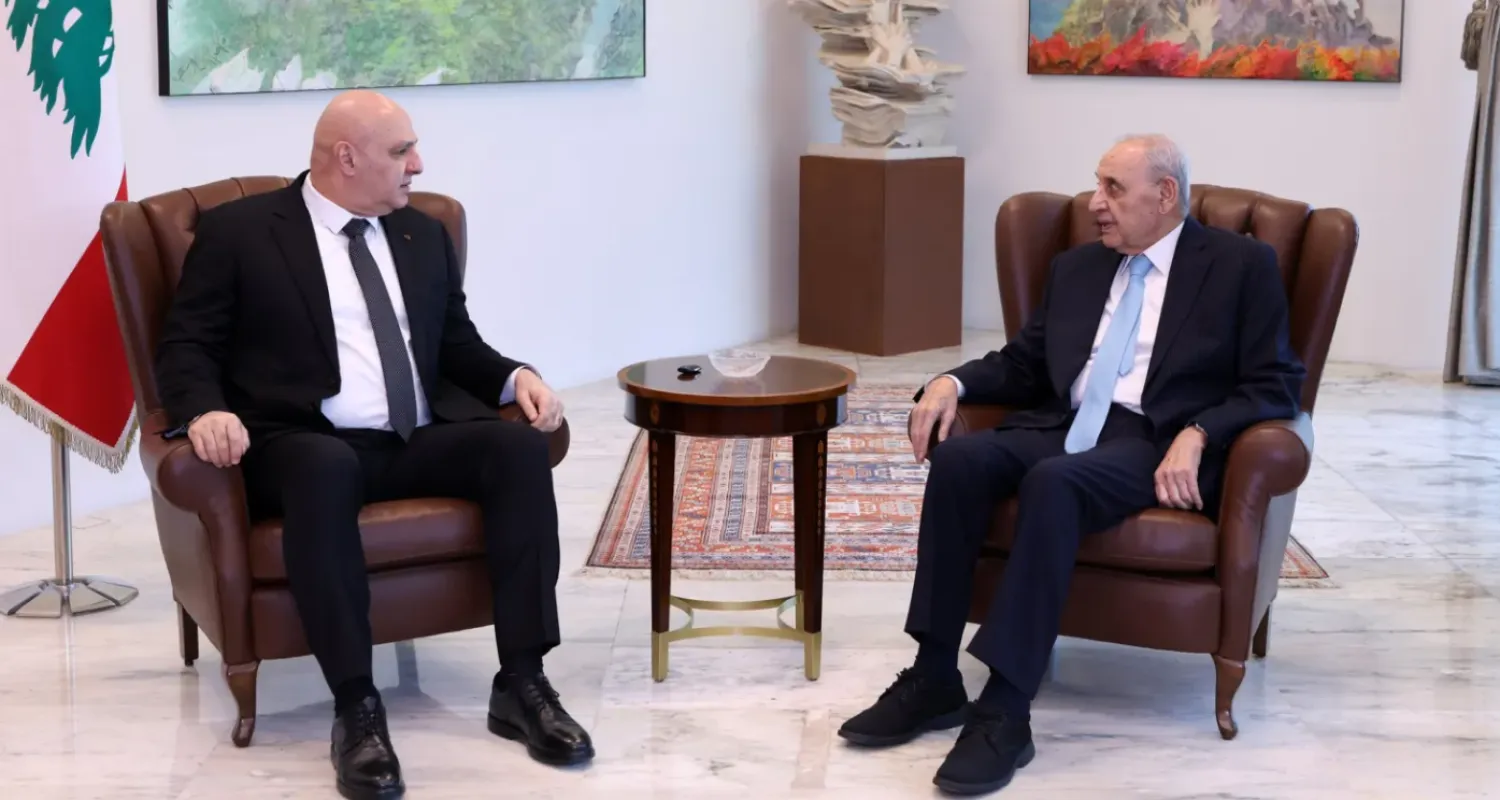
Lebanese President Joseph Aoun holding talks with Parliament Speaker Nabih Berri (File - National News Agency)
TT

Ceasefire Efforts Enter an 'Open-Ended Pause,' Alarming Lebanese

Lebanese President Joseph Aoun holding talks with Parliament Speaker Nabih Berri (File - National News Agency)

Lebanese-US efforts to secure a ceasefire have entered a prolonged “open-ended pause,” with no clear indication of when it might end, while the decisive factor remains tied to developments on the ground as the war between Hezbollah and Israel in the south reaches its peak.


This has raised concern among political circles tracking the situation, amid fears that the pause could drag on, leaving Lebanon on its own in the absence of any external push to end the war, and opening the door for President Joseph Aoun to call for direct negotiations with Israel to proceed under the cover of a truce that would relieve pressure created by ongoing hostilities from both sides.


These circles note that ceasefire efforts remain stalled, colliding with Israel’s insistence on delivering a “decisive blow” to Hezbollah to eliminate its stockpile of heavy rockets. In parallel, they say, the group continues to confront Israel’s ground advance in the south to prevent it from securing deeper control over areas south of the Litani River, amid Israeli threats to destroy what remains of bridges linking the river’s southern and northern banks.


Rejection on both sides


Sources confirm there is no prospect of a ceasefire between Israel and Hezbollah, which remains committed to its weapons and is now engaged in what it describes as an “existential battle.” Relinquishing its arms without guarantees, they say, would amount to voluntarily ending its political role.


The same position, the sources add, applies to Israel, backed by the US, which will not halt hostilities unless it eliminates Hezbollah’s weapons as part of ending the role of Iran-aligned actors in the region.


According to the sources, a ceasefire decision is not supported by either side, Hezbollah or Israel and is fully tied to the trajectory of the broader conflict involving Iran, the US, and Israel. This linkage has stalled Aoun’s call for direct negotiations in the absence of guarantees for a truce. Ending the war in the south, they stress, goes beyond the local arena and is directly connected to the wider confrontation on the Iranian front, making the two fronts inseparable.


The sources add that dialogue between Aoun and Hezbollah, for which Speaker of Parliament Nabih Berri had helped prepare the ground, remains suspended, as decision-making lies not with the party’s political wing but with its military wing, with which there is no presidential channel. They say Aoun does not bear responsibility for the breakdown, which was triggered by Secretary-General Naim Qassem backing away from a pledge not to intervene militarily in support of Iran.


They argue there is no value in dialogue that will not produce results as long as authority rests with a military wing directly linked to Iran’s Revolutionary Guard, even if its leadership seeks to justify this by citing the absence of guarantees. The sources reveal that the group has not received assurances regarding its political future; otherwise, it would not hand over its weapons “for free” to the state while Israel continues its occupation of the south and refuses to commit to the cessation-of-hostilities agreement implemented unilaterally more than a year and three months ago.


The same sources say that while the group’s leadership, represented by Qassem, supports Berri’s demand to implement the agreement brokered by France and the US and applied by Lebanon since November 27, 2024, it questions why Washington has stepped back from guarantees ensuring the agreement’s implementation through synchronized steps between Lebanon and Israel.


While the group avoids addressing Qassem’s reversal on supporting Iran, the sources say the issue has been settled between the allies and moved past, without dwelling on the stance of ministers aligned with Berri who backed cabinet decisions, in contrast to those aligned with the group who abstained, reflecting its insistence on avoiding a dispute with its only remaining ally.
 

Berri focuses on displaced


While Berri is currently focused on supporting efforts led by Prime Minister Nawaf Salam’s government, in cooperation with civil society and NGOs, to provide shelter and basic needs for displaced people, he is also urging them to comply with security measures to maintain stability and prevent tensions with host communities. He praised local support efforts and stressed that maintaining security and stability is a “red line” to safeguard civil peace.


Berri’s prioritization of accommodating displaced populations and preparing for further waves, driven by Israeli pressure through displacement and systematic destruction of homes, has prompted questions among observers as to why he has not reactivated his political role.


These circles say the answer ultimately lies with him, noting he was the first to welcome a ceasefire and reject negotiations under pressure. This explains his demand for guarantees on the implementation of any agreement, for which the US bears responsibility, to prevent Lebanon from being drawn into new negotiations without clarity on venue, timing, or agenda, especially when an agreement brokered by France and the US already exists and is overseen by the “mechanism committee” tasked with implementing Resolution 1701, but remains dependent on US follow-through.


The sources also pointed to remarks by US Ambassador to Beirut Michael Issa following a meeting with Maronite Patriarch Bechara al-Rahi, welcoming Aoun’s call for direct negotiations with Israel. They said he effectively acknowledged the initiative but, instead of facilitating it, undermined it by implying it would take place under fire, rather than through US intervention to halt the war and create conditions for negotiations under US sponsorship and guarantees.