Twin Endangered Arabian Sand Gazelles Born at King Salman bin Abdulaziz Royal Reservehttps://english.aawsat.com/varieties/5062718-twin-endangered-arabian-sand-gazelles-born-king-salman-bin-abdulaziz-royal
Twin Endangered Arabian Sand Gazelles Born at King Salman bin Abdulaziz Royal Reserve
The field team of Saudi Arabia’s King Salman bin Abdulaziz Royal Reserve observed in September the birth of twin endangered Arabian sand gazelles. (SPA)
TT
TT
Twin Endangered Arabian Sand Gazelles Born at King Salman bin Abdulaziz Royal Reserve
The field team of Saudi Arabia’s King Salman bin Abdulaziz Royal Reserve observed in September the birth of twin endangered Arabian sand gazelles. (SPA)
The field team of Saudi Arabia’s King Salman bin Abdulaziz Royal Reserve observed in September the birth of twin endangered Arabian sand gazelles, marking the 84th birth of Arabian gazelles within the reserve, reported the Saudi Press Agency on Thursday.
The milestone highlights the authority’s efforts to safeguard wildlife and create a thriving environment for their growth and reproduction.
The authority emphasized that the successful reproduction of these animals reflects the quality and suitability of the natural habitats within the reserve. This success is part of ongoing efforts to preserve endangered species. The reserve has recorded more than 120 mammal births, including oryx, Arabian sand gazelles, and ibex, in its protected areas.
The milestone highlights the authority’s efforts to safeguard wildlife and create a thriving environment for their growth and reproduction. (SPA)
These achievements demonstrate the authority’s dedication to wildlife conservation, evidenced by the release of various endangered species and the creation of tailored environments to support each species. The field team conducts rigorous and regular monitoring to protect these animals and ensure their safety.
Spanning an impressive 130,700 square kilometers, the King Salman bin Abdulaziz Royal Reserve is the largest natural wildlife reserve in the Middle East. It covers four administrative regions: Al-Jawf, Hail, the Northern Borders, and Tabuk. The reserve boasts diverse natural habitats, varied terrain, and unique geographical formations.
Holy Kaaba Aligns with Sun in Rare Astronomical Event Over Makkahhttps://english.aawsat.com/varieties/5277446-holy-kaaba-aligns-sun-rare-astronomical-event-over-makkah
During the moment of alignment, shadows cast by vertical objects in Makkah’s surroundings nearly disappear as sunlight falls almost perpendicularly on the surface. (SPA)
Holy Kaaba Aligns with Sun in Rare Astronomical Event Over Makkah
During the moment of alignment, shadows cast by vertical objects in Makkah’s surroundings nearly disappear as sunlight falls almost perpendicularly on the surface. (SPA)
The skies above Makkah witnessed on Tuesday the sun aligning directly over the Holy Kaaba at 12:18 PM Makkah time, an astronomical phenomenon used to determine the Qibla direction, SPA reported.
Jeddah Astronomy Society Director Eng. Majed Abu Zahra stated that the sun reached its closest point to full alignment above the Holy Kaaba at an elevation of 89.94 degrees, just 0.06 degrees short of full perpendicularity, providing a direct opportunity to verify the accuracy of the Qibla direction using the sun's position and shadows cast by vertical objects, which nearly disappear at the moment of alignment.
He noted that the phenomenon occurs twice annually due to the sun's apparent movement between the Tropics of Cancer and Capricorn, and holds scientific and educational significance for its connection to astronomical calculations and its historical use in correcting mosque orientations.
More Climate Records Under Threat as Spring Heatwave Bakes Western Europehttps://english.aawsat.com/varieties/5277329-more-climate-records-under-threat-spring-heatwave-bakes-western-europe
A woman shields herself from the sun with a newspaper as she crosses London Bridge during a heatwave in London, Britain, May 26, 2026. REUTERS/Jack Taylor
More Climate Records Under Threat as Spring Heatwave Bakes Western Europe
A woman shields herself from the sun with a newspaper as she crosses London Bridge during a heatwave in London, Britain, May 26, 2026. REUTERS/Jack Taylor
Western Europe faced another day of record-breaking temperatures Tuesday as a heatwave pushed the mercury well above normal levels for May.
A so-called "heat dome" of warm air from northern Africa trapped under a high-pressure system over western Europe is behind the sort of heat not usually seen until high summer.
France's weather agency reported that Monday was its hottest day in the month of May on record -- with Tuesday forecast to be even hotter -- while the United Kingdom also posted unprecedented highs and Italy imposed restrictions on outdoor work.
French authorities on Tuesday also reported at least seven deaths linked to the heatwave -- five of which were drownings, as many people sought relief on beaches and other bodies of water, AFP reported.
Scientists say human-driven climate change is amplifying such extremes, with weather events like heatwaves, droughts and floods becoming more intense and frequent.
The United Kingdom's Met Office weather agency said Monday was the hottest May day on record, with temperatures hitting 34.8C at Kew Gardens, southwest London -- a full two degrees above the previous high.
The Met Office forecast a drop later in the week.
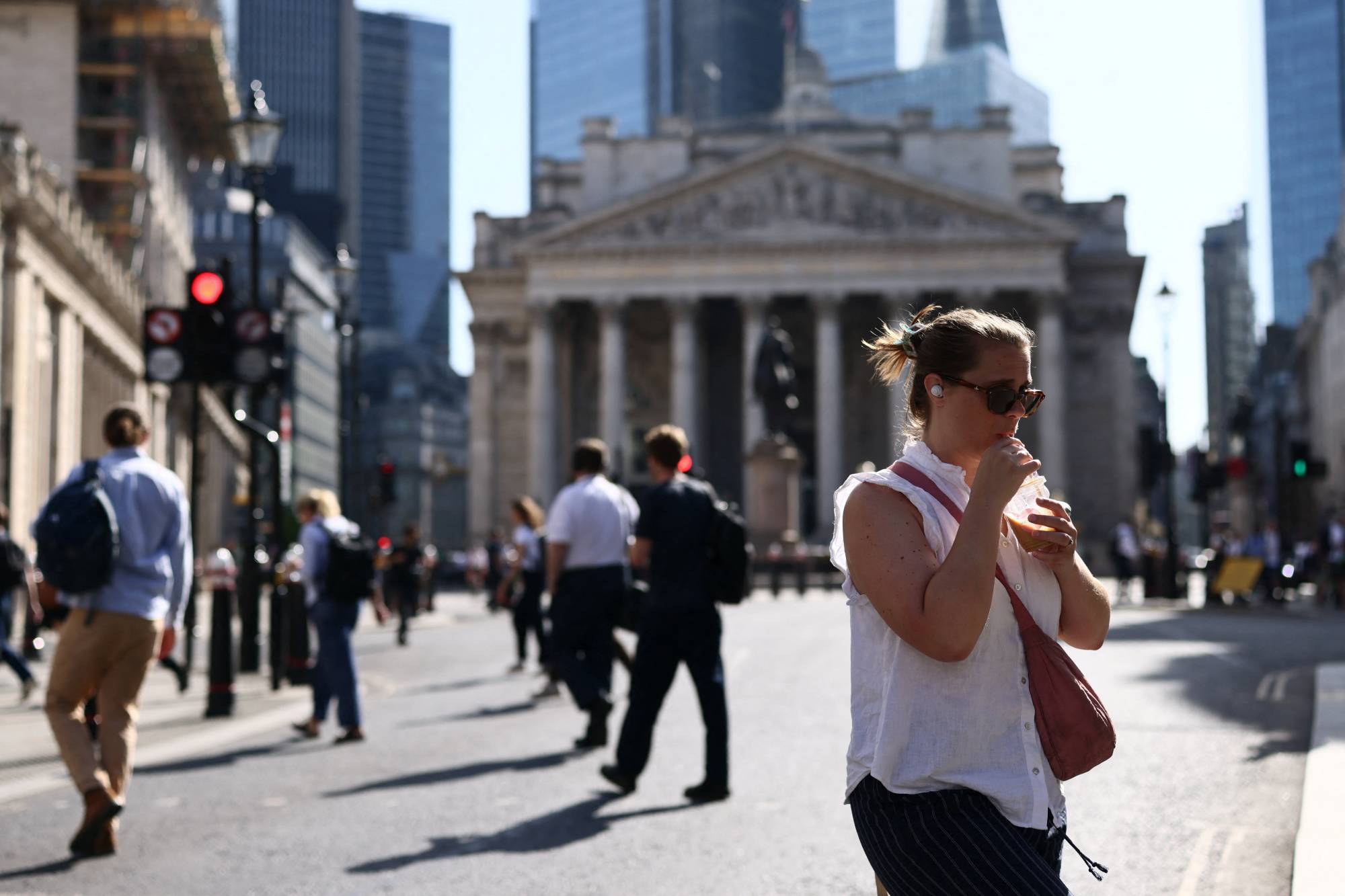
A woman drinks an iced coffee during a heatwave in London, Britain, May 26, 2026. REUTERS/Jack Taylor
Met Office meteorologist Greg Dewhurst told AFP the increase in extreme temperatures was "a good indication of climate change in action" and more likely to become "the new norm."
A record May temperature of 28.8C was recorded at two of Ireland's weather stations amid the current blast of heat, Met Eireann data showed.
A grass fire broke out near Arthur's Seat hill near Edinburgh, sending smoke over the Scottish city that saw temperatures climb to 25C, according to firefighters and the BBC.
Across the English Channel, France's weather agency said "Monday was the hottest day recorded for the month of May since measurements began,” with tennis fans in the capital Paris baking in temperatures of 33C at Roland Garros.
Highs of 36C were expected in some regions on Tuesday, Meteo-France said, adding that the spell was likely to last at least until the end of the week.
Government authorities also noted the heat had taken a deadly turn.
"What I can say today is that there have been seven deaths directly or indirectly related to the heat," government spokesperson Maud Bregeon told television broadcaster TF1 on Tuesday.
The heat drove many people to the country's beaches to cool off in the water, even though lifeguard supervision is not due to start in many areas until July.
"We were just wondering this morning whether the beach was supervised," Thomas Dupuy told AFP while visiting a beach in the southwestern city of Anglet with his two young children.
"I'm extremely careful for myself, for my children who can't swim yet," he added. "We know the currents can pull you out, the Atlantic beaches are dangerous."
On Monday, the western town of Bergerac recorded a high of 34.7C, with the cities of Nantes and Angers not far behind.
Spain's State Meteorological Agency (Aemet) warned the "extraordinarily high temperatures for this time of year" will continue across the country all week, except in the Canary Islands, in the Atlantic Ocean.
"Widespread tropical nights" are also forecast in southwestern Spain from Wednesday, with temperatures peaking from Wednesday to Friday at between 36C and 38C, it wrote on X.
Farther east, Italy's Lazio region, which includes Rome, on Monday approved rules limiting work in conditions "with prolonged exposure in the sun" between 12:30 pm and 4:00 pm.
An April report by the European Copernicus Climate Change Service and the World Meteorological Organization stated that since the 1980s, "Europe has warmed twice as fast as the global average" and "heatwaves are becoming increasingly frequent and severe" across at least 95 percent of the continent's territory.
British Doctors: Social Media as Bad for Children as Smokinghttps://english.aawsat.com/varieties/5277327-british-doctors-social-media-bad-children-smoking
(FILES) This photo illustration shows a mobile phone screen displaying the icons for the social networking apps Facebook, Twitter and Instagram, taken in Manchester on March 22, 2018. (Photo by Oli SCARFF / AFP)
British Doctors: Social Media as Bad for Children as Smoking
(FILES) This photo illustration shows a mobile phone screen displaying the icons for the social networking apps Facebook, Twitter and Instagram, taken in Manchester on March 22, 2018. (Photo by Oli SCARFF / AFP)
Social media ranks alongside smoking as a danger to children, senior British doctors said on Tuesday, as they urged lawmakers to tackle the harm that they say excessive screen time is causing to young people.
The Academy of Medical Royal Colleges detailed the impact of social media on children in a submission to the government's consultation on protecting children online, which closes on Tuesday.
"It ranks alongside smoking and wearing seatbelts in cars as a unifying force for the medical profession."
"There can be few issues which have united clinicians so resoundingly in recent years as the impact that unfettered exposure to tech and devices is currently having on children and young people's health," said the body, which represents the UK and Ireland's 23 royal medical colleges and faculties.
More than half of 132 doctors surveyed saw at least one case of health harm that could be related to tech and devices every week, and over a third saw evidence of harm multiple times a week, it said.
Harms ranged from physical injuries, for example caused by replicating acts of extreme pornography, to mental health impacts, such as trauma from seeing violence online.
Britain is consulting on restricting children's access to social media, including a possible ban for under-16s, as well as curfews, app time limits and curbs on what it has described as addictive design features.
Australia last year became the first country to ban social media for children under 16, with European countries considering similar measures.
Britain's online safety law requires social media companies to take measures to protect children from illegal and harmful online content, but the government has committed to going further.
"The question isn't whether we are going to act; we will, whether that is a ban on social media for the under-16s or restrictions on key features and functions," Technology Secretary Liz Kendall told BBC News.
Hundreds of British families are testing social media bans, curfews and app time limits to see how they impact children's sleep, family life and schoolwork.
Experts are divided on how effective a total ban would be, while a group of young people in London recently told Reuters they were opposed to restrictions.
لم تشترك بعد
انشئ حساباً خاصاً بك لتحصل على أخبار مخصصة لك ولتتمتع بخاصية حفظ المقالات وتتلقى نشراتنا البريدية المتنوعة