
Seal Marks Her 50th Birthday at a Sanctuary

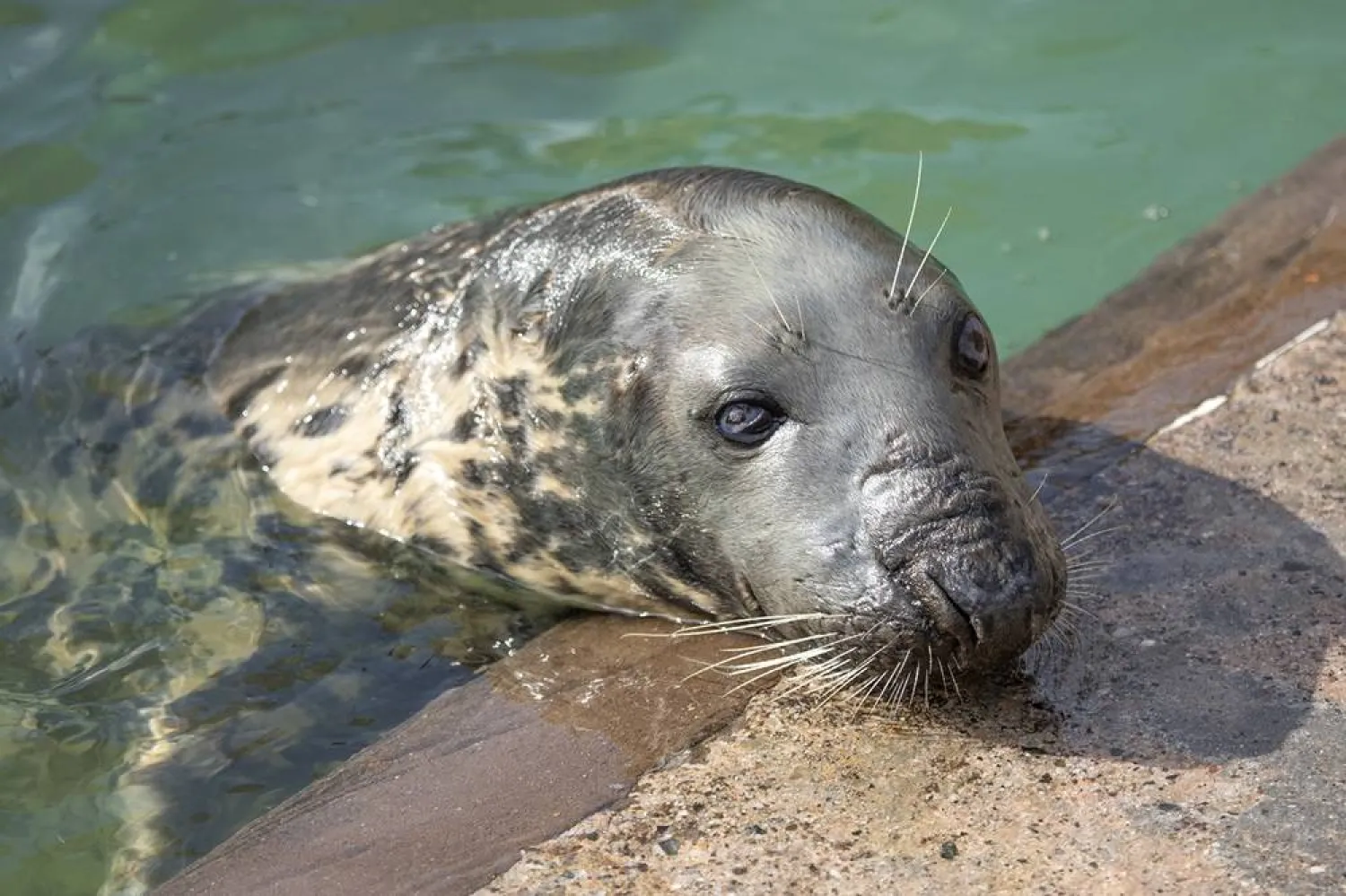
In this undated image made available by Cornish Seal Sanctuary shows Sheba the seal at the Cornish Seal Sanctuary in Gweek, south west England. (Barry Williams/Cornish Seal Sanctuary via AP)
TT

Seal Marks Her 50th Birthday at a Sanctuary

In this undated image made available by Cornish Seal Sanctuary shows Sheba the seal at the Cornish Seal Sanctuary in Gweek, south west England. (Barry Williams/Cornish Seal Sanctuary via AP)

As gray seals go, Sheba is grayer than most.

The grand dame of the Cornish Seal Sanctuary is being celebrated Saturday for her 50th birthday, far surpassing the lifespan of a seal in the wild and possibly being the oldest in captivity.

"Reaching 50 is a huge milestone, not just for Sheba but for everyone here who has been part of her journey," said Tamara Cooper, curator at the facility in southwest England.

Things weren't looking bright for the young pup when she was rescued from a Cornwall beach in September 1974.

Ken Jones found Sheba with a head injury and nasty eye infection and took her home where he and his wife, Mary, rehabilitated seals in a pool.

As Sheba grew up, so did the rescue operation, moving from Jones' backyard to the Helford River in the village of Gweek and expanding to rehabilitate over 70 seal pups a year.

Sheba’s condition, including loss of vision, prevented her return to the sea and she’s now outlasted all of the other creatures who have come and gone, making her a favorite fixture at the facility.

Sheba’s longevity is attributed to the care she’s received and advances in veterinary medicine.

Seals typically survive 25 to 30 years in the wild, Cooper said. Females in captivity can live to 40 while males live to about 30.

Spook, a male gray seal born at the New York Aquarium in 1965, had been believed to be the oldest seal in captivity when he died weeks shy of his 45th birthday in 2010.

While Sheba's well-known and well-liked by the public and her handlers, she's not the most cooperative creature.

When she was raised by Jones, his focus was on rescue, rehabilitation and release, said Heather Green, an animal care specialist. There was no training for the animals that stayed behind until more recent years.

She has been reluctant to learn new tricks, such as being rolled over for inspections of her belly, flippers, tails and teeth. When it comes to receiving drops for her milky eyes, she does well some days while on others she waddles her mottled-fur frame away and splashes back into the pool.

"She's a bit stubborn," Green said. "She’d been so used to just being fed and not having to work for her fish that even now she still protests slightly. If we ask her to do any behavior or something, it’s all on her own sweet time and she’ll definitely let you know if she’s up for training or not."

The public has been invited to her so-called seal-abration, where she'll be sung "Happy Birthday" and presented with a specially made ice caked topped with the number 50 and mackerel and herring.

"She’ll eat any fish," Green said. "She’s not particularly fussy."



Hello Kitty Designer Bows Out After 40 Years in Charge 

A participant dressed as Hello Kitty throws beans during the annual Setsubun ceremony to celebrate the upcoming arrival of spring. (Reuters)
TT

Hello Kitty Designer Bows Out After 40 Years in Charge 

A participant dressed as Hello Kitty throws beans during the annual Setsubun ceremony to celebrate the upcoming arrival of spring. (Reuters)

The flamboyant designer behind Hello Kitty -- the cute Japanese character that became a global mega brand -- is stepping down after more than four decades in charge of her look.

Yuko Yamaguchi has been responsible since 1980 for the design of Kitty, who is officially not a cat but a little girl from London, overseeing her rise to the epitome of Japan's "kawaii" -- cute -- soft power.

But now Yamaguchi, who often wore Kitty-style dresses in public and piled her hair in buns -- has "passed the baton to the next generation", Sanrio, the company behind the character, said on its website Tuesday.

The company said new designer "Aya" -- a pseudonym -- was due to start by the end of 2026.

Yamaguchi "listened to the voices of fans, actively collaborated with artists and designers from Japan and abroad and has grown Hello Kitty into a character loved by everyone", Sanrio said, as it thanked her for her work.

Hello Kitty started life as an illustration on a vinyl coin purse.

It has since appeared on tens of thousands of products -- everything from handbags to rice cookers -- and has secured lucrative tie-ups with Adidas, Balenciaga and other top brands.

The phenomenon shows no sign of slowing, with a Warner Bros movie in the pipeline and a new Hello Kitty theme park due to open next year on China's tropical Hainan island.

Unlike other Japanese cultural exports such as Pokemon or Dragon Ball, there is minimal narrative around the character, whose full name is Kitty White.

She has a twin sister Mimmy, a boyfriend called Dear Daniel, and a pet cat of her own, Sanrio says. She loves her mother's apple pie and dreams of becoming a pianist or poet.


Hundreds of Thousands without Power After Storm Lashes France 

A man walks along a flooded street of Saint-Germain de Confolens as severe flooding hits western France amid storm Nils, Thursday, Feb. 12, 2026. (AP)
TT

Hundreds of Thousands without Power After Storm Lashes France 

A man walks along a flooded street of Saint-Germain de Confolens as severe flooding hits western France amid storm Nils, Thursday, Feb. 12, 2026. (AP)

Around 450,000 households in southern France were without power on Friday, operator Enedis said, a day after a storm tore through the region, ripping up trees and flooding roads.

High winds and hard rain brought chaos across southern France, northern Spain and parts of Portugal on Thursday, forcing cancellations of flights, trains and ferries and disruption on roads.

French officials said a truck driver was killed when a tree smashed through his windscreen, while dozens were injured in weather-related incidents in Spain and a viaduct in Portugal partially collapsed because of flooding.

French forecasters said the storm, named Nils, was "unusually strong" and France's electricity distributor said it had mobilized around 3,000 as it battled to reconnect households to the grid.

"Enedis has restored service to 50 percent of the 900,000 customers who were without electricity," it wrote around 6:00 am (0500 GMT).

"Flooding complicates repairs because the fields are waterlogged and some roads are blocked," Enedis crisis director Herve Champenois said during a press briefing on Thursday.

Residents across the south of France were shocked at the storm's ferocity.

"I've never seen anything like it," Ingrid, a florist in the city of Perpignan, told AFP. "A tree almost fell on my car -- two seconds more and it would have."

"During the night, you could hear tiles lifting, rubbish bins rolling down the street -- it was crazy," said Eugenie Ferrier, 32, from the village of Roaillan near Bordeaux in the southwest.

Forecasters said the storm had moved eastwards away from French territory during Thursday, though some areas were still on alert for flooding.


Thailand Uses Birth Control Vaccine to Curb Elephant Population Near Expanding Farms

This photo released by Thailand Department of National Parks, Wildlife and Plant Conservation shows a wild elephant after it received an elephant contraception vaccine in the Trat province of Thailand, Tuesday, Jan. 27, 2026. (Thailand Department of National Parks, Wildlife and Plant Conservation via AP)
TT

Thailand Uses Birth Control Vaccine to Curb Elephant Population Near Expanding Farms

This photo released by Thailand Department of National Parks, Wildlife and Plant Conservation shows a wild elephant after it received an elephant contraception vaccine in the Trat province of Thailand, Tuesday, Jan. 27, 2026. (Thailand Department of National Parks, Wildlife and Plant Conservation via AP)

Thailand has begun using a birth control vaccine on elephants in the wild to try and curb a growing problem where human and animal populations encroach on each other — an issue in areas where farms spread into forests and elephants are squeezed out of their natural habitat.

The initiative is part of efforts to address confrontations that can turn deadly. As farmers cut down forests to make more farmland, elephants are forced to venture out of their shrinking habitats in search of food.

Last year, wild elephants killed 30 people and injured 29 in Thailand, according to official figures, which also noted more than 2,000 incidents of elephants damaging crops.

Sukhee Boonsang, director of the Wildlife Conservation Office, recently told The Associated Press that controlling the wild elephant population has become necessary as numbers of elephants living near residential areas rises sharply, increasing the risk of confrontations.

The office obtained 25 doses of a US-made vaccine and conducted a two-year trial on seven domesticated elephants — using up seven doses of the vaccine — which yielded promising results, he said. He explained the vaccine doesn't stop female elephants from ovulating but prevents eggs from being fertilized.

Then, in late January, the vaccine was administered to three wild elephants in eastern Trat province, he said, adding that authorities are now determining which areas to target next as they prepare to use up the remaining 15 doses.

The vaccine can prevent pregnancy for seven years and the elephants will be able to reproduce again if they don’t receive a booster after that time expires. Experts will closely monitor the vaccinated elephants throughout the seven-year period.

The vaccination drive has drawn criticism that it might undermine conservation efforts.

Thailand has a centuries-old tradition of using domesticated elephants in farming and transportation. Elephants are also a big part of Thailand’s national identity — and have been officially proclaimed a symbol of the nation.

Sukhee said the program targets only wild elephants in areas with the highest rates of violent human-elephant conflict. Official statistics show a birth rate of wild elephants in these regions at approximately 8.2% per year, more than double the national average of around 3.5%.

About 800 out of the nation’s approximately 4,400 wild elephants live in these conflict-prone areas, Sukhee said.

“If we don’t take action, the impact on people living in these areas will continue to grow until it becomes unmanageable,” he said.

In addition to the contraception vaccine, authorities have implemented other measures to reduce conflict, Sukhee said, such as creating additional water and food sources within the forests where elephants live, constructing protective fencing, and deploying rangers to guide elephants that stray into residential areas back into the wild.

A court-ordered operation earlier this month to remove wild elephants that have repeatedly clashed with locals in northeastern Khon Kaen province sparked a public outcry after one elephant died during the relocation process.

An initial autopsy revealed that the elephant died from choking after anesthesia was administered ahead of the move, officials said.

The Department of National Parks, Wildlife and Plant Conservation carried out the relocation effort, and its director general, Athapol Charoenshunsa, expressed regret over the incident while insisting that protocol was followed properly. He said an investigation was underway to prevent such incidents from happening again.