



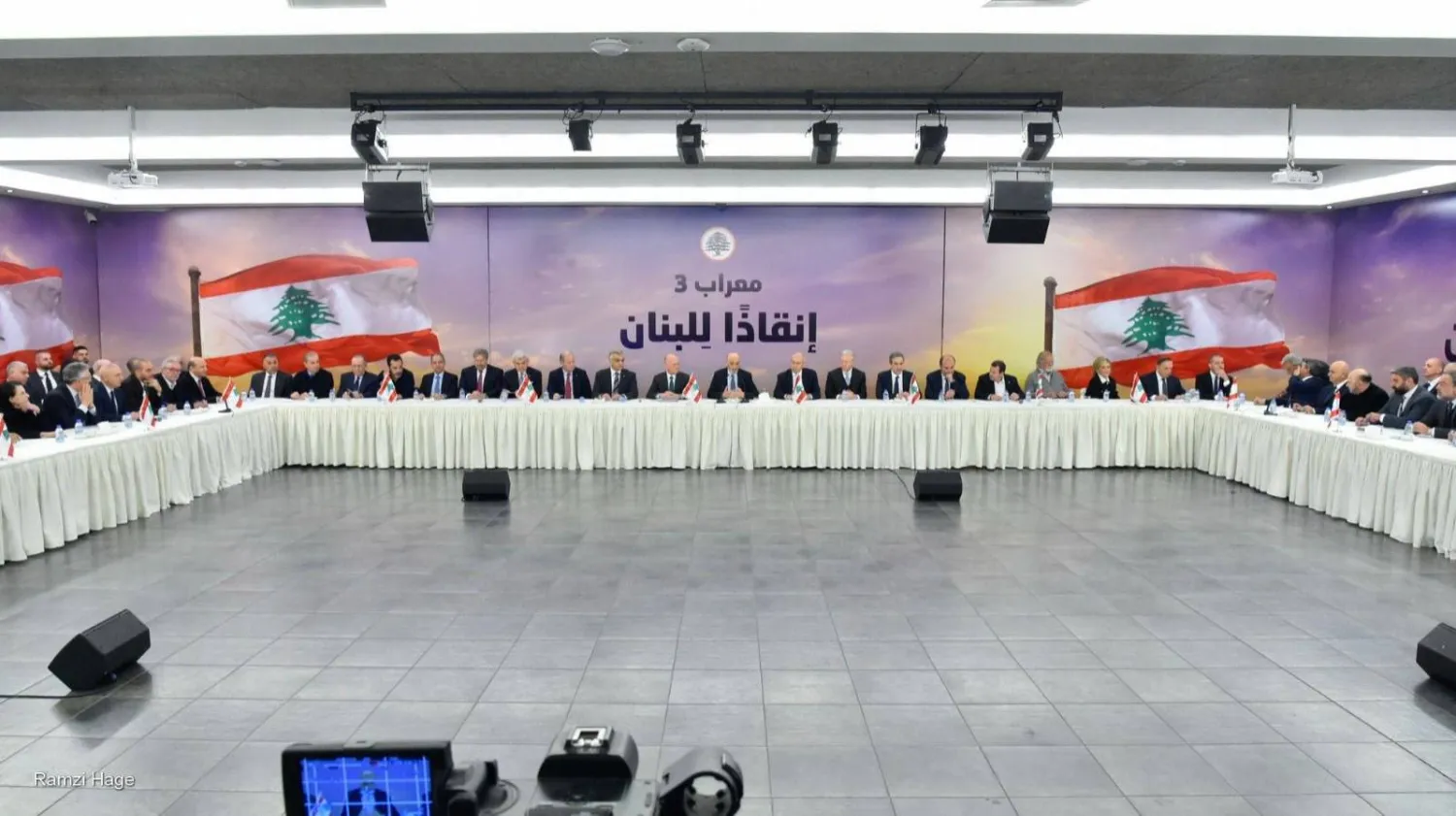

Beirut MPs representing most of Lebanon’s political parties met in the capital to support a government move declaring the city “safe and weapons-free,” following recent security incidents and Israeli strikes.
The conference brought together most factions, except MPs from Hezbollah, the Amal Movement and Al-Jamaa al-Islamiya.
Despite political divisions, participants struck a unified rhetoric, calling for all weapons to be placed exclusively under state control and for a stronger presence of official institutions, chiefly the Lebanese Army, across the capital to ensure stability and restore public confidence in security.
MP Fouad Makhzoumi said Beirut “deserves to be protected together” and would remain “a city that embraces everyone,” describing the “Black Wednesday” as a serious warning of the risks still facing the capital.
He called for the army to deploy across all neighborhoods, for checkpoints to be reinforced and for effective security oversight, stressing that state-building requires a monopoly on arms “without exception.”
He further stressed all necessary measures should be taken to restore order, “up to declaring general mobilization if needed.”
For his part, MP Ghassan Hasbani of the Lebanese Forces said the meeting reflected a national stance tied to the responsibility of representing Beirut’s residents. He voiced support for state efforts to assert full authority, confiscate illegal weapons and treat any armed activity outside state control as a direct threat to the capital’s security and stability.
Kataeb Party lawmaker Nadim Gemayel noted that Lebanon should no longer be used as a bargaining chip by external actors, calling for firm implementation of government decisions and for the army to deploy across the country, starting with Beirut, to protect citizens and reinforce sovereignty.
Similarly, MP Ibrahim Mneimneh said Hezbollah had dragged Lebanon into a conflict unrelated to it, exposing the country to heavy losses, while Beirut and other regions paid the price in security and stability. He stressed that the current phase required restoring state authority and ensuring its exclusive control over arms.
MP Waddah Sadeq said the Lebanese “have the right to loyalty to Lebanon alone,” urging support for what he described as “historic” government decisions. He called for unity under a state based on institutions and the rule of law, and for security forces to fully carry out their duties.
MP Nicolas Sehnaoui of the Free Patriotic Movement highlighted the need for an inclusive national approach to rebuild trust in the state, stressing that limiting arms to the army and legitimate forces remains essential, while avoiding exclusionary rhetoric.
Lawmaker Edgar Traboulsi said Beirut, despite wars and crises, “does not die,” but needs unity and solidarity free from division and incitement.
MP Faisal Sayegh of the Progressive Socialist Party stated that Beirut’s security is inseparable from Lebanon’s, calling for adherence to sovereignty and independence and implementation of the Taif Agreement and relevant government decisions.


