Lebanese Doctor Races to Save the Eyes of Those Hurt by Exploding Tech Devices

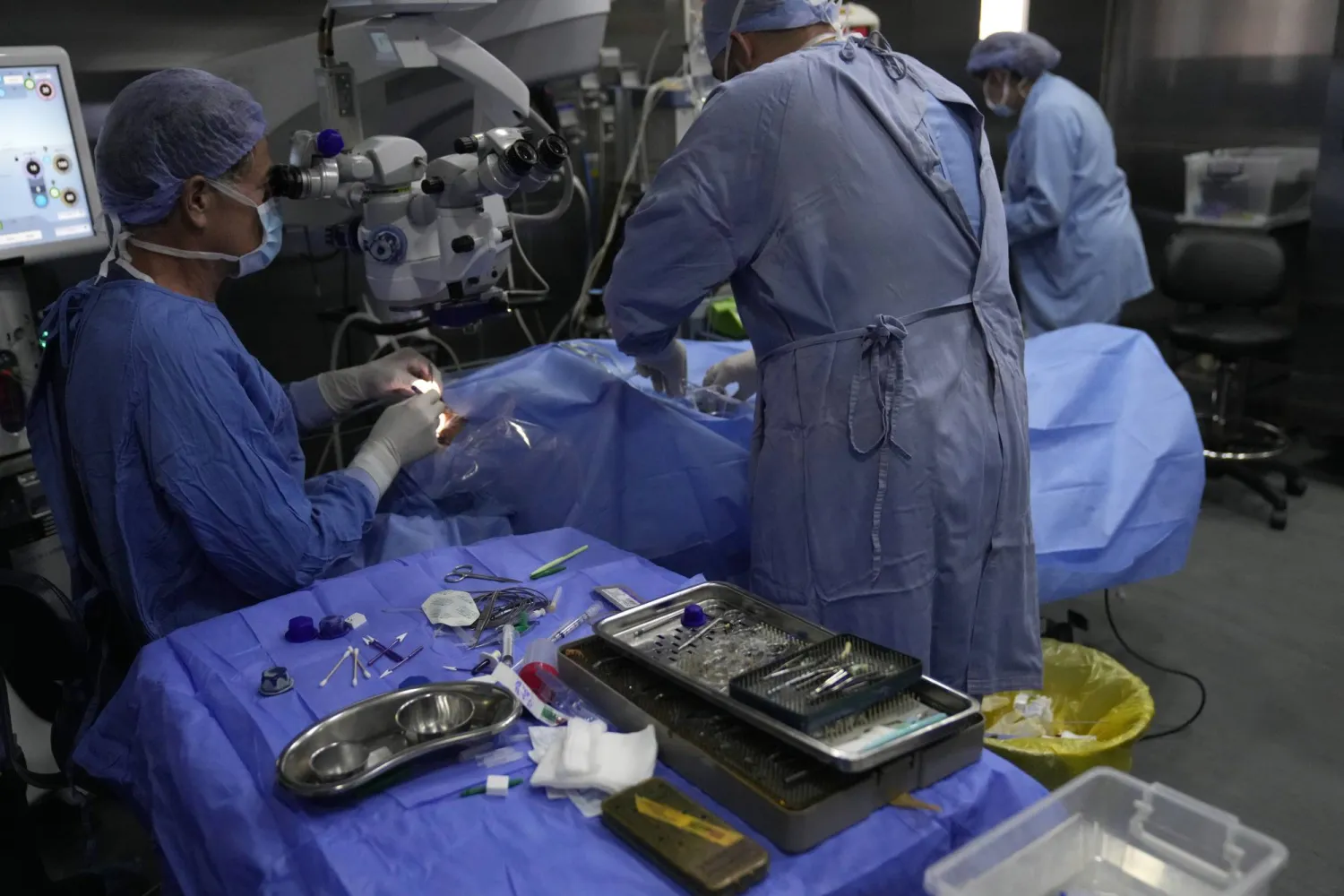
Elias Jaradeh, a legislator and an ophthalmologist, left, who has conducted dozens of operation for victims of this week's attack in Lebanon, makes an eye surgery operation for a man who was injured in the explosion of one of the handheld devices, at the Eye Specialist hospital, in Beirut, Lebanon, Friday, Sept. 20, 2024. (AP Photo/Hussein Malla)
TT

Lebanese Doctor Races to Save the Eyes of Those Hurt by Exploding Tech Devices

Elias Jaradeh, a legislator and an ophthalmologist, left, who has conducted dozens of operation for victims of this week's attack in Lebanon, makes an eye surgery operation for a man who was injured in the explosion of one of the handheld devices, at the Eye Specialist hospital, in Beirut, Lebanon, Friday, Sept. 20, 2024. (AP Photo/Hussein Malla)

For almost a week, ophthalmologist Elias Jaradeh has worked around the clock, trying to keep up with the flood of patients whose eyes were injured when pagers and walkie-talkies exploded en masse across Lebanon.
He has lost track of how many eye operations he has performed in multiple hospitals, surviving on two hours of sleep before starting on the next operation. He has managed to save some patients’ sight, but many will never see again.
“There is no doubt that what happened was extremely tragic, when you see this overwhelming number of people with eye injures arriving at the same time to the hospital, most of them young men, but also children and young women,” he told The Associated Press at a Beirut hospital this past week, struggling to hold back tears.
Lebanese hospitals and medics were inundated after thousands of hand-held devices belonging to the Hezbollah militant group detonated simultaneously on Tuesday and Wednesday last week, killing at least 39 people. Around 3,000 more were wounded, some with life-altering disabilities. Israel is widely believed to have been behind the attack, although it has neither confirmed nor denied its involvement.
Although the explosions appear to have targeted Hezbollah fighters, many of the victims were civilians. And many of those hurt in the attack suffered injuries to their hands, face and eyes because the devices received messages just before they detonated, so they were looking at the devices as they exploded.
Authorities have not said how many people lost their eyes.
Veteran and hardened Lebanese eye doctors who have dealt with the aftermath of multiple wars, civil unrest and explosions, said they have never seen anything like it.
Jaradeh, who is also a lawmaker representing south Lebanon as a reformist, said most of the patients sent to his hospital, which specializes in ophthalmology, were young people who had significant damage to one or both eyes. He said he found plastic and metal shrapnel inside some of their eyes.
Four years ago, a powerful blast tore through Beirut’s port, killing more than 200 people and wounding more than 6,000. That explosion, caused by the detonation of hundreds of tons of ammonium nitrates that had been stored unsafely at a port warehouse, blew out windows and doors for miles around and sent cascades of glass shards pouring onto the streets, leading to horrific injuries.
Jaradeh also treated people hurt in the port explosion, but his experience with those wounded by the exploding pagers and walkie-talkies has been so much more intense because of the sheer volume of people with eye injuries.
“Containing the shock after the Beirut port blast was, I believe, 48 hours while we haven’t reached the period of containing the shock now,” Jaradeh said.
Jaradeh said he found it hard to dissociate his job as a doctor from his emotions in the operating theater.
“No matter what they taught you (in medical school) about distancing yourself, I think in a situation like this, it is very hard when you see the sheer numbers of wounded. This is linked to a war on Lebanon and war on humanity,” Jaradeh said.



Sources to Asharq Al-Awsat: Hamas to Discuss Weapons Issue With Mediators in Coming Days

A Palestinian child picks flowers on Thursday from a field near destroyed buildings in the Nuseirat refugee camp, north of Deir al-Balah in central Gaza (AFP)
TT

Sources to Asharq Al-Awsat: Hamas to Discuss Weapons Issue With Mediators in Coming Days

A Palestinian child picks flowers on Thursday from a field near destroyed buildings in the Nuseirat refugee camp, north of Deir al-Balah in central Gaza (AFP)

As Israeli Prime Minister Benjamin Netanyahu intensifies pressure to disarm Hamas and other armed factions as part of the second phase of a ceasefire, the Palestinian movement is pushing back, saying the issue of weapons must be resolved through a broader “national consensus.”

Factional sources in Gaza told Asharq Al-Awsat that “general consultations” are underway with Hamas on the weapons issue alongside other matters.

One source said more serious talks with mediators are likely to begin in the coming days, particularly as preparations to hand over governmental responsibilities in the enclave to the Gaza Administration Committee begin.

Netanyahu said at a news conference on Tuesday that the disarmament process will happen either the easy way or the hard way, but it will happen in the end.

US President Donald Trump has also said Hamas must disarm as it had pledged to do, while his envoy to the United Nations, Mike Waltz, said the Board of Peace would put pressure on the movement to disarm.

Senior Hamas officials insist the weapons file is a purely Palestinian matter that does not concern the movement alone, and that any decision must be taken within a framework of “national consensus.”

No agreement yet

A Hamas source told Asharq Al-Awsat that the issue of the “weapons of resistance” remains at the stage of general consultations, whether among factions or with mediators.

The source said Hamas has again floated ideas and approaches, including placing the weapons under the custodianship of an agreed Palestinian body, or under guarantees from mediators, in a way that would prevent their disarmament by US or Israeli means or their transfer to either side.

The sources stressed that no agreement has been reached to date and that the issue has not yet been seriously discussed.

Israeli Channel 13 reported on Monday that the United States is expected in the coming days to present Israel and Hamas with a document setting a deadline to begin disarmament and comply with the conditions of the second phase.

The report said the document would allow the Israeli government to act independently to carry out the process if the Palestinian movement failed to comply.

Israeli military sources, cited by the public broadcaster on Sunday, expressed doubt that Hamas would accept disarmament. Channel 14 reported that a series of military plans had been approved to force Hamas to do so, including the possibility of reoccupying the Gaza Strip in full.

US envoy Steve Witkoff said days ago that a new meeting with Hamas might be needed if required, adding that he expected the movement to agree to disarm eventually.

Inclusive national framework

Hamas sources inside and outside Gaza said the movement wants any agreement on weapons to be reached within a comprehensive, inclusive national framework. They said consultations have taken place with Palestinian factions and that a proposal is being formulated to present to mediators during serious talks on the issue.

Sources said some mediators raised the issue of weapons during recent meetings, including a meeting in Istanbul days ago between Hamas leaders and Turkish Foreign Minister Hakan Fidan.

One source said mediators and some parties, which he did not specify, had shown acceptance of approaches put forward during the general consultations that affirm the right of Palestinian factions to retain what enables them to resist occupation.

On Hamas’s understanding of “national consensus,” sources, including a senior leader, told Asharq Al-Awsat that the weapons do not belong to Hamas alone, noting that other armed factions have taken part effectively in resisting the Israeli occupation.

“We cannot alone decide the fate of an important issue tied to the principles and future of the Palestinian cause,” one of the Hamas sources said.

While Hamas appears keen to avoid being seen as standing alone behind a decision to hand over or dismantle faction weapons in a way that would portray it as defeated, the sources rejected that interpretation.

They said several issues must be settled within a framework of Palestinian national consensus, as was done in the handover of governance in Gaza to a technocratic committee.

They added that a national committee of Gaza factions would work with the committee to ensure it receives all the tools needed for government work, to reach an inclusive national formulation on this “fateful issue.”

The sources said national consensus is not limited to weapons but extends to other “existential issues.”

What role for Fatah

Asked whether Fatah would take part in new factional consultations on the weapons issue, a senior Hamas source said: “Certainly, we are seeking that. But we do not know whether it will refuse, as it did in consultations on forming the technocratic committee, or agree. In any case, Hamas has no problem with decisions being taken in the same way.”

He said the goal of factional consultations due to be held soon in Cairo is to reach an explicit agreement on the fate of the weapons of resistance, without any unilateral decision by Hamas or any other faction on this and other critical issues related to the future of Gaza and the Palestinian cause.

These include moving toward a comprehensive Palestinian national dialogue to restore unity under Arab, Islamic, and international sponsorship.

Israeli and US threats

It remains unclear how Israel and the US will respond to Hamas’s steps, as Israel threatens a return to military action. Some Palestinians believe the Trump administration may be open to other options regarding the future of the weapons.

Trump said about Hamas members, roughly two weeks ago, that they were born with weapons in their hands, so giving them up is not a simple matter.

US Ambassador to the United Nations Mike Waltz said on Wednesday that all military, terrorist, and offensive infrastructure will be destroyed, including tunnels and weapons production facilities, and they will not be rebuilt.

He added that independent international monitors would oversee the disarmament process in Gaza, placing weapons permanently out of use through an agreed process to decommission them, supported by an internationally funded buyback and reintegration program.

Mousa Abu Marzook, a member of Hamas’s political bureau, said in televised remarks that any arrangements concerning Gaza must be reached in understanding with the movement, including the weapons issue. He said Hamas has never accepted handing over its weapons in any form.


Israeli Fire Kills Two in Gaza as Truce Deal Moves to Next Phase

Mourners react during the funeral of Palestinians who, according to medics, were killed by Israeli gunfire on Thursday, at Nasser Hospital in Khan Younis, in the southern Gaza Strip. REUTERS/Ramadan Abed
TT

Israeli Fire Kills Two in Gaza as Truce Deal Moves to Next Phase

Mourners react during the funeral of Palestinians who, according to medics, were killed by Israeli gunfire on Thursday, at Nasser Hospital in Khan Younis, in the southern Gaza Strip. REUTERS/Ramadan Abed

Israeli fire killed at least two Palestinians in Gaza on Thursday, health officials said, in the latest violence rattling a fragile ceasefire as Hamas and Israel looked to implement the second phase of the US-brokered Gaza peace plan.

Medics said two men were killed by Israeli forces in eastern Khan Younis, in an area adjacent to where the army operates. The Israeli military told Reuters it wasn't aware of any casualties as a result of Israeli fire on Thursday.

The Gaza health ministry said Israeli airstrikes, tank shelling and gunfire have killed at least 490 people since the truce took effect in October after two years of war that widely demolished the Palestinian enclave.

Israel said four soldiers have been killed by Palestinian militants in the small coastal territory over the same period.

The two sides have traded blame over the truce violations.

By advancing to phase two, the US and mediator partners Egypt and Qatar must confront the more contentious issue of Hamas disarmament, which the group has long rejected. The plan also calls for deploying an international peacekeeping force.


Lebanese Security Arrests Network Smuggling Drugs from Türkiye to Saudi Arabia

 A billboard on the road to Beirut International Airport promoting tourism in Lebanon. (AP) 
 A billboard on the road to Beirut International Airport promoting tourism in Lebanon. (AP) 
TT

Lebanese Security Arrests Network Smuggling Drugs from Türkiye to Saudi Arabia

 A billboard on the road to Beirut International Airport promoting tourism in Lebanon. (AP) 
 A billboard on the road to Beirut International Airport promoting tourism in Lebanon. (AP) 

Lebanese General Security has dismantled an organized network involved in smuggling drugs from Türkiye to Saudi Arabia, as authorities reiterated that Lebanon “will not be a platform or transit route for drug trafficking to sisterly or friendly countries.”

In a statement, the Media Affairs Office of Lebanon's General Security said that, as part of close monitoring of passenger movements at border crossings, officers at Beirut’s Rafic Hariri International Airport arrested four Turkish nationals, three men and one woman, while they were attempting to enter Lebanon on a flight arriving from Istanbul.

According to the statement, suspicions were raised by the suspects’ frequent travel patterns. Acting on instructions from the competent judiciary, the detainees were subjected to security interrogations that revealed they had established an organized network to smuggle narcotics from Türkiye to the Kingdom, in coordination with external parties and in exchange for financial payments.

Investigations also showed that they had carried out several previous operations using professional methods.

The statement added that investigations produced evidence confirming their direct involvement in smuggling activities. The suspects and seized materials were referred to the competent authorities under the supervision of the Mount Lebanon Public Prosecutor’s Office.

Interior and Municipalities Minister Ahmad Al-Hajjar praised “the significant efforts made by the security services, particularly the Directorate General of General Security, in combating drug-trafficking networks,” commending the “high-quality operation carried out at Beirut’s Rafic Hariri International Airport that led to the arrest of an organized network involved in smuggling narcotics.”

He stressed that Lebanon “will never be a platform or transit route for drug trafficking to sisterly or friendly countries, especially the Kingdom of Saudi Arabia,” and will not allow its territory to be used to undermine the security of Arab and international societies.