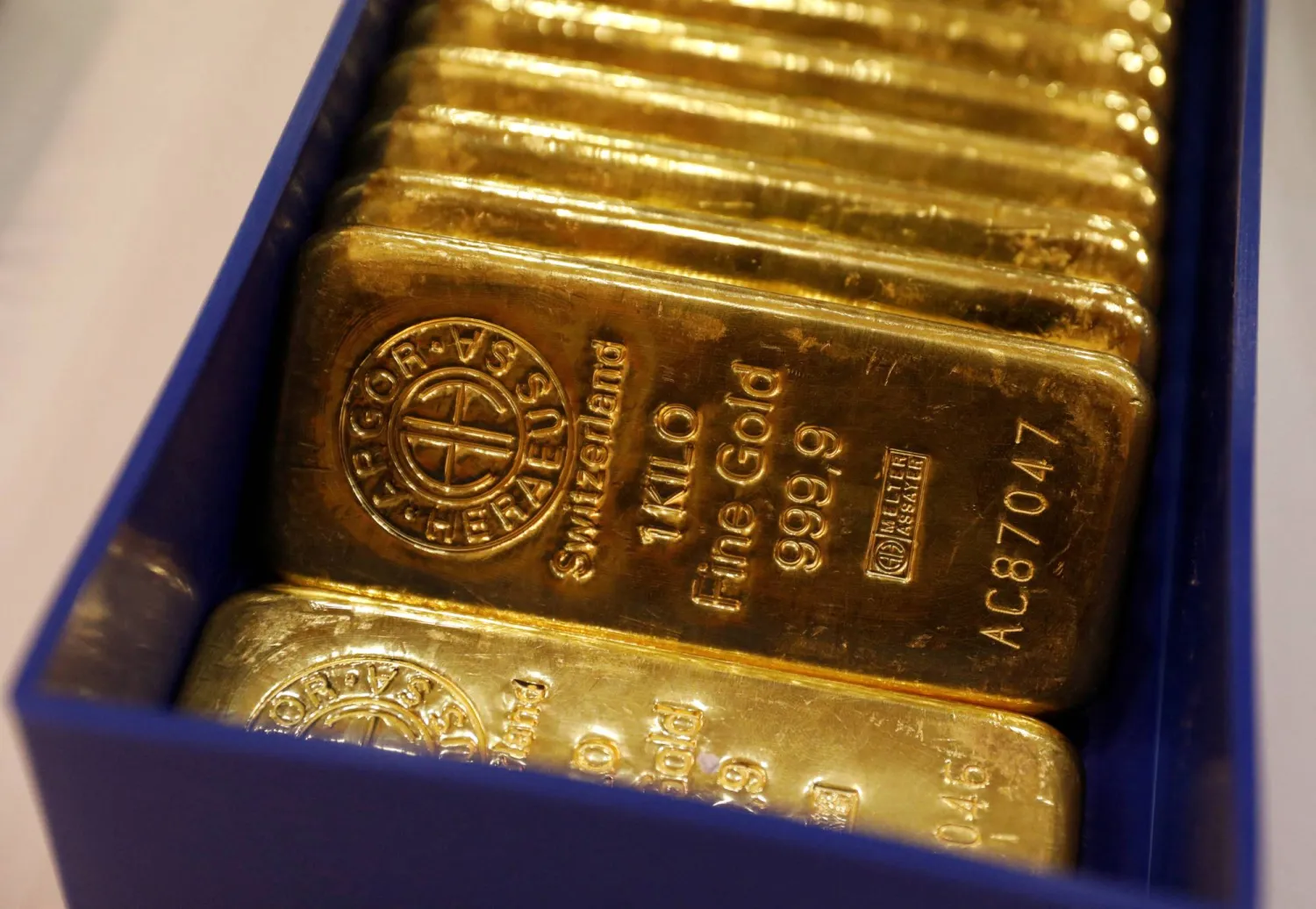
Gold Prices Sprint to Record High on Dovish Fed-Speak, Mideast Concerns

FILE PHOTO: Gold bullions are displayed at GoldSilver Central's office in Singapore June 19, 2017. REUTERS/Edgar Su/File Photo
TT

Gold Prices Sprint to Record High on Dovish Fed-Speak, Mideast Concerns

FILE PHOTO: Gold bullions are displayed at GoldSilver Central's office in Singapore June 19, 2017. REUTERS/Edgar Su/File Photo

Gold prices charged to another record high on Tuesday, aided by broadly dovish comments from US Federal Reserve officials and escalating tensions in the Middle East.
Spot gold gained 0.3% to $2,636.85 per ounce as of 0507 GMT. Bullion rose to a record high of $2,638.37 earlier in the session. It had also hit an all-time peak on Monday.
US gold futures rose 0.4% to $2,661.60.
"Gold prices continue to be well-supported amid a series of dovish Fed rhetoric overnight," said IG market strategist Yeap Jun Rong.
Fed policymakers on Monday said their large half-percentage-point rate cut last week was meant to try to sustain what they see as an emerging and healthy balance in the economy, reported Reuters.
Chicago Fed Bank President Austan Goolsbee said there are "lots of cuts" to come over the next 12 months, while Fed President Neel Kashkari noted that the actual path would depend on incoming data.
Fed futures traders have priced in 75 basis points in rate cuts by the end of 2024, according to the CME FedWatch Tool.
Zero-yield bullion tends to be a preferred investment in a low interest rate environment and during geopolitical turmoil.
"A new war front opened in the Middle East between Israel and Hezbollah has also driven some flows for safe-haven gold in a bid to hedge against the geopolitical risks of any wider regional war," Yeap Jun Rong said.
"Tensions in the region will likely be kept high for longer, which could see gold prices retain its bullish bias."
Israel's military launched airstrikes against Hezbollah sites in Lebanon on Monday, resulting in 492 deaths and forcing tens of thousands to flee and marking the country's deadliest day in decades.
Among other metals, spot silver rose 1.3% to $31.07 per ounce, platinum was up 1.4% to $969.35 and palladium climbed 1.1% to $1,053.09.



Iraq Says Kurdish Authorities Refusing to Let It Send Oil Through Their Pipeline

A truck drives at the Iraq-Iran border crossing of Bashmagh near Sulaimaniyah in Iraq's autonomous Kurdistan region on March 11, 2026. (AFP)
TT

Iraq Says Kurdish Authorities Refusing to Let It Send Oil Through Their Pipeline

A truck drives at the Iraq-Iran border crossing of Bashmagh near Sulaimaniyah in Iraq's autonomous Kurdistan region on March 11, 2026. (AFP)

Iraq’s oil ministry said the Kurdistan Regional Government had refused to let it use a pipeline as an alternative route for crude flows disrupted by the Iran conflict, accusing authorities there of putting up irrelevant conditions.

A senior Kurdish government official told Reuters authorities there would be happy for the Iraqi government to use the pipeline, but said Baghdad first needed to lift what he called a "dollar ‌embargo" on the ‌region.

"We want a deal. We ‌want ⁠to help Iraq ⁠and bring relief to the markets, but this embargo must end first," the official said.

Oil production from Iraq's main southern oilfields, where most of its crude is produced and exported, has plunged 70% to just 1.3 million bpd, sources told Reuters on March 8, ⁠as the Iran conflict effectively shut off ‌the vital Strait of ‌Hormuz.

Iraq's oil ministry sent a letter in early March to ‌the Kurdistan Regional Government seeking permission to pump ‌at least 100,000 barrels per day of crude from Kirkuk oilfields through the Kurdistan pipeline network to Türkiye's Ceyhan energy hub, two oil officials told Reuters last week.

The Kurdish official ‌said they had been pressing for an end to what he said was ⁠a bar ⁠on the region's banks accessing dollars for goods imported through its borders and airports.

Kurdish officials say tensions with Baghdad have risen after the federal government moved to implement a new electronic customs system, allowing it to monitor imports and revenues, a step the KRG sees as undermining its autonomy and control over trade.

Iraq's oil ministry said the Kurdistan Regional Government's Ministry of Natural Resources had "set a number of conditions unrelated to the issue of crude oil exports."


Over 400 Million Barrels of Emergency Oil Reserves to Flow to Global Markets Soon, IEA Says

 A woman holds a fuel pump as she fills her car tank at a gas station in the Manhattan borough of New York City on March 14, 2026. (AFP)
A woman holds a fuel pump as she fills her car tank at a gas station in the Manhattan borough of New York City on March 14, 2026. (AFP)
TT

Over 400 Million Barrels of Emergency Oil Reserves to Flow to Global Markets Soon, IEA Says

 A woman holds a fuel pump as she fills her car tank at a gas station in the Manhattan borough of New York City on March 14, 2026. (AFP)
A woman holds a fuel pump as she fills her car tank at a gas station in the Manhattan borough of New York City on March 14, 2026. (AFP)

Oil from the International Energy Agency emergency reserves will begin flowing to global markets soon, with member countries pledging to make available 411.9 million barrels, ‌the agency ‌said in ‌a ⁠statement on Sunday.

Governments have ⁠committed to make available 271.7 million barrels of oil from government stocks, 116.6 million ⁠barrels from obligated industry ‌stocks ‌and 23.6 million barrels ‌from other sources, the ‌statement said.

It added that 72% of planned releases are in ‌the form of crude oil and 28% ⁠are ⁠oil products.

Stocks from Asia Oceania countries will be available immediately and stocks from Europe and the Americas will be available at the end of March.


Saudi Economy Accelerates as Diversification and Legal Reforms Drive Growth

Quality of life represents a strategic national priority in Saudi Arabia (SPA). 
TT

Saudi Economy Accelerates as Diversification and Legal Reforms Drive Growth

Quality of life represents a strategic national priority in Saudi Arabia (SPA). 

Saudi Arabia’s economy has undergone nearly a decade of transformation under Crown Prince Mohammed bin Salman, as sweeping reforms and diversification efforts reshape the country’s economic landscape.

Since the launch of Saudi Vision 2030 in April 2016, the Kingdom has embarked on its most significant economic shift in decades. The transformation has extended far beyond fiscal adjustments or limited diversification programs, evolving instead into a broad structural reform aimed at reducing reliance on oil and building a more diverse and dynamic economy.

Economic indicators suggest the strategy is gaining traction. Saudi Arabia’s gross domestic product (GDP) rose from about SAR 2.6 trillion in 2016 to nearly SAR 4.7 trillion in recent years, roughly $1.3 trillion, according to the latest official figures. That represents an average cumulative annual growth rate of about 8 percent, placing the Kingdom among the fastest-growing major economies globally during this period.

The shift reflects Vision 2030’s broader strategy to expand non-oil industries and widen the country’s production base beyond hydrocarbons.


Faisal Al-Fadhel, a legal expert in economic legislation and a member of the board of trustees of the Riyadh Economic Forum, said the reforms launched under Crown Prince Mohammed bin Salman have introduced a more diversified and sustainable economic model.

“Saudi Arabia has moved toward reducing its dependence on oil while expanding promising sectors such as tourism, technology, logistics and advanced industries,” Al-Fadhel told Asharq Al-Awsat. “This approach enhances the resilience of the national economy and increases the attractiveness of the Saudi market for both domestic and foreign investors.”

Recent economic indicators support that assessment. Non-oil activities have recorded strong growth, the private sector’s contribution to GDP has expanded, and foreign direct investment inflows have increased. At the same time, Saudi Arabia has improved its standing in global competitiveness indicators, reinforcing its ambitions to become a regional hub for business and investment.

Al-Fadhel noted that the transformation has also been supported by a broad legislative reform agenda designed to modernize the regulatory environment. Key economic and commercial laws — including the Companies Law, Investment Law, and Bankruptcy Law — have been updated, alongside regulations related to corporate governance, investor protection and competition. The reforms aim to improve transparency, regulatory certainty and the efficiency of the investment environment.

Non-Oil Sectors Lead Growth

One of the most visible outcomes of the economic shift is the rising contribution of non-oil sectors, which now account for 56 percent of GDP. Data show that non-oil activities were the primary driver of real economic growth in 2025.

Saudi Arabia ended 2025 with its strongest growth in two years, with GDP expanding 4.5 percent, according to estimates by the General Authority for Statistics (GASTAT). The economy grew 5 percent in the fourth quarter, with all major sectors contributing to the expansion compared with 2024.

Labor Market Changes

The Saudi labor market has also seen notable shifts. Unemployment among Saudi nationals has declined, while female participation in the workforce has reached record levels following a series of labor and regulatory reforms.

More than 2.48 million Saudis have joined the private sector in recent years, reflecting the impact of job localization policies. Economic transformation programs have also generated roughly 800,000 new jobs, with strong growth in engineering professions.

Employment opportunities have expanded particularly in tourism, supported by major entertainment and tourism projects, as well as in the pharmaceutical and medical manufacturing industries, where job numbers have doubled.

Investment at the Center

Investment has become a central pillar of the Kingdom’s economic strategy. Crown Prince Mohammed bin Salman has positioned both domestic and foreign investment as key drivers of growth and diversification.

The government established the Ministry of Investment and launched the National Investment Strategy as a comprehensive framework to boost capital formation. Total investment — measured by fixed capital formation — has risen from about SAR 672 billion in 2017 to roughly SAR 1.44 trillion by the end of 2024, more than doubling in less than a decade.

Al-Fadhel emphasized that the private sector is a critical partner in achieving Vision 2030 goals through expanded investment, technological adoption, innovation, and entrepreneurship.

Public Investment Fund Expands Role

The Public Investment Fund (PIF) has emerged as a central instrument of the transformation. With assets estimated at SAR 3.47 trillion, it has become one of the world’s largest sovereign wealth funds.

PIF is leading major investments in tourism, renewable energy, industry, technology and entertainment while launching large-scale development projects designed to create new industries and strengthen Saudi Arabia’s position as a global economic hub.