Gold Near Record High; Investors Await Fed Chair Powell's Speech

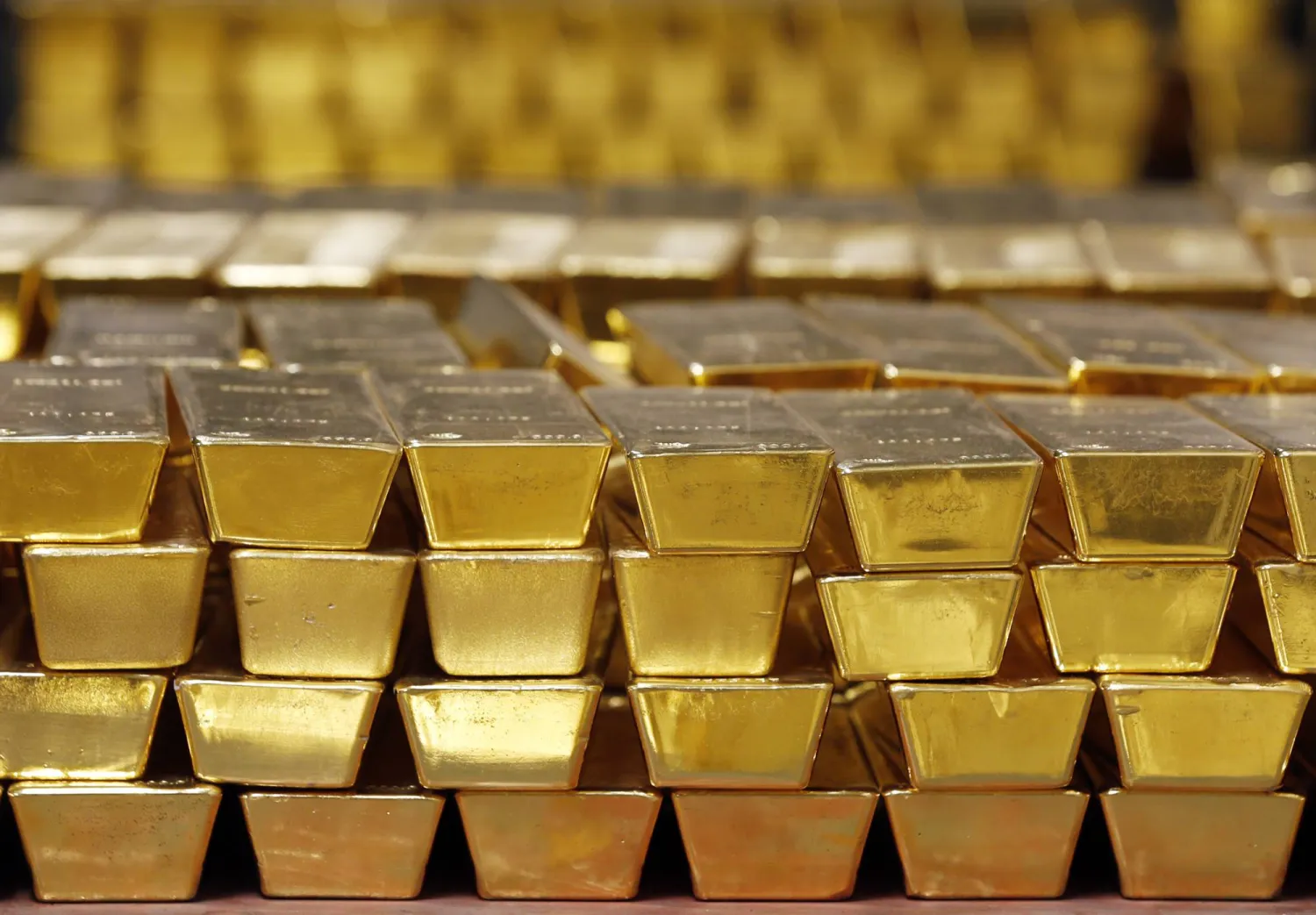
FILE - Gold bars are shown stacked in a vault at the United States Mint, on July 22, 2014, in West Point, N.Y. (AP Photo/Mike Groll, File)
TT

Gold Near Record High; Investors Await Fed Chair Powell's Speech

FILE - Gold bars are shown stacked in a vault at the United States Mint, on July 22, 2014, in West Point, N.Y. (AP Photo/Mike Groll, File)

Gold prices rebounded and looked set to scale a fresh peak on Thursday, on mounting expectations for another US interest rate cut this year, while investors awaited Federal Reserve Chair Jerome Powell's address later today for more policy cues.
Spot gold climbed 0.4% to $2,668.05 per ounce, as of 0913 GMT, a few dollars away from the record $2,670.43 it hit on Wednesday.
US gold futures were up 0.2% to $2,691.20, reported Reuters.
"Gold price strength is feeding on itself just now. That’s to say momentum is driving speculative flows despite a rising US dollar and Treasury yields," said independent analyst Ross Norman.
"Powell's comments will be observed for indications about the depth of further cuts. But really it's a case of when, not if."
Last week, the Fed trimmed the benchmark policy rate by 50 basis points to 4.75%-5.00%. Traders now see a 62% chance of an additional 50 bps reduction in November, according to the CME FedWatch Tool.
Lower interest rates boost non-yielding gold's appeal.
Powell is set to give opening remarks later in the day at a conference, where New York Fed President John Williams and Fed Vice Chair for Supervision Michael Barr will also speak.
Markets will also scan the US jobless claims data on Thursday and the core personal consumption expenditure index - the Fed's preferred inflation indicator - on Friday.
Bullion has risen more than 29% so far in 2024, hitting record highs several times, fueled by the US rate cuts, safe-haven demand due to geopolitical and economic uncertainty and robust central bank buying.
"In the coming weeks, gold could set new records and we see $3,000 an ounce as the maximum extension of the bullish movement," analysts at Intesa Sanpaolo said.
"We forecast a 4Q24 gold average of $2,595, as some profit-taking could materialize towards year end."
Among other metals, spot silver climbed 0.9% to $32.16 per ounce, holding close to the four-month high it hit on Wednesday.
Platinum rose 1.8% to $1,005.61 and palladium gained 2.4% to $1,062.36.



OPEC Further Lowers 2026 Global Oil Demand Growth Forecast

FILE PHOTO: People walk past an installation depicting barrel of oil with the logo of Organization of the Petroleum Exporting Countries (OPEC)  in Baku, Azerbaijan November 19, 2024. REUTERS/Maxim Shemetov/File Photo
FILE PHOTO: People walk past an installation depicting barrel of oil with the logo of Organization of the Petroleum Exporting Countries (OPEC) in Baku, Azerbaijan November 19, 2024. REUTERS/Maxim Shemetov/File Photo
TT

OPEC Further Lowers 2026 Global Oil Demand Growth Forecast

FILE PHOTO: People walk past an installation depicting barrel of oil with the logo of Organization of the Petroleum Exporting Countries (OPEC)  in Baku, Azerbaijan November 19, 2024. REUTERS/Maxim Shemetov/File Photo
FILE PHOTO: People walk past an installation depicting barrel of oil with the logo of Organization of the Petroleum Exporting Countries (OPEC) in Baku, Azerbaijan November 19, 2024. REUTERS/Maxim Shemetov/File Photo

OPEC on Wednesday lowered its forecast for world oil demand growth in 2026 to 580,000 barrels per day, a copy of its monthly report showed, marking the fourth straight downward revision.

The producer group continues to see a smaller impact on consumption since the Iran war started than other forecasters such as the International Energy Agency, which expects demand to decline in 2026, Reuters reported.

The Organization of the Petroleum Exporting Countries also raised its forecast for 2027 oil demand growth, according to the report on OPEC's website.


Bank of America Pledges $250 Billion for US Infrastructure Financing

Signage is seen at the Bank of America Tower in Manhattan, New York City, New York, US, November 2, 2022. (Reuters)
TT

Bank of America Pledges $250 Billion for US Infrastructure Financing

Signage is seen at the Bank of America Tower in Manhattan, New York City, New York, US, November 2, 2022. (Reuters)

Bank of America said on Wednesday it plans to deploy $250 billion by July 2027 to support US digital and infrastructure projects, a move it says will boost the country's economic growth and help create tens of thousands of jobs.

The Wall Street bank said its "Critical Infrastructure Finance Initiative," launched on the heels of the nation's 250th anniversary celebrations, will provide primary market lending, investments, ‌capital markets services, ‌and banking and advisory offerings.

The announcement underscores how ‌major ⁠US financial institutions are seeking ⁠to capitalize on rising demand for AI data centers, critical minerals and energy infrastructure upgrades.

It comes days after Morgan Stanley said it would facilitate roughly $1.5 trillion over the next decade to finance technology and infrastructure projects.

Last year JPMorgan Chase launched a $1.5 trillion plan to facilitate, finance and invest in industries deemed critical to the US national security and economic resilience, including defense, ⁠energy and advanced manufacturing.

BOOSTING GROWTH, CREATING JOBS

Bank of ‌America's financing will target three areas: ‌digital infrastructure, including data centers and computing; energy and power infrastructure, including renewable generation ‌and energy storage; and core infrastructure such as transportation and natural gas.

"Meeting ‌America's growing infrastructure needs requires mobilizing capital at scale across increasingly interconnected sectors," said Karen Fang, global head of infrastructure and sustainable finance at Bank of America.

"Delivering these projects requires integrated financing solutions spanning corporate and project-level capital in both public ‌and private markets."

The $250 billion target will be measured over an 18-month period from January 1, 2026, to July ⁠4, 2027, ⁠the bank said.

"If we all do our job right, we should be deploying more capital," said Fang, who is also co-head of global capital solutions at BofA, when asked about potential deployment of more capital after July 2027.

Many projects require new infrastructure to be built before becoming operational, she said.

In the United States, infrastructure construction loans typically have terms of five to seven years. Once projects are completed and operating, they are often refinanced with longer-term debt lasting 10, 15 or 20 years, Fang said.

She said greater infrastructure investment would help drive economic growth and create long-term jobs.

"Infrastructure spending will lead to economic growth and prosperity," she said.


IEA Cuts 2026 Oil Demand Forecast Again as Hormuz Remains Shut

Boats and a vessel in the Strait of Hormuz, as seen from Musandam, Oman, August 3, 2026. (Reuters)
TT

IEA Cuts 2026 Oil Demand Forecast Again as Hormuz Remains Shut

Boats and a vessel in the Strait of Hormuz, as seen from Musandam, Oman, August 3, 2026. (Reuters)

The International Energy Agency on Wednesday sharply reduced its forecast for global oil demand this year, as supplies remain crimped by the closure of the Strait of Hormuz and high prices deter buyers.

Demand is expected to slump by 1.6 million barrels per day (mb/d), compared with its forecast slump of one million barrels in its previous monthly report in July.

Crude prices have remained well above levels seen before the US and Israeli attacks on Iran in late February, sparking a war that has seen Iran launch attacks at several Gulf countries.

Tehran also responded by effectively shutting down tanker and cargo traffic in the Strait of Hormuz, through which around one-fifth of global oil supplies usually transit.

"The ongoing closure of the Strait of Hormuz and elevated fuel prices continue to weigh on oil consumption," the Paris-based IEA said.

Despite a purported ceasefire and repeated claims that a deal to open the strait was imminent -- what the IEA referred to as "sudden diplomatic pivots" -- only a handful of ships are being let through, leading to volatile pricing on global oil markets.

The IEA said global supplies rose by 2.4 million barrels per day in July, to reach 101.5 mb/d, but that was still 6.3 mb/d lower than a year ago.

But "renewed hostilities and maritime disruptions in July and early August undermined the recovery efforts," the agency said.

It now expects global supply to fall by 4.3 mb/d on average this year, before recovering next year.

On the demand side, the IEA is projecting a return to growth in the fourth quarter of this year.