A Lebanese Family Was Holding a Sunday Gathering When an Israeli Strike Toppled Their Building

First responders inspect the rubble of a building after it was targeted by an Israeli airstrike in the southern Lebanese village of Ain El Delb on September 29, 2024. (AFP)
TT

A Lebanese Family Was Holding a Sunday Gathering When an Israeli Strike Toppled Their Building

First responders inspect the rubble of a building after it was targeted by an Israeli airstrike in the southern Lebanese village of Ain El Delb on September 29, 2024. (AFP)

It was Sunday, family time for most in Lebanon, and Hecham al-Baba was visiting his sister. She insisted he and their older brother stay for lunch, hoping to prolong the warm gathering in stressful times.
The brother declined. Like many in Lebanon, he hadn’t been sleeping because of Israel’s intensifying airstrikes, so he left to take a nap.
The 60-year-old al-Baba, on his annual visit from Germany to see his family in Lebanon, stayed. His sister Donize even convinced him to call an old flame over for coffee. He excitedly stepped into the bathroom to clean up before his visitor arrived.
Within seconds, a huge boom shook the basement apartment. Al-Baba fell to the floor. Something hit him in the chest, knocking the breath out of him. He pulled himself up and reached for the door, screaming his sister’s name. A second explosion threw him back to the floor. The bathroom ceiling — and the whole building above it — collapsed on his back.
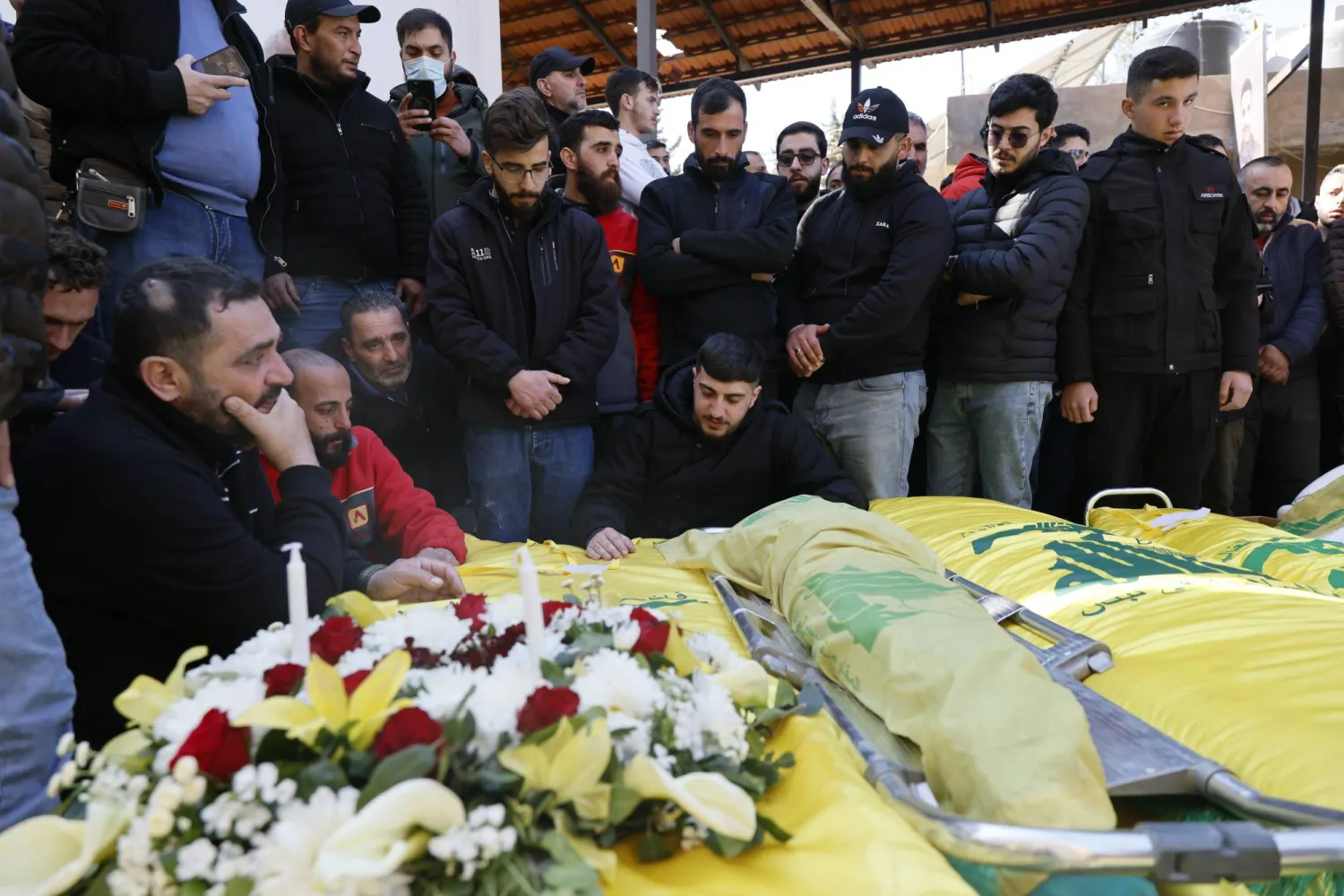
An Israeli air raid hit the six-story residential building in Ain el Delb, a neighborhood outside the coastal city of Sidon. The entire building tipped over down a hillside and landed on its face, taking with it 17 apartments full of families and visitors. More than 70 people were killed, and 60 injured, The Associated Press reported.
Israel said the Sept. 29 strike targeted a Hezbollah commander and claimed the building was a headquarters for the group. It could not be independently confirmed whether any of the residents belonged to Hezbollah.
In a video that surfaced online mourning one of the people believed to be residing in the building, he appeared in an old photo wearing military fatigues, a sign of affiliation with Hezbollah.
Either way, experts say the strike illustrates Israel’s willingness to kill significant numbers of civilians in pursuit of a single target. That tactic has fueled the high death toll among Palestinians in Gaza in Israel’s year-old campaign against Hamas.
Israel has intensified bombardment of Lebanon since Sept. 23, vowing to cripple Hezbollah, which began firing into northern Israel after Hamas’ Oct. 7 attack triggered the war in Gaza. Israel says it is targeting Hezbollah members and infrastructure and says the group places military assets in civilian areas.
Some 2,000 people have been killed, including Hezbollah fighters and commanders — but also hundreds of civilians, often in strikes on homes.
“It seems to be a feature so similar to Gaza in that these are families being killed together in single strikes,” said Emily Tripp, director of the London-based group Airwars, which monitors conflicts.
In the first week of Israel's escalation, it hit a home in Tyre province, killing a family of 15, all of them women and children except for a Hezbollah member. A strike in Byblos killed six family members of a Hezbollah fighter, who had already died in fighting a month before — raising questions about the quality of intelligence used in the strikes. A hit on a shack housing Syrian migrant worker families killed 23.
The strike in Ain el Delb was one of the deadliest of the Israeli campaign. Among those killed were al-Baba’s sister, her husband and two of their children, a daughter in her 20s and a teenage boy.
Al-Baba was trapped for hours, with the rubble pressing him in an agonizing, kneeling position, his neck twisted, his face stuck to the bathroom floor, unable to feel his legs. He knew his sister’s family was dead from the constant, unanswered ringing of their phones.
“No one said a word. I didn’t hear a movement,” he said.
'People don't know. Israel knows' The Israeli military said it enacted evacuation procedures before acting on confirmed intelligence in the Ain el Delb strike. Residents who spoke to The Associated Press said they received no warning.
“I wish we had. We would have left,” said Abdul-Hamid Ramadan, who lived on the top floor and whose wife Jinan and daughter Julia were killed. “I would have lost my home. But not my wife and daughter.”
Israel says it often issues evacuation orders before striking. But in Lebanon, as in Gaza, rights groups say the advance warnings are often inadequate and come in the middle of the night or through social media.
Ramadan, a retired army officer, said he knew of no Hezbollah members or weapons in the building, where he has lived for more than 20 years.
No one thought the neighborhood — where most residents are Sunni Muslims and Christians — would be on the list of Israeli targets. In the building, 15 out of the 17 apartments were occupied by longtime residents who all knew each other. Displaced people from the south had begun arriving a week earlier, seeking shelter with relatives in the building.
Al-Baba said his sister confided in him before she was killed that she was concerned about a much-loved Shiite tenant, mainly because he had been receiving guests. She feared he may be a target of Israel and asked her brother if she should leave. She decided to stay because she had no idea where to go.
Neither al-Baba nor his sister knew anything about the tenant being linked to Hezbollah.
Israeli strikes have stoked fears among Lebanese over the possibility their building could be hit for hosting someone who Israel claims, rightly or wrongly, to be connected to Hezbollah. Building administrations have asked tenants to declare the names of displaced sheltering with them. Some have refused to take in people from the south.
The first strike hit the building's lower floors around 4 p.m. The Ramadan family were shocked but didn’t think the building was collapsing. Only Ramadan's wife, Jinan, ran for the stairs. A few moments passed, long enough for Ramadan’s son Achraf to bring his sister Julia a glass of water to calm her.
Then the second missile hit. The building swayed, then collapsed.
Ramadan fell off the couch, which along with a nearby cabinet protected him from the falling ceiling. Achraf, a fitness trainer and former soldier, took cover under a door frame. Julia fell to the floor.
For what seemed like two hours, the three communicated through the rubble. Ramadan said Julia was only two meters (yards) away, her voice faint but audible. He called for help using his mobile phone still in his hands.
When help came, Achraf got out first; then his father, about six hours after the strike. In the chaos, they thought Julia had been pulled out. But the rescuers returned to find the 28-year-old dead. Her mother died in the hospital from internal bleeding.
“I lost the cornerstone of the house: my wife, my partner and friend,” Ramadan said. “I lost my daughter Julia ... She was my joy, my smile, the future.”
They are buried in unmarked graves in a section of the Sidon cemetery dedicated to the Ain el Delb building victims.
Like in Gaza, there is concern that the number of civilian casualties is “quite high” given that the alleged military target is often unstated or relatively small, said Rich Weir, the senior conflict, crisis and arms researcher at Human Rights Watch.
He said there has been an “escalation in terms of the amount of damage ... the taking down of entire buildings in densely packed residential neighborhoods, which brings inherent risks to civilians.” Israel has also expanded the scope of its targets, hitting Hezbollah financial institutions, he said.
Ramadan was not surprised at the killing of so many people for one possible Hezbollah member. It has happened before, he said.
“We hear in the news an apartment was targeted. And people wonder who it was,” he said. “People don’t know. Israel knows.”
‘Worse than a coffin’ At the bottom of the building’s wreckage, Hecham al-Baba was trapped in pitch black darkness for four hours, squeezed with his legs bent under him. The falling door had broken two of his ribs. It was difficult to breathe. All he could think about was that he might lose his legs.
“There was no blood going to my legs,” he said. “I couldn’t feel them. I couldn’t move. I tried to stay strong. I don’t want to remember. It upsets me.”
Finally, he heard movement: people removing bricks, a bulldozer. He started screaming. His lungs and chest hurt. They called to him to shout louder. “I told them I can’t.”
Then through a hole, a beam of light flashed in the darkness. At the sight of him, a rescuer cried out, “What a way to be stuck! It’s worse than a coffin.”
It took another four hours before the rescuers pulled him out head-first through the floor beneath him, covered in dust and soot.
The entire rescue operation took more than 43 hours. The Health Ministry put the death toll at 45, but the civil defense chief for Sidon, Mohamed Arkadan, said first responders pulled 73 bodies from the rubble. Five bodies remain unaccounted for, he said.
Doctors told al-Baba his ribs will heal with time.
But not his pain.
He said he will wear black all his life to mourn his sister. Past conflicts never stopped him from returning to Lebanon to visit family. This time, it may be a while before he comes back.
“There will be no peace,” he said, thinking of his family tragedy and the wars in both Lebanon and Gaza. “No one will bring me justice. No one.”



UN Agency Begins Clearing Huge Gaza City Waste Dump as Health Risks Mount

Palestinians walk near a landfill, in Gaza City, February 11, 2026. (Reuters)
TT

UN Agency Begins Clearing Huge Gaza City Waste Dump as Health Risks Mount

Palestinians walk near a landfill, in Gaza City, February 11, 2026. (Reuters)

The United Nations Development Program began clearing a huge wartime garbage dump on Wednesday that has swallowed one of Gaza City’s oldest commercial districts and is an environmental and health risk.

Alessandro Mrakic, head of the UNDP Gaza Office, said work had started to remove the solid-waste mound that has overtaken the once busy Fras Market in the Palestinian enclave's main city.

He put the volume of the dump at more than 300,000 cubic meters (390,000 cubic yards) and 13 meters (14 yards) high.

It formed after municipal crews were blocked from reaching Gaza’s main landfill in the Juhr al-Dik area - adjacent to the border with Israel - when the Gaza war began in October 2023.

The area in Juhr ‌al-Dik is now ‌under full Israeli control.

Over the next six months, UNDP plans ‌to ⁠transfer the waste to ⁠a new temporary site prepared in the Abu Jarad area south of Gaza City and built to meet environmental standards.

The site covers 75,000 square meters and will also accommodate daily collection, Mrakic said in a statement sent to Reuters. The project is funded by the Humanitarian Fund and the European Union's Civil Protection and Humanitarian Aid Operations.

Some Palestinians sifted through the garbage, looking for things to take away, but there was relief that the market space would eventually be cleared.

"It needs to be moved to a ⁠site with a complex of old waste, far away from people. There's ‌no other solution. What will this cause? It will cause ‌us gases, it will cause us diseases, it will cause us germs," elderly Gazan Abu Issa said ‌near the site.

The Gaza Municipality confirmed the start of the relocation effort in collaboration with the ‌UNDP, calling it an urgent step to contain a worsening solid-waste crisis after about 350,000 cubic meters of rubbish accumulated in the heart of the city.

'A SYMBOL OF THE WAR'

Fras Market, an historic quarter that before the war served nearly 600,000 residents with items ranging from food to clothes and household tools, has been ‌buried under garbage for more than a year.

Amjad al-Shawa, head of the Palestinian NGOs Network and a liaison with UN and international agencies, ⁠said the dump had fueled “serious ⁠health and environmental problems and the spread of insects and illnesses.”

“It is a symbol of the war that continued for two years,” he told Reuters. “Its removal may give people a sense of hope that the ceasefire (agreed last October) is moving forward.”

Shawa said the waste would be transported to a transitional site near the former Netzarim settlement in central Gaza until Israeli forces withdraw from eastern areas and municipal access to the permanent landfills can be restored.

UNDP said it had collected more than 570,000 tons of solid waste across Gaza since the war began as part of its emergency response to avert a further deterioration in public health conditions.

The number of temporary dumpsites has decreased from 141 to 56 as part of efforts in 2024-25 to remove smaller dumping sites, a UNDP report last December said.

"However, only 10 to 12 of these temporary dumping sites are accessible and operational, and Gaza’s two main sanitary landfills remain inaccessible. The environmental and public health risks remain critical," it added.


Israel Says Killed Hamas Operative Responsible for 2004 Bus Bombings

Destroyed buildings are pictured in the Jabalia camp for Palestinian refugees in the northern Gaza Strip on February 8, 2026. (AFP)
TT

Israel Says Killed Hamas Operative Responsible for 2004 Bus Bombings

Destroyed buildings are pictured in the Jabalia camp for Palestinian refugees in the northern Gaza Strip on February 8, 2026. (AFP)

The Israeli military said on Wednesday it killed a senior Hamas operative who had been convicted of orchestrating two bus bombings in 2004 that left 16 civilians dead and dozens more wounded.

The bombings were among the deadliest attacks during the second intifada, the Palestinian uprising of the early 2000s.

In a joint statement, the military and the Shin Bet domestic security agency said their forces killed Bassem Hashem Al-Haymouni in a strike in the Gaza Strip last week.

They described him as "a senior operative" for Hamas who "had been active since 2004" as part of a cell responsible for carrying out deadly attacks in Israel.

They identified him as the mastermind of an August 2004 attack in the southern Israeli city of Beer Sheva, in which suicide bombers blew up two buses.

He "dispatched several suicide bombers to carry out a coordinated attack on two buses in Beer Sheva, in which 16 Israeli civilians were murdered and approximately 100 others were injured", the statement said.

Haymouni was apprehended and sentenced, but was released in 2011 as part of the so-called "Shalit deal", in which Israel freed more than 1,000 Palestinian prisoners in exchange for the release of soldier Gilad Shalit.

Palestinian fighters had seized Shalit in 2006 during a cross-border raid near the Kerem Shalom crossing and held him hostage for five years.

His case became a major national issue in Israel.

The military and Shin Bet statement said that after Haymouni was released, he "resumed recruiting attackers and directing terrorist activity".

It added that the strike on Haymouni was also in response to violations of the ongoing ceasefire in Gaza.

"During the war he was involved in the production and placement of explosive devices intended to harm Israeli troops," it said, referring to the war in Gaza sparked by Hamas's October 7, 2023 attack on Israel.

The US-brokered Gaza ceasefire entered its second phase last month, and foresees a demilitarization of the territory -- including the disarmament of Hamas -- along with a gradual withdrawal of Israeli forces.

Hamas has said that disarmament is a red line, although it has indicated it could consider handing over its weapons to a future Palestinian governing authority.

A Palestinian technocratic committee has been set up with a goal of taking over day-to-day governance in the Strip, but it remains unclear whether, or how, it will address the issue of demilitarization.


Somali President to Asharq Al-Awsat: Working with Saudi-led Partners to Void Israel’s Somaliland Recognition

Prince Mohammed bin Salman, Crown Prince and Prime Minister meets with Somali President Hassan Sheikh Mohamud Makkah. (SPA file)
TT

Somali President to Asharq Al-Awsat: Working with Saudi-led Partners to Void Israel’s Somaliland Recognition

Prince Mohammed bin Salman, Crown Prince and Prime Minister meets with Somali President Hassan Sheikh Mohamud Makkah. (SPA file)

Somali President Hassan Sheikh Mohamud unveiled a three-pronged political and legal strategy to nullify what he described as Israeli recognition of the breakaway region of Somaliland, warning that such a move threatens Somalia’s sovereignty and regional stability.

Speaking to Asharq Al-Awsat, Mohamud said his government is acting in close coordination with partners led by Saudi Arabia to safeguard stability and shield the Horn of Africa from what he called “reckless escalation.”

Without naming specific countries, the Somali leader said some regional states may see the Israeli recognition as an opportunity to pursue “narrow, short-term interests at the expense of Somalia’s unity and regional stability.”

“I do not wish to name any particular country or countries,” he said. “But it is clear that some may view this recognition as a chance to achieve limited gains.”

He stressed that Somalia’s unity is a “red line,” adding that Mogadishu has taken firm positions to protect national sovereignty. “We warn against being misled by reckless Israeli adventurism,” he said.

Three parallel steps

Mohamud was referring to recognition announced by Israeli Prime Minister Benjamin Netanyahu of the self-declared Republic of Somaliland as an independent state.

“I affirm with the utmost clarity and firmness that any recognition of Somaliland as an independent state constitutes a blatant violation of the sovereignty and unity of the Federal Republic of Somalia,” he said.

He described the move as a grave breach of international law, the UN Charter, and African Union resolutions that uphold respect for inherited African borders.

On that basis, Somalia has adopted and will continue to pursue three parallel measures, he revealed.

The first involves immediate diplomatic action through the UN, African Union, and Organization of Islamic Cooperation to reject and legally and politically invalidate the recognition.

Mohamud said Somalia called for and secured a formal session at the UN Security Council to address what he termed a “flagrant Israeli violation” of Somalia’s sovereignty and territorial integrity.

The session, he said, marked a significant diplomatic victory for Mogadishu, particularly given Somalia’s current membership on the council.

He expressed “deep appreciation” for statements of solidarity and condemnation issued by the African Union, Arab League, OIC, Gulf Cooperation Council, Intergovernmental Authority on Development (IGAD), and the EU, among others.

The second step centers on coordinating a unified Arab, Islamic, and African position. Mohamud praised Saudi Arabia for being among the first to issue a clear statement rejecting any infringement on Somalia’s unity.

He said the Saudi position reflects the Kingdom’s longstanding commitment to state sovereignty and territorial integrity, reinforced by the Saudi cabinet’s “firm and principled” support for Somalia during what he described as a delicate moment.

The third step focuses on strengthening internal national dialogue to address political issues within the framework of a single Somali state, free from external interference or dictates.

Regional security

Mohamud warned that if left unchecked, the recognition could set a “dangerous precedent and undermine regional and international peace and security.”

He said it could embolden separatist movements not only in the Horn of Africa but across Africa and the Arab world, citing developments in countries such as Sudan and Yemen as evidence of the high cost of state fragmentation.

“This concerns a vital global shipping artery and core Arab national security,” he said, referring to the Red Sea.

“Any political or security tension along Somalia’s coast will directly affect international trade and energy security.”

He added that instability would impact Red Sea littoral states, particularly Saudi Arabia, Egypt, Sudan, Eritrea, Yemen, and Jordan. “Preserving Somalia’s unity is a cornerstone of collective Red Sea security,” he said.

Strategic foothold

Mohamud argued that Israel’s objective goes beyond political recognition.

“We believe the goal extends beyond a political gesture,” he told Asharq Al-Awsat. “It includes seeking a strategic foothold in the Horn of Africa near the Red Sea, enabling influence over the Bab al-Mandeb Strait and threatening the national security of Red Sea states.”

He described the move as a test of Somali, Arab, and African resolve on issues of sovereignty and territorial unity, emphasizing that Somalia’s opposition to secession is a principled and enduring national stance supported widely in the Arab and African worlds, “foremost by Saudi Arabia.”

He rejected any attempt to turn Somalia into a battleground for regional or international rivalries. “We will not allow Somalia to become an arena for settling conflicts that do not serve our people’s interests or our region’s security,” he declared.

Saudi ties

Regarding Saudi-Somali relations, Mohamud described the partnership as “deep-rooted and strategic, rooted in shared history, religion, and a common destiny.” Saudi Arabia, he said, “remains a central partner in supporting Somalia’s stability, reconstruction, development, and Red Sea security.”

He voiced admiration for Saudi Arabia’s Vision 2030 and the economic and development gains achieved under the leadership of Custodian of the Two Holy Mosques King Salman bin Abdulaziz and Prince Mohammed bin Salman, Crown Prince and Prime Minister.

Asked about the recent Saudi Cabinet decision rejecting any attempt to divide Somalia, Mohamud said the federal government received it with “great appreciation and relief.”

He said the position extends the Kingdom’s historic support for Somalia’s territorial unity and sovereignty, reinforces regional stability, and sends an important message to the international community on the need to respect state sovereignty and refrain from interference in internal affairs.