


Sudan War Deaths are Likely Much Higher than Recorded

Sudanese women who fled the conflict in Geneina in Sudan's Darfur region, line up to receive rice portions from Red Cross volunteers in Ourang on the outskirts of Adre, Chad July 25, 2023. REUTERS/Zohra Bensemra
TT

Sudan War Deaths are Likely Much Higher than Recorded

Sudanese women who fled the conflict in Geneina in Sudan's Darfur region, line up to receive rice portions from Red Cross volunteers in Ourang on the outskirts of Adre, Chad July 25, 2023. REUTERS/Zohra Bensemra

More than 61,000 people are estimated to have died in Khartoum state during the first 14 months of Sudan's war, with evidence suggesting the toll from the devastating conflict is significantly higher than previously recorded, according to a new report by researchers in Britain and Sudan.
The estimate includes some 26,000 people who suffered violent deaths, a higher figure than one currently used by the United Nations for the entire country, Reuters said.
The preprint study by the London School of Hygiene and Tropical Medicine's Sudan Research Group, released on Wednesday before peer review, suggested that starvation and disease are increasingly becoming the leading causes of death reported across Sudan.
The estimated deaths from all causes in Khartoum state were at a rate 50% higher than the national average before the conflict between the army and paramilitary Rapid Support Forces erupted in April 2023, researchers said. The UN says the conflict has driven 11 million people from their homes and unleashed the world's biggest hunger crisis. Nearly 25 million people - half of Sudan's population - need aid as famine has taken hold in at least one displacement camp.
But counting the dead has been challenging.
Even in peace time, many deaths are not registered in Sudan, researchers say. As fighting intensified, people were cut off from places that record deaths, including hospitals, morgues and cemeteries. Repeated disruptions to internet services and telecommunications left millions unable to contact the outside world. The study “tried to capture that invisibility” using a sampling technique known as “capture-recapture”, said lead author Maysoon Dahab, an infectious disease epidemiologist and co-director of the Sudan Research Group.
Originally designed for ecological research, the technique has been used in published studies to estimate the number of people killed during pro-democracy protests in Sudan in 2019 and the COVID-19 pandemic, when it was not possible to carry out full counts, she said.
Using data from at least two independent sources, researchers look for individuals who appear on multiple lists. The less overlap there is between the lists, the higher the chances that deaths have gone unrecorded, information that can be used to estimate the full number of deaths.
In this case, researchers compiled three lists of the dead. One was based on a public survey circulated via social media platforms between November 2023 and June 2024. The second used community activists and other “study ambassadors” to distribute the survey privately within their networks. And the third was compiled from obituaries posted on social media, a common practice in the cities of Khartoum, Omdurman and Bahri, which together make up the greater capital.
"Our findings suggest that deaths have largely gone undetected," the researchers wrote.
UNCOUNTED TOLL
Deaths captured in the three lists made up just 5% of the estimated total for Khartoum state and 7% of those attributed to "intentional injury". The findings suggest that other war-affected parts of the country could have experienced similar or worse tolls, the study said.
The researchers noted that their estimate of violent deaths in Khartoum state surpassed the 20,178 killings recorded across the country over the same period by the Armed Conflict Location & Event Data project (ACLED), a US-based crisis monitoring group.
ACLED's data, which is based on reports from sources including news organizations, human rights groups and local authorities, has been cited by UN officials and other humanitarian workers.
Dahab said the researchers did not have sufficient data to estimate mortality levels in other parts of the country or determine how many deaths in all could be linked to the war.
The study also notes other limitations. The methodology used assumes that every death has an equal chance of showing up in the data, for example. However, well-known individuals and those who suffered violent deaths may have been more likely to be reported, the researchers said.
Paul Spiegel, who heads the Center for Humanitarian Health at the John Hopkins Bloomberg School of Public Health and was not involved in the study, said there were issues with all three sources of data that could skew the estimates. But he said the researchers had factored such limitations into their methodology and analysis.
"While it is difficult to know how the various biases in this capture-recapture methodology could affect the overall numbers, it is a novel and important attempt to estimate the number of deaths and bring attention to this horrific war in Sudan," he said.
An official with the Sudanese American Physicians Association, an organization that offers free healthcare across the country, said the findings appeared credible.
"The number might even be more," its program manager, Abdulazim Awadalla, told Reuters, saying weakened immunity from malnutrition was making people more susceptible to infection.
"Simple diseases are killing people," he said.
The study was funded by the US Centers for Disease Control and Prevention and the UK Foreign, Commonwealth and Development Office.
"WE BURIED HIM HERE"
Among the war's many victims was Khalid Sanhouri, a musician whose death in Omdurman's Mulazmeen neighborhood was announced on social media in July last year.
A neighbor, Mohammed Omar, told Reuters that friends and relatives were unable to get medical care for Sanhouri after he fell ill due to the intensity of the fighting at the time.
"There were no hospitals or pharmacies where we could get medicine, not even markets to buy food," Omar said.
They couldn't even reach the nearest graveyard.
“So, we buried him here,” Omar said, pointing to a grave just beyond the bullet-pocked wall surrounding the musician’s home.
Hundreds of graves have popped up next to homes across greater Khartoum since last year, residents say. With the return of the army to some neighborhoods, they have started relocating the bodies to Omdurman's main cemetery.
There are as many as 50 burials a day there, undertaker Abdin Khidir told Reuters. The cemetery has expanded into an adjoining football field.
Still, the bodies keep coming, Khidir said.
The warring sides have traded blame for the growing toll.
Army spokesman Brigadier General Nabil Abdallah referred questions about the study's estimates to the Ministry of Health but said: "The main cause of all this suffering is the terrorist Rapid Support militia (RSF), which has not hesitated from the first moment to target civilians."
The health ministry said in a statement to Reuters that it has observed far fewer deaths than the estimates in the study. Its tally of war-related deaths stands at 5,565, it said.
The RSF did not dispute the study's estimates, blaming the deaths in the capital on “deliberate air strikes on populated areas, in addition to artillery shelling and drone strikes.”
"It is known that the army is the only one with [such weapons]," it said in a statement to Reuters.
The war erupted from a power struggle between the Sudanese Armed Forces and the RSF ahead of a planned transition to civilian rule. The RSF quickly took over most of the capital and has now spread into at least half the country, though the military regained control of some neighborhoods in Omdurman and Bahri in recent months. Both sides have committed abuses that may amount to war crimes, including attacking civilians, a UN fact-finding mission said in September. The war has also produced ethnically driven violence in the western Darfur region blamed largely on the RSF.
However, the new report highlighted the significant and likely growing toll taken by the war's indirect impacts, including hunger, disease and the collapse of healthcare.
Sick patients lined the hallways at al-Shuhada hospital in Bahri, which has seen a spike in cases of malnutrition and diseases such as malaria, cholera and dengue fever.
Fresh fruits, vegetables and meat were hard to come by until the arrival of the army opened up supply routes, said hospital manager Hadeel Malek.
"As we all know, malnutrition leads to weak immunity in general," she said. "This is one factor ... which led to many deaths, especially among pregnant women and children."
Both sides deny impeding aid and commercial deliveries.



Lebanon PM Pledges Reconstruction on Visit to Ruined Border Towns

This handout picture released by the Lebanese Government Press Office shows Lebanon's Prime Minister Nawaf Salam being showered with confetti as he is received by locals during a tour in the heavily-damaged southern village of Dhayra near the border with Israel on February 7, 2026. (Lebanese Government Press Office / AFP)
TT

Lebanon PM Pledges Reconstruction on Visit to Ruined Border Towns

This handout picture released by the Lebanese Government Press Office shows Lebanon's Prime Minister Nawaf Salam being showered with confetti as he is received by locals during a tour in the heavily-damaged southern village of Dhayra near the border with Israel on February 7, 2026. (Lebanese Government Press Office / AFP)

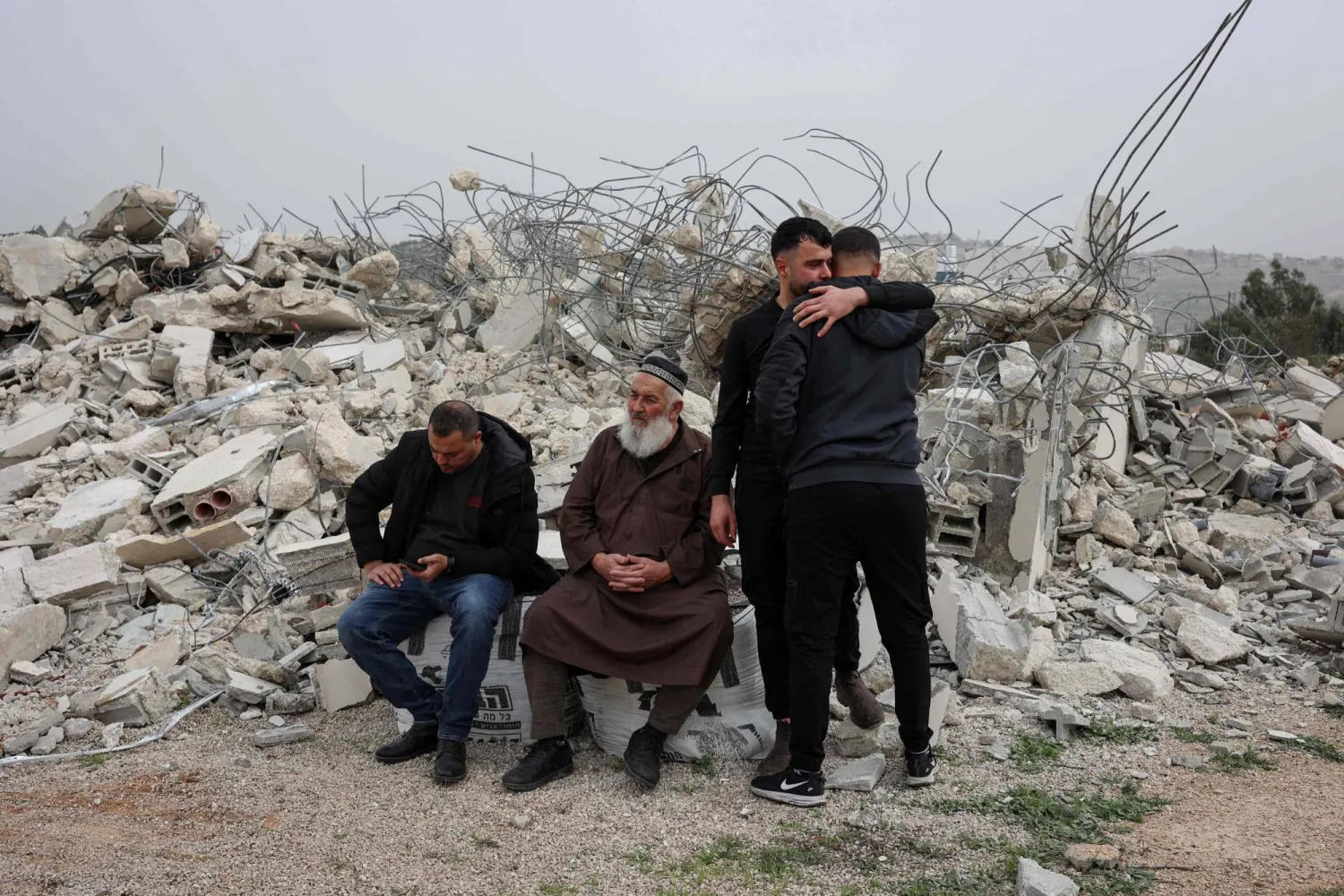
Lebanese Prime Minister Nawaf Salam visited heavily damaged towns near the Israeli border on Saturday, pledging reconstruction.

It was his first trip to the southern border area since the army said it finished disarming Hezbollah there, in January.

Swathes of south Lebanon's border areas remain in ruins and largely deserted more than a year after a US-brokered November 2024 ceasefire sought to end hostilities between Israel and the Iran-backed group.

Lebanon's government has committed to disarming Hezbollah, and the army last month said it had completed the first phase of its plan to do so, covering the area between the Litani River and the Israeli border about 30 kilometers (20 miles) further south.

Visiting Tayr Harfa, around three kilometers from the border, and nearby Yarine, Salam said frontier towns and villages had suffered "a true catastrophe".

He vowed authorities would begin key projects including restoring roads, communications networks and water in the two towns.

Locals gathered on the rubble of buildings to greet Salam and the delegation of accompanying officials in nearby Dhayra, some waving Lebanese flags.

In a meeting in Bint Jbeil, further east, with officials including lawmakers from Hezbollah and its ally the Amal movement, Salam said authorities would "rehabilitate 32 kilometers of roads, reconnect the severed communications network, repair water infrastructure" and power lines in the district.

Last year, the World Bank announced it had approved $250 million to support Lebanon's post-war reconstruction, after estimating that it would cost around $11 billion in total.

Salam said funds including from the World Bank would be used for the reconstruction and rehabilitation projects.

The second phase of the government's disarmament plan for Hezbollah concerns the area between the Litani and the Awali rivers, around 40 kilometers south of Beirut.

Israel, which accuses Hezbollah of rearming, has criticized the army's progress as insufficient, while Hezbollah has rejected calls to surrender its weapons.

Despite the truce, Israel has kept up regular strikes on what it usually says are Hezbollah targets and maintains troops in five south Lebanon areas.

Lebanese officials have accused Israel of seeking to prevent reconstruction in the heavily damaged south with repeated strikes on bulldozers, excavators and prefabricated houses.

Visiting French Foreign Minister Jean-Noel Barrot on Friday said the reform of Lebanon's banking system needed to precede international funding for reconstruction efforts.

The French diplomat met Lebanon's army chief Rodolphe Haykal on Saturday, the military said.


Over 2,200 ISIS Detainees Transferred to Iraq from Syria, Says Iraqi Official

 One of the American buses transporting ISIS fighters, according to a security source from the Syrian Democratic Forces, heads from Syria towards Iraq, in Qamishli, Syria, February 7, 2026. (Reuters)
One of the American buses transporting ISIS fighters, according to a security source from the Syrian Democratic Forces, heads from Syria towards Iraq, in Qamishli, Syria, February 7, 2026. (Reuters)
TT

Over 2,200 ISIS Detainees Transferred to Iraq from Syria, Says Iraqi Official

 One of the American buses transporting ISIS fighters, according to a security source from the Syrian Democratic Forces, heads from Syria towards Iraq, in Qamishli, Syria, February 7, 2026. (Reuters)
One of the American buses transporting ISIS fighters, according to a security source from the Syrian Democratic Forces, heads from Syria towards Iraq, in Qamishli, Syria, February 7, 2026. (Reuters)

Iraq has so far received 2,225 ISIS group detainees, whom the US military began transferring from Syria last month, an Iraqi official told AFP on Saturday.

They are among up to 7,000 ISIS detainees whose transfer from Syria to Iraq the US Central Command (CENTCOM) announced last month, in a move it said was aimed at "ensuring that the terrorists remain in secure detention facilities".

Previously, they had been held in prisons and camps administered by the Kurdish-led Syrian Democratic Forces (SDF) in northeast Syria.

The announcement of the transfer plan last month came after US envoy to Syria Tom Barrack declared that the SDF's role in confronting ISIS had come to an end.

Saad Maan, head of the security information cell attached to the Iraqi prime minister's office, told AFP on Saturday that "Iraq has received 2,225 terrorists from the Syrian side by land and air, in coordination with the international coalition", which Washington has led since 2014 to fight IS.

He said they are being held in "strict, regular detention centers".

A Kurdish military source confirmed to AFP the "continued transfer of ISIS detainees from Syria to Iraq under the protection of the international coalition".

On Saturday, an AFP photographer near the Kurdish-majority city of Qamishli in northeastern Syria saw a US military convoy and 11 buses with tinted windows.

- Iraq calls for repatriation -

ISIS seized swathes of northern and western Iraq starting in 2014, until Iraqi forces, backed by the international coalition, managed to defeat it in 2017.

Iraq is still recovering from the severe abuses committed by the extremists.

In recent years, Iraqi courts have issued death and life sentences against those convicted of terrorism offences.

Thousands of Iraqis and foreign nationals convicted of membership in the group are incarcerated in Iraqi prisons.

On Monday, the Iraqi judiciary announced it had begun investigative procedures involving 1,387 detainees it received as part of the US military's operation.

In a statement to the Iraqi News Agency on Saturday, Maan said "the established principle is to try all those involved in crimes against Iraqis and those belonging to the terrorist ISIS organization before the competent Iraqi courts".

Among the detainees being transferred to Iraq are Syrians, Iraqis, Europeans and holders of other nationalities, according to Iraqi security sources.

Iraq is calling on the concerned countries to repatriate their citizens and ensure their prosecution.

Maan noted that "the process of handing over the terrorists to their countries will begin once the legal requirements are completed".


Drone Attack by RSF in Sudan Kills 24, Including 8 Children, Doctors’ Group Says

Displaced Sudanese wait to receive humanitarian aid at the Abu al-Naga displacement camp in the Gedaref State, some 420km east of the capital Khartoum on February 6, 2026. (AFP)
TT

Drone Attack by RSF in Sudan Kills 24, Including 8 Children, Doctors’ Group Says

Displaced Sudanese wait to receive humanitarian aid at the Abu al-Naga displacement camp in the Gedaref State, some 420km east of the capital Khartoum on February 6, 2026. (AFP)

A drone attack by a notorious paramilitary group hit a vehicle carrying displaced families in central Sudan Saturday, killing at least 24 people, including eight children, a doctors’ group said.

The attack by the Rapid Support Forces occurred close to the city of Rahad in North Kordofan province, said the Sudan Doctors Network, which tracks the country’s ongoing war.

The vehicle transported displaced people who fled fighting in the Dubeiker area of North Kordofan, the doctors’ group said in a statement. Among the dead children were two infants, the group said.

The doctors’ group urged the international community and rights organizations to “take immediate action to protect civilians and hold the RSF leadership directly accountable for these violations.”

There was no immediate comment from the RSF, which has been at war against the Sudanese military for control of the country for about three years.

Sudan plunged into chaos in April 2023 when a power struggle between the military and the RSF exploded into open fighting in the capital, Khartoum, and elsewhere in the country.

The devastating war has killed more than 40,000 people, according to UN figures, but aid groups say that is an undercount and the true number could be many times higher.

It created the world’s largest humanitarian crisis with over 14 million people forced to flee their homes. It fueled disease outbreaks and pushed parts of the country into famine.