


Global Crypto Market Tops $3 trillion on Hopes of Trump-fuelled Boom

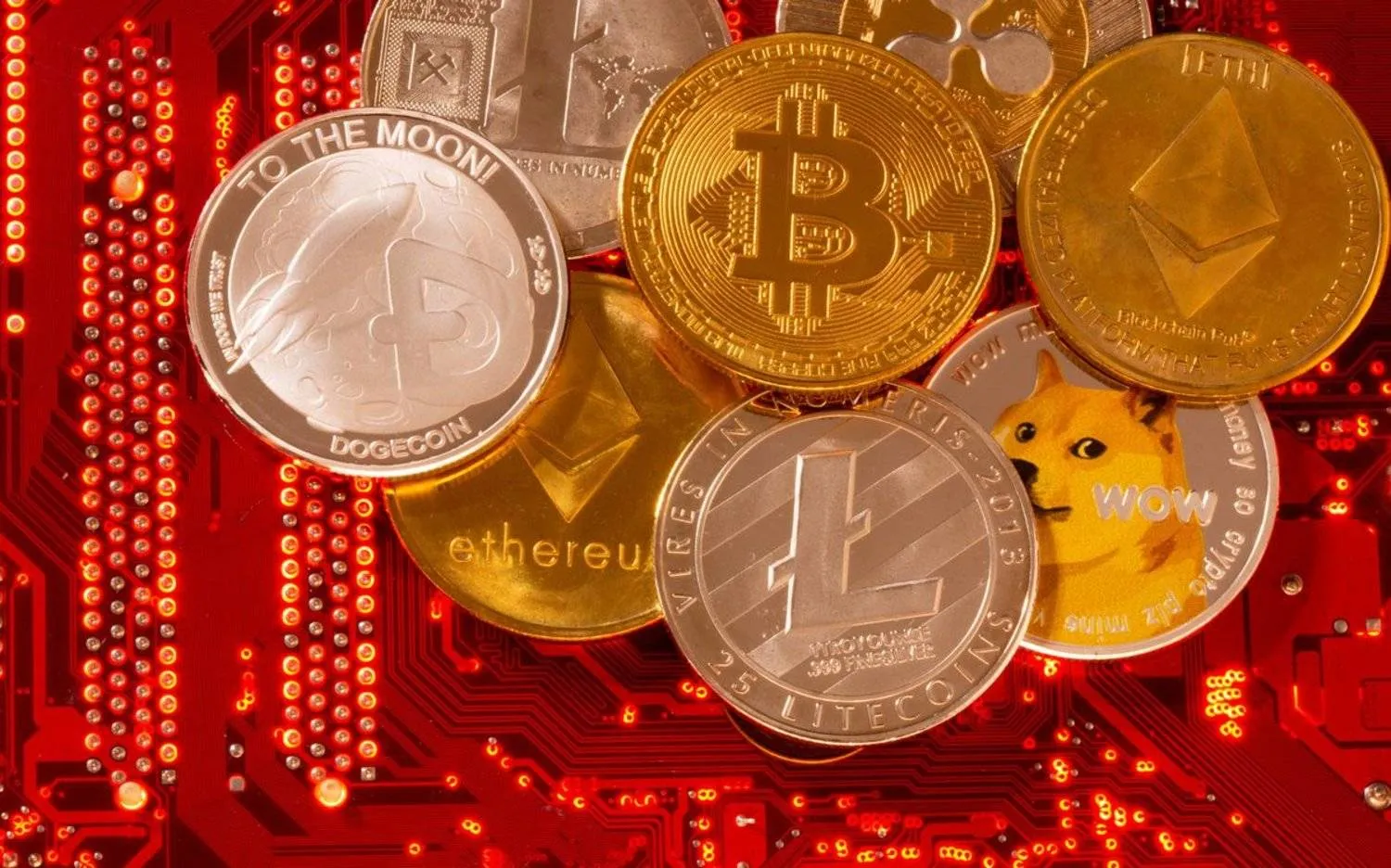
Representations of cryptocurrencies Bitcoin, Ethereum, DogeCoin, Ripple, Litecoin are placed on PC motherboard in this illustration taken, June 29, 2021. Reuters
TT

Global Crypto Market Tops $3 trillion on Hopes of Trump-fuelled Boom

Representations of cryptocurrencies Bitcoin, Ethereum, DogeCoin, Ripple, Litecoin are placed on PC motherboard in this illustration taken, June 29, 2021. Reuters

The global cryptocurrency market's value has topped $3 trillion as the election of Donald Trump as US president spurred bets that friendlier US regulation could usher in a new boom for all corners of the asset class.

The sum market value of cryptocurrencies touched a high of nearly $3.2 trillion early on Nov. 14 in Asia, based on analytics and data aggregator CoinGecko, and was last just shy of that level.

That puts it above the heady days of 2021, when pandemic-era stimulus pumped up speculative investments, and marks a revival from just a few months ago when crypto prices and turnover had flatlined, Reuters reported.

Bitcoin dominates the crypto market and the market value milestone coincided with the token's rise to a record $93,480 .

"Generally the way this market goes is bitcoin will break out and then the rest of the altcoins will follow," said Matthew Dibb, chief investment officer at cryptocurrency asset manager Astronaut Capital.

"So there is that gradual rotation of capital...and then we can expect the total market cap to increase."

Trump's election, and that of several pro-crypto lawmakers to US Congress, has driven the wave of euphoria by potentially clearing some uncertainty around US regulations.

Bitcoin, last trading around $91,500, has doubled this year and is up 30% since the US election on Nov. 5 to $90,000. Smaller cryptocurrency ether is up about 33% since the vote to $3,220.

Dogecoin, an alternative and volatile token promoted by billionaire Trump-ally Elon Musk, has gained 140%.

Crypto exchange-traded funds have also been snapped up, possibly an indicator of buying by financial institutions which tend to shy away from directly holding cryptocurrencies.

Spot bitcoin ETFs have attracted about $4.05 billion in net flows since Nov. 6, based on Refinitiv Lipper data, around 15% of the total inflows since they launched in January.

"People wanted more exposure to crypto, clearly, from the Trump presidency and they wanted more risky asset exposure in general," said David Glass digital assets strategist at Citi.

"From the crypto front, there's the story of removing regulatory headwinds, and the potential strategic bitcoin reserve."

Trump has made reference to a US "strategic bitcoin reserve", similar to that of gold, which would be held by the US government, but the details are unclear.

The current upsurge could have further to run.

"Bitcoin enthusiasts are known for bold predictions, but hitting $100,000 by year-end seems feasible," said Carl Szantyr, founder and managing partner at Blockstone Capital.

DEJA VU

The explosive rally is the latest in the boom-bust roller coaster that had bitcoin below $20,000 at the start of last year, in the depths of the "crypto winter" that followed the collapse of brokerage FTX and other crypto projects.

To be sure, cryptocurrencies' market value is dwarfed by traditional asset classes. At current prices, the value of the 209,000 tonnes of gold the World Gold Council says has been mined in history is worth nearly $19 trillion.

The market capitalisation of the S&P 500 index is $50.6 trillion.

Some parts of the ecosystem do also not show signs of recovery and others point to a degree of caution. Average sales prices for non-fungible tokens have been around $2,000 since May, according to NonFungible.com, which tracks the Ethereum and Ronin blockchains, and have kicked up, but only to about $2,700.

In Singapore DBS Bank, which operates a digital exchange, said while trading had surged and it had executed more than one-third of last year's total volume in the first ten days of November, investors were not yet heading into the more obscure parts of the market.

"We've not seen our clients shift their assets towards more exotic platforms or decentralised exchanges," said David Hui, chief commercial officer of DBS Digital Exchange.

Still, those in the industry say the renewed attention will bring momentum.

"There's increased interest and willingness to look at DeFi and other possibilities associated with blockchain," said Danny Chong, a co-founder of decentralised asset tracking platform Tranchess.

"The heightened market capitalisation, which if sustained for a longer period, would likely also invite deeper interest into new and existing themes," he said, including tokenisation of real world assets and blockchain-based payment services.



OpenAI's Altman Says World 'Urgently' Needs AI Regulation

OpenAI’s CEO Sam Altman speaks at the AI Summit in New Delhi, India, Thursday, Feb. 19, 2026. (AP Photo)
TT

OpenAI's Altman Says World 'Urgently' Needs AI Regulation

OpenAI’s CEO Sam Altman speaks at the AI Summit in New Delhi, India, Thursday, Feb. 19, 2026. (AP Photo)

Sam Altman, head of ChatGPT maker OpenAI, told a global artificial intelligence conference on Thursday that the world "urgently" needs to regulate the fast-evolving technology.

An organization could be set up to coordinate these efforts, similar to the International Atomic Energy Agency (IAEA), AFP quoted him as saying.

Altman is one of the hosts of top tech CEOs in New Delhi for the AI Impact Summit, the fourth annual global meeting on how to handle advanced computing power.

Frenzied demand for generative AI has turbocharged profits for many companies while fueling anxiety about the risks to individuals and the planet.

"Democratization of AI is the best way to ensure humanity flourishes," Altman said, adding that "centralization of this technology in one company or country could lead to ruin".

"This is not to suggest that we won't need any regulation or safeguards," he said. "We obviously do, urgently, like we have for other powerful technologies."

Many researchers and campaigners say stronger action is needed to combat emerging issues, ranging from job disruption to sexualized deepfakes and AI-enabled online scams.

"We expect the world may need something like the IAEA for international coordination of AI," with the ability to "rapidly respond to changing circumstances", Altman said.

"The next few years will test global society as this technology continues to improve at a rapid pace. We can choose to either empower people or concentrate power," he added.

"Technology always disrupts jobs; we always find new and better things to do."

Generative AI chatbot ChatGPT has 100 million weekly users in India, more than a third of whom are students, he said.

Earlier on Thursday, OpenAI announced with Indian IT giant Tata Consultancy Services (TCS) a plan to build data center infrastructure in the South Asian country.


Saudi Arabia Showcases Responsible Use of AI at AI Impact Summit in India

Saudi Arabia took part in a high-level session on harnessing artificial intelligence on the sidelines of the AI Impact Summit 2026 hosted by India.
TT

Saudi Arabia Showcases Responsible Use of AI at AI Impact Summit in India

Saudi Arabia took part in a high-level session on harnessing artificial intelligence on the sidelines of the AI Impact Summit 2026 hosted by India.

Saudi Arabia, represented by the Saudi Data and Artificial Intelligence Authority (SDAIA), took part in a high-level session on harnessing artificial intelligence for people, planet, and progress on the sidelines of the AI Impact Summit 2026 hosted by India, the Saudi Press agency reported on Wednesday.

The event drew participation from more than 70 countries and 25 international organizations, as well as senior decision-makers and technology experts.

The Saudi delegation, led by SDAIA President Dr. Abdullah Alghamdi, included Saudi Ambassador to India Haitham Al-Maliki and officials from relevant government entities.

The session aimed to launch a global network of specialized AI scientific institutions, accelerate discovery through advanced technologies, strengthen international cooperation among states and research bodies, and support the deployment of artificial intelligence to address global challenges and advance the United Nations Sustainable Development Goals (SDGs) 2030.

Deputy Chief Strategy Officer at SDAIA Dr. Abdulrahman Habib emphasized the need to unify international efforts to promote the responsible and ethical use of artificial intelligence, ensuring a sustainable, positive impact on societies and economies worldwide and supporting the 2030 SDGs.

He also reviewed Saudi Arabia’s data and AI initiatives, highlighting efforts to develop regulatory frameworks and national policies that balance innovation with the governance of emerging technologies, as well as applied models that have enhanced quality of life, improved government service efficiency, and advanced environmental sustainability.

SDAIA's participation in the summit underscores Saudi Arabia’s role in shaping the global future of AI and in strengthening its presence in international forums focused on advanced technologies, in line with the objectives of Saudi Vision 2030, which prioritizes digital transformation and innovation.


Google Says to Build New Subsea Cables from India in AI Push

A logo of Google is on display at Bharat Mandapam, one of the venues for AI Impact Summit, in New Delhi, India, February 17, 2026. REUTERS/Bhawika Chhabra
TT

Google Says to Build New Subsea Cables from India in AI Push

A logo of Google is on display at Bharat Mandapam, one of the venues for AI Impact Summit, in New Delhi, India, February 17, 2026. REUTERS/Bhawika Chhabra

Google announced Wednesday it would build new subsea cables from India and other locations as part of its existing $15 billion investment in the South Asian nation, which is hosting a major artificial intelligence summit this week.

The US tech giant said it would build "three subsea paths connecting India to Singapore, South Africa, and Australia; and four strategic fiber-optic routes that bolster network resilience and capacity between the United States, India, and multiple locations across the Southern Hemisphere".