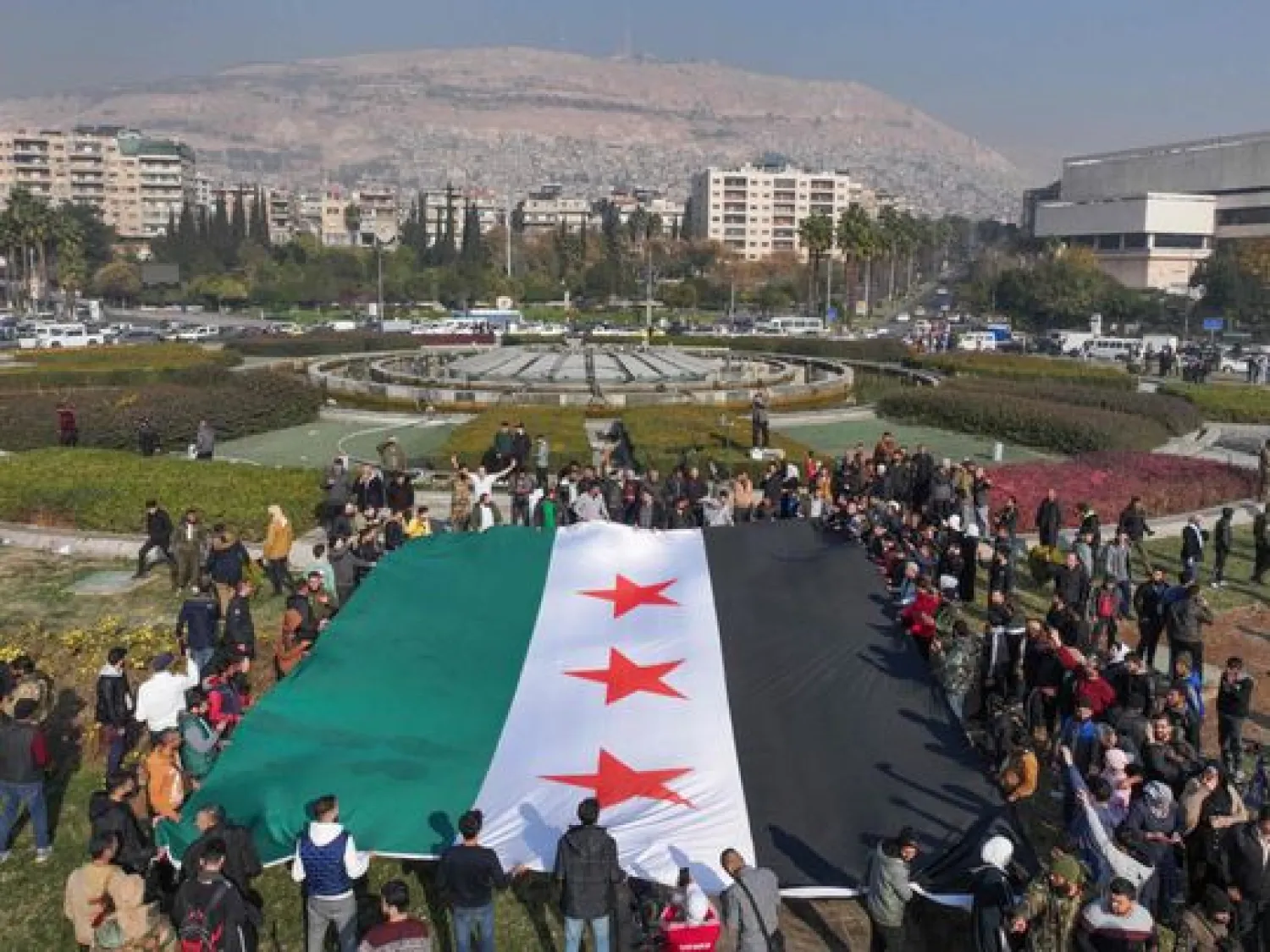
Syrians Search for Loved Ones While Rejoicing in Assad's Fall

People celebrate with a large Syrian opposition flag at Umayyad Square in Damascus. OMAR HAJ KADOUR / AFP
TT

Syrians Search for Loved Ones While Rejoicing in Assad's Fall

People celebrate with a large Syrian opposition flag at Umayyad Square in Damascus. OMAR HAJ KADOUR / AFP

Syrian rescuers searched a jail synonymous with the worst atrocities of ousted president Bashar al-Assad's rule, as people in the capital flocked to a central square Monday to celebrate their country's freedom.
Assad fled the country as opposition factions swept into the capital, bringing to a spectacular end on Sunday five decades of brutal rule by his clan over a country ravaged by one of the deadliest wars of the century, AFP reported.
He oversaw a crackdown on a democracy movement that erupted in 2011, sparking a war that killed 500,000 people and forced half the country to flee their homes.
At the core of the system of rule that Assad inherited from his father Hafez was a brutal complex of prisons and detention centres used to eliminate dissent by jailing those suspected of stepping out of the ruling Baath party's line.
On Monday, rescuers from the Syrian White Helmets said they were searching for secret doors or basements in Saydnaya prison, looking for any detainees who might be trapped.
"We are working with all our energy to reach a new hope, and we must be prepared for the worst," the organisation said in a statement.
While Syria has been at war for 13 years, the government's collapse ended up coming in a matter of days, with a lightning offensive launched by the Hayat Tahrir al-Sham (HTS).
Rooted in Syria's branch of Al-Qaeda, HTS is proscribed by Western governments as a terrorist group.
While it remains to be seen how HTS operates now that Assad is gone, it has sought to moderate its image and to assure Syria's many religious minorities that they need not fear.
In central Damascus on Monday, despite all the uncertainties for the future, the atmosphere was filled with joy.
"It's indescribable, we never thought this nightmare would end, we are reborn," 49-year-old Rim Ramadan, a civil servant at the finance ministry, told AFP.
"We were afraid for 55 years of speaking, even at home, we used to say the walls had ears," Ramadan said, as people honked their car horns and fighters fired their guns into the air.
"We feel like we're living a dream," she added.
'Historic opportunity'
During the offensive launched on November 27, opposition factions wrested city after city from Assad's control, opening the gates of prisons along the way and freeing thousands of people, many of them held on political charges.
Social media groups were alight with Syrians sharing images of detainees reportedly brought out from the dungeons, in a collective effort to reunite families with their loved ones, some of whom had been missing for years.
Others, like Fadwa Mahmoud, whose husband and son are missing, posted calls for help finding their loved ones.
"Where are you, Maher and Abdel Aziz, it's time for me to hear your news, oh God, please come back, let my joy become complete," wrote Mahmoud, herself a former detainee.
US President Joe Biden said Assad should be "held accountable" as he called his downfall "a historic opportunity" for the people of Syria.
"The fall of the regime is a fundamental act of justice," he said.
But he also cautioned that hardline groups within the victorious opposition alliance would face scrutiny.
"Some of the opposition groups that took down Assad have their own grim record of terrorism and human right abuses," Biden said.
The United States has taken note of recent statements by the opposition suggesting they were adopting a more moderate posture, but Biden said: "We will assess not just their words, but their actions."
Amnesty International also called for perpetrators of rights violations to face justice, with its chief Agnes Callamard urging the forces that ousted Assad to "break free from the violence of the past".
"Any political transition must ensure accountability for perpetrators of serious violations and guarantee that those responsible are held to account," UN rights chief Volker Turk said on Monday.
Where is Assad?
How Assad might face justice remains unclear, especially after Russia refused on Monday to confirm reports by Russian news agencies that he had fled to Moscow.
The Syrian embassy in Moscow raised the flag of the opposition, and the Kremlin said it would discuss the status of its bases in Syria with the new authorities.
Russia played an instrumental role in keeping Assad in power, directly intervening in the war starting in 2015 and providing air cover to the army on the ground as it sought to crush the rebellion.
Iran, another key ally of Assad, said it expected its "friendly" ties with Syria to continue, with its foreign minister saying the ousted president "never asked" for Tehran's help against the offensive.
Türkiye, historically a backer of the opposition, called for an "inclusive" new government in Syria, as the sheer unpredictability of the situation began to settle in.
"It is not just Assad's regime falling, it is also the question of what comes in its place?" said Aron Lund, a specialist at the Century International think tank.
While Syria's war began with a crackdown on grassroots democracy protests, it morphed over time and drew in extremists and foreign powers backing opposing sides.
Israel, which borders Syria, sent troops into a buffer zone after Assad's fall, in what Foreign Minister Gideon Saar described as a "limited and temporary step".
A Syria war monitor said Monday that Israel also carried out overnight strikes on Syrian military positions and depots in several parts of the country.
And in northern Syria, a Turkish drone strike on a Kurdish-held area killed 11 civilians, six of them children, according to the Syrian Observatory for Human Rights war monitor.



Israel Army Issues Evacuation Warning for Lebanon Village ahead of Strikes

 Smoke rises after Israeli strikes following Israeli military's evacuation orders, in Chehour, southern Lebanon November 19, 2025. REUTERS/Ali Hankir
Smoke rises after Israeli strikes following Israeli military's evacuation orders, in Chehour, southern Lebanon November 19, 2025. REUTERS/Ali Hankir
TT

Israel Army Issues Evacuation Warning for Lebanon Village ahead of Strikes

 Smoke rises after Israeli strikes following Israeli military's evacuation orders, in Chehour, southern Lebanon November 19, 2025. REUTERS/Ali Hankir
Smoke rises after Israeli strikes following Israeli military's evacuation orders, in Chehour, southern Lebanon November 19, 2025. REUTERS/Ali Hankir

The Israeli army issued an evacuation warning on Sunday for the village of Kafr Hatta in southern Lebanon ahead of air strikes on Hezbollah targets in the area, AFP reported.

"The Israeli (army) will soon, and once again, strike terrorist Hezbollah military infrastructure in the village, in order to address the prohibited attempts it is making to rebuild its activities there," Arabic-language spokesman Colonel Avichay Adraee wrote on X, posting a map of the expected target.

The Lebanese army said Thursday that it had completed disarming Hezbollah south of the Litani river, the first phase of a nationwide plan. Kafr Hatta is located north of the river.


Sudan PM Announces Govt Return to Khartoum from Wartime Capital

File Photo: Some shops reopen despite extensive damage (Asharq Al-Awsat)
TT

Sudan PM Announces Govt Return to Khartoum from Wartime Capital

File Photo: Some shops reopen despite extensive damage (Asharq Al-Awsat)

Sudan's Prime Minister Kamil Idris announced on Sunday the government's return to Khartoum, after nearly three years of operating from wartime capital of Port Sudan, AFP reported.

"Today, we return, and the Government of Hope returns to the national capital," Idris told reporters in Khartoum, ravaged by the war between the army and the Rapid Support Forces.

"We promise you better services, better healthcare and the reconstruction of hospitals, the development of educational services... and to improve electricity, water and sanitation services," he said.


Iran Protest Death Toll Rises as Alarm Grows over Crackdown 'Massacre'

Smoke rises as protesters gather amid evolving anti-government unrest at Vakilabad highway in Mashhad, Razavi Khorasan province, Iran, released on January 10, 2026, in this screen grab obtained from a social media video. SOCIAL MEDIA/via REUTERS
TT

Iran Protest Death Toll Rises as Alarm Grows over Crackdown 'Massacre'

Smoke rises as protesters gather amid evolving anti-government unrest at Vakilabad highway in Mashhad, Razavi Khorasan province, Iran, released on January 10, 2026, in this screen grab obtained from a social media video. SOCIAL MEDIA/via REUTERS

At least 192 protesters have been killed in Iran's biggest movement against the Islamic republic in more than three years, a rights group said Sunday, as warnings grew that authorities were committing a "massacre" to quell the demonstrations.

The protests, initially sparked by anger over the rising cost of living, have now become a movement against the theocratic system in place in Iran since the 1979 revolution and have already lasted two weeks.

The mass rallies are one of the biggest challenges to the rule of supreme leader Ali Khamenei, 86, coming in the wake of Israel's 12-day war against the Islamic republic in June, which was backed by the United States.

Protests have swelled in recent days despite an internet blackout that has lasted more than 60 hours, according to monitor Netblocks, with activists warning the shutdown was limiting the flow of information and the actual toll risks being far higher.

"Since the start of the protests, Iran Human Rights has confirmed the killing of at least 192 protesters," the Norway-based non-governmental organization said, warning that the deaths "may be even more extensive than we currently imagine".

Videos of large demonstrations in the capital Tehran and other cities over the past three nights have filtered out despite the internet cut that has rendered impossible normal communication with the outside world via messaging apps or even phone lines.

Video verified by AFP showed large crowds taking to the streets in new protests on Saturday night in several Iranian cities including Tehran and Mashhad in the east, where images showed vehicles set on fire.

Several circulating videos, which have not been verified by AFP, allegedly showed relatives in a Tehran morgue identifying bodies of protesters killed in the crackdown.

The US-based Center for Human Rights in Iran (CHRI) said it had received "eyewitness accounts and credible reports indicating that hundreds of protesters have been killed across Iran during the current internet shutdown".

"A massacre is unfolding in Iran. The world must act now to prevent further loss of life," it said.

It said hospitals were "overwhelmed", blood supplies were running low and that many protesters had been shot in the eyes in a deliberate tactic.


- 'Significant arrests' -


The US-based Human Rights Activists News Agency said it had confirmed the deaths of 116 people in connection with the protests, including 37 members of the security forces or other officials.

State TV on Sunday broadcast images of funeral processions for security forces killed in recent days, as authorities condemned "riots" and "vandalism".

National police chief Ahmad-Reza Radan said authorities made "significant" arrests of protest figures on Saturday night, without giving details on the number or identities of those arrested, according to state TV.

Iran's security chief Ali Larijani drew a line between protests over economic hardship, which he called "completely understandable", and "riots", accusing them of actions "very similar to the methods of terrorist groups", Tasnim news agency reported.

Iran's President Masoud Pezeshkian said "rioters" must not distrupt Iranian society.

"The people (of Iran) should not allow rioters to disrupt society. The people should believe that we (the government) want to establish justice," he told state broadcaster IRIB.

In Tehran, an AFP journalist described a city in a state of near paralysis.

The price of meat has nearly doubled since the start of the protests, and while some shops are open, many others are not.

Those that do open must close at around 4:00 or 5:00 pm, when security forces deploy in force.


- 'Legitimate targets' -


Reza Pahlavi, the exiled son of the ousted shah, who has played a prominent role in calling for the protests, called for new actions later Sunday.

"Do not abandon the streets. My heart is with you. I know that I will soon be by your side," he said.

US President Donald Trump has spoken out in support of the protests and threatened military action against Iranian authorities "if they start killing people".

Israel's Foreign Minister Gideon Saar urged the European Union on Sunday to designate Iran's Revolutionary Guards Corps as a "terrorist organization" over the suspected violence against protesters.

He also said Israel supports the Iranian people's "struggle for freedom".

Iran's parliament speaker Mohammad Bagher Ghalibaf said Iran would hit back if the US launched military action.

"In the event of a military attack by the United States, both the occupied territory and centers of the US military and shipping will be our legitimate targets," he said in comments broadcast by state TV.

He was apparently also referring to Israel, which the Islamic republic does not recognize and considers occupied Palestinian territory.