


German Police Say 4 Women and a Boy Were Killed in the Christmas Market Attack

Tributes to the victims are seen outside the Johanniskirche (Johannes Church), a makeshift memorial near the site of a car-ramming attack on a Christmas market in Magdeburg, eastern Germany, on December 22, 2024. (AFP)
TT

German Police Say 4 Women and a Boy Were Killed in the Christmas Market Attack

Tributes to the victims are seen outside the Johanniskirche (Johannes Church), a makeshift memorial near the site of a car-ramming attack on a Christmas market in Magdeburg, eastern Germany, on December 22, 2024. (AFP)

More details emerged Sunday about those killed when a man drove a car at speed through a Christmas market in Germany, while mourners continued to place flowers and other tributes at the site of the attack.

Police in Magdeburg, the central city where the attack took place on Friday evening, said that the victims were four women ranging in age from 45 to 75, as well as a 9-year-old boy they had spoken of a day earlier.

Authorities said 200 people were injured, including 41 in serious condition. They were being treated in multiple hospitals in Magdeburg, which is about 130 kilometers (80 miles) west of Berlin, and beyond.

Authorities have identified the suspect in the Magdeburg attack as a Saudi doctor who arrived in Germany in 2006 and had received permanent residency.

The suspect was on Saturday evening brought before a judge, who behind closed doors ordered that he be kept in custody pending a possible indictment.

Police haven’t publicly named the suspect, but several German news outlets identified him as Taleb A., withholding his last name in line with privacy laws, and reported that he was a specialist in psychiatry and psychotherapy.

Describing himself as a former Muslim, the suspect appears to have been an active user of the social media platform X, accusing German authorities of failing to do enough to combat what he referred to as the “Islamification of Europe.”

The horror triggered by yet another act of mass violence in Germany make it likely that migration will remain a key issue as German heads toward an early election on Feb. 23.

The far-right Alternative for Germany party had already been polling strongly amid a societal backlash against the large numbers of refugees and migrants who have arrived in Germany over the past decade.

Right-wing figures from across Europe have criticized German authorities for having allowed high levels of migration in the past and for what they see as security failures now.

Hungarian Prime Minister Viktor Orban, who is known for a strong anti-migration position going back years, used the attack in Germany to lash out at the European Union’s migration policies.

At an annual press conference in Budapest on Saturday, Orban insisted that “there is no doubt that there is a link between the changed world in Western Europe, the migration that flows there, especially illegal migration and terrorist acts.”

Orban vowed to “fight back” against the EU migration policies “because Brussels wants Magdeburg to happen to Hungary, too.”
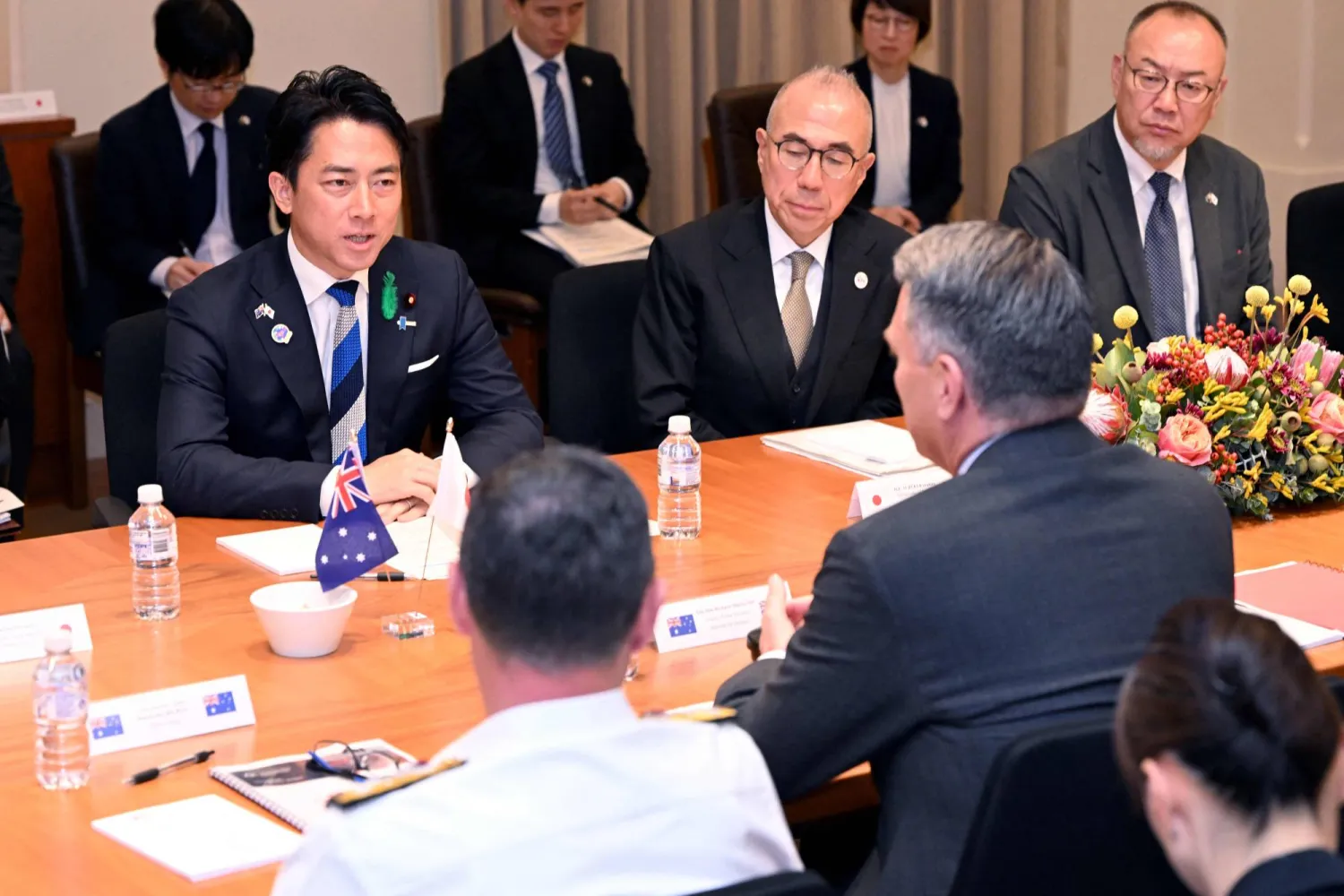



Australia, Japan Sign Contracts to Start $7 Billion Warship Deal

Australia's Deputy Prime Minister and Minister for Defense Richard Marles (R) listens to Japan's Minister of Defense Koizumi Shinjiro (L) during a Defense Ministers' Meeting at the Commonwealth Parliament Offices in Melbourne on April 18, 2026. (Photo by William WEST / AFP)
TT

Australia, Japan Sign Contracts to Start $7 Billion Warship Deal

Australia's Deputy Prime Minister and Minister for Defense Richard Marles (R) listens to Japan's Minister of Defense Koizumi Shinjiro (L) during a Defense Ministers' Meeting at the Commonwealth Parliament Offices in Melbourne on April 18, 2026. (Photo by William WEST / AFP)

Australia and Japan signed contracts on Saturday launching their landmark A$10 billion ($7 billion) deal to supply Australia with warships, Tokyo's most consequential military sale since ending a military export ban in 2014.

Defense Ministers Richard Marles and Shinjiro Koizumi signed a memorandum "reaffirming the Australian and Japanese governments' shared commitment to the successful delivery" of the warships, Marles said in a statement.

The deal struck in ⁠August anchors Japan's ⁠push away from its postwar pacifism to forge security ties beyond its alliance with the US to counter China.

Mitsubishi Heavy Industries is to supply the Royal Australian Navy with three upgraded Mogami-class ⁠multi-role frigates built in Japan from 2029. Eight more frigates will be built in Australia.

Japan's Defense Ministry posted on X that Koizumi and Marles welcomed the "conclusion of contracts for General Purpose Frigates, and confirmed to further strengthen bilateral defense ties" in the signing in Melbourne.

Contracts were signed for the first three frigates, to be built ⁠in ⁠Japan, before there is a "transition to an onshore build" at the Henderson shipyard near Perth in Western Australia, Reuters quoted Marles as saying.

Australia plans to deploy the ships - designed to hunt submarines, strike surface ships and provide air defense - to defend critical maritime trade routes and its northern approaches in the Indian and Pacific Oceans, where China's military footprint is expanding.


Iran Partially Reopens Airspace

FILE - Two police officers walk in front of an anti-US billboard in Tehran, Iran, Sunday, April 5, 2026. (AP Photo/Vahid Salemi, File)
TT

Iran Partially Reopens Airspace

FILE - Two police officers walk in front of an anti-US billboard in Tehran, Iran, Sunday, April 5, 2026. (AP Photo/Vahid Salemi, File)

Iran partially reopened its airspace on Saturday to international flights crossing the eastern part of its territory, the country's Civil Aviation Authority said.

"Air routes in the eastern section of the country's airspace are open for international flights transiting through Iran," it said, adding that some airports had also reopened at 7:00 am (0330 GMT).

More than three hours later, however, flight tracker websites still showed no international flights crossing Iran, and several avoiding its airspace by making long detours.


Trump Hints at Resuming Attacks if Ceasefire with Iran Expires Without Deal

IN FLIGHT - APRIL 17: US President Donald Trump speaks to members of the press aboard Air Force One on April 17, 2026 just prior to landing at Joint Base Andrews, Maryland. (Photo by WIN MCNAMEE / GETTY IMAGES NORTH AMERICA / Getty Images via AFP)
TT

Trump Hints at Resuming Attacks if Ceasefire with Iran Expires Without Deal

IN FLIGHT - APRIL 17: US President Donald Trump speaks to members of the press aboard Air Force One on April 17, 2026 just prior to landing at Joint Base Andrews, Maryland. (Photo by WIN MCNAMEE / GETTY IMAGES NORTH AMERICA / Getty Images via AFP)

US President Donald Trump said the blockade of the Strait of Hormuz will remain and attacks will resume if no agreement is reached with Iran, after Tehran said it had fully reopened the strait to commercial vessels but threatened to close it again over the US blockade.

Asked by a reporter Friday night what he will do if there’s no deal when a ceasefire with Iran expires next week, Trump said, “I don’t know. Maybe I won’t extend it, but the blockade is going to remain. But maybe I won’t extend it, so you’ll have a blockade and unfortunately we’ll have to start dropping bombs again.”

However, Trump also told reporters accompanying him aboard Air Force One to Washington that, “I think it’s going to happen,” referring to a deal.

Questions lingered Saturday about how much freedom ships actually had to transit the waterway as Tehran threatened to close it again if the US kept in place its blockade of Iranian ships and ports.

Iran’s Friday announcement about the opening of the crucial body of water, through which 20% of the world’s oil is shipped, came as a 10-day truce between Israel and Hezbollah in Lebanon appeared to hold.

The war with Iran, which began on February 28 with a US-Israeli attack, has killed thousands and sent oil prices surging because of the de facto closure of ⁠the strait.

Trump has told Reuters there would probably be more direct talks between Iran and the US this weekend. Some diplomats said that was unlikely given the logistics of gathering in Islamabad, where the talks are expected to take place.

There were no signs of preparations early on Saturday for talks in the Pakistani capital.