


Fire Risk and Strong Winds Continue in Southern California with Potential Rain on the Horizon 

A mobile home park destroyed in the Palisades Fire is seen on January 21, 2025 in the Pacific Palisades neighborhood of Los Angeles, California. (Getty Images via AFP)
TT

Fire Risk and Strong Winds Continue in Southern California with Potential Rain on the Horizon 

A mobile home park destroyed in the Palisades Fire is seen on January 21, 2025 in the Pacific Palisades neighborhood of Los Angeles, California. (Getty Images via AFP)

Parched Southern California was forecast to face more dangerous winds on Wednesday but could get some badly needed rain this weekend, dampening the prospects of another round of killer wildfires though even a small amount of precipitation could create new challenges like toxic ash runoff.

Los Angeles officials were preparing for that prospect even as a small number of residents were allowed to return to the devastated Pacific Palisades and Altadena areas and firefighters quickly controlled small blazes that broke out.

Mayor Karen Bass issued an executive order Tuesday to expedite cleanup efforts in burn areas and mitigate the environmental impacts of fire-related pollutants. She ordered crews to remove vegetation, shore up hillsides, install barriers and reinforce roads ahead of the possible weekend rain, which could create mud and debris flows.

“This is to prevent additional damage to areas already ravaged by fire and also to protect our watershed, beaches and ocean from toxic runoff,” Bass said during a news conference.

Los Angeles County supervisors also approved an emergency motion to install flood control infrastructure and expedite and remove sediment in fire-impacted areas.

A 60% to 80% chance of a small amount of rain was forecast for Southern California starting Saturday, with most areas likely getting not more than a third of an inch (0.8 cm), according to Ryan Kittell, a meteorologist for the National Weather Service’s office for Los Angeles. However up to an inch (2.5 centimeters) could fall in localized thunderstorms, which would be a worst-case scenario if enough to trigger debris flows on scorched hillsides.

“But even if the rain doesn’t materialize this time, it could be a good practice run for those communities because this will be a threat that they’ll have to deal with for months or years,” Kittell said.

In 2018, Montecito, a town 80 miles (130 kilometers) up the coast from Los Angeles, was ravaged by mudslides after a downpour hit mountain slopes burned bare by a huge wildfire. Twenty-three people died, and hundreds of homes were damaged.

Winds eased somewhat Tuesday afternoon after peaking at 60 mph (96 kph) in many areas, but gusty conditions were expected to return the next two days. Red flag warnings for critical fire risk were extended through 8 p.m. Thursday in LA and Ventura counties.

“Our concern is the next fire, the next spark that causes the next wildfire,” said David Acuna, a spokesman with the California Department of Forestry and Fire Protection, or Cal Fire. Another worry was that the two major blazes, the Palisades and Eaton fires, could break their containment lines as firefighters continue to keep watch for hot spots.

Fire engines and water-dropping aircraft allowed crews to swiftly douse several small blazes that popped up in LA and San Diego counties, officials said.

Evacuation orders were lifted for the Friars Fire, which broke out near a San Diego mall, and partially for the Lilac Fire, which burned through dry brush after threatening some structures, Cal Fire said. Nearby crews fully contained the Pala Fire, another small blaze. The Clay fire in Riverside was 40% contained Tuesday night and evacuation orders were lifted.

Southern California Edison preemptively shut off power to more than 60,000 customers in five counties to prevent new fires from being sparked by winds toppling electrical equipment; electricity was later restored to some. The utility was considering precautionary shutoffs for an additional 160,000 customers.

Authorities urged residents to review evacuation plans, prepare emergency kits and be on the lookout for fires and report them quickly.

Bass also warned that winds could carry ash and advised Angelenos to visit the city's website to learn how to protect themselves from toxic air during the latest Santa Ana wind event.

The low humidity, bone-dry vegetation and strong winds came as firefighters continued to battle the Palisades and Eaton fires, which have killed at least 28 people and destroyed more than 14,000 structures since they broke out Jan. 7. Containment of the Palisades Fire reached 63%, and the Eaton Fire was at 89%.

The federal Bureau of Alcohol, Tobacco and Firearms is investigating the causes of the fires but has not released any findings.

Several lawsuits have been filed by people who lost their homes in the Eaton Fire, alleging Southern California Edison equipment sparked the blaze. On Tuesday a judge overseeing one of the lawsuits ordered the utility to produce data from circuits in the area where the fire started.

President Donald Trump, who criticized the response to the wildfires during his inaugural address Monday, has said he will travel to Los Angeles on Friday.


Tech-equipped Indigenous Firefighters Protect Thai Forests

Hmong volunteer firefighter Mongkol Yingyotmongkolsaen using a drone to monitor fires in the Doi Suthep-Pui National Park area of Chiang Mai. Lillian SUWANRUMPHA / AFP
TT

Tech-equipped Indigenous Firefighters Protect Thai Forests

Hmong volunteer firefighter Mongkol Yingyotmongkolsaen using a drone to monitor fires in the Doi Suthep-Pui National Park area of Chiang Mai. Lillian SUWANRUMPHA / AFP

In the dry-season heat of northern Thailand, Hmong villagers zip through forested slopes, blasting tinder with leaf blowers and cutting through brush with machetes, while others scan for smoke on live feeds from their phones.

Across about a dozen villages in the hills of Doi Suthep-Pui National Park, just above the city of Chiang Mai, Indigenous volunteers patrol on foot and clear firebreaks while also deploying drones and treetop cameras -- all to detect blazes early and defend Thailand's second-largest city from wildfire smoke, said AFP.

"The forest we protect is part of the national park -- the lungs of Chiang Mai," said Mathaphan Phuchakritdapa, who started the firefighting volunteer force a decade ago and is chief of Suthep subdistrict.

"If it burns, the city's lungs are destroyed. That's why we have to take care of it as best we can."

He and his team shifted to tech-driven firefighting after devastating wildfires in 2020 tore through the mountains above the tourism-dependent city.

The blazes lasted weeks in March and April that year, killing at least five people and injuring and displacing residents and wildlife.

The thick smoke from fires then and since has regularly pushed Chiang Mai to the top of global air pollution rankings.

- 'Worst in my life' -

Satellite imagery from the peak of the 2020 crisis showed northern Thailand blanketed by dense clusters of fire hotspots, with nearly 400 recorded in Chiang Mai province in a single day.

"It was the worst fire I've seen in my life," said Mathaphan, adding it took more than 40 days to bring it under control.

The hotter, drier weather caused by climate change creates the conditions for more frequent and destructive fires, and accumulated dry leaves can intensify them and accelerate their spread.

Outbreaks are often linked to human activities such as clearing forest and brush for foraging, hunting and agriculture.

To control air pollution, Chiang Mai authorities announced a strict five-month ban on open burning from the beginning of this year.

Authorities often blame local "hill tribes", while those communities say fires are set by outsiders for commercial purposes.

Data from NASA's fire monitoring service shows far fewer fires in the region in mid-March this year compared to the same period in 2020.

"Both local communities and state agencies are taking the issue more seriously, leading to tighter controls over burning and fire outbreaks," Mathaphan told AFP.

The Hmong, an Indigenous ethnic group originally from the mountains of southern China, have lived on these slopes in northern Thailand since migrating in the mid-20th century.

Volunteer teams roar through the hills on motorbikes, blasting away leaves with blowers and drowning out the buzz of a drone capturing footage of the blaze-prone landscape.

- 'Giving back' -

Mongkol Yingyotmongkolsaen, a 47-year-old Hmong volunteer, returned from the city three years ago and began applying his skills as a photographer to firefighting.

He installed low-cost, internet-connected video cameras high among treetops that share live feeds with villagers who can remotely monitor conditions in real time.

Mongkol also flies standard and infrared drones to monitor for fires from above, track any flames that are spreading and detect heat at night.

This allows teams to identify hotspots earlier, plan safer routes and contain fires more quickly, he said, making their work much easier.

"This is my way of giving back to my community," he added.

Across the subdistrict, each household contributes a volunteer, forming a network of about 270 people managing nearly 1,600 hectares of forest.

Monitoring this vast area requires about 1.5 million baht ($45,000) a year to cover the cost of food, fuel and equipment maintenance.

But the community receives only around 50,000 baht annually in government funding -- an amount the local chief, Mathaphan, said is insufficient.

Still, their volunteer-based approach to fire prevention has become a model for other communities, he said -- helping shift perceptions of Hmong villagers who are often blamed for deforestation and "destructive" farming practices.

"We are not destroying the forest," Mathaphan said. "We are protecting it."


Moon Race: How China is Challenging the US

China is challenging the United States' supremacy in spaceflight. Pedro Pardo / AFP/File
TT

Moon Race: How China is Challenging the US

China is challenging the United States' supremacy in spaceflight. Pedro Pardo / AFP/File

Walking on the Moon by 2030, building a lunar base, and then perhaps on to Mars: after 30 years of honing its expertise, China is challenging the United States' supremacy in spaceflight.

As US space agency NASA prepares for its crewed lunar flyby mission, Artemis II, we take a look at China's ambitions in space:

- What is China's crewed program? -

China's crewed space program -- known as Project 921 -- was launched on September 21, 1992, aiming to develop its own expertise and space station.

The program has conducted around 15 crewed missions since the first flight of a Chinese astronaut, Yang Liwei, in 2003.

Blocked from the International Space Station (ISS) in 2011 by the United States, China built its own orbital hub.

The Tiangong, or "Heavenly Palace", space station welcomed its first occupants in 2021.

Three Chinese astronauts -- known as "taikonauts" -- are currently staying there.

The station allows China to accumulate crucial experience in spacewalks, docking, maintenance and effects on the body.

None of China's crewed launches have been fatal, and the program is following a long-term roadmap rather than a series of isolated projects.

"This effectiveness stems from strong political commitment at the highest level of the state, stable funding... and the integration of the entire industrial chain into the project," said Richard de Grijs, professor of physics and astronomy at Australia's Macquarie University.

"Compared to the Western, and particularly US, approach, where priorities can shift with each political cycle, this model offers clear advantages in terms of predictability and risk management," he told AFP.

While China's space program has been historically slower, "it won't change course at the whim of its leadership either".

- When will Chinese astronauts land on the Moon? -

The Chinese space agency (CNSA) hopes to put astronauts on the Moon by 2030.

China has already sent several robots to the Moon and brought back lunar samples.

But a crewed mission requires different equipment, which is currently being tested.

China is set to conduct a test flight of its new Mengzhou ("Dream Ship") spacecraft in 2026. Replacing the ageing Shenzhou, it will carry astronauts into lunar orbit.

Engineers are also developing a new ultra-powerful rocket around 90-metres (295-feet) long -- the Long March-10, essential for propelling the spacecraft to the Moon. It made its first low-altitude flight on February 11.

The Lanyue ("Seize the Moon") lander, which will transport the astronauts from orbit to the lunar surface, could also make its maiden flight between 2028 and 2029.

- Does China want a lunar base? -

China hopes to build a basic version of a crewed scientific base, called the International Lunar Research Station (ILRS), by 2035.

The base will be built near the Moon's south pole, where water in the form of ice is believed to be present.

China is collaborating with Russia on the project.

The base is expected to be built with bricks made on-site from lunar soil using 3D printers. Tested on Earth and on Tiangong, the technique is to be tested on the Moon during the uncrewed Chang'e-8 mission, scheduled for around 2028.

The CNSA says it wants to carry out archaeological research into the origin of the Moon, achieve breakthroughs in strategic technologies and exploit lunar resources.

An expanded version of the base is planned for around 2040.

China is also developing a constellation of relay satellites around the Moon to communicate between its far side and Earth.

- Is this a race with the United States? -

China never talks about a "Moon race" or competition with the United States.

"They are ambitious for the future of their program and see the Moon as the logical next step, for its own sake, not for any rivalry. I don't think it would change anything for them if America wasn't going," said Jonathan McDowell, astrophysicist and space analyst.

"Having said that," he added, "the establishment of a lunar base by China would be a real challenge to America's ability to establish such a base -- there's only a small amount of suitable area near the lunar south pole."

For now, China lags behind the United States in terms of crewed flights, according to Chen Lan, a specialist in the Chinese space program.

NASA's Dragon and Orion spacecraft remain superior compared to China's Shenzhou, he noted.

"However, I expect when China realizes manned lunar landing by 2030 with the new spaceship and lunar landing vehicle, it will catch up with the US in the human spaceflight field."

- Mars next? -

After 2040, the Chinese lunar base will be used to "validate technology and capabilities for a manned mission to Mars", according to the CNSA.

Chinese space manufacturing companies and scientists have previously pointed to the Red Planet as a potential destination for astronauts.

"But I don't think that there will be serious plans to Mars before completion of the lunar landing and the initial lunar base," Chen said.


3-limbed Sea Turtle Being Tracked at Sea by Satellite

An adult female Kemp's ridley sea turtle is seen swimming in a tank at Loggerhead Marinelife Center after a satellite tracking device was attached to its shell in Juno Beach, Fla. on Tuesday, March 24, 2026. (AP Photo/Cody Jackson)
TT

3-limbed Sea Turtle Being Tracked at Sea by Satellite

An adult female Kemp's ridley sea turtle is seen swimming in a tank at Loggerhead Marinelife Center after a satellite tracking device was attached to its shell in Juno Beach, Fla. on Tuesday, March 24, 2026. (AP Photo/Cody Jackson)

The veterinary staff at a Florida sea turtle hospital is getting help from space to monitor the animals they have rehabilitated. They're particularly interested in amputees.

Using satellite tracking devices in a collaboration between the Loggerhead Marinelife Center and the Smithsonian Conservation Biology Institute, scientists are learning how well sea turtles can survive in the wild after losing a limb.

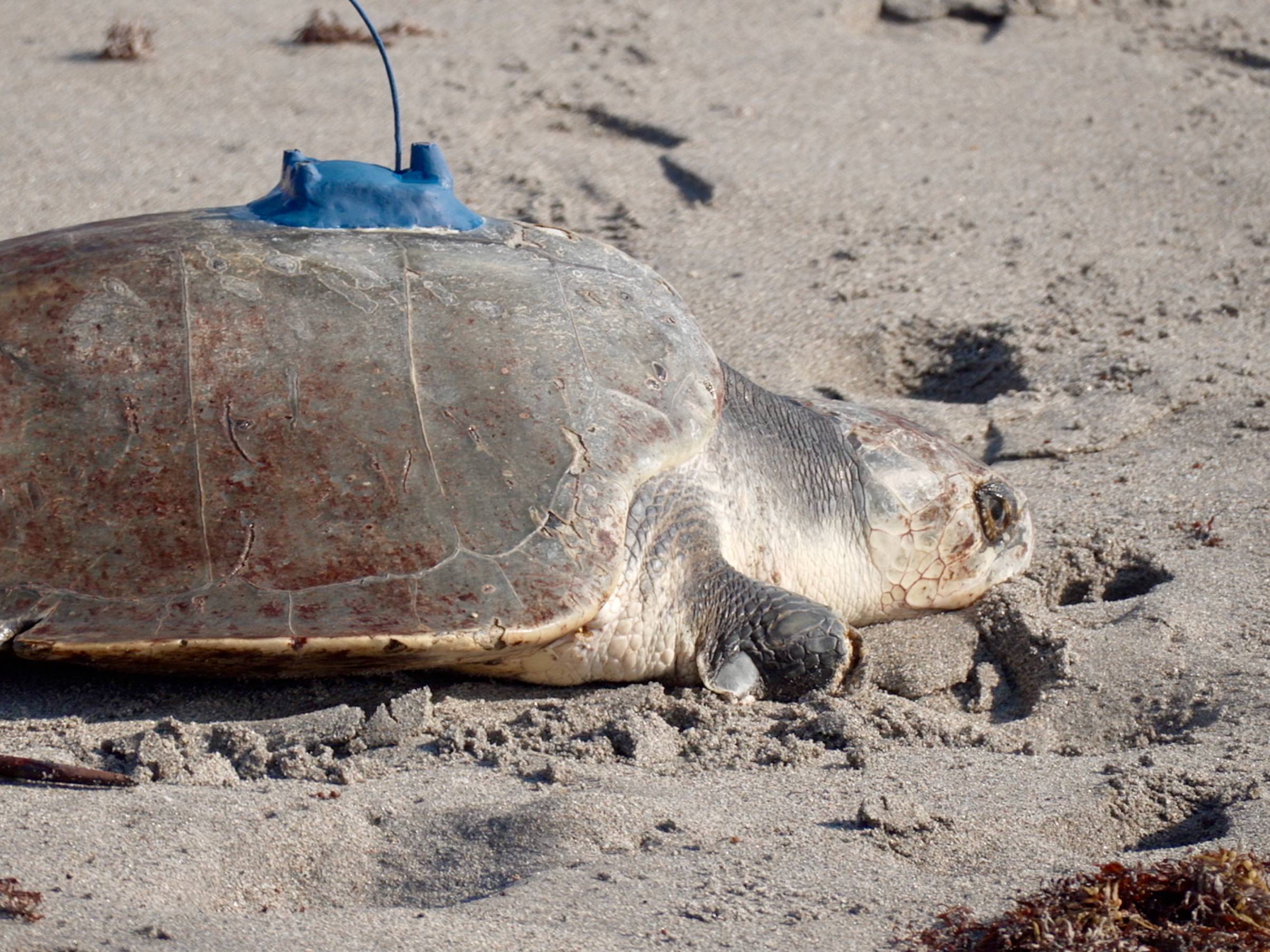
Amelie, a Kemp's ridley sea turtle who lost her right forelimb to a predator — most likely a shark, the center said — was taken to the beach on Wednesday for her highly anticipated release. The turtle paused for about 30 seconds, then slowly made her way into the Atlantic Ocean as onlookers cheered.

Amelie had been rescued and brought to the center by the Inwater Research Group in Port St. Lucie, Florida, seven weeks earlier after a traumatic amputation. She underwent surgery to clean and close the wound, and was treated for pneumonia while in a tank at the center.

When veterinarians deemed her healthy enough to return to the sea, they glued a tracking device to her shell.

A rehabilitated adult female Kemp's ridley sea turtle crawls toward the ocean during a release in Juno Beach, Fla. on Wednesday, March 25, 2026. (AP Photo/Cody Jackson)

An ultrasound confirmed that Amelie is developing eggs, giving researchers another reason to track her movements.

Kemp's ridley turtles, the rarest of sea turtle species, are more typically found on Florida's Gulf Coast, so treating Amelie was especially significant, said Andy Dehart, the center's president and CEO.

Amelie is actually the fourth amputee sea turtle being tracked by the enter, Loggerhead research director Sarah Hirsch said. They include a three-limbed turtle named Pyari who has traveled nearly 700 miles since her release in January, her tracker shows.

“We do know that they can be successful in the wild because we have seen them on our nesting beaches, but we really want to understand their dive behaviors, how they’re migrating once they’re back in the wild," The Associated Press quoted Hirsch as saying.

The satellite tags have a saltwater switch that detects when the turtle comes up to the surface to breathe, triggering the transmission of data to the satellites. Their location appears online after a 24-hour delay. To view Amelie and other turtles tracked for various research projects, visit the Loggerhead website.

“They’ve been through a lot," Hirsch said. "They’ve gotten a lot of medical care here, and to see them be able to go back out and contribute to the population is really rewarding.”
