KAUST Identifies Top 10 Sites for Solar and Wind Energy Storage in Red Sea 

The study focused on determining how the transition to renewable sources can support water management in the Kingdom. (SPA)
TT

KAUST Identifies Top 10 Sites for Solar and Wind Energy Storage in Red Sea 

The study focused on determining how the transition to renewable sources can support water management in the Kingdom. (SPA)

King Abdullah University of Science and Technology (KAUST) has identified the top 10 recommended locations for solar and wind energy storage through a new research study.

These locations will contribute to accelerating the Kingdom's transition to renewable energy sources, boosting water resource management, and strengthening food security in line with Saudi Vision 2030, reported the Saudi Press Agency on Monday.

The Kingdom possesses immense potential in solar and wind energy. Therefore, the study focused on determining how the transition to these renewable sources can support water management in the country, aiming to achieve at least half of its electricity capacity from renewable energy sources. Achieving this goal requires significant changes in the energy sector, which was responsible for about half of the Kingdom's carbon dioxide emissions in 2022.

Study leader Professor Yoshihide Wada emphasized that renewable energy is essential for the Kingdom's sustainable future.

The main challenge lies in how to store energy for use during periods of high demand, he added.

In the Kingdom, electricity consumption significantly increases between the winter and summer seasons in some years, necessitating infrastructure capable of storing energy harvested from wind and solar sources during the cooler months for use in the hotter months, he said.

He also noted that one of the solutions the Kingdom is investing in is batteries, which store energy only for daily cycles. However, he said, to store energy over longer seasonal cycles, the Kingdom is considering seasonal pumped hydro storage.

In this approach, desalinated water can be stored in reservoirs on high mountains and released on demand to generate energy and supply water, Wada explained.

Nevertheless, the locations for seasonal pumped hydro storage are not inexpensive, with each site costing approximately ten billion dollars. Therefore, it is crucial to conduct a thorough site evaluation when assessing feasibility.

For this purpose, scientists considered several factors, including the evaporation of stored water, water salinity and the feasibility of constructing nearby solar or wind power plants.


A Knife-wielding Man Kills a Woman at a Tokyo Pokemon Shop before Taking His Own Life

Police officers walk toward a commercial complex to investigate where a female employee at a Pokemon merchandise shop was stabbed to death at Ikebukuro district in Tokyo, Japan March 26, 2026, in this photo taken by Kyodo. Mandatory credit Kyodo/via REUTERS
TT

A Knife-wielding Man Kills a Woman at a Tokyo Pokemon Shop before Taking His Own Life

Police officers walk toward a commercial complex to investigate where a female employee at a Pokemon merchandise shop was stabbed to death at Ikebukuro district in Tokyo, Japan March 26, 2026, in this photo taken by Kyodo. Mandatory credit Kyodo/via REUTERS

A man brandishing a knife stabbed a woman in a Pokemon store in downtown Tokyo before turning the knife on himself, leaving both dead, Japanese police said Thursday.

Officers rushed to the scene in a popular shopping center after receiving an emergency call reporting a rampage by a knife-wielding man.

Police said the woman, who was stabbed in the neck, was in her 20s and believed to be an employee at the Pokemon store on the second floor of the Sunshine City building, which houses shops and offices, The AP news reported.

The attacker then stabbed himself in the neck, Tokyo police said. Both the attacker and the victim were in critical condition when they were taken to hospital and were later pronounced dead, police said.

Police said they are investigating the attack as murder.

The Pokemon Company, in a statement posted on X, said the store, Pokemon Center Mega Tokyo, will be closed until further notice as it prioritizes cooperation with the police investigation and support for the store staff.

“We deeply apologize to our customers for the tremendous worry and inconveniences,” the company said.

A man who was at the Pokemon shop, which was crowded with dozens of other customers including children, told the Asahi that he ran out when he heard a woman screaming for help and noise of shelves crashing down to the floor. When he turned back he saw a store staff with blood stains on his shirt and a man wearing black clothes forcing his way into a sales counter.

Japan's NHK public television said shoppers fled the area, while employees in nearby stores pulled down the shutters for safety.

Japan has strict gun control laws and violent crimes are still rare, but there have been a number of high-profile knife attacks in recent years.


Moon Race: How China is Challenging the US

China is challenging the United States' supremacy in spaceflight. Pedro Pardo / AFP/File
TT

Moon Race: How China is Challenging the US

China is challenging the United States' supremacy in spaceflight. Pedro Pardo / AFP/File

Walking on the Moon by 2030, building a lunar base, and then perhaps on to Mars: after 30 years of honing its expertise, China is challenging the United States' supremacy in spaceflight.

As US space agency NASA prepares for its crewed lunar flyby mission, Artemis II, we take a look at China's ambitions in space:

- What is China's crewed program? -

China's crewed space program -- known as Project 921 -- was launched on September 21, 1992, aiming to develop its own expertise and space station.

The program has conducted around 15 crewed missions since the first flight of a Chinese astronaut, Yang Liwei, in 2003.

Blocked from the International Space Station (ISS) in 2011 by the United States, China built its own orbital hub.

The Tiangong, or "Heavenly Palace", space station welcomed its first occupants in 2021.

Three Chinese astronauts -- known as "taikonauts" -- are currently staying there.

The station allows China to accumulate crucial experience in spacewalks, docking, maintenance and effects on the body.

None of China's crewed launches have been fatal, and the program is following a long-term roadmap rather than a series of isolated projects.

"This effectiveness stems from strong political commitment at the highest level of the state, stable funding... and the integration of the entire industrial chain into the project," said Richard de Grijs, professor of physics and astronomy at Australia's Macquarie University.

"Compared to the Western, and particularly US, approach, where priorities can shift with each political cycle, this model offers clear advantages in terms of predictability and risk management," he told AFP.

While China's space program has been historically slower, "it won't change course at the whim of its leadership either".

- When will Chinese astronauts land on the Moon? -

The Chinese space agency (CNSA) hopes to put astronauts on the Moon by 2030.

China has already sent several robots to the Moon and brought back lunar samples.

But a crewed mission requires different equipment, which is currently being tested.

China is set to conduct a test flight of its new Mengzhou ("Dream Ship") spacecraft in 2026. Replacing the ageing Shenzhou, it will carry astronauts into lunar orbit.

Engineers are also developing a new ultra-powerful rocket around 90-metres (295-feet) long -- the Long March-10, essential for propelling the spacecraft to the Moon. It made its first low-altitude flight on February 11.

The Lanyue ("Seize the Moon") lander, which will transport the astronauts from orbit to the lunar surface, could also make its maiden flight between 2028 and 2029.

- Does China want a lunar base? -

China hopes to build a basic version of a crewed scientific base, called the International Lunar Research Station (ILRS), by 2035.

The base will be built near the Moon's south pole, where water in the form of ice is believed to be present.

China is collaborating with Russia on the project.

The base is expected to be built with bricks made on-site from lunar soil using 3D printers. Tested on Earth and on Tiangong, the technique is to be tested on the Moon during the uncrewed Chang'e-8 mission, scheduled for around 2028.

The CNSA says it wants to carry out archaeological research into the origin of the Moon, achieve breakthroughs in strategic technologies and exploit lunar resources.

An expanded version of the base is planned for around 2040.

China is also developing a constellation of relay satellites around the Moon to communicate between its far side and Earth.

- Is this a race with the United States? -

China never talks about a "Moon race" or competition with the United States.

"They are ambitious for the future of their program and see the Moon as the logical next step, for its own sake, not for any rivalry. I don't think it would change anything for them if America wasn't going," said Jonathan McDowell, astrophysicist and space analyst.

"Having said that," he added, "the establishment of a lunar base by China would be a real challenge to America's ability to establish such a base -- there's only a small amount of suitable area near the lunar south pole."

For now, China lags behind the United States in terms of crewed flights, according to Chen Lan, a specialist in the Chinese space program.

NASA's Dragon and Orion spacecraft remain superior compared to China's Shenzhou, he noted.

"However, I expect when China realizes manned lunar landing by 2030 with the new spaceship and lunar landing vehicle, it will catch up with the US in the human spaceflight field."

- Mars next? -

After 2040, the Chinese lunar base will be used to "validate technology and capabilities for a manned mission to Mars", according to the CNSA.

Chinese space manufacturing companies and scientists have previously pointed to the Red Planet as a potential destination for astronauts.

"But I don't think that there will be serious plans to Mars before completion of the lunar landing and the initial lunar base," Chen said.



3-limbed Sea Turtle Being Tracked at Sea by Satellite

An adult female Kemp's ridley sea turtle is seen swimming in a tank at Loggerhead Marinelife Center after a satellite tracking device was attached to its shell in Juno Beach, Fla. on Tuesday, March 24, 2026. (AP Photo/Cody Jackson)
TT

3-limbed Sea Turtle Being Tracked at Sea by Satellite

An adult female Kemp's ridley sea turtle is seen swimming in a tank at Loggerhead Marinelife Center after a satellite tracking device was attached to its shell in Juno Beach, Fla. on Tuesday, March 24, 2026. (AP Photo/Cody Jackson)

The veterinary staff at a Florida sea turtle hospital is getting help from space to monitor the animals they have rehabilitated. They're particularly interested in amputees.

Using satellite tracking devices in a collaboration between the Loggerhead Marinelife Center and the Smithsonian Conservation Biology Institute, scientists are learning how well sea turtles can survive in the wild after losing a limb.

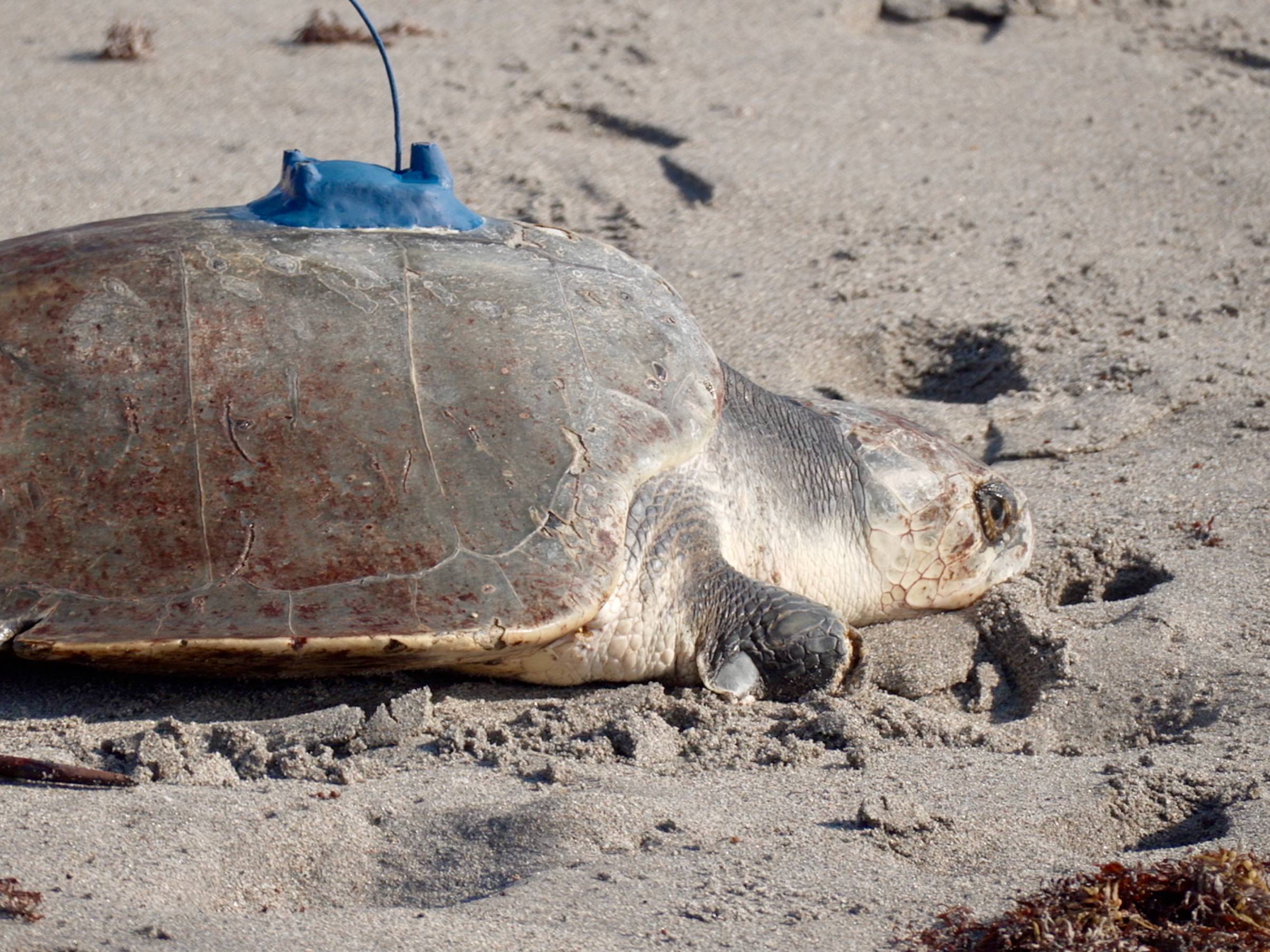
Amelie, a Kemp's ridley sea turtle who lost her right forelimb to a predator — most likely a shark, the center said — was taken to the beach on Wednesday for her highly anticipated release. The turtle paused for about 30 seconds, then slowly made her way into the Atlantic Ocean as onlookers cheered.

Amelie had been rescued and brought to the center by the Inwater Research Group in Port St. Lucie, Florida, seven weeks earlier after a traumatic amputation. She underwent surgery to clean and close the wound, and was treated for pneumonia while in a tank at the center.

When veterinarians deemed her healthy enough to return to the sea, they glued a tracking device to her shell.

A rehabilitated adult female Kemp's ridley sea turtle crawls toward the ocean during a release in Juno Beach, Fla. on Wednesday, March 25, 2026. (AP Photo/Cody Jackson)

An ultrasound confirmed that Amelie is developing eggs, giving researchers another reason to track her movements.

Kemp's ridley turtles, the rarest of sea turtle species, are more typically found on Florida's Gulf Coast, so treating Amelie was especially significant, said Andy Dehart, the center's president and CEO.

Amelie is actually the fourth amputee sea turtle being tracked by the enter, Loggerhead research director Sarah Hirsch said. They include a three-limbed turtle named Pyari who has traveled nearly 700 miles since her release in January, her tracker shows.

“We do know that they can be successful in the wild because we have seen them on our nesting beaches, but we really want to understand their dive behaviors, how they’re migrating once they’re back in the wild," The Associated Press quoted Hirsch as saying.

The satellite tags have a saltwater switch that detects when the turtle comes up to the surface to breathe, triggering the transmission of data to the satellites. Their location appears online after a 24-hour delay. To view Amelie and other turtles tracked for various research projects, visit the Loggerhead website.

“They’ve been through a lot," Hirsch said. "They’ve gotten a lot of medical care here, and to see them be able to go back out and contribute to the population is really rewarding.”