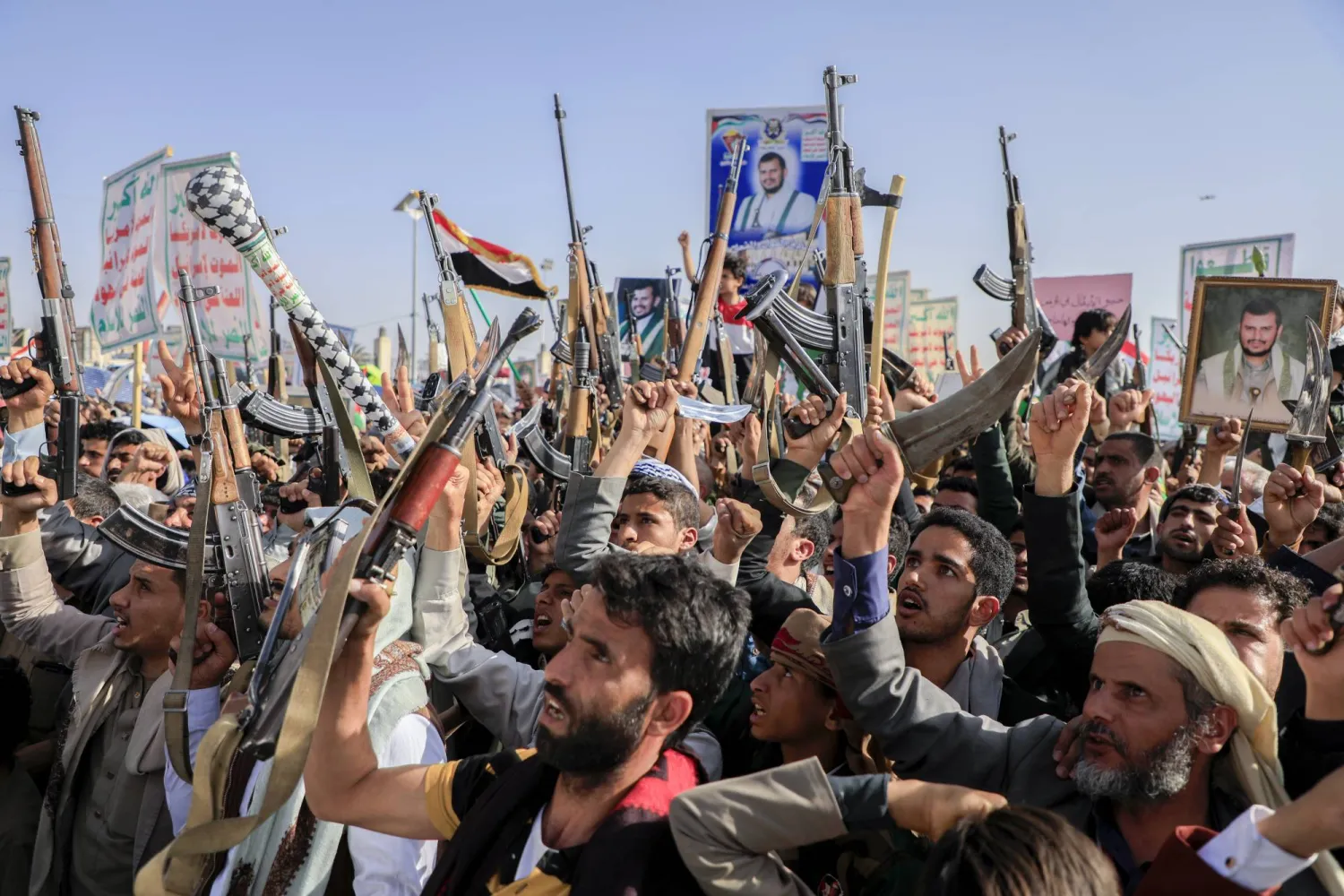
Yemen’s Houthis Escalate Attacks in Marib, Al-Jawf

Houthi supporters raise weapons as they shout slogans during an anti-US and anti-Israel rally in Sanaa, Yemen, Friday, Feb. 14, 2025. (AP Photo/Osamah Abdulrahman)
TT

Yemen’s Houthis Escalate Attacks in Marib, Al-Jawf

Houthi supporters raise weapons as they shout slogans during an anti-US and anti-Israel rally in Sanaa, Yemen, Friday, Feb. 14, 2025. (AP Photo/Osamah Abdulrahman)

Amid fears that Houthis could ignite a full-scale war against government forces and shatter the fragile truce in place since April 2022, Yemen’s army said on Thursday it had repelled intensified attacks by the group in the Marib and Al-Jawf frontlines.

The military’s media unit reported that army forces thwarted a Houthi assault late on Wednesday in northern and southern Marib, describing it as a hostile operation by the militants.

Houthis targeted Yemeni army positions with artillery and explosive-laden drones, killing two soldiers and wounding seven others, the army’s official September Net website reported on Thursday.

The attacks came as government forces repelled an offensive in the northern front and in the Al-Ayrif sector, south of Marib.

Military sources said army units also fought off a Houthi assault in the Hazm Mas area, north of Marib, responding with counterfire and destroying militant vehicles.

In retaliation, army artillery struck Houthi positions and weapons depots, inflicting losses on the group, the report added.

The latest Houthi escalation came a day after Yemeni army forces repelled an attempted infiltration by the group in the Qanaw front, east of Bir Al-Maraziq in Al-Jawf governorate, which borders Marib.

The military’s media center quoted a source as saying that army units detected Houthi movements near their positions and engaged them with medium and light weapons, triggering fierce clashes that lasted for hours.

According to the source, the fighting left four Houthis dead and five wounded, while government forces destroyed a militant vehicle.

The eastern frontlines of Al-Jawf frequently witness intermittent clashes due to repeated attacks by the Iran-backed Houthis, the source added.

Fears of renewed conflict in Yemen were a key focus of the latest briefing by UN Envoy Hans Grundberg to the Security Council, where he warned that the country was at a “critical turning point.”

Grundberg expressed regret over the rising hostilities, saying: “Regrettably, we have also seen a continuation of military activity in Yemen with reports of the movement of reinforcements and equipment towards the frontlines, and shelling, drone attacks and infiltration attempts by Houthis on multiple frontlines including Abyan, al Dhale, Lahj, Marib, Sadah, Shabwa and Taiz.”

“I call on the parties to refrain from military posturing and retaliatory measures that could lead to further tension and risk plunging Yemen back into conflict,” the envoy added, noting that his Office remains in regular contact with the parties, urging them to de-escalate tensions and take concrete confidence-building measures through the Military Coordination Committee.


Representatives of 3 Countries Receive Families of ISIS Fighters from Syria’s Roj Camp

Women and their children at the Roj camp in Syria. (AFP file)
TT

Representatives of 3 Countries Receive Families of ISIS Fighters from Syria’s Roj Camp

Women and their children at the Roj camp in Syria. (AFP file)

Representatives of Sudan, Somalia and Indonesia have received another group of their nationals from the Roj camp in Syria’s northeastern Hasakah province, the country’s last remaining camp housing families of ISIS fighters.

The handover took place three days ago during a visit by the foreign representatives, accompanied by Syrian government officials and members of the Internal Security Forces, according to a local activist.

The repeated visits by government security delegations suggest that Damascus is preparing to take over administration of the facility from the dissolved Kurdish Syrian Democratic Forces (SDF), the activist said.

Ibrahim al-Halabi, a resident of Hasakah, told Asharq Al-Awsat that the delegation met women living at the site who described their circumstances.

Located in the far northeast of Hasakah province, Roj houses around 2,200 women and children in 750 tents. Its residents hold various foreign and Arab nationalities, including Turkish, Russian, British, French, German, Australian, Indonesian, Sudanese, Somali and Tunisian citizenship. It became Syria’s last remaining camp for families of ISIS fighters following the closure of al-Hol, also in the Hasakah countryside.

Several groups of Sudanese, Somali and Indonesian nationals have already been repatriated since 2022.

According to Halabi, the latest handover included 12 Indonesian women and their children, 30 Somali women and between three and nine Sudanese women.

Dual citizenship complicates repatriation

Halabi explained that Sudanese and Somali nationals repatriated in previous operations held only one nationality. Others, however, have dual citizenship, including Sudanese-British and Somali-British nationals, complicating efforts to arrange their return.

Some women have refused to be handed over to Sudanese authorities, demanding instead that they be transferred to the British government. As a result, Sudanese and Somali women holding dual nationality have yet to be repatriated, Halabi noted.

He added that Syrian government Internal Security Forces had entered Roj several times recently, during which residents from Australia, Sudan, Somalia, Indonesia and Trinidad and Tobago were transferred out.

The latest visit brought considerable relief to residents.

Halabi also viewed the visits as a sign that Damascus would assume responsibility for managing the facility. However, he expected security arrangements to remain under the supervision of former SDF personnel integrated into the government’s Internal Security Forces under the January 2026 agreement between Damascus and the Kurdish-led force.

Roj's future

In February, the Syrian government took control of al-Hol, previously the country’s largest detention camp for families of ISIS fighters, after wresting it from the SDF, which had administered both facilities.

Al-Hol, described as the world’s most dangerous camp, had housed tens of thousands of families of various nationalities.

Following its takeover, Damascus began evacuating foreign residents and transferring them to another camp in the northern Aleppo province.

With al-Hol closed, Roj emerged as the most prominent remaining facility housing women and widows of ISIS members from different countries.

However, activists in northern Syria say it remains unclear when the camp will close or where its residents will be transferred afterward.


Iraq Reopens One Border Crossing with Iran, Closes Another as It Pursues Mediation

Iraqi Prime Minister Ali al-Zaidi. (INA)
TT

Iraq Reopens One Border Crossing with Iran, Closes Another as It Pursues Mediation

Iraqi Prime Minister Ali al-Zaidi. (INA)

Iraqi Foreign Minister Fuad Hussein confirmed Tuesday that Prime Minister Ali al-Zaidi’s secret visit to Iran was aimed at bringing Tehran and Washington closer together, as Baghdad reopened one border crossing with Iran and announced the temporary closure of another.

Speaking to the Iraqi News Agency (INA) on the sidelines of the Paris Peace Forum, Hussein described the visit as “an attempt to bring the Iranian and American positions closer together, alongside other efforts.”

He stressed Iraq’s interest in easing tensions, citing the economic impact of the closure of the Strait of Hormuz and casualties from the US war on Iran.

“We have strong relations with our neighbor Iran, as well as excellent relations with the United States,” Hussein said. “That is why Iraq can play this role, although other countries are also doing so.”

Request for time

A senior Iraqi government official told Asharq Al-Awsat that al-Zaidi had conveyed an American message to Tehran outlining a possible formula for resolving the conflict between the two countries.

The Iranian side, however, requested more time to respond, according to the official.

A source familiar with the visit confirmed to Iran’s Fars News Agency that al-Zaidi had traveled to Tehran last Friday for several hours and met Mohammad Bagher Ghalibaf, Iran’s parliament speaker and head of its negotiating delegation.

The agency reported that talks focused exclusively on Baghdad’s efforts to end the war.

Despite repeated official statements presenting the visit as a mediation effort, a source close to Iraq’s Coordination Framework suggested it might instead have been motivated by domestic concerns.

“Al-Zaidi’s recent policies, particularly the ban on Iranian flights and the closure of some border crossings, have caused considerable harm to Iran,” the source told Asharq Al-Awsat.

The visit may therefore have been intended to explain Baghdad’s position on those measures and avoid angering Tehran, it added.

It pointed to the recent public confrontation between al-Zaidi and Kataib Hezbollah, warning that tensions could lead to a direct clash. Given its influence and close ties with some armed factions, Tehran could help ease the dispute.

Regional role

Ihssan Shmary, an academic and head of the Political Thinking Center, believes al-Zaidi’s visit was primarily part of his efforts to establish a regional diplomatic role through an initiative he had previously presented to US President Donald Trump.

Speaking to Asharq Al-Awsat, Shmary said that the trip coincided with extensive Arab and regional efforts to reduce tensions and prevent renewed fighting between Washington and Tehran.

He described the trip as an attempt to break the deadlock between the two countries and secure a foreign policy achievement for Iraq.

Nevertheless, he questioned Baghdad’s ability to bring Washington and Tehran to the negotiating table.

“Iraq may be very far from being able to play the role of a country that brings the US and Iran together at a table of understanding,” he cautioned.

Al-Sheeb reopens, Mandali closes

In a separate development, Omar al-Waeli, head of Iraq’s Border Ports Authority, announced Tuesday the reopening of the al-Sheeb crossing with Iran, which had been closed since October 21.

Authorities also decided to temporarily close the Mandali crossing in the Diyala province beginning Friday.

Al-Waeli explained that al-Sheeb would resume operations following completion of the required technical procedures, while Mandali’s closure would allow similar technical requirements to be addressed.

The decisions followed earlier remarks by Foreign Minister Hussein revealing that the US Treasury Department had formally requested Baghdad to close all its border crossings with Iran except two.

Ban on Iranian flights remains in place

Meanwhile, Iran’s Football Federation announced Tuesday that Iraq had refused permission for a direct flight carrying the Iranian national team to land at Basra airport.

The team was scheduled to participate in a friendly tournament alongside Iraq, Lebanon and Palestine.

Iran’s Mehr News Agency quoted the federation as blaming obstacles imposed by the Iraqi government, particularly its refusal to authorize a direct flight to Basra.

As a result, the players traveled to the Iranian city of Abadan, from where they would continue to Basra by road.

An Iraqi Transport Ministry official told Asharq Al-Awsat that Iranian aircraft were permitted to land only at Najaf airport.

The Iranian side had chosen to fly the team to Abadan because it was closer to the stadium in Basra, the official explained.

He confirmed that Iraq remained committed to its ban on Iranian flights landing at Iraqi airports, with Najaf as the sole exception, to avoid US Treasury sanctions.


Houthis Target Sanaa Bakeries to Fund War Effort

Houthis shut dozens of bakeries to extort money from owners. (Facebook)
TT

Houthis Target Sanaa Bakeries to Fund War Effort

Houthis shut dozens of bakeries to extort money from owners. (Facebook)

Yemen's capital Sanaa is facing a looming bread shortage after the terrorist Houthi militia shut dozens of bakeries in a campaign to extract illegal payments from owners, targeting even charitable bakeries that feed poor families while forcing others to use low-quality flour.

Local sources told Asharq Al-Awsat that Houthi-controlled industry and trade authorities had deployed about 12 inspection teams since the middle of last week to raid, shut down and extort money from some 78 bakeries in the Maeen and Al-Wahda districts, citing alleged violations of bread weight regulations.

Bakery owners said the inspections were a pretext to impose more levies and force them to fund the Houthi war effort under threat of closure.

Only 25 of the 78 shuttered bakeries have reopened, after their owners were forced to pay. The rest remain closed and subject to restrictions, fueling fears that the crackdown could spread to other neighborhoods, further disrupting bread production and deepening residents' hardship.

Although Houthi inspection teams said the campaign was aimed at enforcing weight regulations, they also targeted charitable establishments known as "bakeries for the poor," demanding zakat payments despite having no authority to collect the Islamic charitable levy.

The crackdown on charitable bakeries has deprived hundreds of poor and displaced families of bread they once received free or at discounted prices.

Bakery owners in Sanaa told Asharq Al-Awsat that harassment and extortion had intensified, accusing the Houthis of turning bread production into a source of revenue.

The demands include contributions to the war effort under the banner of "supporting the front lines," as well as funding mobilization and recruitment campaigns.

Owners said the mounting costs threatened their ability to stay in business.

Residents reported dwindling bread supplies and visible shortages in several neighborhoods, warning that prolonged closures would hurt more than bakery owners.

The Houthis also face accusations of increasingly exploiting regulatory bodies under their control to squeeze money from the remaining businesses, imposing ever-higher levies instead of policing markets, protecting consumers, improving product quality and keeping prices stable.

The practices threaten one of the most essential staples in Yemeni households, adding to the strain on residents.

Beyond the closures, bakery owners in Sanaa said the Houthis had forced them in recent weeks to buy poor-quality wheat flour, some of it stored for years in warehouses belonging to the Houthi-run Zakat Authority, and mix it with the white flour used to make bread and pastries.

Bakers condemned the orders, saying they showed disregard for potential health risks to consumers.

The measures coincided with a surge in white flour prices, with bags now costing several times their previous prices.

Bakery owners said the mounting levies and restrictions, which threatened to bankrupt them, had left them with little choice but to accept and use the poor-quality flour.

With product quality deteriorating and customer demand falling, workers in the bread industry fear their businesses could collapse.