Syrian National Dialogue Conference to Begin on Feb. 25

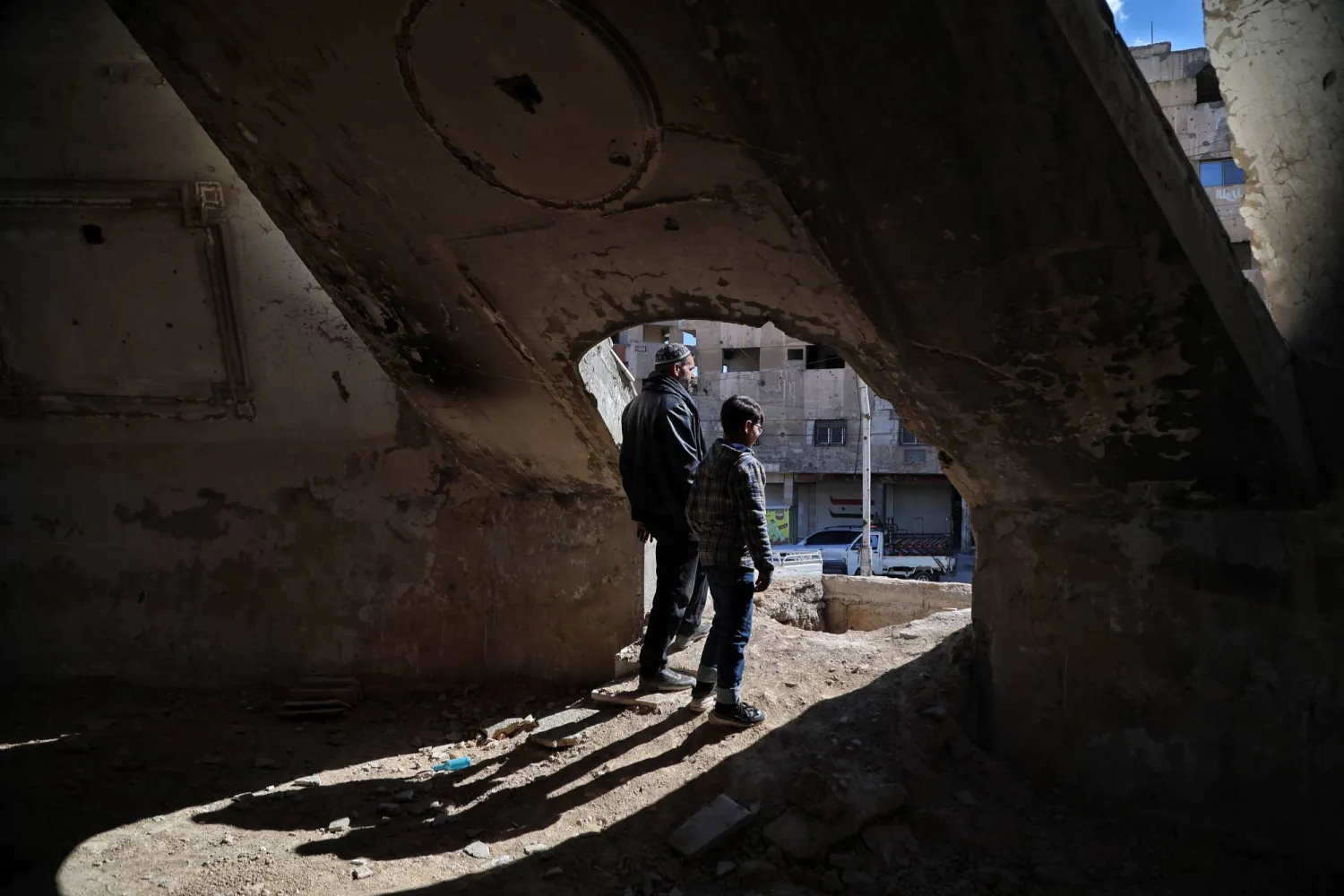
A Syrian family who once sought refuge in tunnels during the bombings by al-Assad's regime stands at the entrance of a tunnel beneath the city in Douma, the countryside of Damascus, Syria, 21 February 2025. EPA/BILAL AL HAMMOUD
TT

Syrian National Dialogue Conference to Begin on Feb. 25

A Syrian family who once sought refuge in tunnels during the bombings by al-Assad's regime stands at the entrance of a tunnel beneath the city in Douma, the countryside of Damascus, Syria, 21 February 2025. EPA/BILAL AL HAMMOUD

Syria's new authorities will hold a national dialogue conference starting on February 25 to discuss a new path for the nation after the overthrow of Bashar al-Assad in December, two members of its preparatory committee said on Sunday.
Foreign capitals will be closely watching the conference as part of a political process in Syria that they say needs to be inclusive of its ethnically diverse and multi-religious population as they consider suspending sanctions on the country, Reuters reported.
Holding the conference has been a key pledge of Hayat Tahrir al-Sham (HTS) which took control of Damascus on December 8 in a stunning offensive that prompted then-president Assad to flee to Russia, ending more than 50 years of his family's autocratic rule.
The preparatory committee's seven members consulted with some 4,000 people across Syria over the last week to gather views that would help shape a constitutional declaration, a new economic framework and a plan for institutional reform, the committee told reporters on Sunday.
HTS-appointed President Ahmed Sharaa has said the conference was part of an inclusive political process to draft a constitution, which he said could take up to three years, and then hold elections, which he said could take four years.
The conference is scheduled for two days but could be extended if necessary, committee member Hassan Dugheim said, and a new government expected to be formed next month would also benefit from the conference's recommendations.


War between Hezbollah and Israel Deepens Fractures in Lebanon

A Hezbollah flag is placed in front of a house destroyed by an Israeli strike, following an escalation between Hezbollah and Israel, amid the US-Israeli conflict with Iran, during a media tour in Chaat, Lebanon, March 23, 2026. REUTERS/Yara Nardi/File Photo
TT

War between Hezbollah and Israel Deepens Fractures in Lebanon

A Hezbollah flag is placed in front of a house destroyed by an Israeli strike, following an escalation between Hezbollah and Israel, amid the US-Israeli conflict with Iran, during a media tour in Chaat, Lebanon, March 23, 2026. REUTERS/Yara Nardi/File Photo

War between Israel and Hezbollah is pushing Lebanon's fragile state and society towards breaking point, straining sectarian and political faultlines as Shi'ite Muslims are displaced and enmity deepens between the Iran-backed group and its opponents.

Of all Lebanon's many crises since a 1975-90 civil war, the renewed conflict ignited by the Iran war could be its most destabilizing, Lebanese analysts and figures from across the political spectrum say.

Israel has threatened Gaza-like destruction and an occupation of the south and there are acrid splits in Lebanon over Hezbollah's weapons, which the group has refused to give up despite a year-long effort by the state to disarm it peacefully, Reuters said.

Israeli bombardment and orders for people to leave have driven Hezbollah's Shi'ite constituents into Christian, Druze and other areas, where many blame the group for starting a war in support of Tehran only 15 months after the last one.

Local authorities are vetting displaced people seeking rented accommodation, fearing the presence of anyone who might be a target for Israel.

Tensions between Hezbollah and the government are worsening. The administration led by Prime Minister Nawaf Salam and President Joseph Aoun has banned Hezbollah's military wing, called for talks with Israel and demanded Iran's ambassador leave.

Hezbollah official Mahmoud Qmati has compared the government to the Vichy France leaders sentenced to death for collaborating with Nazi Germany in World War Two.

"We are capable of turning the country upside down," he told a Lebanese media outlet although he later said his remarks were taken out of context.

Druze lawmaker Wael Abu Faour says internal tensions ‌are increasing because of political ‌divisions over the war and displacement and "the defiant rhetoric from more than one side".

"This exacerbates fears for internal stability," he said.

'TICKING BOMB'

More ‌than 1,000 ⁠people have ⁠been killed in Lebanon and over a million - more than a fifth of the population - have been displaced, most of them Shi'ite Muslims, since Hezbollah fired at Israel on March 2 and Israel hit back.

A foreign official said the displacement was straining communal ties and would be "a ticking bomb" if the displaced cannot go home.

Israel's military has ordered people to leave much of the south as well as Beirut's Hezbollah-controlled southern suburbs and the group's heartlands in eastern Lebanon.

Israel's defense minister has said his country intends to create a "security zone" up to the Litani River, which meets the sea about 30 km (19 miles) north of the border with Israel. He has said hundreds of thousands of Shi'ites will not return south of the Litani until security is ensured for northern Israel.

Nadim Gemayel, a Christian lawmaker opposed to Hezbollah, expressed concern that Israel was deliberately pushing Shi'ites into other parts of Lebanon to create conflict with other communities.

Hezbollah has long been at odds with many other Lebanese factions and has an arsenal more potent than the army's.

During a brief civil war ⁠in 2008, when a Western-backed government tried to outlaw Hezbollah's communications network, Hezbollah fighters took over Beirut. The government backed down.

Gemayel said tension "already ‌exists, but the ignition hasn't happened yet, and I hope that it will never happen".

"If the Israelis stay long, very long ‌in the south, this will be catastrophic for everyone ... Lebanon cannot assimilate such a displacement of people," he said, urging the Lebanese government to "disarm Hezbollah and terminate this war".

In response to a request for comment on ‌the accusation Israel was seeking to stir sectarian tensions, an Israeli official did not directly address the question but said the only conflict in Lebanon was the one started by Hezbollah and ‌urged the country to eject the group.

The Israeli military said it was operating solely against Hezbollah, and that any allegations it was operating against a specific population were "false and misleading”.

However, an Israeli military official told Reuters that evacuation notices had been issued only to Shi'ite villages in Lebanon's south, and that Christian villages were still populated and not targeted by Israeli forces.

'SECTARIAN LOGIC'

Hezbollah lawmaker Hassan Fadlallah said some Lebanese were dealing with the issue of displacement "with sectarian logic".

"We will overcome this phase because the displaced will return to their land and their homes as soon as the aggression ceases," he said.

Underlining tensions, residents of a predominantly Christian area north of Beirut brawled with ‌displaced people and demanded they leave on Tuesday when fragments of an Iranian ballistic missile intercepted over Lebanon fell onto the area.

Moves to establish a shelter for displaced in Beirut's Karantina district, in a predominantly Christian area near the port, prompted objections by Christian politicians. Salam ⁠later decreed the site would instead be used to ⁠store aid.

In the predominantly Christian neighborhood of Dekwaneh east of Beirut, about 2,000 displaced Shi'ites are sheltering in a vocational college.

Zeinab al-Meqdad, 50, said her family had encountered no problems in the neighborhood since fleeing her home in the southern suburbs on March 2.

Antoine Abu Aboud, a local official, said another 1,000 displaced were in hotels and rented accommodation in Dekwaneh.

"There is a war, and the situation is bigger than us. Today, we Lebanese must be patient with one another," he said.

He said the local council had tightened vetting of people seeking to rent, sending IDs to security forces for checks, saying residents feared anyone who could "represent a danger to their building or lives".

COEXISTENCE BETWEEN STATE AND HEZBOLLAH ARMS ENDING?

Divisions in Lebanese society are mirrored in the state, which has also been shaken by the fallout of the war.

Hezbollah held decisive sway over the state until being pummeled by Israel in 2024. After that conflict, the government sought to disarm it, but the many rockets fired by Hezbollah since March 2, and its rapid deployment of fighters back to the south, have shaken confidence in the state at home and abroad.

Hezbollah believes the government will ultimately retreat from decisions including the banning of its military wing.

"All the measures taken by the government will be reversed when Israel fails to achieve its objectives," Fadlallah said. "When we finish confronting this aggression, we, as Lebanese, will address our internal problems."

Israeli officials have indicated Israel's offensive will continue beyond the Iran war, and much hinges on what happens in the broader conflict.

A 15-point US proposal for ending the war includes Iran cutting off funding for allies such as Hezbollah, according to Israeli cabinet sources. Iran has indicated that Lebanon must be included in any ceasefire.

Christian lawmaker Alain Aoun said Lebanon was in a transitional phase, with the final terms to be determined by the war.

"The coexistence between the state and Hezbollah arms which we witnessed for decades is nearing its end in one way or another, with all the potential repercussions for society and the political system," he said.



Egypt, Syria Boost Rapprochement Through Reconstruction, Economic Cooperation

Egyptian Foreign Minister Badr Abdelatty with his Syrian counterpart Asaad al-Shaibani during a meeting in New York last September. (Egyptian Foreign Ministry)
TT

Egypt, Syria Boost Rapprochement Through Reconstruction, Economic Cooperation

Egyptian Foreign Minister Badr Abdelatty with his Syrian counterpart Asaad al-Shaibani during a meeting in New York last September. (Egyptian Foreign Ministry)

Egypt and Syria are seeking to strengthen bilateral cooperation and expand economic and trade partnerships, following a series of visits and meetings at various levels in recent weeks.

Egypt’s Foreign Minister Badr Abdelatty stressed his country’s “commitment to actively contributing to efforts to rebuild Syria.”

In a phone call with his Syrian counterpart, Asaad al-Shaibani, he highlighted the importance of building on the results of a recent visit by an Egyptian economic delegation to Damascus and following up on its outcomes in a way that serves the interests of both countries, according to a statement Thursday by Egypt’s Foreign Ministry.

In January, Damascus hosted the first Egyptian-Syrian Economic and Investment Forum, with the participation of 26 leaders from Egyptian chambers of commerce and the business community. The forum aimed to establish effective partnerships between the two countries’ commercial institutions and explore prospects for cooperation in trade, industry, services, infrastructure and reconstruction.

The Federation of Egyptian Chambers of Commerce said the forum sought to create Syrian-Egyptian-European alliances through the Union of Mediterranean Chambers, as well as to promote Syrian exports to Africa via the Federation of African Chambers.

During their call, Abdelatty and Shaibai also discussed ways to advance and develop bilateral relations across various fields, particularly in the economic and trade sectors.

Meanwhile, Syria’s Minister of Economy and Industry Nidal al-Shaar met with Egypt’s chargé d’affaires in Damascus, Ambassador Osama Khadr, to discuss ways to develop economic relations and partnerships.

According to the Syrian Arab News Agency (SANA), the talks addressed opportunities to expand economic cooperation, boost trade exchange and enhance collaboration across multiple sectors.

Al-Shaar stressed the importance of strengthening economic ties between Syria and Egypt and activating areas of cooperation in a way that serves mutual interests and supports market activity in both countries.

Former Egyptian assistant foreign minister Youssef El-Sharkawy said Egyptian-Syrian rapprochement is primarily driven by economic considerations.

Existing trade agreements between the two countries need to be activated to enhance cooperation, he remarked, adding that Cairo has continued to support Damascus both politically and economically.

In remarks to Asharq Al-Awsat, El-Sharkawy said economic cooperation represents a key avenue for strengthening rapprochement and improving political understanding, particularly amid evolving regional dynamics that require ongoing coordination with all parties.

Egypt remains committed to supporting the stability and sovereignty of Syria and its neighbors, especially Lebanon, he stressed.

According to Egypt’s Foreign Ministry, the call between Abdelatty and Shaibani also addressed the volatile regional situation amid escalating military tensions. Abdelatty pointed to Egyptian and regional efforts to contain tensions and de-escalate developments linked to Iran.

There has been progress in economic and trade cooperation between the two countries, according to Ayman El-Ashry, head of the Cairo Chamber of Commerce, who noted that the Syrian government is offering significant incentives to Egyptian investors.

Syrian President Ahmad al-Sharaa also met with an Egyptian business delegation during its January visit to Damascus, expressing appreciation for Egypt’s support, including its hosting of Syrian refugees during its civil war.

The World Bank estimates the cost of rebuilding Syria at around $216 billion, including $75 billion for housing, $59 billion for non-residential buildings and $82 billion for infrastructure.


No ‘Positive Signs’ as Israel Refuses to Tie Ending War on Lebanon to Iran

 In this photo released by the Lebanese Presidency press office, Lebanese President Joseph Aoun, right, shakes hands with Egyptian Foreign Minister Badr Abdelatty in Baabda, east of Beirut, Lebanon, Thursday, March 26, 2026. (Lebanese Presidency press office via AP)
In this photo released by the Lebanese Presidency press office, Lebanese President Joseph Aoun, right, shakes hands with Egyptian Foreign Minister Badr Abdelatty in Baabda, east of Beirut, Lebanon, Thursday, March 26, 2026. (Lebanese Presidency press office via AP)
TT

No ‘Positive Signs’ as Israel Refuses to Tie Ending War on Lebanon to Iran

 In this photo released by the Lebanese Presidency press office, Lebanese President Joseph Aoun, right, shakes hands with Egyptian Foreign Minister Badr Abdelatty in Baabda, east of Beirut, Lebanon, Thursday, March 26, 2026. (Lebanese Presidency press office via AP)
In this photo released by the Lebanese Presidency press office, Lebanese President Joseph Aoun, right, shakes hands with Egyptian Foreign Minister Badr Abdelatty in Baabda, east of Beirut, Lebanon, Thursday, March 26, 2026. (Lebanese Presidency press office via AP)

Lebanese President Joseph Aoun reiterated on Thursday the need for the state to impose its authority throughout its territories and impose monopoly over weapons as part of an initiative to launch direct negotiations with Israel to end the war.

Egyptian Foreign Minister Badr Abdelatty said that his country was carrying out “intense” contacts, including relaying messages between Iran and the United States, and communicating with Israel, to ease the tensions and prevent the regional conflict from expanding.

Abdelatty was in Beirut where he met with Aoun and several officials as part of Egypt’s efforts to support Lebanon and contain the regional and international escalation.

He conveyed to Aoun President Abdel Fattah al-Sisi's support and “full solidarity with Lebanon, its leadership and people.”

He stressed that Egypt stands by Lebanon during its plight.

“Cairo will not spare an effort to offer political, diplomatic and humanitarian support and it is constantly working with various concerned parties to ease the tensions and avert a deterioration,” added the FM.

‘Unencouraging’ signs

Sources monitoring Abdelatty’s meetings in Beirut said the signs were “unencouraging” and that the political and military circumstances “are not positive” when it comes to Lebanon, especially with Israeli Prime Minister Benjamin Netanyahu’s refusal that the war on Lebanon be included in US-Iran negotiations on ending the regional conflict.

He is insisting on his position to eliminate Hezbollah regardless if a ceasefire is reached between Washington and Tehran, said the sources, meaning the war on Lebanon will stretch on.

They warned that the Lebanese front may witness further escalation in the coming phase.

Abdelatty echoed these concerns, telling reporters in Lebanon that “diplomacy continues, but it has not reached tangible results.”

“Some sides are seeking calm and exploring the possibility of negotiations, so progress may be achieved in the future,” he revealed.

Aoun

Aoun underscored his initiative aimed at ending the military escalation and the Israeli occupation of southern regions, as well as the Lebanese state imposing its authority throughout its territories.

The initiative is based on consolidating security and stability across Lebanon’s borders and preventing any armed presence outside the state, he added. Illegal weapons will be seized to ensure state monopoly over arms and that it alone has control over decisions of war and peace.

“Lebanon does not want to be an arena for the wars of others,” he declared. “Lebanon’s official position reflects a clear desire to keep the country out of regional conflicts.”

He warned that Israel’s failure to respond to his proposal means that the military escalation will continue, deepening the suffering of the people, especially those in the South.

“The Lebanese people are united in refusing to be dragged to civil war,” Aoun added. The army and security forces are carrying out their duties in preserving civil peace and protecting the people, especially the displaced in shelters.

Referring to the continued escalation, he lamented that “might is still prevailing over reason.”

Humanitarian aid

Abdelatty announced that Egypt has sent nearly a 1,000 tons of humanitarian aid to Lebanon that include medical and food products and shelters for the displaced.

“The aid reflects the Egyptian people’s solidarity with the Lebanese people and their keenness on easing their suffering,” the FM stressed.

“Egypt is ready to meet all the demands of our brothers in Lebanon, on the humanitarian, political or diplomatic levels. It will not relent in maintaining its efforts to end the hostilities and restore calm,” he added.