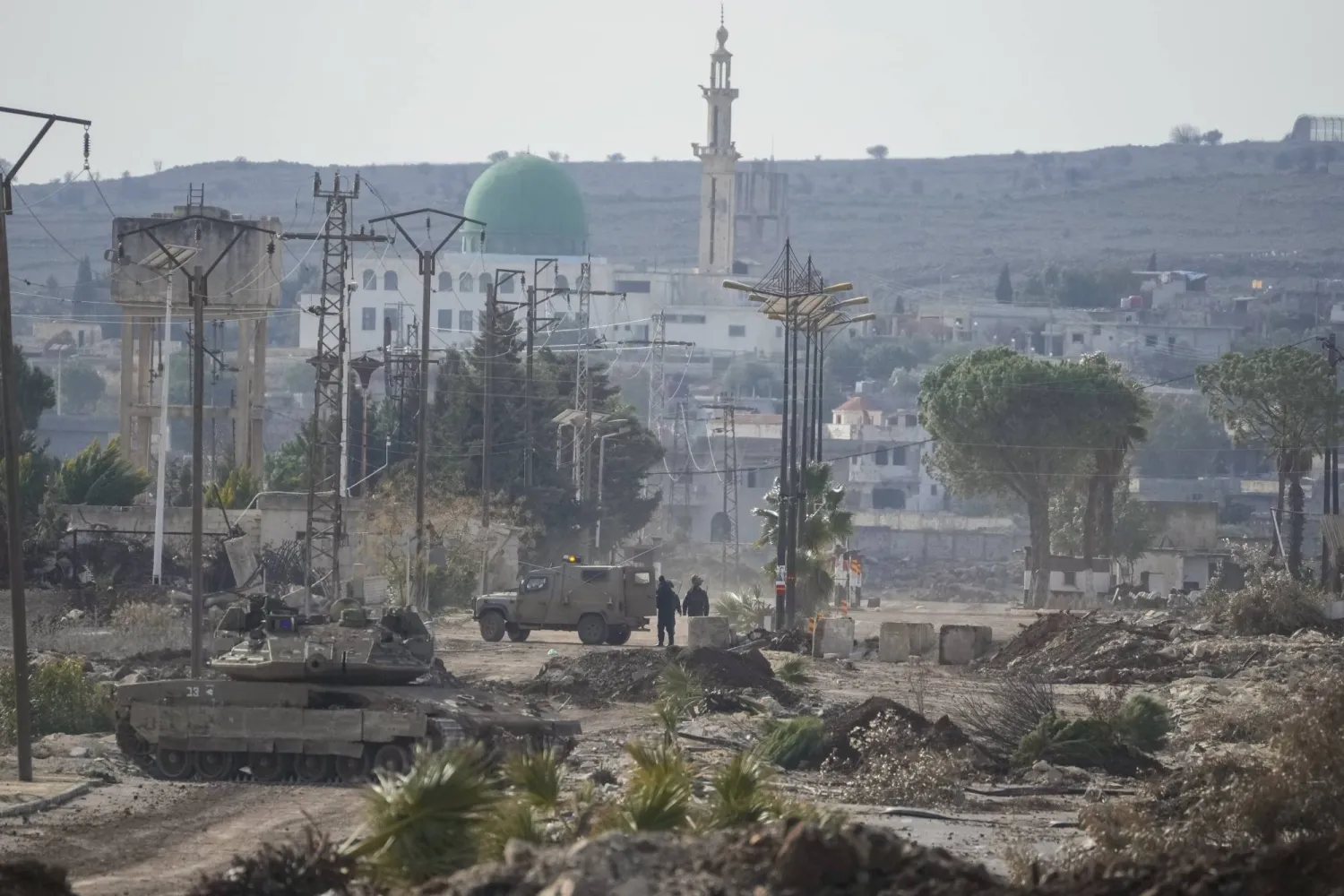
Netanyahu Says Israel Won't Allow Syrian Forces 'South of Damascus'

FILE - Israeli army armored vehicles block a road leading to the town of Quneitra, Syria, Jan. 5, 2025. (AP Photo/Mosa'ab Elshamy, File)
TT

Netanyahu Says Israel Won't Allow Syrian Forces 'South of Damascus'

FILE - Israeli army armored vehicles block a road leading to the town of Quneitra, Syria, Jan. 5, 2025. (AP Photo/Mosa'ab Elshamy, File)

Israeli Prime Minister Benjamin Netanyahu said Sunday that Israel will not allow Syria’s new army or the group that led the ouster of former President Bashar Assad to “enter the area south of Damascus” as his government made clear Israeli forces would stay in parts of southern Syria for an indefinite period.
Netanyahu’s comments at a military graduation led to new concerns over the Israeli presence, and sway, in a swath of southern Syria as Damascus' new leaders attempt to consolidate control after years of civil war.
“Take note: We will not allow HTS forces or the new Syrian army to enter the area south of Damascus,” Netanyahu said, referring to Syria’s new authorities as well as Hayat Tahrir al-Sham, the main former opposition group.
“We demand the complete demilitarization of southern Syria in the provinces of Quneitra, Daraa and Suwayda from the forces of the new regime. Likewise, we will not tolerate any threat to the Druze community in southern Syria.”
There was no immediate response from Syrian authorities, The Associated Press reported.
Defense Minister Israel Katz added that Israeli forces will remain on the peak of Mt. Hermon in southern Syria and in a buffer zone “for an indefinite period of time to protect our communities and thwart any threat.”
He said Israeli forces have built two posts on the mountain and another seven in the buffer zone “to ensure defense and offense against any challenge.”
After the fall of Assad in December, Israel seized the UN-patrolled buffer zone on Syrian territory. The zone was set up under a 1974 ceasefire agreement. Syria’s new authorities and UN officials have called for Israel to withdraw.
Meanwhile, Netanyahu’s government has been under pressure to protect Israelis living near border areas in the north.
Katz said Israel will “strengthen ties with friendly populations in the region,” notably the Druze.
More broadly, Israeli forces “will not allow hostile forces to establish themselves and be present in the security zone in southern Syria from here to Damascus. And we will act against any threat,” Katz added.



Gaza No Longer in Famine After Aid Access Improves, Hunger Monitor Says

Palestinians wait to receive food from a charity kitchen after the global hunger monitor, in Gaza City, August 28, 2025. REUTERS/Mahmoud Issa/File Photo
TT

Gaza No Longer in Famine After Aid Access Improves, Hunger Monitor Says

Palestinians wait to receive food from a charity kitchen after the global hunger monitor, in Gaza City, August 28, 2025. REUTERS/Mahmoud Issa/File Photo

There is no longer famine in Gaza, a global hunger monitor said on Friday, after access for humanitarian and commercial ​food deliveries improved following a fragile October 10 ceasefire in the war between Israel and Palestinian Hamas militants.

The latest assessment by the Integrated Food Security Phase Classification comes four months after it reported that 514,000 people - nearly a quarter of Palestinians in the Gaza Strip - were experiencing famine. The IPC warned on Friday that the situation in the enclave remained critical, Reuters reported.

"Under a worst-case scenario, which would include renewed hostilities and a halt in humanitarian and commercial inflows, the entire Gaza Strip (would be) at risk of famine through mid-April 2026. This underscores the severe and ongoing humanitarian crisis," the IPC said in the report.

Israel controls all access to the coastal enclave. COGAT, the Israeli military agency that coordinates aid, in August disputed that there was famine in Gaza. COGAT says 600-800 trucks have entered Gaza daily since the start of the truce in October, ‌and that food made ‌up 70% of all those supplies.

COGAT rejected the report's findings.

"The report relies on ‌severe ⁠gaps in ​data collection ‌and on sources that do not reflect the full scope of humanitarian assistance. As such, it misleads the international community, fuels disinformation and presents a false depiction of the reality on the ground."

Israel's Foreign Ministry said that far more aid was going into Gaza than what was reflected in the report and that food prices there had dropped sharply since July.

Hamas disputes Israel's aid figures, saying far fewer than 600 trucks a day have made it into Gaza. Aid agencies have repeatedly said far more aid needs to get into the small, crowded territory and have said Israel is blocking needed items from entering, which Israel denies.

NO FAMINE, BUT STILL CATASTROPHIC CONDITIONS

The IPC said five famines have been confirmed in the past 15 years: in Somalia ⁠in 2011, South Sudan in 2017 and 2020, Sudan in 2024, and most recently in Gaza in August.

For a region to be classified as in famine at least 20% of people ‌must be suffering extreme food shortages, with one in three children acutely malnourished and ‍two people out of every 10,000 dying daily from starvation or malnutrition ‍and disease.

"No areas are classified in famine," the IPC said of Gaza on Friday. "The situation remains highly fragile and is contingent on ‍sustained, expanded and consistent humanitarian and commercial access."

Even if a region has not been classified as in famine because those thresholds have not been met, the IPC can determine households are suffering catastrophic conditions, which it describes as an extreme lack of food, starvation and significantly increased risks of acute malnutrition and death.

The IPC said on Friday that more than 100,000 people in Gaza were experiencing catastrophic conditions, but projected that figure to decline to around 1,900 people by ​April 2026. It said the entire Gaza Strip was classified in an emergency phase, one step below catastrophic conditions.

"Over the next 12 months, across the entire Gaza Strip, nearly 101,000 children aged 6–59 months are expected to suffer from acute ⁠malnutrition and require treatment, with more than 31,000 severe cases," the IPC said.

"During the same period, 37,000 pregnant and breastfeeding women will also face acute malnutrition and require treatment," it said.

AID CHALLENGES REMAIN

Antoine Renard, the top UN World Food Programme official in Gaza and the West Bank, said there were signs of improvement in the dire hunger situation in Gaza.

"The fact that most of the population is having two meals per day is actually a clear sign that we are actually having a bit of reversal," he told reporters on Thursday.

However, he said it was "a constant struggle" to get streamlined access to Gaza at scale and speed with humanitarian and commercial trucks facing congestion at the border crossings.

The United Nations and aid groups also warned on Wednesday that humanitarian operations in Gaza were at risk of collapse if Israel does not lift impediments that include a "vague, arbitrary, and highly politicized" registration process.

The International Rescue Committee’s Zoe Daniels said high food prices meant it was hard for many people in Gaza to obtain enough high-quality food even when it was available in the market, while Jolien Veldwijk of CARE said the situation in Gaza had not improved as much as it ‌should have.

"People are relying on canned food that is pre-cooked or community kitchens, and they don’t hold the nutritional value that is needed for people to recover from malnutrition.”


Lebanon-Israel Truce Committee Talks Widen as Hezbollah Disarmament Deadline Nears

People inspect a damaged building, after Israeli military said on Sunday that it struck a militant from the Lebanese Iran-aligned Hezbollah group, in Beirut's southern suburbs, Lebanon November 23, 2025. REUTERS/Mohamed Azakir
TT

Lebanon-Israel Truce Committee Talks Widen as Hezbollah Disarmament Deadline Nears

People inspect a damaged building, after Israeli military said on Sunday that it struck a militant from the Lebanese Iran-aligned Hezbollah group, in Beirut's southern suburbs, Lebanon November 23, 2025. REUTERS/Mohamed Azakir

The committee overseeing the Hezbollah-Israel truce in Lebanon focused on Friday on how to return displaced people to their homes, addressing civilian issues to help prevent ​renewed war if a year-end deadline to disarm Hezbollah is not met.

The 15th meeting of the committee reflected a long-standing US push to broaden talks between the sides beyond monitoring the 2024 ceasefire, in line with President Donald Trump's agenda of cementing peace deals across the volatile Middle East, according to Reuters.

Israel has publicly urged Lebanese authorities to fulfil a commitment under the truce to disarm Hezbollah, ‌warning that ‌it would act "as necessary" if Lebanon does not ‌take ⁠steps ​against the ‌Iran-aligned proxy militia.

At Friday's meeting in the south Lebanon coastal town of Naqoura, civilian participants discussed steps to support safe returns of residents uprooted by the 2023-24 war and advance economic reconstruction, the US Embassy in Beirut said.

A source familiar with the discussions told Reuters they also addressed disputes over how to limit weaponry south of the Litani River ⁠and deploying the Lebanese army into Hezbollah's stronghold region.

The Lebanese and Israeli participants agreed ‌that durable political and economic progress was essential ‍to reinforcing security gains and ensuring ‍long-term stability and prosperity, the US Embassy added in a ‍statement.

The committee added that a strengthened Lebanese army, which participants described as the guarantor of security south of the Litani River but was for many years outgunned by Hezbollah, was critical to sustaining stability.

Lebanese President Joseph Aoun ​affirmed the priority of returning residents of border villages to their homes, a presidency statement said, adding that the ⁠committee would reconvene on January 7.

Lebanon and Israel have been officially enemy states for more than 70 years. Since the US-brokered truce, the two sides have traded accusations of violations while Israel has continued to carry out strikes that have killed hundreds, saying it is targeting Hezbollah attempts to rebuild military capabilities.

At the committee's December 3 meeting, the first including civilians from both sides, Lebanese Prime Minister Nawaf Salam said he hoped civilian participation would help defuse tensions.

Israeli Prime Minister Benjamin Netanyahu said then the atmosphere at the meeting was good and ‌that the sides agreed to put forth ideas for economic cooperation, but that Hezbollah must be disarmed regardless.


Egypt Says Gas Deal with Israel is 'Strictly Commercial'

Under the deal, Leviathan will sell about 130 bcm of gas to Egypt through 2040 or until all contract values are fulfilled - File Photo
TT

Egypt Says Gas Deal with Israel is 'Strictly Commercial'

Under the deal, Leviathan will sell about 130 bcm of gas to Egypt through 2040 or until all contract values are fulfilled - File Photo

Egypt said that a natural gas deal with Israel was a "strictly commercial" arrangement with no political dimensions, adding it was concluded by private energy companies under market rules without direct government intervention, Reuters reported.

Earlier this week, Israel approved an export deal signed in August with Chevron and its partners, NewMed and Ratio, to supply up to $35 billion of gas to Egypt from the Leviathan natural gas field.

Egypt's position on the Palestinian cause is "firm and unwavering," supporting the legitimate rights of the Palestinian people, rejecting forced displacement, and adhering to a two-state solution, the head of Egypt's State Information Service, Diaa Rashwan, said in a statement.

Israeli Prime Minister Benjamin Netanyahu on Wednesday described the agreement as the largest gas deal in Israel's history, adding it would help bolster regional stability.

Under the deal, Leviathan, which has reserves of around 600 billion cubic metres, will sell about 130 bcm of gas to Egypt through 2040 or until all contract values are fulfilled, NewMed said in a statement.

Egypt's gas production began declining in 2022, forcing it to abandon its ambitions to become a regional supply hub. It has increasingly turned to Israel to make up the shortfall.