EU Begins Easing Syria Energy, Transport and Banking Sanctions

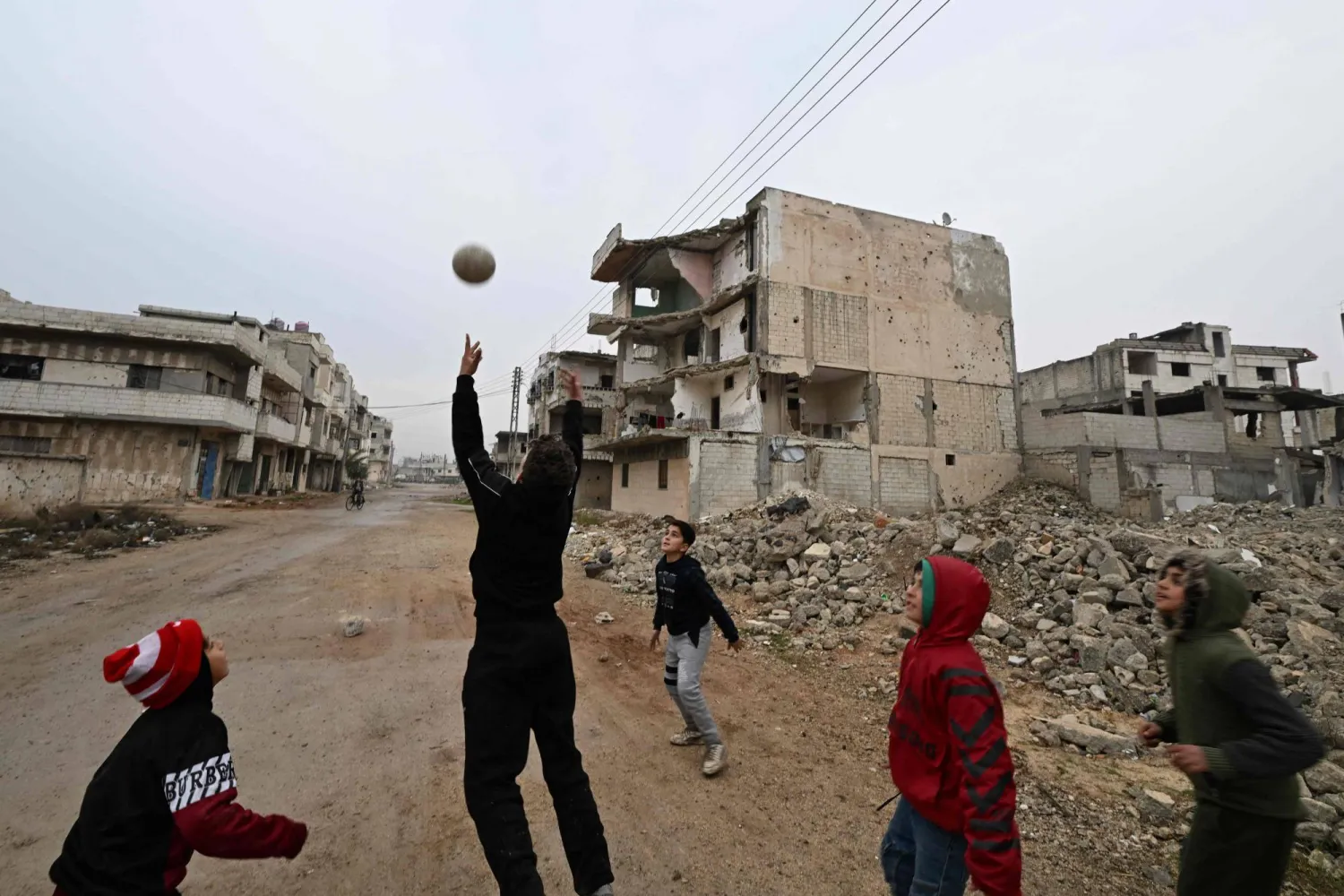
Syrian children play in the heavily damaged Baba Amr neighborhood following the return of their families to the central Syrian city of Homs on February 10, 2025. (Photo by LOUAI BESHARA / AFP)
TT

EU Begins Easing Syria Energy, Transport and Banking Sanctions

Syrian children play in the heavily damaged Baba Amr neighborhood following the return of their families to the central Syrian city of Homs on February 10, 2025. (Photo by LOUAI BESHARA / AFP)

The European Union on Monday began easing energy and transport sanctions and banking restrictions against Syria, aiming to help breathe life into the conflict-torn country’s economy if its new leaders work toward a peaceful future.
The EU started to impose asset freezes and travel bans on Syrian officials, banks, agencies and other organizations in 2011, in response to then-President Bashar Assad’s crackdown on protesters, which festered into a civil war.
But after Assad was toppled in a lightning opposition offensive in December, Hayat Tahrir al-Sham (HTS), now in control of Syria, set up an interim administration, saying that a new government would be formed through an inclusive process by March.
Eager to encourage the new leadership, the EU said it was suspending measures targeting oil, gas and electricity as well as transport, and notably the aviation sector. The possibility to fund and provide certain economic resources to five banks will be reinstated.
Restrictions on the export of luxury goods to Syria for personal use will also be eased, The Associated Press reported.
The decision to lift the sanctions was taken by EU foreign ministers and was made as part of efforts “to support an inclusive political transition in Syria, and its swift economic recovery, reconstruction, and stabilization,” a statement said.
The EU said that it would monitor developments in Syria to see whether other economic sanctions could be lifted, but it has also kept open the possibility of slapping the sanctions back on should the new leaders take the country in the wrong direction.
In January, former HTS leader Ahmad al-Sharaa was named Syria’s interim president after a meeting of most of the country’s former opposition factions. The groups agreed to dissolve the country’s constitution, the former national army, security service and official political parties.
International pressure has mounted for al-Sharaa to follow through on promises of an inclusive political transition. UN special envoy for Syria Geir Pedersen has said the formation of a “new inclusive government” by March 1 could help determine whether Western sanctions are lifted.



China Will Push More Proactive Macro Policies in 2026, Xi Says

Pedestrians walk along a street in the Central Business District of Beijing, China, 31 December, 2025. (EPA)
TT

China Will Push More Proactive Macro Policies in 2026, Xi Says

Pedestrians walk along a street in the Central Business District of Beijing, China, 31 December, 2025. (EPA)

China will implement more proactive ​macroeconomic policies next year, President Xi Jinping said on Wednesday, according ‌to state ‌media.

The ‌Chinese ⁠economy ​is ‌expected to achieve about 5% growth for 2025, to about 140 ⁠trillion yuan ($20 trillion), ‌Xi said.

The ‍country ‍will promote ‍effective qualitative improvement and reasonable quantitative growth in ​the economy, Xi said at ⁠a New Year's tea party of top Chinese Communist Party officials.


India Overtakes Japan as World's 4th Largest Economy

 A man walks at the seafront as scattered clouds are seen over Mumbai's skyline, India, June 10, 2015. (Reuters)
 A man walks at the seafront as scattered clouds are seen over Mumbai's skyline, India, June 10, 2015. (Reuters)
TT

India Overtakes Japan as World's 4th Largest Economy

 A man walks at the seafront as scattered clouds are seen over Mumbai's skyline, India, June 10, 2015. (Reuters)
 A man walks at the seafront as scattered clouds are seen over Mumbai's skyline, India, June 10, 2015. (Reuters)

India has overtaken Japan as the world’s fourth largest economy and officials hope to pass Germany within three years, the government’s end-of-year economic review revealed.

Official confirmation, however, depends on data due in 2026 when final annual gross domestic product figures are released, with the International Monetary Fund (IMF) suggesting India will cross over Japan next year, reported AFP.

“India is among the world’s fastest-growing major economies and is well-positioned to sustain this momentum,” read the government economic briefing note, which was released late on Monday.

“With GDP valued at $4.18 trillion, India has surpassed Japan to become the world’s fourth largest economy, and is poised to displace Germany from the third rank in the next two-and-a-half to three years, with projected GDP of $7.3 trillion by 2030.”

IMF projections for 2026 put India’s economy at $4.51 trillion, compared with Japan’s $4.46 trillion.

The upbeat assessment comes despite economic worries after Washington in August hit India with huge tariffs over its purchases of Russian oil.

New Delhi said continued growth reflects its “resilience amid persistent global trade uncertainties”. But other measurements offer a less rosy outlook.

In terms of population, India overtook neighboring China as the most populous nation in 2023.

India’s GDP per capita was $2,694 in 2024, according to the latest World Bank figures, 12 times smaller than Japan’s $32,487, and 20 times smaller than Germany’s $56,103.

Government figures show that more than a quarter of India's 1.4 billion people are aged between 10 and 26. Creating enough well-paid jobs for millions of young graduates is an upcoming hurdle, but the report offered a rosy outlook.

“As one of the world's youngest nations, India's growth story is being shaped by its ability to generate quality employment that productively absorbs its expanding workforce and delivers inclusive, sustainable growth,” a note in the review said.

India’s Prime Minister Narendra Modi this year unveiled sweeping consumption tax cuts and pushed through labor law reforms after growth slowed to a four-year low in the 12 months ending March 31.

Currency pressures have also mounted.

The rupee hit a record low against the dollar in early December, after falling about 5% in 2025.

That came amid concerns over the lack of a trade deal with Washington and the impact of higher levies on Indian goods.

India became the world's fifth largest economy in 2022, when its GDP overtook that of former colonial ruler Britain, according to IMF figures.


King Salman International Airport Kicks of Construction of 3rd Runway to Boost Operational Efficiency

 The airport will incorporate the King Khalid terminals - SPA
The airport will incorporate the King Khalid terminals - SPA
TT

King Salman International Airport Kicks of Construction of 3rd Runway to Boost Operational Efficiency

 The airport will incorporate the King Khalid terminals - SPA
The airport will incorporate the King Khalid terminals - SPA

King Salman International Airport (KSIA), a PIF company, has commenced construction works on the third runway, marking a strategic step that reflects continued progress in airfield development and enhances the airport’s operational readiness to support long-term growth in air traffic demand.

The third runway forms a key component of the KSIA Master Plan and represents a major milestone in the airport’s expansion journey.
According to a press release issued by the KSIA, the project is being delivered in collaboration with FCC Construcción SA and Al-Mabani General Contractors Company and has been designed in alignment with Riyadh’s prevailing wind patterns to ensure safe and efficient aircraft operations under all operating conditions, SPA reported.

The current operational capacity stands at 65 aircraft movements per hour. With the implementation of operational enhancements and the introduction of the third runway, capacity is expected to increase to 85 aircraft movements per hour, contributing to improved operational efficiency and supporting long-term growth.

The third runway incorporates multiple access taxiways to ensure smooth aircraft flow and will span 4,200 meters in length.

Acting CEO of KSIA Marco Mejia said: “Launching construction of the third runway marks a pivotal step in delivering the KSIA Master Plan and reflects our commitment to developing world-class infrastructure capable of supporting future growth, enhancing operational efficiency, and expanding long-haul connectivity without constraints.”

King Salman International Airport is a strategic and transformative national project that reflects the Kingdom’s ambition to position Riyadh as a global capital and a leading aviation hub. The project was announced by His Royal Highness Prince Mohammed bin Salman bin Abdulaziz, Crown Prince, Prime Minister, Chairman of the Council of Economic and Development Affairs and Chairman of the Board of Directors of King Salman International Airport, underscoring its national significance and its role in advancing the objectives of Saudi Vision 2030.

Located on the existing site of King Khalid International Airport in Riyadh, the airport will incorporate the King Khalid terminals, in addition to three new terminals, residential and leisure assets, six runways, and logistics facilities. Spanning 57 square kilometers, it is designed to accommodate 100 million passengers annually and handle over two million tons of cargo by 2030.

This phase of construction contributes to strengthening King Salman International Airport’s international flight network across multiple global destinations, reinforcing Riyadh’s position as an internationally connected aviation gateway and supporting national development objectives within the air transport sector.