Oil Drops for Third Day on OPEC+ Output Increase, Trump Tariffshttps://english.aawsat.com/business/5118715-oil-drops-third-day-opec-output-increase-trump-tariffs
Oil Drops for Third Day on OPEC+ Output Increase, Trump Tariffs
FILE PHOTO: An oil and gas industry worker walks during operations of a drilling rig at Zhetybay field in the Mangystau region, Kazakhstan, November 13, 2023. REUTERS/Turar Kazangapov/File Photo
Oil Drops for Third Day on OPEC+ Output Increase, Trump Tariffs
FILE PHOTO: An oil and gas industry worker walks during operations of a drilling rig at Zhetybay field in the Mangystau region, Kazakhstan, November 13, 2023. REUTERS/Turar Kazangapov/File Photo
Oil prices declined for a third day on Wednesday, as investors worried about OPEC+ plans to proceed with output increases in April, and US President Donald Trump's tariffs on Canada, China and Mexico escalated trade tensions.
Brent futures fell $1.02, or 1.44%, to $70.02 a barrel by 1149 GMT. US West Texas Intermediate (WTI) crude declined $1.33, or 1.95%, to $66.93 a barrel.
The contracts settled near multi-month lows the previous day, weighed down by expectations the US tariffs and counter-tariffs by the affected countries will slow economic growth and reduce fuel demand, Reuters reported.
"The imposition of tariffs on China, Canada and Mexico by the US sparked swift reprisals from each nation that increased concerns over a slowdown in economic growth and the consequent impact on energy demand," Ashley Kelty, an analyst at Panmure Liberum, said.
Canada and China retaliated immediately to Trump's tariffs on Tuesday, and Mexican President Claudia Sheinbaum said the country would respond, without giving details.
Meanwhile, the Organization of the Petroleum Exporting Countries and its allies including Russia, a group known as OPEC+, decided on Monday to increase output for the first time since 2022, further pressuring crude prices.
The group will make a small increase of 138,000 barrels per day from April, the first step in planned monthly increases to unwind its nearly 6 million bpd of cuts, equal to almost 6% of global demand.
"There is a bit of a concern in the market that the OPEC+ decision is the start of a series of more monthly supply additions, but the statement from OPEC+ reiterates an approach in bringing back barrels only if the market can absorb them," UBS analyst Giovanni Staunovo said.
Analysts at Morgan Stanley Research said it was possible OPEC+ would deliver only a few monthly increases, rather than fully unwind the cuts.
The Trump administration also said on Tuesday it was ending a licensce the US granted to US oil producer Chevron since 2022 to operate in Venezuela and export its oil.
The decision puts 200,000 bpd of supply at risk, ING commodities strategists wrote in a note on Wednesday.
Meanwhile, US crude stocks fell by 1.46 million barrels in the week ended February 28, market sources said, citing American Petroleum Institute figures on Tuesday.
Investors await government data on US stockpiles, due on Wednesday.
Russian Economy Minister to Asharq Al-Awsat: Russia is a Reliable Partner for Saudi Arabiahttps://english.aawsat.com/business/5280427-russian-economy-minister-asharq-al-awsat-russia-reliable-partner-saudi-arabia
Russian Economy Minister to Asharq Al-Awsat: Russia is a Reliable Partner for Saudi Arabia
Russia’s Minister of Economic Development, Maxim Reshetnikov, during a session at the St. Petersburg International Economic Forum (SPIEF)
Russia’s Minister of Economic Development Maxim Reshetnikov affirmed his country’s satisfaction with the level of development in its strategic relations with Saudi Arabia, explaining that the Kingdom’s participation as the guest of honor at the 29th St. Petersburg International Economic Forum this year reflects a high level of dialogue and a shared interest in expanding cooperation across all fields.
He noted that this partnership has acquired broader and deeper dimensions within the framework of Vision 2030.
The Kremlin had announced the Kingdom’s selection as the principal guest of honor for this year’s forum, coinciding with the 100th anniversary of diplomatic relations between the two countries.
Saudi Energy Minister Prince Abdulaziz bin Salman is leading a Saudi delegation that includes a number of senior officials and representatives of national institutions and major companies, foremost among them Saudi Aramco.
Reshetnikov told Asharq Al-Awsat on the sidelines of Russia’s leading economic forum, often described as the Russian Davos, that relations between the two countries have developed actively in recent years. He revealed a qualitative leap in bilateral trade indicators, with trade volume more than doubling over the past five years. He added that investment cooperation continues to expand and expressed the expectation that the conclusion of an upcoming intergovernmental agreement on the promotion and protection of mutual investments will provide a strong additional boost for investors in both countries.
Members of the Saudi delegation at the St. Petersburg International Economic Forum (SPIEF).
Coordination Beyond Oil
Reshetnikov said that joint coordination to ensure the stability of global energy supplies represents a central pillar of the bilateral agenda, pointing to the significant international success achieved by the two countries through their leadership of the OPEC+ alliance.
In a related context, Reshetnikov stressed that Russia was a reliable partner in ensuring the Kingdom’s food security, supplying agricultural and food products including wheat, barley, sunflower oil, and poultry. He also pointed to new opportunities for expanding cooperation, revealing that ambitious plans are being studied to establish joint agricultural centers and advanced logistics corridors within the Kingdom in the coming period.
He noted that, within the framework of Vision 2030, Saudi Arabia is actively developing industry and infrastructure, areas in which Russian expertise can be utilized. At the same time, technological and industrial cooperation is becoming increasingly important.
Reshetnikov added that the two sides are working to expand cooperation in advanced technologies, including digitalization, artificial intelligence, smart-city solutions, cybersecurity, and water desalination technologies.
He also expressed his country’s full readiness to participate in the development of Saudi Arabia’s space program, drawing on Russia’s extensive expertise in astronaut training, space biology, and medicine.
Major Tourism Boom
Addressing tourism, the Russian minister described the sector as one of the most promising areas of growth and cooperation between the two countries. Total tourist traffic increased by 38 percent last year, reaching a level ten times higher than that recorded in 2019.
He pointed to the entry into force of a mutual visa-waiver regime for citizens of both countries on May 11, 2026, following the signing of a landmark agreement, as well as the resumption of direct flights by Saudia and flynas. He said he expects interest in travel between the two countries to increase further.
The minister highlighted achievements in developing tourism-sector cooperation, noting that 2025 alone saw more than 143,000 Saudi tourists visit Russia, an increase of 33 percent compared with the previous year.
In the same context, the Russian minister emphasized that his country is working intensively to broaden the scope of tourism exchanges, building on agreements concluded at the highest levels of leadership to establish a solid foundation for the growth of this vital sector.
Reshetnikov said that every effort is being made to ensure that Russia’s domestic tourism sector meets the expectations of Saudi visitors by providing an ideal travel environment suited to their needs and culture.
To achieve this goal and ensure the comfort of visitors from the Kingdom, the minister explained that Russia is rapidly expanding the application of halal standards and Muslim-friendly services across its hospitality sector.
He revealed that the first hotels in Moscow, Sochi, and Kazan have obtained the necessary official certifications, while more than 100 additional hotel establishments have submitted similar applications, which are currently under review.
Significant Improvement in Infrastructure
Reshetnikov outlined the ambitious features of Russia’s tourism infrastructure, noting that it has undergone a profound transformation over the past decade through the construction of modern airports and roads, as well as the redevelopment of city centers and public spaces to create an attractive environment for major investors and entrepreneurs alike.
Russia today has accommodation capacity exceeding one million hotel rooms, in addition to 400 ski resorts featuring more than 500 classified slopes with a combined length exceeding 1,000 kilometers. The country also boasts extensive southern coastlines stretching nearly 2,000 kilometers.
Looking ahead, the Russian minister announced a strategic plan to build 11 coastal resorts and a new year-round marina by 2030. These major projects will be distributed across the shores of five seas, in addition to the area surrounding the renowned Lake Baikal, with a target capacity of 10 million visitors annually.
Reshetnikov extended an open invitation to the Saudi business community to invest in these promising destinations, emphasizing that investors in these projects will benefit from distinguished preferential treatment and describing them as a truly excellent opportunity.
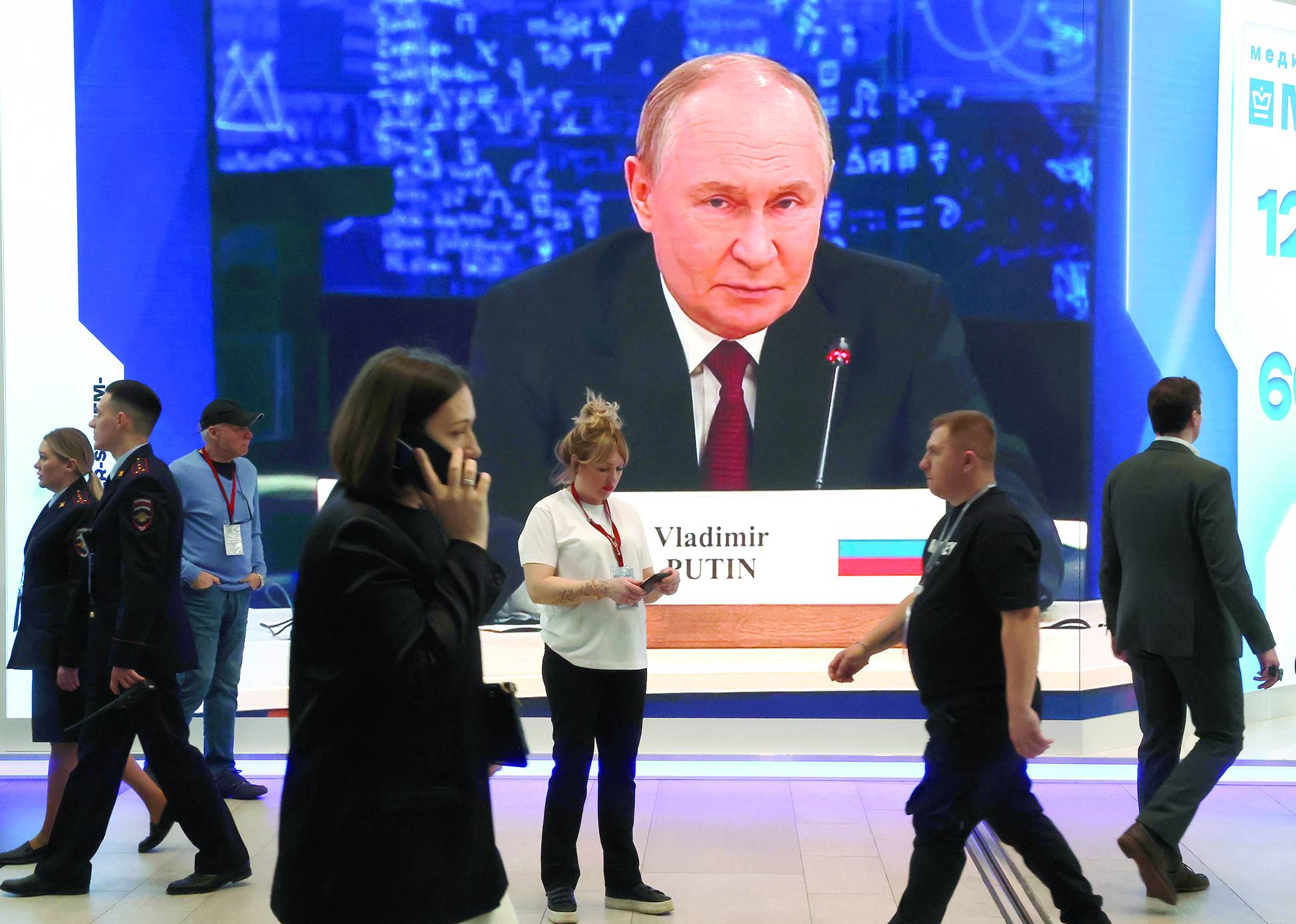
Participants walk past a large screen showing an image of Russian President Vladimir Putin during the St. Petersburg International Economic Forum (SPIEF) in St. Petersburg, Russia, 03 June 2026. EPA/ANATOLY MALTSEV
A Resilient Economy in the Face of Sanctions
Assessing the performance of the Russian economy, Reshetnikov noted that the International Monetary Fund recently raised its forecast for Russia’s economic growth in 2026 to 1.1 percent, based on higher oil prices. He described this as a positive indicator, particularly given the IMF’s cautious assessment of Russia.
He added that investors do not look solely at GDP growth. They also assess the sustainability of macroeconomic policy, the budget position, debt levels, projects with clear profitability and strategic value, and an acceptable level of risk.
The minister said that Russia’s public debt is among the lowest in the G20, standing at around 17 percent of GDP. Over the past three years alone, including 2025, Russia’s GDP has grown by more than 10 percent in real terms.
He argued that this represents annual growth of approximately 3.3 percent, above the global average, allowing Russia to maintain its position as the world’s fourth-largest economy on a purchasing power parity basis.
Reshetnikov stressed the importance of these indicators in demonstrating the attractiveness of the Russian market for foreign investment in general and Arab investment in particular.
He said Russia was an attractive long-term investment destination for Arab investors, particularly in agriculture and fertilizer production, infrastructure, digital technologies, and industrial solutions. These sectors are aligned with the priorities of Gulf countries, including asset diversification and the development of new industries.
He also emphasized the resilience of the Russian economy in the face of external challenges, saying that in recent years the Russian economy has demonstrated its ability to adapt to pressure and maintain positive momentum despite sanctions, the restructuring of logistics chains, and restricted access to Western capital. At the same time, the infrastructure underpinning cooperation remains a key issue, including settlements in national currencies, correspondent banking relations, logistics, and investment protection.
South Korea's KEPCO Wins Saudi Jafurah Power Projecthttps://english.aawsat.com/business/5280403-south-koreas-kepco-wins-saudi-jafurah-power-project
South Korea's KEPCO Wins Saudi Jafurah Power Project
The Jafura field (Aramco)
Korea Electric Power Corp (KEPCO) said it had won a contract to build and operate the second phase of a cogeneration power plant at Saudi Arabia's Jafurah project.
The company expects total revenue of about 2.1 trillion won ($1.4 billion) from the project.
KEPCO said in a statement it signed the power and steam sales agreements with Saudi Aramco for the project and completed a construction contract with Doosan Enerbility.
The plant will have power generation capacity of 331 megawatts and produce about 465 metric tons of steam per hour. It is scheduled to be built by June 2029, after which it will supply power and steam for 17 years, KEPCO said.
KEPCO said the project is an expansion of the 317-MW first phase of the Jafurah cogeneration plant, which it won through an international tender in 2022 and expects to complete by the end of June.
Egypt Says Close to Issuing $500 Million Japan Samurai Bondhttps://english.aawsat.com/business/5280327-egypt-says-close-issuing-500-million-japan-samurai-bond
A minibus moves along a main road underneath new Cairo Monorail track as a train moves above in the Fifth Settlement, a neighborhood of the New Cairo suburb of Cairo, on May 22, 2026. (Photo by Khaled DESOUKI / AFP)
Egypt Says Close to Issuing $500 Million Japan Samurai Bond
A minibus moves along a main road underneath new Cairo Monorail track as a train moves above in the Fifth Settlement, a neighborhood of the New Cairo suburb of Cairo, on May 22, 2026. (Photo by Khaled DESOUKI / AFP)
Egypt is finalizing plans for its first yen-denominated bond sale in three years, Foreign Minister Badr Abdelatty told Reuters on a trip to Japan on Thursday.
The African Development Bank said in December it would partially guarantee Cairo's planned $500 million-equivalent Samurai bonds on the Japanese markets this year.
"We are completing the final steps," Abdelatty said on the sidelines of an event in Tokyo, adding that he had been promoting the sale and other investment opportunities while in Japan.
"We had extensive discussions with our Japanese friends on monetary, fiscal, financial support, especially with regard to budget support and samurai bonds as well."
Egypt's economy has been boosted in recent years by major real estate investments and an $8 billion IMF loan, though the Iran war is piling pressure on its finances.
The bond sale would be Egypt's third in the currency, following issuances in 2022 and 2023.
"It will be very important, despite the fact that we've been hit hard with implications of the (Iran) war," Abdelatty said.
لم تشترك بعد
انشئ حساباً خاصاً بك لتحصل على أخبار مخصصة لك ولتتمتع بخاصية حفظ المقالات وتتلقى نشراتنا البريدية المتنوعة