

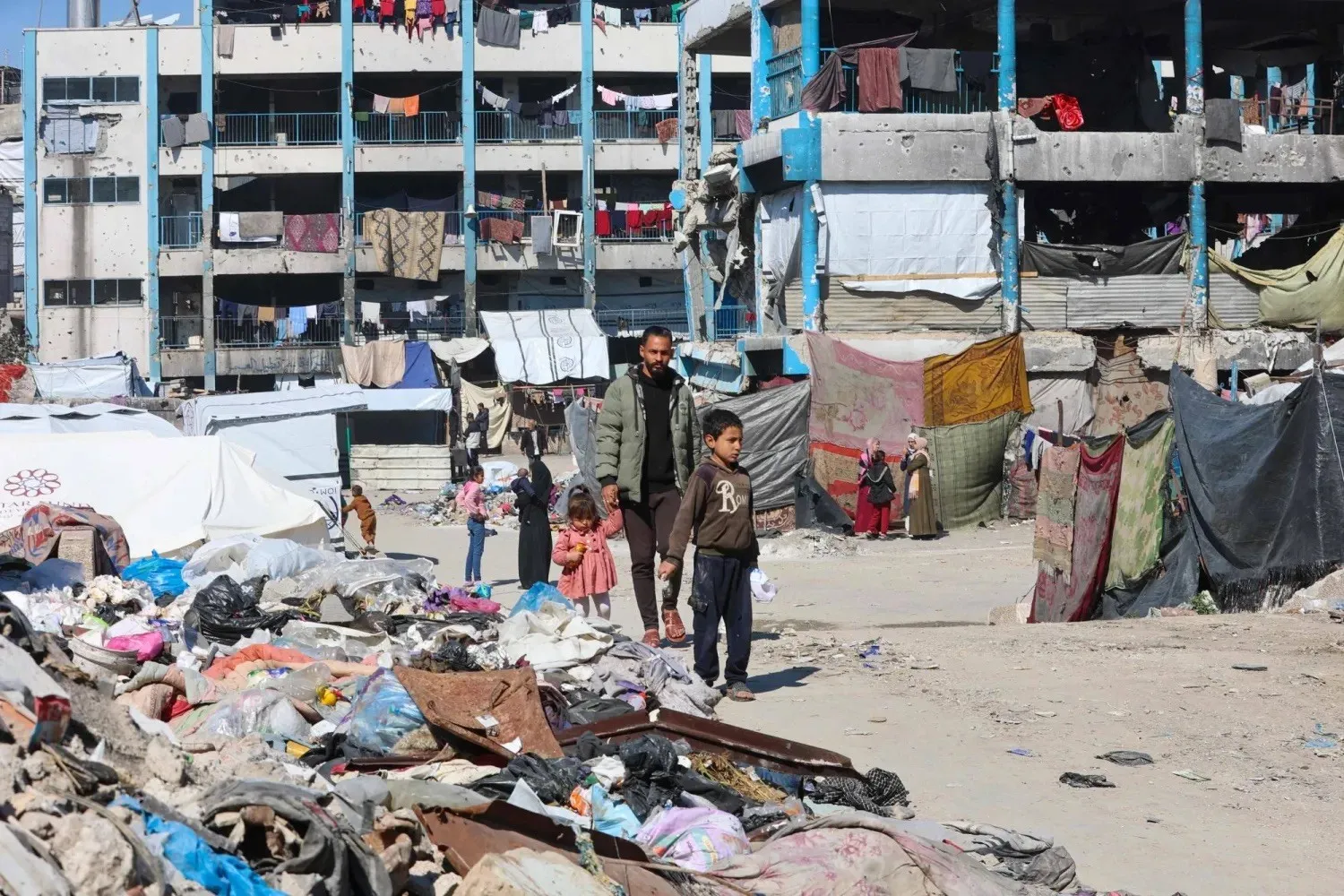

Education in Gaza Struggles Amid Efforts to Resume School Year

A school-turned-shelter for displaced persons in Jabalia, northern Gaza, on February 27 (AFP)
TT

Education in Gaza Struggles Amid Efforts to Resume School Year

A school-turned-shelter for displaced persons in Jabalia, northern Gaza, on February 27 (AFP)

Efforts to resume teaching in Gaza face significant challenges after more than a year of disruption following the October 7, 2023, attack. Schools had just reopened when the conflict broke out, forcing a prolonged suspension of classes.

For over a year, formal education remained at a standstill. However, youth-led and community-driven initiatives, along with support from UNRWA, established makeshift schools—using tents and metal structures—mainly in displacement areas such as Mawasi Khan Younis in southern Gaza.

Following the January 19 ceasefire, authorities began preparing for the resumption of the school year, which officially restarted on February 24. However, the situation remains fraught with difficulties.

One of the biggest obstacles is the presence of displaced families sheltering in school buildings, refusing to leave due to a lack of alternative housing. Teacher Ahmed Siyam from Gaza City’s Al-Nasr neighborhood told Asharq Al-Awsat that many families have nowhere else to go, especially after Israel blocked the entry of mobile homes and large quantities of tents, exacerbating the crisis.

While no exact figures exist on the number of displaced people in Gaza’s schools, estimates suggest that more than 1.2 million Palestinians remain homeless after Israeli airstrikes leveled residential areas across the enclave.

The Ministry of Education has urged displaced families to vacate classrooms to accommodate students, but with no viable alternatives, most have remained. In response, the ministry—working with UNRWA and other agencies—has set up temporary classrooms in open spaces. While this initiative has seen partial success, many parents have opted for online learning, which is also hindered by severe electricity and internet shortages.

Electricity and Connectivity Shortages

Since October 7, Gaza has suffered a complete blackout due to Israel’s blockade on fuel supplies for the enclave’s only power plant. The population has been forced to rely on solar energy, but Israeli strikes have repeatedly targeted solar panels, limiting their availability to those who can afford increasingly scarce supplies.

Wael Al-Halais, a resident of Al-Shati refugee camp in western Gaza, says his home lacks both electricity and internet, making it nearly impossible for his three children to continue their studies. He also fears for their safety, as the nearest makeshift school is 800 meters away, with no reliable transportation available.

According to Gaza’s Government Media Office, Israel has targeted 1,166 educational institutions over the past 15 months, including 927 schools, universities, learning centers, and kindergartens—many of which were completely destroyed. The war has also claimed the lives of 12,800 students and 800 teachers and administrative staff.

Deputy Education Minister Khaled Abu Nada outlined a plan to salvage the 2023–2024 academic year while preparing for the 2024–2025 school year under exceptional measures, including a special session for high school exams (Tawjihi).

The ministry also aims to rehabilitate damaged schools, expand temporary learning spaces, enhance digital education, and introduce psychological support programs to help students cope with the trauma of war.



Syria Moves Military Reinforcements East of Aleppo After Telling Kurds to Withdraw

Military vehicles drive along a road as the last Kurdish-led Syrian Democratic Forces (SDF) fighters left the Syrian city of Aleppo on Sunday, state-run Ekhbariya TV said, following a ceasefire deal that allowed evacuations after days of deadly clashes, in Latakia, Syria, January 14, 2026. (Reuters)
TT

Syria Moves Military Reinforcements East of Aleppo After Telling Kurds to Withdraw

Military vehicles drive along a road as the last Kurdish-led Syrian Democratic Forces (SDF) fighters left the Syrian city of Aleppo on Sunday, state-run Ekhbariya TV said, following a ceasefire deal that allowed evacuations after days of deadly clashes, in Latakia, Syria, January 14, 2026. (Reuters)

Syria's army was moving reinforcements east of Aleppo city on Wednesday, a day after it told Kurdish forces to withdraw from the area following deadly clashes last week.

The deployment comes as Syria's government seeks to extend its authority across the country, but progress has stalled on integrating the Kurds' de facto autonomous administration and forces into the central government under a deal reached in March.

The United States, which for years has supported Kurdish fighters but also backs Syria's new authorities, urged all parties to "avoid actions that could further escalate tensions" in a statement by the US military's Central Command chief Admiral Brad Cooper.

On Tuesday, Syrian state television published an army statement with a map declaring a large area east of Aleppo city a "closed military zone" and said "all armed groups in this area must withdraw to east of the Euphrates" River.

The area, controlled by Kurdish forces, extends from near Deir Hafer, around 50 kilometers (30 miles) from Aleppo, to the Euphrates about 30 kilometers further east, as well as towards the south.

State news agency SANA published images on Wednesday showing military reinforcements en route from the coastal province of Latakia, while a military source on the ground, requesting anonymity, said reinforcements were arriving from both Latakia and the Damascus region.

Both sides reported limited skirmishes overnight.

An AFP correspondent on the outskirts of Deir Hafer reported hearing intermittent artillery shelling on Wednesday, which the military source said was due to government targeting of positions belonging to the US-backed, Kurdish-led Syrian Democratic Forces.

- 'Declaration of war' -

The SDF controls swathes of the country's oil-rich north and northeast, much of which it captured during Syria's civil war and the fight against the ISIS group.

On Monday, Syria accused the SDF of sending reinforcements to Deir Hafer and said it would send its own personnel there in response.

Kurdish forces on Tuesday denied any build-up of their personnel and accused the government of attacking the town, while state television said SDF sniper fire there killed one person.

Cooper urged "a durable diplomatic resolution through dialogue".

Elham Ahmad, a senior official in the Kurdish administration, said that government forces were "preparing themselves for another attack".

"The real intention is a full-scale attack" against Kurdish-held areas, she told an online press conference, accusing the government of having made a "declaration of war" and breaking the March agreement on integrating Kurdish forces.

Syria's government took full control of Aleppo city over the weekend after capturing its Kurdish-majority Sheikh Maqsud and Achrafieh neighborhoods and evacuating fighters there to Kurdish-controlled areas in the northeast.

Both sides traded blame over who started the violence last week that killed dozens of people and displaced tens of thousands.

- PKK, Türkiye -

On Tuesday in Qamishli, the main Kurdish city in the country's northeast, thousands of people demonstrated against the Aleppo violence, while shops were shut in a general strike.

Some protesters carried Kurdish flags and banners in support of the SDF.

"This government has not honored its commitments towards any Syrians," said cafe owner Joudi Ali.

Other protesters burned portraits of Turkish Foreign Minister Hakan Fidan, whose country has lauded the Syrian government's Aleppo operation "against terrorist organizations".

Türkiye has long been hostile to the SDF, seeing it as an extension of the Kurdistan Workers' Party (PKK) and a major threat along its southern border.

Last year, the PKK announced an end to its long-running armed struggle against the Turkish state and began destroying its weapons, but Ankara has insisted that the move include armed Kurdish groups in Syria.

On Tuesday, the PKK called the "attack on the Kurdish neighborhoods in Aleppo" an attempt to sabotage peace efforts between it and Ankara.

A day earlier, Ankara's ruling party levelled the same accusation against Kurdish fighters.

The Britain-based Syrian Observatory for Human Rights reported 45 civilians and 60 soldiers and fighters from both sides killed in the Aleppo violence.


Lebanon Says France to Host Conference to Support Army

French Special Presidential Envoy to Lebanon, Jean-Yves Le Drian looks on during a meeting with Lebanese Prime Minister Nawaf Salam (not pictured) at the Government Palace in Beirut, Lebanon, 14 January 2026. (EPA)
TT

Lebanon Says France to Host Conference to Support Army

French Special Presidential Envoy to Lebanon, Jean-Yves Le Drian looks on during a meeting with Lebanese Prime Minister Nawaf Salam (not pictured) at the Government Palace in Beirut, Lebanon, 14 January 2026. (EPA)

Lebanon said Wednesday that a conference in support of the country's army as it seeks to disarm Hezbollah would take place in Paris on March 5.

The announcement follows recent promises of support to the military, which lacks funds, equipment and technical expertise.

Presidency spokeswoman Najat Charafeddine said President Joseph Aoun met French envoy Jean-Yves Le Drian, Saudi envoy Yazid bin Farhan and ambassadors including from the US, Egypt and Qatar, discussing preparations for "a conference to support the Lebanese army and internal security forces".

"It was decided to hold the conference in Paris on March 5, to be opened by French President Emmanuel Macron," she said at the presidential palace.

Under US pressure and fearing expanded Israeli strikes, Lebanon has committed to disarming the Iran-backed Hezbollah, which was badly weakened in more than a year of hostilities with Israel that largely ended in late 2024.

Last week, Lebanon's army said it had completed the first phase of its plan to disarm the group, covering the area south of the Litani river, around 30 kilometers (20 miles) from the Israeli border.

A plan for the disarmament north of the Litani is to be presented to cabinet next month.
Israel, which accuses Hezbollah or rearming, has criticized the army's progress as insufficient, while Hezbollah has rejected calls to surrender its weapons.

Lebanon's army has dismantled tunnels and other military infrastructure belonging to Hezbollah near the Israeli border in recent months, seizing weapons and ammunition, despite its limited capacities.

Despite the ceasefire, Israel has kept up regular strikes on Lebanon, usually saying it is targeting Hezbollah, and has maintained troops in five south Lebanon areas it deems strategic.

Last month, talks with international envoys in Paris touched on the Lebanese army's needs, while its chief agreed to document its progress in disarming Hezbollah.


Iraqi Officials Arrest Man Wanted by Australian Police as 'Number One Priority'

Australian Federal Police Commissioner Krissy Barrett said the arrested man, Kazem Hamad, was a threat to national security. (Getty Images file)
TT

Iraqi Officials Arrest Man Wanted by Australian Police as 'Number One Priority'

Australian Federal Police Commissioner Krissy Barrett said the arrested man, Kazem Hamad, was a threat to national security. (Getty Images file)

Iraqi officials have arrested a man wanted by Australian Federal Police as a person of interest in ​the investigation into a spate of firebombings, including an antisemitic attack on a Melbourne synagogue, police said on Wednesday.

Australian Federal Police Commissioner Krissy Barrett said the arrested man, Kazem Hamad, was a threat to national security and that she had identified ‌him as her "Number ‌One priority".

Iraq's National ‌Center ⁠for ​International ‌Judicial Cooperation said in a statement that Kadhim Malik Hamad Rabah al-Hajami had been arrested as part of a drugs investigation, after a request from Australia.

Barrett said Iraqi officials had made an independent decision to arrest the man ⁠in their own criminal investigation, after Australian Federal Police provided ‌information to Iraqi law enforcement ‍late last year.

"This ‍arrest is a significant disruption to an ‍alleged serious criminal and his alleged criminal enterprise in Australia," she said in a statement.

In October, Barrett said that in addition to being a ​suspect in arson attacks in Australia linked to the tobacco trade, the man ⁠was "a person of interest in the investigation into the alleged politically-motivated arson attack on the Adass Israel Synagogue" in Melbourne.

Australia expelled Iran's ambassador in August after the Australian Security Intelligence Organization traced the funding of hooded criminals who allegedly set fire to the Melbourne synagogue in December 2024 to Iran's Revolutionary Guard Corps.

Hamad, previously convicted in Australia for drug trafficking ‌offences, was deported from Australia to Iraq in 2023.