Gold Climbs to Record High, $3,000/oz Milestone in View

A participant shows gold bars during the 21st edition of the international gold and jewelry exhibition at the Kuwait International Fairgrounds in Kuwait City on May 23, 2024. (Photo by Yasser AL ZAYYAT / AFP)
TT

Gold Climbs to Record High, $3,000/oz Milestone in View

A participant shows gold bars during the 21st edition of the international gold and jewelry exhibition at the Kuwait International Fairgrounds in Kuwait City on May 23, 2024. (Photo by Yasser AL ZAYYAT / AFP)

Gold reached an all-time high on Friday, driven by uncertainty over US tariffs, trade tensions and growing expectations of monetary policy easing by the Federal Reserve.
Spot gold was down 0.1% at $2,984.71 an ounce as of 0701 GMT. Earlier in the session, safe-haven bullion hit a record high of $2,993.80 and hovered near the key milestone of $3,000.
Bullion is on track for a second consecutive weekly increase, with a 2.5% gain so far.
US gold futures rose 0.2% to $2,997.50.
"The risk-off market stance reflects investors' expectations that trade tensions are likely to get worse before it cools, and are turning to safe-haven gold once again as a hedge against portfolio volatility," said IG market strategist Yeap Jun Rong.
In the latest development of US President Donald Trump's multi-front trade war, the European Union retaliated to blanket US tariffs on steel and aluminium by imposing a 50% tax on American whiskey exports. In response, the president threatened on Truth Social to impose a 200% tariff on European wine and spirit imports.
"The psychological $3,000 level is now coming into view for gold prices, and as we approach the second quarter, where reciprocal tariffs could trigger another wave of market turbulence, gold remains a compelling safe-haven asset in an environment where alternatives are scarce," Rong said.
Trump's tariffs are widely expected to fuel inflation and economic uncertainty, and have prompted gold to reach multiple record highs in 2025.
Gold is seen as a hedge against political risks and inflation.
Investors now await the Fed's monetary policy meeting, scheduled for Wednesday. The central bank is expected to keep its benchmark overnight interest rate in the 4.25%-4.50% range.
Non-yielding bullion thrives in a low-interest-rate environment.
Meanwhile, Russian President Vladimir Putin said on Thursday Russia supported a US proposal for a ceasefire in Ukraine in principle, but sought a number of clarifications and conditions that appeared to rule out a quick end to the fighting.
Spot silver firmed 0.2% to $33.86 an ounce, platinum lost 0.3% to $991.34 and palladium gained 0.7% to $964.45.



AlUla Conference Urges Emerging Economies to Act Decisively, Define Their Own Growth Models

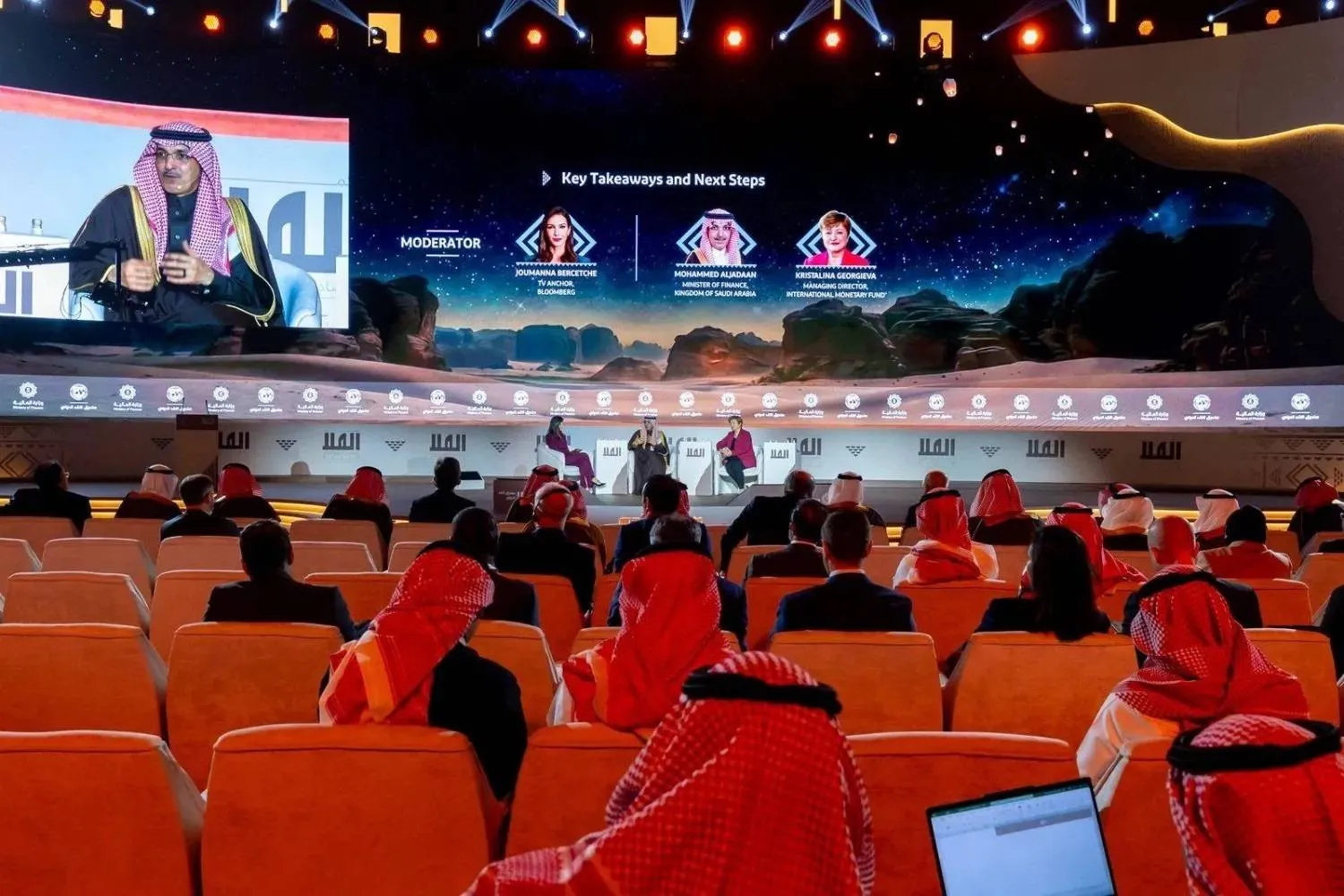
Saudi Arabia’s Minister of Finance addresses attendees at the AlUla Conference for Emerging Market Economies (Asharq Al-Awsat). 
TT

AlUla Conference Urges Emerging Economies to Act Decisively, Define Their Own Growth Models

Saudi Arabia’s Minister of Finance addresses attendees at the AlUla Conference for Emerging Market Economies (Asharq Al-Awsat). 

The AlUla Conference for Emerging Market Economies concluded with a clear call for emerging nations to move beyond imitation and take ownership of their economic futures, as global uncertainty reshapes trade, finance and development models.

Speakers stressed that emerging markets now possess the confidence and capacity to set their own standards and compete globally on their own terms.

Conference discussions reflected a growing shift in mindset among emerging economies, which are increasingly positioning themselves as influential players in the global economy rather than peripheral participants.

A central theme was the expanding role of the private sector, which participants described not only as a partner in development but as a primary engine of sustainable growth.

Saudi Finance Minister Mohammed Al-Jadaan emphasized the need for decisive reform, regardless of political or economic difficulty. He rejected the notion of a “perfect time” for change, urging emerging economies to diagnose their own challenges and take responsibility for addressing them without waiting for external direction.

Speaking during the conference’s closing session on Monday, Al-Jadaan said postponing necessary reforms only increases their cost. He noted that successful structural transformation depends on bold leadership and an acceptance that meaningful economic reform inevitably requires difficult decisions.

Transparency, he said, remains central to Saudi Arabia’s Vision 2030, particularly in building trust with citizens, investors and international partners. Al-Jadaan revealed that more than 87 per cent of Vision 2030 initiatives have been completed or are on track, while 93 per cent of key performance indicators have been achieved or are progressing as planned.

He cited artificial intelligence as an example of adaptive policymaking, noting that while the technology was not initially a dominant focus, changing global conditions required adjustments to ensure Saudi Arabia captures its economic value.

In the same closing dialogue, International Monetary Fund Managing Director Kristalina Georgieva called on governments to shift from directly managing economies to enabling them. She said reducing state control over companies is essential to unlocking innovation and allowing the private sector to flourish.

Georgieva highlighted the mounting challenges facing emerging economies, including geopolitical tensions, demographic change and climate pressures, all of which have increased global uncertainty and made international cooperation indispensable.

Despite differing national circumstances, she said emerging economies share a common goal of building strong institutions and pursuing sound fiscal and monetary policies to enhance resilience.

She also underscored the role of international financial institutions in sharing best practices and supporting a more integrated global economy, concluding with a symbolic message: “One hand does not clap,” to emphasize the importance of partnership in achieving shared prosperity.

The second edition of the AlUla Conference for Emerging Market Economies was hosted in AlUla in partnership between Saudi Arabia’s Ministry of Finance and the International Monetary Fund, bringing together finance ministers, central bank governors, international financial leaders and experts from around the world at a time of heightened global economic uncertainty.


Gold Falls on Investor Caution ahead of Key US Economic Data

Gold bars being washed after removal from molds at a refinery in Sydney (AFP)
TT

Gold Falls on Investor Caution ahead of Key US Economic Data

Gold bars being washed after removal from molds at a refinery in Sydney (AFP)

Gold fell on Tuesday, though held above the $5,000-per-ounce level, as investors stayed cautious ahead of key US jobs and inflation data due later this week that could help gauge the US Federal Reserve's interest rate trajectory.

Spot gold fell 0.7% to $5,030.80 per ounce by 0716 GMT. The metal gained 2% on Monday, as the dollar weakened to its lowest level in more than ‌a week. ‌Gold scaled a record high of $5,594.82 on ‌January ⁠29.

US gold ‌futures for April delivery lost 0.5% to $5,051.70 per ounce.

Spot silver slipped 2.1% to $81.63 an ounce, after rising nearly 7% in the previous session. It had hit an all-time high of $121.64 on January 29.

"We're in a situation where gold has something of a built-in upside bias broadly, and now it's a question of ⁠just how much will short-term Fed policy expectations matter," said Ilya Spivak, head of ‌global macro at Tastylive.

The US dollar ‍edged higher on Tuesday, ‍making greenback-priced metals more expensive for overseas buyers.

Spivak added that ‍gold is being pulled back to the $5,000 level from both the upper and lower price ranges, while silver is showing more volatility on speculative trading.

Investors are awaiting a string of US economic data - retail sales due Tuesday, the nonfarm payrolls report on Wednesday and inflation data on Friday. Markets are currently pricing ⁠in at least two 25-basis-point rate cuts in 2026, with the first expected in June.

The non-yielding bullion tends to do well in a low-interest-rate environment.

White House economic adviser Kevin Hassett said on Monday that US job gains could be lower in the coming months.

For gold, "$5,000 is a support and $80 for silver. But intraday, both metals will be broadly range-bound, with a slight tilt towards negativity because of profit booking," Jigar Trivedi, a senior research analyst at IndusInd Securities, said, adding that investors are ‌cautious given recent volatility.

Spot platinum shed 2% to $2,080.30 per ounce, while palladium lost 1.1% to $1,721.75.


Macron Calls on Europe to Invest in Its Strategic Sectors

French President Emmanuel Macron delivers a speech during a meeting with students from the "Prepas Talents du service public" as part of a program that aims to give every young person an opportunity to join the civil service, at the Elysee Palace in Paris, France, 06 February 2026. (EPA)
TT

Macron Calls on Europe to Invest in Its Strategic Sectors

French President Emmanuel Macron delivers a speech during a meeting with students from the "Prepas Talents du service public" as part of a program that aims to give every young person an opportunity to join the civil service, at the Elysee Palace in Paris, France, 06 February 2026. (EPA)

French President Emmanuel Macron has called on Europe to boost investment in strategic sectors or risk being "swept aside" in the face of competition from the United States and China, in an interview published on Tuesday.

The French leader warned that US "threats" and "intimidation" were not over and urged against complacency, in an interview with several European publications including Le Monde, The Economist and The Financial Times.

Ahead of a European Union meeting, he advocated for "simplifying" and "deepening the EU's single market", and for "diversifying" trade partnerships.

"There are threats and intimidation. And then, suddenly, Washington backs down. And we think it's over. But don't believe it for a second. Every day, there are threats against pharmaceuticals, digital technology..." he said.

"When there is blatant aggression... we must not bow down or try to reach a settlement," he said.

"We tried this strategy for months, and it's not working. But above all, it strategically leads Europe to increase its dependence."

He said that the EU's public and private investment needed "some EUR1.2 trillion ($1.4 trillion) per year", including green and digital technologies, defense and security.

He also renewed his call for common European debt, an idea France has championed for years, but other countries have rejected.

"Now is the time to launch a common borrowing capacity for these future expenditures, future-oriented Eurobonds," Macron said.