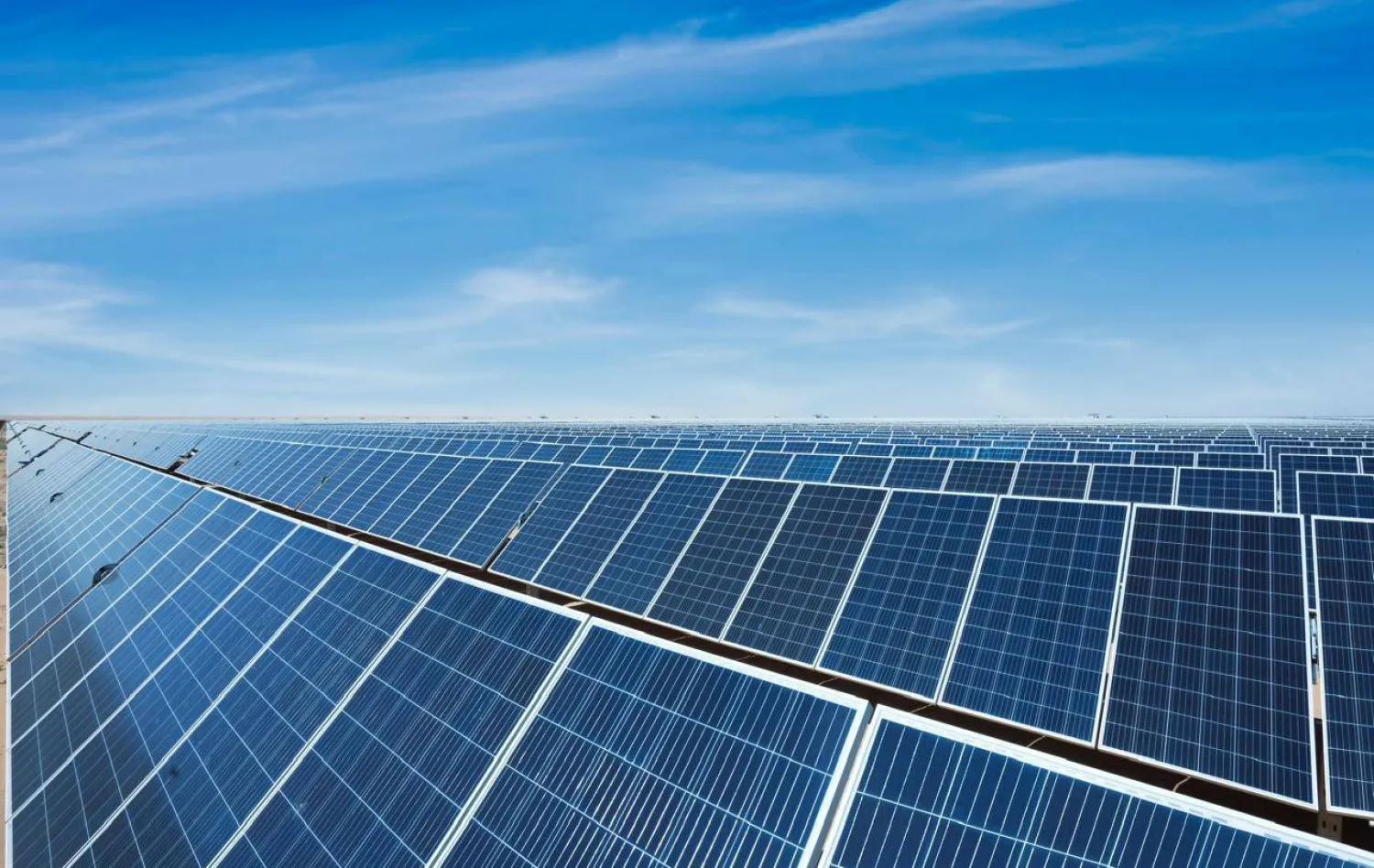
Abu Dhabi's Masdar Buys 234 MW Photovoltaic Solar Project in Spain

The project is expected to be operational by the first half of 2027. Photo: WAM
TT

Abu Dhabi's Masdar Buys 234 MW Photovoltaic Solar Project in Spain

The project is expected to be operational by the first half of 2027. Photo: WAM

Abu Dhabi's state-owned renewable power company Masdar said on Thursday it has bought Valle Solar, one of the largest photovoltaic solar projects in Spain's Valencia region.
The project, expected to be operational by the first half of 2027, will feature a 234 megawatt solar plant with a potential 259 MW battery energy storage system, Masdar said in a statement.
The acquisition was conducted through Masdar's wholly owned subsidiary, Saeta, which it acquired from Canada's Brookfield in a $1.4 billion deal in September.


Saudi Central Bank Reserve Assets Reach Highest Level in Six Years

Saudi Central Bank logo at the Financial Technology Conference (Photo: Turki Al-Oqaily)
TT

Saudi Central Bank Reserve Assets Reach Highest Level in Six Years

Saudi Central Bank logo at the Financial Technology Conference (Photo: Turki Al-Oqaily)

Reserve assets at the Saudi Central Bank (SAMA) recorded a notable increase in March 2026, reaching 1.86 trillion riyals ($496 billion), the highest level since February 2020, according to central bank data.

On an annual basis, reserve assets rose 9.4 percent from 1.7 trillion riyals ($453 billion) in March 2025. On a monthly basis, they increased 4.5 percent from 1.78 trillion riyals ($474.6 billion) in February 2026.

Foreign securities investments led the components of these assets, accounting for 56.6 percent of the total. They rose 9.2 percent to 1.05 trillion riyals, up from 961.8 billion riyals in March 2025.

In the same context, foreign currency and deposits abroad increased from 649 billion riyals to 714.6 billion riyals year-on-year, while the reserve position at the International Monetary Fund rose slightly from 12.5 billion riyals to 12.8 billion riyals over the same period.


OPEC+ Hikes Oil Production Quotas, Reaffirms Commitment to Market Stability

FILE PHOTO: A view shows the logo of the Organization of the Petroleum Exporting Countries (OPEC) outside its headquarters in Vienna, Austria, May 28, 2024. REUTERS/Leonhard Foeger/File Photo
TT

OPEC+ Hikes Oil Production Quotas, Reaffirms Commitment to Market Stability

FILE PHOTO: A view shows the logo of the Organization of the Petroleum Exporting Countries (OPEC) outside its headquarters in Vienna, Austria, May 28, 2024. REUTERS/Leonhard Foeger/File Photo

The seven OPEC+ countries, which had previously announced additional voluntary adjustments in April and November 2023, namely Saudi Arabia, Russia, Iraq, Kuwait, Kazakhstan, Algeria, and Oman, met virtually on Sunday, deciding a production adjustment of 188,000 barrels per day.

“In their collective commitment to support oil market stability, the seven participating countries decided to implement a production adjustment of 188,000 barrels per day from the additional voluntary adjustments announced in April 2023,” a statement issued after the meeting said.

“The additional voluntary adjustments announced in April 2023 may be returned in part or in full subject to evolving market conditions and in a gradual manner,” it said.

The countries added that they “will continue to closely monitor and assess market conditions.”

While stressing market stability, they reaffirmed the importance of adopting a cautious approach and retaining full flexibility to increase, pause or reverse the phase out of the voluntary production adjustments, including reversing the previously implemented voluntary adjustments announced in November 2023.

The seven OPEC+ countries also noted that this measure will provide an opportunity for the participating countries to accelerate their compensation.

They reiterated their collective commitment to achieve full conformity with the Declaration of Cooperation, including the additional voluntary production adjustments that will be monitored by the Joint Ministerial Monitoring Committee (JMMC). They also confirmed their intention to fully compensate for any overproduced volume since January 2024.

The seven OPEC+ countries said they will meet again on June 7.


Nissan Says Gulf Strategy Unchanged Despite Geopolitical Challenges

Cartier during a presentation at a company event (Asharq Al-Awsat)
TT

Nissan Says Gulf Strategy Unchanged Despite Geopolitical Challenges

Cartier during a presentation at a company event (Asharq Al-Awsat)

Nissan Motor Co.’s Chief Performance Officer Guillaume Cartier said the Gulf and Middle East remain central to the company’s growth and profitability despite recent geopolitical challenges, adding that investment plans in the region remain unchanged.

Cartier told Asharq Al-Awsat that the automaker is securing supply chains through alternative logistics routes to ensure the continued flow of vehicles and spare parts, as it seeks to sustain operations in one of its key global markets.

He said Nissan has rerouted shipments in recent weeks to alternative ports, including Jeddah in Saudi Arabia and Fujairah in the United Arab Emirates, while using transit hubs in Sri Lanka and Singapore.

The steps have secured supplies for the next four months, he said, amid continued uncertainty over regional demand.

Cartier described current geopolitical pressures as temporary and said Nissan’s strategic direction in Saudi Arabia and the Gulf remains steady.

He added that the company remains confident in the region’s long-term outlook and will continue executing its plans.

New strategy

Cartier said Nissan’s new strategy hinges on tight alignment across product, market and technology execution.

He said cutting models from 56 to 45 is aimed at boosting efficiency, not reducing market presence.

The strategy focuses on placing the right product in the right market and channeling investment into higher-return models to drive sales volumes.

Customer acceptance of new technologies will be decisive, he said.

Performance and outlook

Cartier said the “Re:Nissan” plan will run through 2026, with a final review in 2027, adding that performance is very positive and ahead of plan following the restructuring that improved efficiency and profitability.

He described Gulf markets, led by Saudi Arabia, as a “golden jewel” among high-value markets, citing Nissan’s strong presence and broad customer base.

The expansion strategy centers on a broad lineup across segments, including SUVs such as Patrol, Pathfinder and X-Trail, alongside models sourced from Japan, China and India.

Saudi Arabia is the region’s largest market, where Nissan already posts strong performance, and the diversified lineup is expected to support further growth, he said.

Regional push

Cartier said Nissan is expanding beyond the Gulf, strengthening its presence in Syria and broadening operations in Iraq as part of a push to widen its regional footprint and tap emerging opportunities.

The move reflects a focus on markets with future growth potential despite challenges, he added.

US, China targets

Nissan aims to sell more than one million vehicles annually in both the United States and China by 2030 by delivering the right product with the right technology, Cartier said.

He said the US strategy will focus on SUVs and hybrid V6 vehicles, while China will see a faster rollout of electric and hybrid models and broader market coverage.

2030 vision

Cartier said Nissan is working toward a distinct global identity by 2030 built on innovation and boldness, integrating technology and design into a new brand promise.

The company is developing vehicles designed to stand out from competitors by combining performance with advanced technologies, he added.

Hybrids and AI

Cartier said Nissan is stepping up investment in its third-generation e-Power hybrid technology, improving fuel consumption, emissions and noise levels.

He said slower-than-expected electric vehicle adoption in some regions makes hybrids a practical option for now, especially in markets such as Saudi Arabia, where infrastructure is still developing.

Artificial intelligence is a core pillar of Nissan’s strategy, with plans to expand advanced driver assistance systems such as ProPILOT to around 90% of production in the future, he said.

The aim is to deliver technology at scale in a practical way that improves customer experience and safety.