Myanmar Quake Death Toll Passes 1,600, as Junta Lets in Foreign Rescuers

 People sit by while others walk past a collapsed building in Naypyitaw, Myanmar, Saturday, March 29, 2025, after an earthquake has rocked Myanmar on Friday. (AP)
People sit by while others walk past a collapsed building in Naypyitaw, Myanmar, Saturday, March 29, 2025, after an earthquake has rocked Myanmar on Friday. (AP)
TT

Myanmar Quake Death Toll Passes 1,600, as Junta Lets in Foreign Rescuers

 People sit by while others walk past a collapsed building in Naypyitaw, Myanmar, Saturday, March 29, 2025, after an earthquake has rocked Myanmar on Friday. (AP)
People sit by while others walk past a collapsed building in Naypyitaw, Myanmar, Saturday, March 29, 2025, after an earthquake has rocked Myanmar on Friday. (AP)

Myanmar's military rulers let in hundreds of foreign rescue personnel on Saturday after an earthquake killed more than 1,600 people, the deadliest natural disaster to hit the impoverished, war-torn country in years.

Friday's 7.7 magnitude quake, among the biggest to jolt the Southeast Asian nation in the last century, crippled airports, bridges and highways amid a civil war that has wrecked the economy and displaced millions.

The death toll in Myanmar climbed to 1,644, the military government said on Saturday, according to BBC Burmese news service.

In neighboring Thailand, where the quake rattled buildings and brought down a skyscraper under construction in the capital Bangkok, at least nine people were killed.

Survivors in Mandalay, Myanmar's second-biggest city, dug with their bare hands on Friday in desperate attempts to save those still trapped, lacking heavy machinery and with authorities absent.

In Bangkok on Saturday, rescue operations continued at the site of the 33-story tower's collapse, where 47 people were missing or trapped under the rubble - including workers from Myanmar.

The US Geological Service's predictive modelling estimated Myanmar's death toll could exceed 10,000 and losses could exceed the country's annual economic output.

A day after making a rare call for international assistance, Myanmar's junta chief, Senior General Min Aung Hlaing, travelled to hard-hit Mandalay near the epicenter of the quake, which brought down buildings and triggered fires in some areas.

"The Chairman of the State Administration Council instructed authorities to expedite search and rescue efforts and address any urgent needs," the junta said in a statement on state media, referring to Min Aung Hlaing.

AIRPORTS CLOSED

An initial assessment by Myanmar's opposition National Unity Government said at least 2,900 buildings, 30 roads and seven bridges had been damaged by the quake.

"Due to significant damage, Naypyitaw and Mandalay international airports are temporarily closed," said the NUG, which includes remnants of the elected civilian government ousted by the military in a 2021 coup that triggered the civil war.

The control tower at the airport in Naypyitaw, Myanmar's purpose-built capital city, collapsed, rendering it inoperable, a person with knowledge of the situation told Reuters.

A Myanmar junta spokesman did not respond to calls seeking comment.

Hospitals in central and northwestern Myanmar were struggling to cope with the influx of injured people, the UN Office for the Coordination of Humanitarian Affairs said, warning that damage to roads was hindering access.

Seventeen cargo trucks of shelter and medical supplies were due to arrive on Sunday to address shortages of medicines, including blood bags and anesthetics, the agency added.

A Chinese rescue team arrived at the airport in Myanmar's commercial capital of Yangon, hundreds of kilometers from Mandalay and Naypyitaw, and will travel upcountry by bus, state media said.

Chinese President Xi Jinping spoke by phone with the junta chief, China's embassy in Myanmar said on Saturday, and said Beijing would provide $13.77 million worth of aid, including tents, blankets and emergency medical kits.

The United States, which has a testy relationship with the Myanmar military and has sanctioned its officials, including Min Aung Hlaing, has said it would provide some assistance.

Relief supplies from India on a military aircraft also landed in Yangon, according to Myanmar state media, and India's government said it was also dispatching ships with 40 tons of humanitarian aid.

Russia, Malaysia and Singapore were also sending planeloads of relief supplies and personnel.

'NO HELP COMING'

Residents in the hardest-hit areas are desperate for the help.

The quake, which hit around lunchtime on Friday, affected wide swathes of Myanmar, from the central plains around Mandalay to the hills of Shan in the east, parts of which are not completely under the junta's control.

Rescue operations in Mandalay could not match the scale of the disaster, one resident said by phone, asking not to be named because of security concerns.

"Many people are trapped but there is no help coming just simply because there isn't manpower or equipment or vehicles," he said.

In Bangkok, 1,000 km (620 miles) from the epicenter, authorities on Saturday pushed ahead with efforts to find construction workers trapped under the rubble of the collapsed tower, using excavators, drones and search-and-rescue dogs.

Thailand's Deputy Prime Minister Anutin Charnvirakul said all possible resources had been deployed to search for survivors and to bring out bodies of the deceased.

"We always have hope," he told reporters. "We're still working around the clock."

Chanpen Kaewnoi, 39, said she rushed over on Friday afternoon after seeing news reports that the under-construction building where her mother and younger sister were working had collapsed.

"I called my sister, but no matter how many times I tried to call her there was no connection," she said after a sleepless night at the site.

"I want to wait for my mother and sister," said Chanpen, herself a construction worker, "I want to see their faces again."

Across the sprawling metropolis, where such quakes are rare, there may be up to 5,000 damaged buildings, including residential towers, said Anek Siripanichgorn, a board member of Council of Engineers Thailand, which is helping municipal authorities.

"We are going through hundreds of cases," he said. "If we see cases where there is potential danger, we will immediately send engineers."


Democratic 'Blue Wave' Swept Through State Capitals across US

Birds fly in front of the US Capitol at sunrise a day after the US midterm elections. ROBERTO SCHMIDT / AFP
TT

Democratic 'Blue Wave' Swept Through State Capitals across US

Birds fly in front of the US Capitol at sunrise a day after the US midterm elections. ROBERTO SCHMIDT / AFP

The blue wave Democrats rode to retake control of the US Congress this week extended into state-level races, as the party won majorities in a number of legislatures previously held by Republicans.

Democrats secured new trifectas -- control of both chambers of the legislature and the governor's seat -- in at least five states in Tuesday's midterms, flipping at least 11 state legislative chambers from Republican control, according to data from NGO State Navigate late Wednesday.

The victories mean the party will have the power to lead policy decisions on everything from health care to taxation in states such as Texas and Georgia, where they had long taken a backseat.

"Democrats are on track to have their largest net gain in state legislative seats in the 21st century," Chaz Nuttycombe, State Navigate's executive director, told AFP.

"It's not a blue wave; it's a blue cataclysm."

Among the most striking results are in Texas, where Democrats wrested the majority in the state's lower chamber from Republicans for the first time since 2002 while also winning the governorship.

In Georgia, Keisha Lance Bottoms turned the governor's seat blue for the first time in more than two decades, and Democrats similarly flipped control of the legislature's lower chamber.

- Far from Washington gridlock -

President Donald Trump has vowed to use his veto powers to reject legislation from the incoming Democratic Congress, a move that could lead to gridlock at the national level.

Experts have suggested the state-level gains could circumvent that issue.

Democrats this week won complete control of government in five states -- Wisconsin, Michigan, Minnesota, Pennsylvania and Nevada -- and were on the verge of doing the same in Arizona as of early Thursday.

"They won't have to be frustrated by vetoes and Senate filibusters, which are no doubt going to frustrate Democrats at the national level," said Thad Kousser, a professor at the University of California, San Diego, referring to the state Democratic trifectas.

The victories will allow Democrats the freedom to legislate on prominent policy points.

Kousser noted that many of the most pressing issues in voters' lives are now decided at the state level, referencing the 2022 Supreme Court decision ending federal abortion protections and giving states the power to dictate their own abortion laws.

Data centers and artificial intelligence have also emerged as top issues as the Trump administration has shied away from regulatory action.

In Texas, Democratic Governor-elect Gina Hinojosa campaigned on tighter regulations for AI data centers.

"The key issues that matter most for Americans' daily lives are things like education, criminal justice and medical care, and those policies are primarily made by states," Kousser said.

Nuttycombe of State Navigate put it this way: "State governments are much more efficient than Congress and can actually get things done."

"Some of these states haven't had Democratic trifectas in decades; the legislators will feel they have a lot of catching up to do."


Iran Says Two Tankers and Tugboat Caught Fire in Hormuz

FILE PHOTO: Vessels at the Strait of Hormuz, as seen from Musandam, Oman, November 3, 2026. REUTERS/Stringer/File Photo
TT

Iran Says Two Tankers and Tugboat Caught Fire in Hormuz

FILE PHOTO: Vessels at the Strait of Hormuz, as seen from Musandam, Oman, November 3, 2026. REUTERS/Stringer/File Photo

Two oil tankers and a tugboat caught fire in the Strait of Hormuz, Iran's Revolutionary Guards said, according to local media on Thursday.

Since the outbreak of the Iran war on February 28, Tehran has severely restricted traffic through the strategic waterway, which normally carries about one-fifth of global oil consumption.

The United States has in response imposed a blockade on Iranian ports and helped tankers travel the strait.

"Last night, in two separate incidents, a large oil tanker attempting to pass through the illegal passageway south of the Strait of Hormuz suffered a fire after striking a mine and was brought to a halt," the Guards told the Fars news agency.

"Another supertanker was halted by a massive fire while exiting the eastern Strait of Hormuz. A tugboat that had approached the supertanker to extinguish the fire also caught fire."

Fars also reported the IRGC navy's electronic warfare unit had taken control of two LUCAS drones, a US-developed model short for Low-cost Uncrewed Combat Attack System.


France Workers Strike, March for 'Dignified Wage'

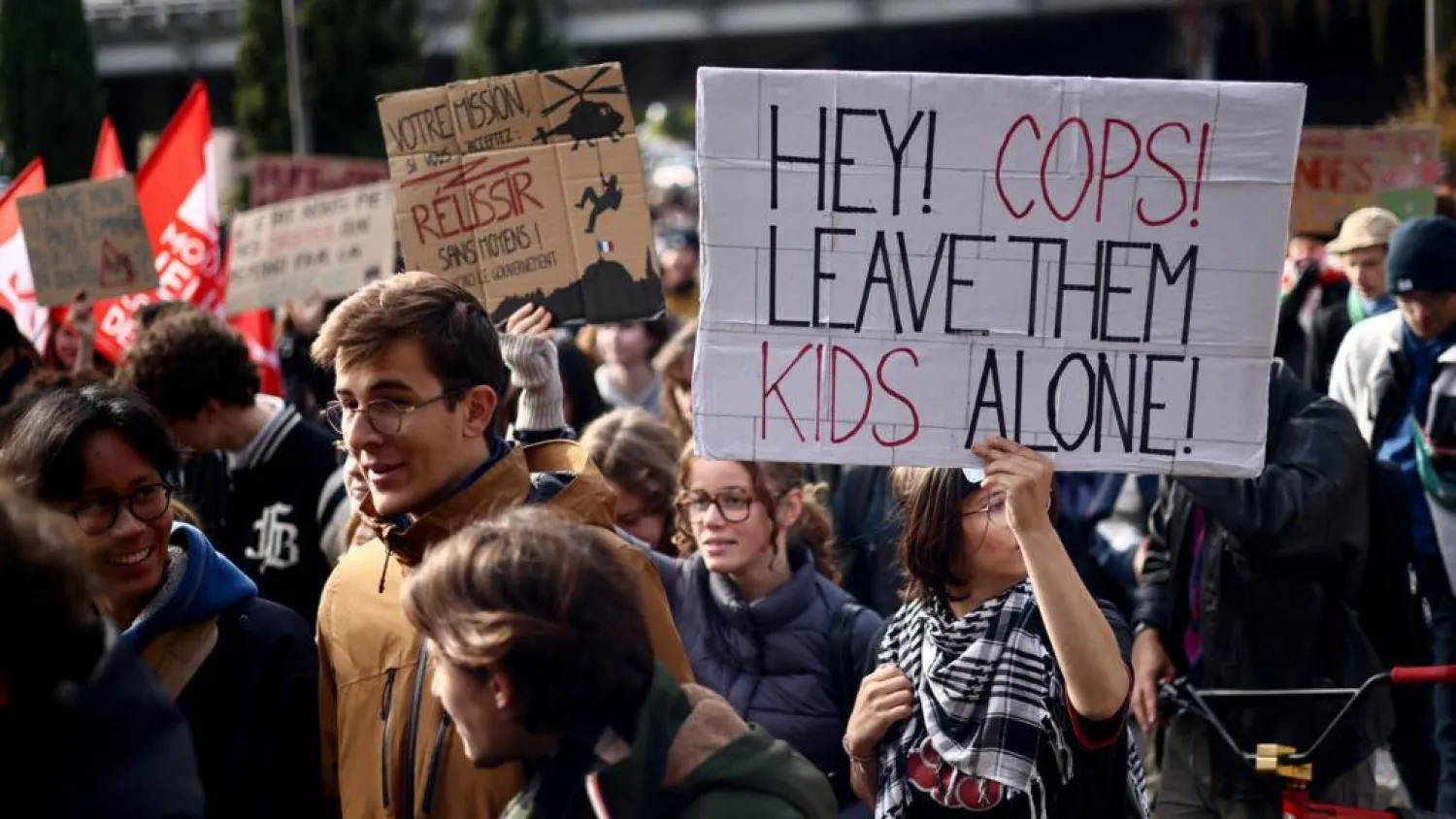
The high school student movement that began with youth protesting dismal learning conditions. Alex MARTIN / AFP/File
TT

France Workers Strike, March for 'Dignified Wage'

The high school student movement that began with youth protesting dismal learning conditions. Alex MARTIN / AFP/File

Striking workers marched across France against the rising cost of living on Thursday, with hundreds of thousands of people expected to take to the streets nationwide in a new escalation following weeks of protest. 

The demonstrations come as the eurozone's second largest economy battles to redress its finances, six months ahead of elections to replace centrist President Emmanuel Macron, with the far right leading in opinion polls, AFP said. 

The high school student movement that began with youths protesting over learning conditions has coincided with widespread anger over the rising cost of living and inequality, which culminated on October 17 in the worst rioting France has seen in years. 

Sylvie Larneury, 61, a healthcare manager, and her 61-year-old partner, an IT specialist, were on strike Thursday so they could join the march in the central city of Clermont-Ferrand. 

"We're fed up. We're not starving, but we have to help our children even though they've studied," she said. 

"We've had enough of social injustice," she added, criticizing what she called "a repressive government that defends its own interests and not those of the majority". 

The unions are calling for across-the-board wage raises, tax reforms and better learning conditions for young people and have complained about police restrictions on certain protests. 

Protesting in the city of Lyon, winegrower Martin Thiberge said he wanted to take part in demonstrations he saw as drawing together people from across French society. 

"We want to make a living from our work, to make a dignified wage," he said. 

Authorities estimated some 500,000 to 700,000 people would protest across the country on Thursday, while as many as 80,000 people were expected to march from 2:00 pm (1300 GMT) in the capital Paris. 

Unions hoped for a turnout comparable to France's pension reform protests in 2023 that saw over one million people march. 

- School blockades - 

Dozens of high-schoolers protested in several cities, with the government reporting blockades at 81 out of the country's 3,700 high schools. 

A high school student association said classes had been suspended at 1,000 such secondary schools, including those blockaded and those closed on a day of strikes. 

Around 16 percent of teachers nationwide were on strike, the education ministry said. 

In Paris, police used tear gas to try to prevent students from blocking access to the Helene-Boucher high school, an AFP reporter said. 

Public and private education unions have called for strike action, as well as unions representing rail workers, public hospitals and postal services. 

Train travel experienced some disruption on Monday morning. 

At the capital's Montparnasse train station, a psychologist who gave her name as Jeanne said her trip had been delayed. 

"It's tedious to get up early, wait, and then see your train cancelled, but it's understandable there's a strike," she said. 

- Police violence alleged - 

Interior Minister Laurent Nunez announced Wednesday that 70,000 police officers and security forces would be deployed across the country, promising "an extremely firm response" to any "acts of violence" or disorder. 

The protests have been largely peaceful, though some disintegrated into clashes with police, who have fired tear gas and water cannon to disperse crowds. 

An attempted murder investigation has been launched after petrol bombs were thrown at security forces in Paris on Saturday. 

The police response has been criticized as heavy-handed and internal police investigations have been launched over allegations of brutality against demonstrators. 

Several teenage protesters have been seriously wounded and thousands arrested. 

Similar protests have erupted in other European countries in recent weeks in Denmark, Germany and Italy.