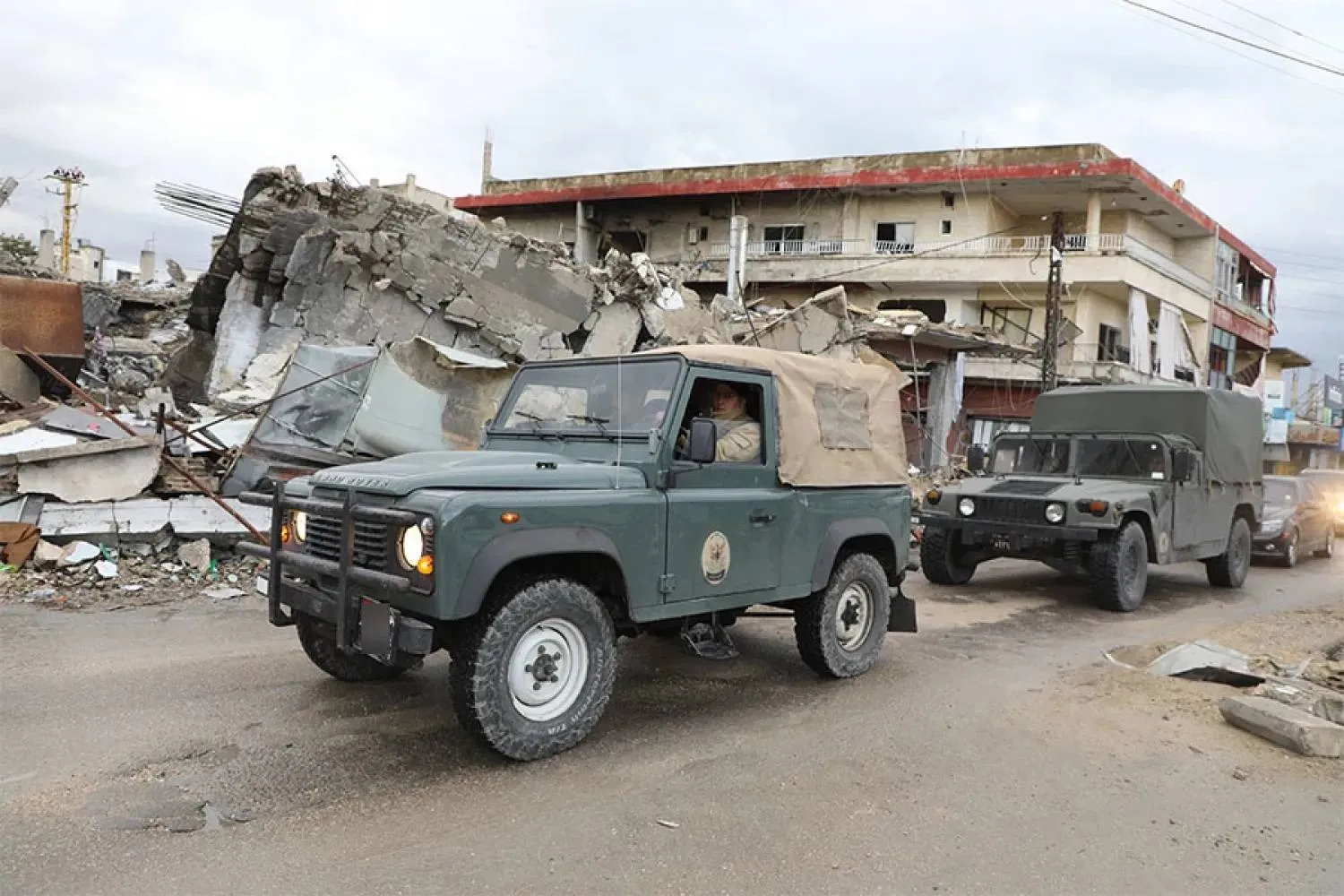

The Lebanese army and security forces are carrying out a “preventive” redeployment of units in the south under Israeli fire, in a move seen as aimed at avoiding direct contact or friction with Israeli forces.
The step comes amid the absence of a political decision to confront Israeli incursions militarily, and is viewed as the adoption of “protective tactics” for personnel in an area witnessing ongoing clashes.
A Lebanese security source familiar with the matter told Asharq Al-Awsat that the forces follow a fixed field principle of remaining alongside residents until the last moment before they need to evacuate an area.
“Personnel stay where civilians are, and withdraw only after displacement is complete, and before any potential Israeli advance, ensuring neither they nor residents are exposed to danger,” the source said.
Deployment is directly tied to displacement patterns and conditions in each town, the source said, noting that “the presence of residents is a decisive factor in the Internal Security Forces maintaining their posts.”
“Posts are not evacuated under a declared central plan, but based on changing field data,” the source added. “Every town that is emptied of its residents is automatically followed by the evacuation of its police post, with personnel joining the nearest military point.”
The town of Khiam was “among the last locations to maintain a security presence alongside residents until the final stages of displacement, before it was evacuated” as Israeli forces advanced.
Military pullback, local pushback
The town of Debel highlights the complexity of the situation between the military and civilians. A local source said the army had maintained an advanced position on its outskirts, but as limited Israeli incursions began nearby, the position was withdrawn overnight into the town, specifically to the public school.
“The withdrawal did not stop there,” the source said. “The following day, personnel were completely pulled out of Debel toward Rmeish, leaving no effective military presence inside the town, while personnel from Debel remained in their homes in civilian clothing.”
The most sensitive step was a proposal to relocate soldiers from the town, along with their families, outside the area, a move locally seen as a prelude to emptying the town. It was met with widespread rejection.
About 200 security personnel from Debel serve in the army and security forces, meaning their departure with their families would have led to the near-total evacuation of the town. Political and local efforts, involving the defense and interior ministries and religious authorities, led to the plan being frozen.
Despite the tension, the source said the town is not under siege, noting that the Debel-Rmeish road remains open, easing pressure for evacuation. Residents and personnel remain in their homes, while military positions and police posts continue operating in nearby towns, such as Ain Ebel and Rmeish.
Local media reported that the army repositioned at the Khardali checkpoint, the main gateway to the southern Litani area from the eastern sector, and is preparing to redeploy at the Kafra checkpoint, as Israeli forces advance toward Beit Lif and the facing Wadi al-Oyoun from the south.
Lebanese army commander General Rodolphe Haykal inspected units in Beirut and the southern city of Sidon and reviewed security measures within their areas of responsibility.
He urged troops to maintain readiness “to prevent any breach of security, and to act firmly against any attempt to undermine internal stability.”
“Despite rumors and incitement campaigns aimed at undermining the sacrifices and efforts of soldiers, the army will not hesitate to carry out its national duties,” he said, calling on troops “not to be influenced by such rumors, to adhere to their doctrine, and remain committed to performing their national duty.”
Preventive strategy
Former MP and retired brigadier general Chamel Roukoz said the moves “cannot be described as a traditional military withdrawal,” but rather a calculated field redeployment shaped by an asymmetric confrontation, given Israeli air and firepower superiority and the risk of direct targeting of exposed positions.
He said the army operates within a margin set by political authority, noting that no decision has been issued by the government to engage or confront Israeli forces directly.
“The military institution manages its deployment accordingly, balancing field presence with safety requirements,” he said.
On the evacuation of positions, including those reported in Debel, Roukoz said the measures “do not reflect abandonment of territory or a collapse of the front,” but rather precautions imposed by field realities, where some positions become easy targets under bombardment.
He said the redeployment carries operational and morale dimensions, aiming to avoid direct friction in the absence of a political decision, preserve troop morale, and avoid pushing forces into unequal confrontations.
The army command, he added, is showing “high flexibility” in managing deployment, shifting from exposed positions to safer ones.
Roukoz said the developments fall within “protection and redeployment tactics adopted in high-risk environments,” reflecting careful management of the balance between political decision-making and field realities.