Over 500 Media Professionals at 'Riyadh Tour' for Arabian Horses

General view of Riyadh, Saudi Arabia. (SPA)
TT

Over 500 Media Professionals at 'Riyadh Tour' for Arabian Horses

General view of Riyadh, Saudi Arabia. (SPA)

The "Riyadh Tour", the fourth stage of the Global Champions Arabians Tour taking place in Riyadh, set a major record in the number of registered media professionals covering the competition, with more than 500 journalists in attendance.
The media representatives come from various broadcast, radio, and print media outlets both inside and outside the Kingdom, SPA reported.

The "Riyadh Tour" is receiving exceptional and extensive media coverage through daily broadcasting of the competitions.
The Riyadh Tour competitions began yesterday and are scheduled to run through next Saturday at the Jump Saudi venue in Al-Janadriyah.

The event features some of the world’s finest purebred Arabian horse stables, with total prize money exceeding €24 million.


Scores of Grandfather Clocks to be Sold at Auction in the UK

Grandfather pendulum clocks collection for sale at an antique market (Shutterstock)
TT

Scores of Grandfather Clocks to be Sold at Auction in the UK

Grandfather pendulum clocks collection for sale at an antique market (Shutterstock)

A private collection of antique grandfather clocks - which have been assembled over the course of 35 years - is to go on sale.

They come from town such as Devizes, Royal Wootton Bassett and Calne in Wiltshire and currently belong to Paul and Jan Succony, according to BBC.
The couple want to see the historic items go to a good home when they go under the hammer at RWB Auctions on Wednesday.

“I'm now well over 70 and I'm still working as a consultant in the food sector and we felt it was time to move on some clocks from the part of our collection which still need to be restored,” said Paul. “We do have to consider the future and it's not practical for us to keep all that we have.”

The couple's collection includes various clocks and clock parts. What began as a personal purchase grew into a lifelong passion for the pair.

Paul, who lives near Devizes, continued: “My wife had a vision of sitting beside a log fire, reading Thomas Hardy novels with the reassuring tick of a grandfather clock in the room. So 35 years ago I bought her a grandfather clock.”

“That was the start of it. We embraced the challenge of finding clocks made by local makers and restoring them as we both love local history, and each clock has its own identity.”

Paul added: “Today we have well over 60 clocks and we've sold several to buyers across the globe who want to reconnect with their own history or heritage.”

The collection is expected to sell for upwards of £1,000 at RWB Auctions.

Junior auctioneer and valuer Will Walter said, “These are interesting local pieces which will attract local collectors or those with local ties who may live overseas or who have a connection with these places.”


British Sculptors Achieve Notable Victory in Global Ice Carving Competition

The team sculpted a kraken eating a boat
TT

British Sculptors Achieve Notable Victory in Global Ice Carving Competition

The team sculpted a kraken eating a boat

Two stonemasons have won a snow sculpting prize as part of Team GB's entry to the World Snow Festival in Switzerland, according to BBC.

Sheffield sculptors Lily Marsh and Steve Roche were part of Great Britain's four-person team, which won the public vote and came third in the technical judging at the competition in Grindelwald.

They competed against 10 nations with the Spanish team taking first place in the technical category.

Sculptor Lily Marsh said it was “refreshing” to swap stone for snow. “Normally it's very dusty and it's much quicker to move the materials so I really enjoyed it,” she said.

The team - led by Christine Close, a sculptor based in France - carved a kraken eating a boat as part of the myths and legends theme set by the competition organizers.

They worked with a large block of snow, starting with a small model.

“We used big chisels on the end of broom handles. A bit like gardening hoes.

You use those to stab at it and shave stuff way,” explained Roche.

“And we used a length of chain that had nuts and bolts set in it with two handles at the end like a big chain saw to carve off the really big bits that we needed to get rid of at the start of the design,” he added.

Despite the low temperatures, Roche said the work kept the team warm.

“I was working in a T shirt most days. I was moaning it was too warm. I got sunburned. I had to go to the shop to get sun cream because it was so bright,” he said.

After the judging, sadly the sculptures did not last and were left to melt in the snow, said Marsh.

“It's quite a liberating thing because often you can get precious about the stuff you make or get worried about it not being good enough and actually it's quite a good practice to make something and know that it's definitely going to melt. It releases you from that worry a bit,” he said.


How a Syrian Refugee Chef Met Britain's King Charles

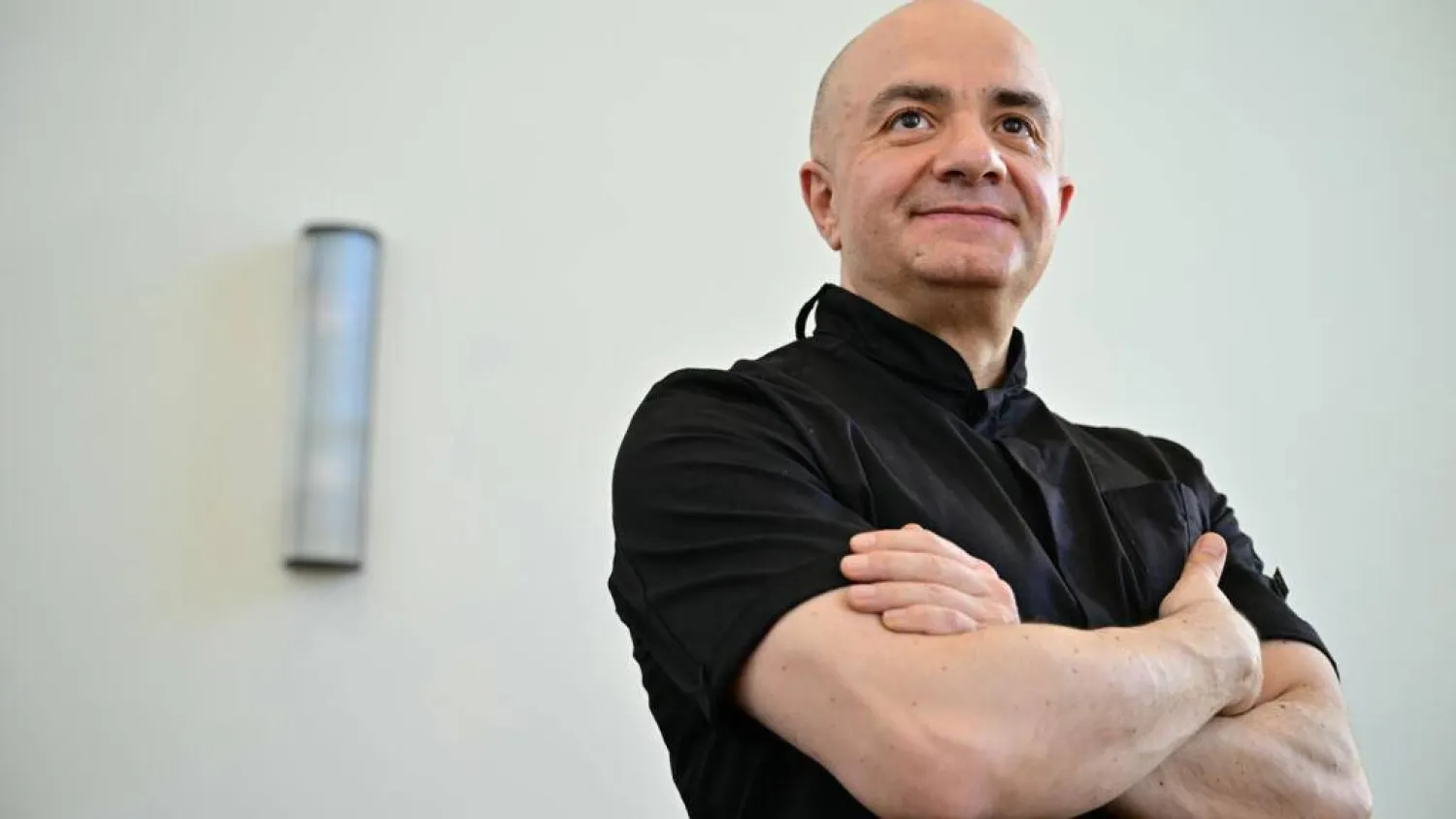
Imad Alarnab, a chef and restaurant owner who fled Syria in 2015, hosted King Charles III at his Soho restaurant. Ben STANSALL / AFP
TT

How a Syrian Refugee Chef Met Britain's King Charles

Imad Alarnab, a chef and restaurant owner who fled Syria in 2015, hosted King Charles III at his Soho restaurant. Ben STANSALL / AFP

Pots clanged and oil sizzled inside the London kitchen of Syrian chef Imad Alarnab, as the former refugee who fled his country's civil war recalled hosting King Charles III.

When the chef left his war-torn homeland in 2015, he never imagined that one day he would watch as cameras flashed and wide-eyed crowds greeted the monarch arriving at his Soho restaurant last year.

Alarnab, 48, said he had asked the king to come to the popular eatery when he met him at Buckingham Palace before an event honoring humanitarian work in 2023.

"I told him 'I would love for you to visit our restaurant one day' and he said: 'I would love to'... I was over the Moon to be honest".

The chef has come a long way since he arrived in London after an arduous journey from Damascus with virtually no money in his pocket.

Fearing for his life, he had escaped Syria after his family was uprooted again and again by fighting.

His culinary empire –- restaurants, cafes, and juice bars peppered across the Syrian capital -- had been destroyed by bombing in just six days in 2013.

Alarnab spent three months crisscrossing Europe in the back of lorries, aboard trains, on foot and even on a bicycle before he reached the UK.

"When I left, I left with nothing," he told AFP, as waiters whirled past carrying steaming plates of traditional Syrian fare.

Starving and exhausted, he spent the last of his money on a train ticket to Doncaster where his sister lived.

'Love letter from Syria'

To make a living, Alarnab initially picked up any odd jobs, such as washing and selling cars, saving enough to bring his wife and three daughters over after seven months.

His love of cooking never left him though. In France, while he was sleeping on the steps of a church, Alarnab had often cooked for hundreds of other refugees.

"I always dreamed of going back to cooking," he said.

So it wasn't long before he found himself back in the kitchen, cooking up a storm across London with his sold-out supper clubs, bustling pop-up cafes, and crowded lunchtime falafel bars.

He now runs two restaurants in the city –- one in Soho's buzzing Kingly Court and another nestled in a corner of the vibrant Somerset House arts center.

"I was looking for a city to love when I found London," Alarnab said, adding it had offered him "space to innovate" and add his own modern twist to classic Syrian dishes.

Far from home, Alarnab said his word-of-mouth success had grown into a "love letter from Syria to the world" that needs no translation.

"You don't really need to speak Arabic or Syrian to know that this is the best falafel ever," he said, pointing to a row of colorful plates.

-'There is hope' -

For Alarnab, spices frying, dough rising and cheese melting inside a kitchen offered an unlikely escape from the real world.

"All my problems, I leave them outside the kitchen and walk in fresh."

When he fled Syria, Alarnab thought going back to Damascus was forever off the table.

Yet he returned for the first time in October, almost a year to the day after longtime leader Bashar al-Assad was toppled in a lightning opposition offensive -- ending almost 14 years of brutal civil war.

He walked the familiar streets of his old home, where his late mother taught him to cook many years ago.

"To return to Damascus and for her not to be there, that was extremely difficult."

Torn between the two cities, Alarnab said he longed to one day rebuild his home in Damascus.

"I wish I could go back and live there. But at the same time, I feel like London is now a part of me. I don't know if I could ever go back and just be in Syria," he said.

Although Syrians still bear the scars of war, Alarnab said he had seen "hope in people's eyes which was missing when I left in 2015".

"The road ahead is still very long, and yes this is only the beginning -- but there is hope."