Deadliest US Strike in Yemen Kills 74 at Oil Terminal
A handout screen grab taken from a video released by Houthis-run al-Masirah TV shows flames and smoke rising from the fuel port of Ras Isa following US airstrikes, in the port province of Hodeidah, Yemen, 18 April 2025. EPA/HOUTHIS AL-MASIRSAH TV / HANDOUT
Deadliest US Strike in Yemen Kills 74 at Oil Terminal
A handout screen grab taken from a video released by Houthis-run al-Masirah TV shows flames and smoke rising from the fuel port of Ras Isa following US airstrikes, in the port province of Hodeidah, Yemen, 18 April 2025. EPA/HOUTHIS AL-MASIRSAH TV / HANDOUT
US strikes on Yemen's Ras Isa fuel terminal on the Red Sea coast have killed at least 74 people in the deadliest attack since the US started its bombing campaign against the Houthis last year, according to the Houthi-run health ministry.
US President Donald Trump ordered the intensification of strikes last month in the biggest US military operation in the Middle East since he took office in January. Washington has vowed to keep attacking the Iran-aligned Houthis until the group halts attacks on Red Sea shipping.
Health ministry spokesperson Anees al-Asbahi said 171 people were injured in Thursday's strikes, according to preliminary figures, with rescue teams continuing efforts to search for victims.
The US military said the strikes aimed to cut off a source of fuel for the Houthi militant group. The port has a heavy military presence in addition to being a primary hub for fuel imports, Yemeni sources said.
Among the dead were employees of Safer Oil Company, which operates the port, and the Yemen Petroleum Company, responsible for overseeing imported fuel shipments and their distribution, the sources added.
US Central Command did not comment on the health ministry's casualty figure.
"The objective of these strikes was to degrade the economic source of power of the Houthis, who continue to exploit and bring great pain upon their fellow countrymen," it had said in a post on X.
The US and Israel have previously targeted the port, viewing it as a hub for launching drones, missiles, and attacks on ships.
Since November 2023, the Houthis have launched dozens of drone and missile attacks on vessels in the Red Sea, saying they were targeting ships linked to Israel in solidarity with Palestinians over the war in Gaza.
Ras Isa terminal, about which is about 55 km (35 miles) north of the port city of Hodeidah, has a storage capacity of 3 million barrels.
Fuel import taxes bring in hundreds of millions of dollars annually for the Houthi administration, sources said.
The Houthis halted attacks on shipping lanes during a two-month ceasefire in Gaza. Although they vowed to resume strikes after Israel renewed its assault on the enclave last month, they have not struck targets in the Red Sea since then.
In March, two days of US attacks killed more than 50 people, Houthi officials said.
Drone Strikes on Dormitory, Shelter Kill 10 in Sudan's El-Obeidhttps://english.aawsat.com/arab-world/5325363-drone-strikes-dormitory-shelter-kill-10-sudans-el-obeid
A lecture hall at the College of Development and Technological Sciences with its roof collapsed after an attack attributed to the paramilitary Rapid Support Forces (RSF), in El Obeid, North Kordofan, Sudan, September 15, 2026. REUTERS/El Tayeb Siddig
Drone Strikes on Dormitory, Shelter Kill 10 in Sudan's El-Obeid
A lecture hall at the College of Development and Technological Sciences with its roof collapsed after an attack attributed to the paramilitary Rapid Support Forces (RSF), in El Obeid, North Kordofan, Sudan, September 15, 2026. REUTERS/El Tayeb Siddig
Drone attacks on a university dormitory and a center sheltering displaced families in Sudan's central city of El-Obeid killed at least 10 people this week, a Sudanese rights group and a medical source said on Friday.
The attacks came as fighting intensified in North Kordofan, a strategically important region where Sudan's army and the paramilitary Rapid Support Forces are battling for territory more than three years into a war that has shattered much of the country.
On Wednesday, a drone struck a dormitory at the University of Kordofan that was being used to house students and civilians, according to the Emergency Lawyers group, a Sudanese rights organization that monitors abuses during the conflict.
The group said the attack killed five people and wounded 47 others, but did not say who was responsible.
A day later, another drone hit a center sheltering families displaced by fighting from across the Kordofan region, killing five people and injuring 13 others, a North Kordofan government official and a medical source at a local hospital told AFP.
The government official accused the RSF of carrying out the attack. The paramilitary group did not immediately respond to the allegation.
In recent months, both the army and the RSF have increasingly deployed drones, killing more than 1,100 during the first five months of this year alone, according to United Nations figures.
El-Obeid, the capital of North Kordofan, has emerged as a key battleground in Sudan's war, owing to its strategic location at a crossroads linking the country's central and western regions.
The UN has repeatedly warned that escalating violence in El-Obeid and the broader Kordofan region risked triggering further atrocities, issuing in July what it described as a red alert over conditions there.
More than 300,000 people have been displaced from the region since the RSF captured El-Fasher, the military's last major stronghold in Darfur, following a major offensive last year, according to the UN.
The war between Sudan's army and the RSF has killed more than 200,000 people, aid workers estimate, displaced more than 13 million and created the world's largest hunger and displacement crises.
UKMTO: Crude Oil Tanker Struck by Unknown Projectile off Omanhttps://english.aawsat.com/arab-world/5325351-ukmto-crude-oil-tanker-struck-unknown-projectile-oman
UKMTO: Crude Oil Tanker Struck by Unknown Projectile off Oman
Vessels at the Strait of Hormuz, as seen from Musandam, Oman, June 24, 2026. REUTERS/Stringer
The master of a crude oil tanker has reported being struck by an unknown projectile 4 nautical miles east of Oman, the United Kingdom Maritime Trade Operations (UKMTO) said early on Saturday.
UKMTO said all crew were reported safe and no environmental impact was currently reported.
Iran-Aligned Faction Demands Downsizing of ‘World’s Largest Embassy’https://english.aawsat.com/arab-world/5325249-iran-aligned-faction-demands-downsizing-%E2%80%98world%E2%80%99s-largest-embassy%E2%80%99
Iran-Aligned Faction Demands Downsizing of ‘World’s Largest Embassy’
Members of Iraq’s Popular Mobilization Forces parade in Baghdad’s Tahrir Square to mark the withdrawal of US troops from Iraq (DPA)
As Iraq’s government steps up celebrations marking the end of the international coalition’s mission and the US withdrawal, an Iran-aligned armed faction is demanding a smaller US mission in Baghdad and an end to what it calls “Washington’s economic dominance.”
Since last Wednesday, authorities in Baghdad have mobilized resources for official celebrations of what they have designated “National Sovereignty Day.”
Iran and its allies have hailed the departure of the last troops - mainly from an air base in Erbil, in the Kurdistan region - as a “victory,” even as some Iraqis voice concern over geopolitical challenges.
An agreed timetable
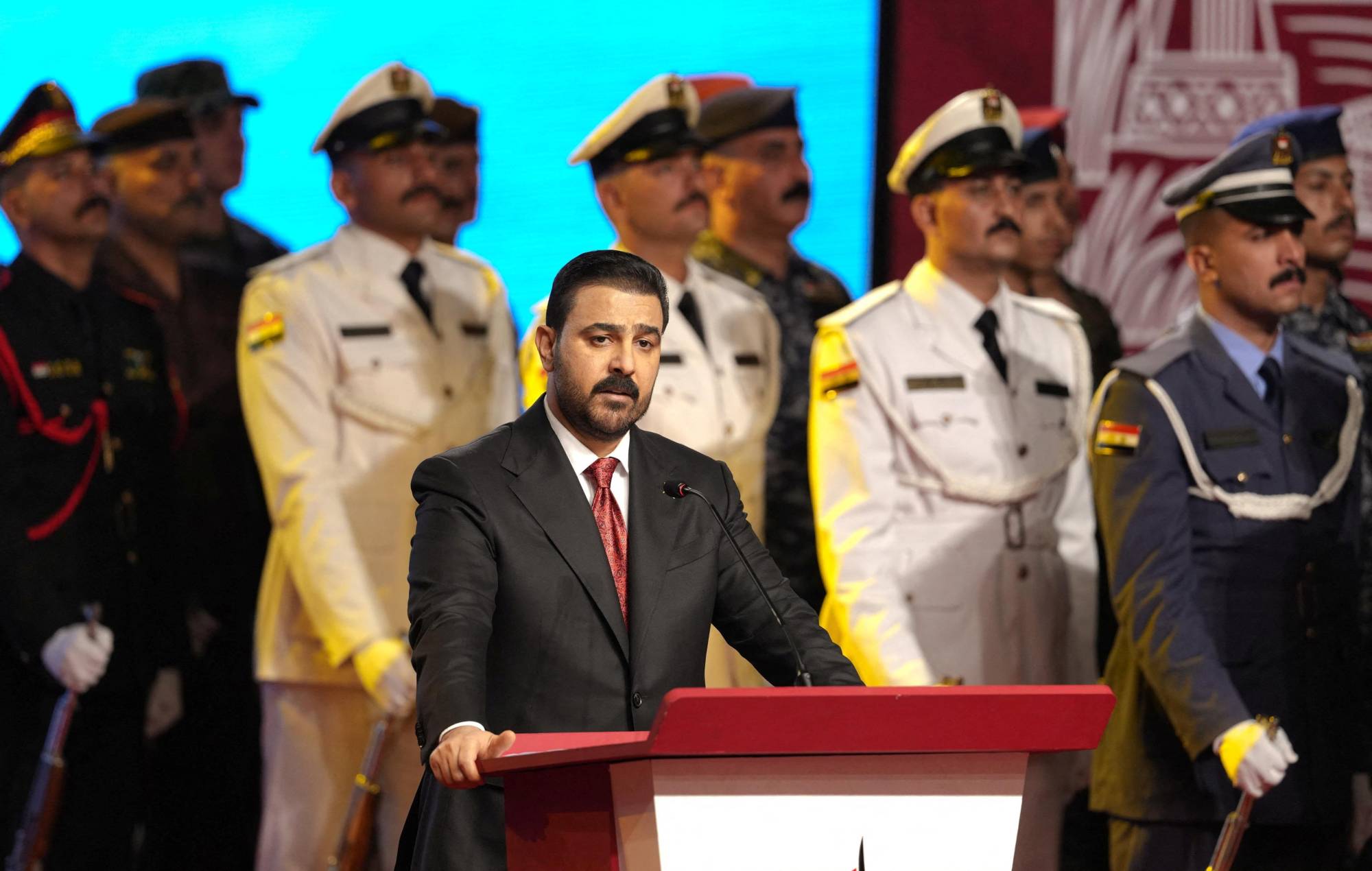
Prime Minister Ali al-Zaidi told a “Sovereignty Day” conference on Friday that Iraq’s foundations of “political, economic and security sovereignty” were taking firm hold.
“Iraqis have passed every difficult test,” he told executive and legislative officials, saying the country had reached a moment when it was renewing its resolve to protect the state and its system of government.
Al-Zaidi said Iraq’s restored sovereignty was reflected in the withdrawal of foreign troops and the complete end of the international coalition’s mission.
He also cited an agreement for Turkish forces and Kurdistan Workers’ Party members to withdraw, an end to the presence of foreign armed groups in Iraq, and the unification of Peshmerga forces to strengthen unified security and military decision-making.
He reaffirmed that Iraq would not be used as a launchpad for attacks on neighboring countries, and pledged to bring weapons under control in line with the constitution and the law, following an agreed timetable to address the factions’ status and integrate them into state institutions.
Iraqi Prime Minister Ali al-Zaidi attends the Sovereignty Day Conference marking the withdrawal of US-led coalition forces from Iraq, in Baghdad, Iraq, October 1, 2026. Iraqi Prime Minister's Media Office/Handout via REUTERS
The government had originally given the factions until Sept. 30 to surrender their weapons, coinciding with the end of the coalition’s mission. The groups had used the coalition’s presence to justify keeping their arms.
The government later dropped that deadline and extended it to June 2027.
Barzani in Baghdad
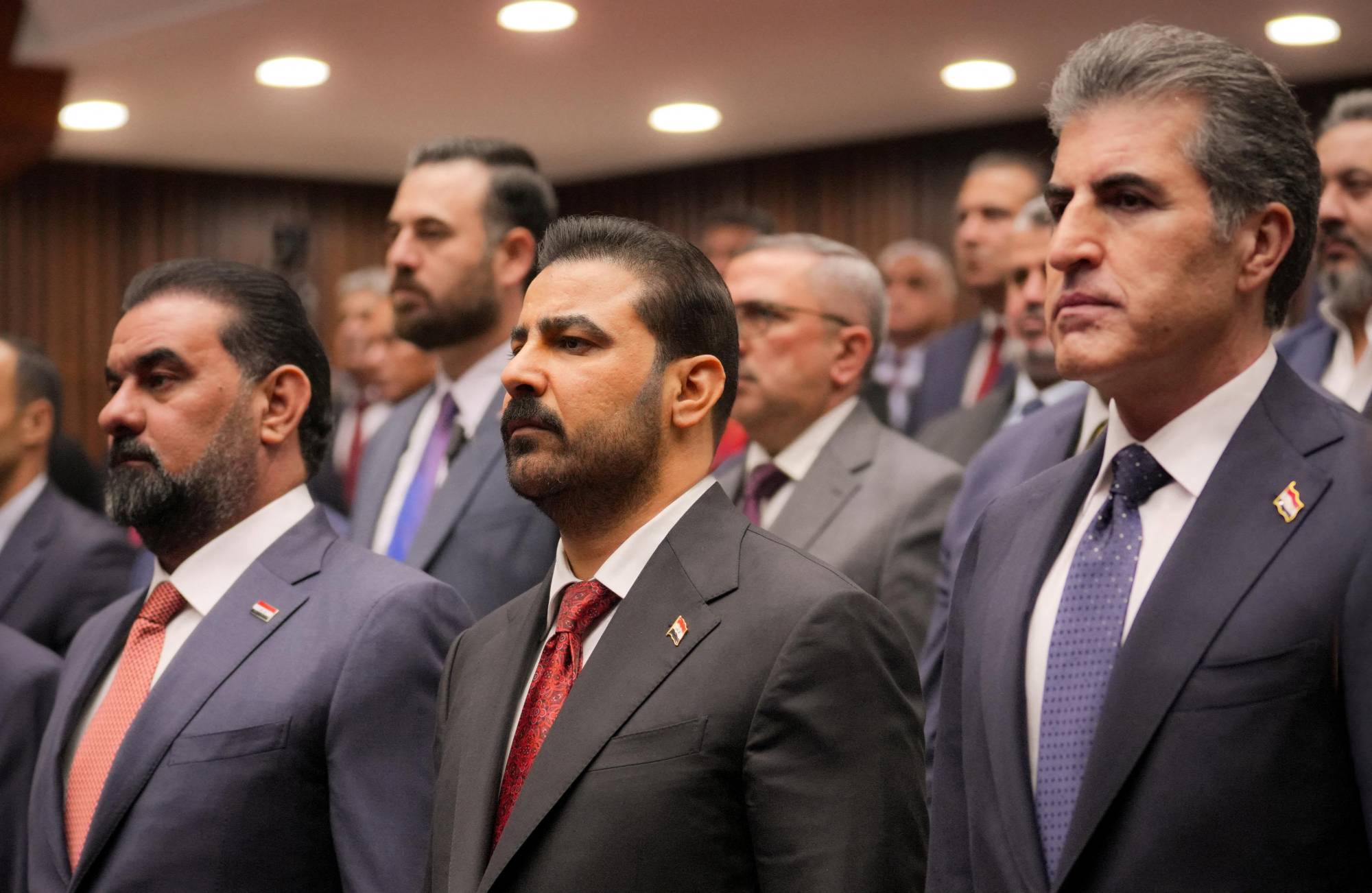
Al-Zaidi’s speech made no mention of the role of foreign forces. Kurdistan Region President Nechirvan Barzani, however, praised the US-led coalition for helping Iraqis defeat ISIS.
“Sovereignty means that the state has the final say,” Barzani said in a speech delivered in Arabic. Decisions on war and peace must rest exclusively with the state’s legitimate authorities, he added, and the constitution and federal system must be upheld.
During that difficult period, the United States, the coalition and Iraq’s friends had stood by the country and provided help at the Iraqi government’s request, he said.
“Today, as they leave Iraqi territory under the agreement concluded with the federal government, we will not forget that support and assistance,” Barzani said, adding that Iraqis would always regard it with appreciation and respect.
“But true gratitude should evolve into assuming national responsibility in Iraq.”
“The world’s largest embassy”
The Nujaba Movement, led by Iran-aligned Akram al-Kaabi, warned against any continued US military presence, including through security companies or advisers.
“Dealing on an equal footing requires the US Embassy to be like other embassies, rather than a vast security and military compound,” the movement said in a statement on Friday, describing it as the world’s largest embassy.
Nujaba demanded an end to US dominance over Iraq’s economy and resources and to American interference in its political affairs.
It also called for freeing Iraqi skies from US aircraft it described as attacking, and keeping US forces away from Iraq’s borders in Syria, Jordan and Kuwait.
Iraqi Prime Minister Ali al-Zaidi delivers a speech during the Sovereignty Day Conference marking the withdrawal of US-led coalition forces from Iraq, in Baghdad, Iraq, October 1, 2026. Iraqi Prime Minister's Media Office/Handout via REUTERS
After the withdrawal
Experts and activists are questioning what comes next.
Foreign troops stationed in Iraq under an agreement with its government had not undermined sovereignty in the first place, political activist Montadhar Naser said.
“Nevertheless, their departure signals that Iraq no longer needs any outside force,” he told Asharq Al-Awsat.
The authorities must now prove they can exercise full control on the ground, he said, while factions continue to defy the state and the law and push Iraq to the brink of regional military confrontations.
Political science professor Talib Mohammed Karim said Iraq’s political groups agreed on sovereignty in principle, but differed over what it meant and how to achieve it.
“The international community, meanwhile, engages with Iraq according to the extent to which it makes unified decisions through its institutions,” he told Asharq Al-Awsat.
لم تشترك بعد
انشئ حساباً خاصاً بك لتحصل على أخبار مخصصة لك ولتتمتع بخاصية حفظ المقالات وتتلقى نشراتنا البريدية المتنوعة