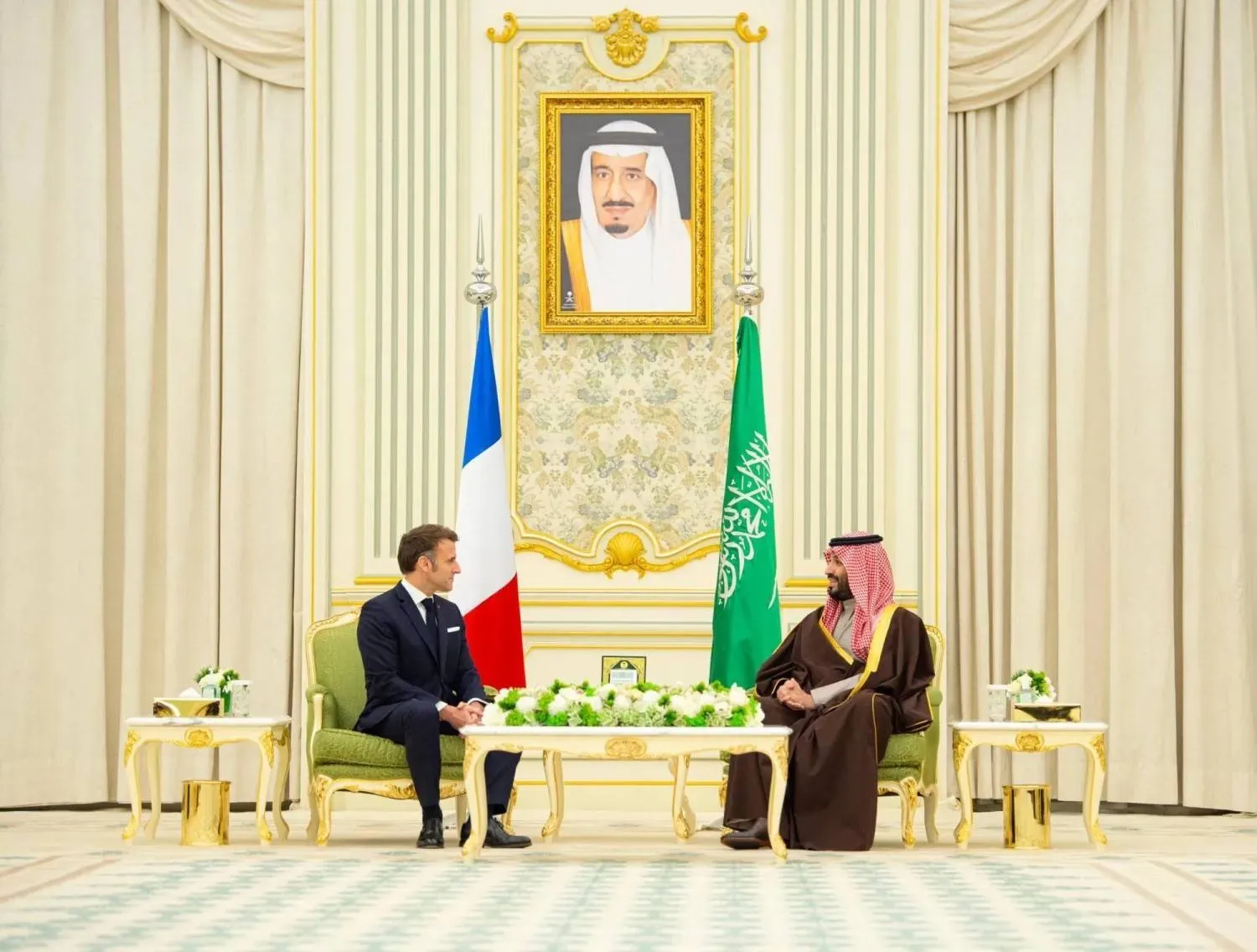
Saudi Crown Prince and Prime Minister Mohammed bin Salman is making an official visit to France on Sunday and Monday at the invitation of President Emmanuel Macron, whose state visit to Saudi Arabia in December 2024 resulted in a broad range of agreements and understandings and the launch of the Saudi-French Strategic Partnership Council.
The visit will be Mohammed bin Salman’s third to Paris, following trips in July 2022 and June 2023.
The crown prince left Saudi Arabia for France on Friday. The Saudi Royal Court said the visit was being made at the direction of Custodian of the Two Holy Mosques King Salman bin Abdulaziz and in response to Macron’s invitation.
First Strategic Partnership Council meeting
The visit comes in the wake of a major expansion in bilateral relations after the two countries signed a strategic partnership agreement, followed by a memorandum serving as a roadmap for cooperation across political, economic, cultural, artistic and sports fields.
In a statement issued late on Thursday into Friday, the Élysée Palace described the visit as “reflecting the vitality of the dialogue between France and the Kingdom of Saudi Arabia” and saying it would help strengthen the strategic partnership between the two countries. It added that Macron and Mohammed bin Salman would, for the first time, convene the French-Saudi Strategic Partnership Council.
Their first meeting will take place Sunday evening, Aug. 23, at the Grand Palais near the Champs-Élysées, where they will attend the closing ceremony of the Esports World Cup, hosted in France for the first time at Saudi Arabia’s request.
The French presidency noted that hosting the major international tournament reflected France’s renewed appeal as a venue for major sporting events following the success of the Paris 2024 Olympic and Paralympic Games.
It is the first time the competition has been held outside the Saudi capital. Sunday evening’s ceremony will include the presentation of prizes after seven weeks of competition involving 2,000 players from 100 countries and 200 clubs, including prominent Saudi teams. Organizers say total prize money amounts to $75 million.
Monday will include an official welcome for Mohammed bin Salman at the Élysée Palace, followed by bilateral talks in the afternoon. Macron and the crown prince will then co-chair the Strategic Partnership Council, which is expected to conclude with the signing of several agreements.
The two leaders will subsequently attend the closing session of a Saudi-French business forum being held in Paris to coincide with the official visit. The day will conclude with an official dinner at the Élysée Palace in honor of Mohammed bin Salman and his accompanying delegation.
According to the French presidency, talks will focus on the major economic and strategic issues underpinning the French-Saudi partnership. The two leaders will also exchange views on key regional challenges amid a situation that requires close coordination between France and its Gulf partners to support stability and peace in the Near and Middle East.
Regional crises on the agenda
French presidential sources said the visit comes amid “a regional crisis that erupted several months ago and whose outcome no one can foresee,” adding that Paris considers the crown prince’s decision to travel to France an “important signal.”
Macron and Mohammed bin Salman are expected to discuss the closure of the Strait of Hormuz, its repercussions and ways of ending the situation, with particular attention to efforts to diversify energy supply routes and improve links between the Middle East and Europe.
Élysée sources stressed that progress had been made on several projects but declined to provide details.
Lebanon will also figure prominently. Paris has called what French sources described as a “preparatory and technical” meeting involving the chiefs of staff of 15 countries, with the United States expected to attend.
France says it is working “closely” with Saudi Arabia on Lebanon and that both countries share a commitment to Lebanese sovereignty and support for the country’s authorities.
Élysée sources also referred to other projects being pursued away from public attention. Indications suggest these concern the expiry of the mandate of the UN Interim Force in Lebanon, UNIFIL, with France and Italy working on a formula aimed at preventing a vacuum. The United Nations has proposed several options.
Syria will also be on the agenda. Paris says it is working with Riyadh on the issue and noted that Macron recently paid an official visit to Syria.
Asked about the defense agreement signed in Makkah on Aug. 8 between Saudi Arabia, Pakistan and Türkiye, Élysée sources described it as “an illustration of the new regional architecture” and said it would be “extremely important to hear the Saudi view” of the development.
Searching for a way out of the war
Observers in Paris generally describe Saudi-French relations as “close and productive,” with regular communication between Mohammed bin Salman and Macron and ongoing coordination on Middle East issues, from the US-Iran war to Lebanon, Gaza, Yemen and maritime security in the Strait of Hormuz, Bab el-Mandeb and the Red Sea.
Bertrand Besancenot, a former French ambassador to Saudi Arabia, said the crown prince’s visit should be viewed in three contexts.
The first is the evolving regional situation, as Gulf leaders consider the best way out of the crisis gripping the region. While they recognize the central role of the United States, they also believe they must explore additional ways to safeguard their security and interests.
The second is Europe’s presence in the region, where European countries have political, economic and strategic interests and a role to play. Coordination with Riyadh, Besancenot said, can help them do so.
He pointed in particular to France’s importance as one of the European countries playing a leading role in the Middle East. Consultation and coordination with Paris could therefore help identify ways out of the current impasse, while also engaging other influential actors, including Pakistan and Türkiye.
Besancenot expects the tripartite Saudi-Pakistani-Turkish security agreement to feature in the Élysée talks.
The third context is the broad strategic partnership between France and Saudi Arabia and the economic, cultural, educational and sports projects they have launched together.
Besancenot also expects other major issues to be discussed, above all the Palestinian file in Gaza and the West Bank.
France and Saudi Arabia last year launched an initiative to revive the two-state solution, which won broad support at the United Nations and prompted major countries, led by France and Britain, to recognize the Palestinian state.
Lebanon and Syria are also expected to feature in the talks, particularly as Paris plans to host a preparatory meeting on Sept. 17 dedicated to supporting the Lebanese Armed Forces and Internal Security Forces.
Maritime security is another issue likely to feature. Riyadh convened a conference attended by 43 delegations that led to the launch of a maritime defense coalition to safeguard the Red Sea, Bab el-Mandeb and the Gulf of Aden, with 14 countries committing to participate.
On Aug. 14, Saudi Arabia formally announced the establishment of the Red Sea Maritime Defense Coalition.
A key question now is whether coordination can be established between the European Union’s Aspides naval mission in the Red Sea, launched in February 2024, and the Saudi-led coalition, particularly as both pursue the same objective. That issue could also feature in Monday’s Élysée talks.