


Romanians Vote in Tense Presidential Runoff That Pits Nationalist Against Pro-EU Centrist

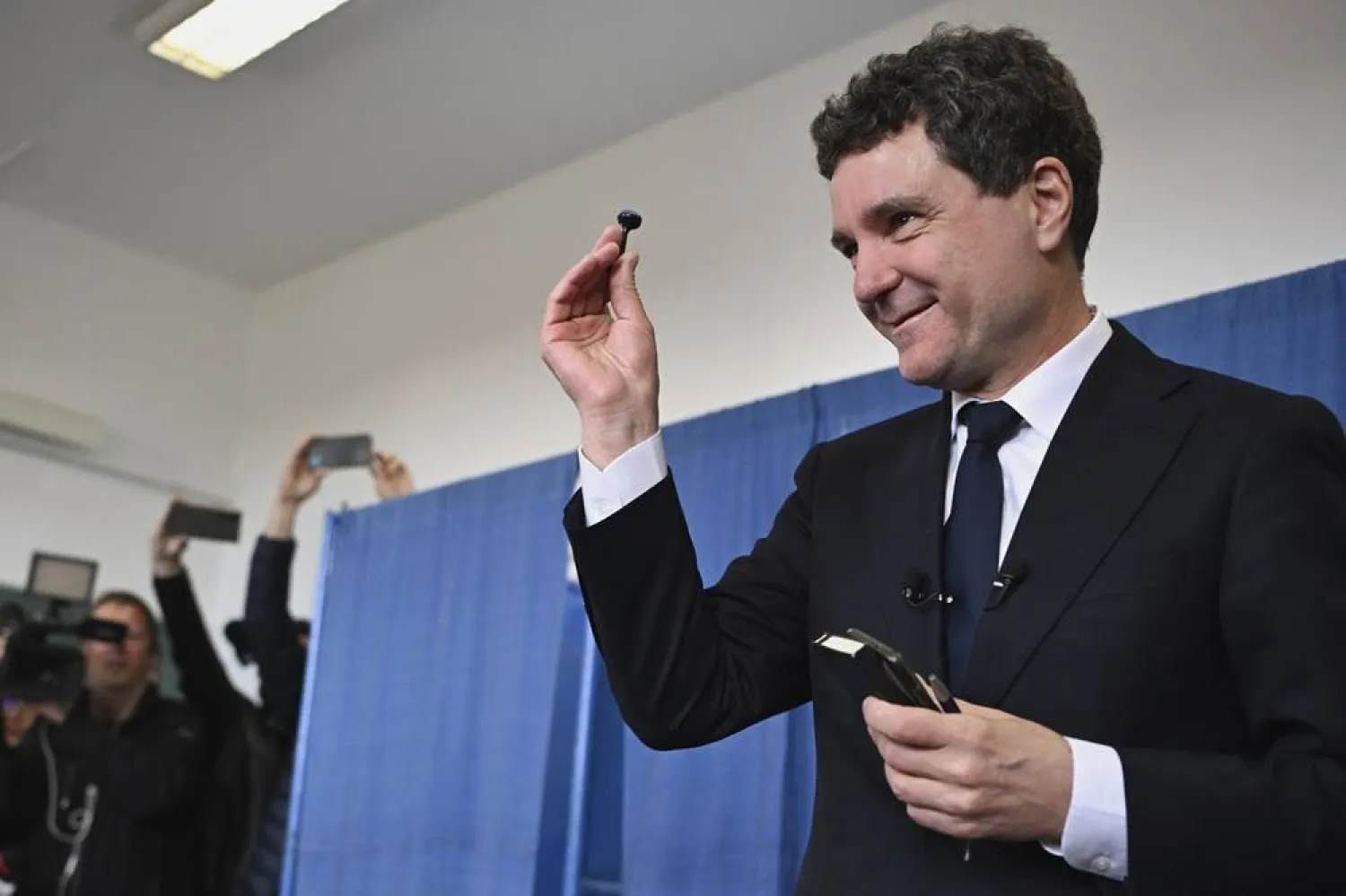
 Presidential candidate Nicusor Dan prepares to cast his ballot in the second round of the country's presidential election redo in Fagaras, Romania, Sunday, May 18, 2025. (AP)
Presidential candidate Nicusor Dan prepares to cast his ballot in the second round of the country's presidential election redo in Fagaras, Romania, Sunday, May 18, 2025. (AP)
TT

Romanians Vote in Tense Presidential Runoff That Pits Nationalist Against Pro-EU Centrist

 Presidential candidate Nicusor Dan prepares to cast his ballot in the second round of the country's presidential election redo in Fagaras, Romania, Sunday, May 18, 2025. (AP)
Presidential candidate Nicusor Dan prepares to cast his ballot in the second round of the country's presidential election redo in Fagaras, Romania, Sunday, May 18, 2025. (AP)

Romanians were voting on Sunday in a tense presidential runoff between a hard-right nationalist and a pro-Western centrist in a high-stakes election rerun that could determine the geopolitical direction of the European Union and NATO member country.

The race pits front-runner George Simion, the 38-year-old leader of the hard-right Alliance for the Unity of Romanians, or AUR, against incumbent Bucharest Mayor Nicusor Dan. It comes months after the cancelation of the previous election plunged Romania into its worst political crisis in decades.

Polls opened at 7 a.m. local time and will close at 9 p.m. (1800 GMT). In the first two hours of voting, more than 1.7 million people — or about 9.5% of eligible voters — had cast ballots, according to official electoral data. Romanians abroad have been able to vote since Friday at specially set-up polling stations, and more than 750,000 have already voted.

Romania’s political landscape was upended last year when a top court voided the previous election after far-right outsider Calin Georgescu topped first-round polls, following allegations of electoral violations and Russian interference, which Moscow denied.

Simion appeared alongside Georgescu at a Bucharest polling station on Sunday and told reporters that he voted against the “humiliations to which our sisters and brothers have been subjected.”

“We voted against abuses and against poverty. We voted against those who look down on all of us,” he said. “I voted for our future to be decided only by Romanians, for Romanians and Romania. So help us God!”

Years of endemic corruption and growing anger toward Romania’s political establishment have fueled a surge in support for anti-establishment and hard-right figures, reflecting a broader pattern across Europe. Both Simion and Dan have made their political careers railing against Romania’s old political class.

Most recent local surveys indicate the runoff will be tight, after earlier ones showed Simion holding a lead over Dan, a 55-year-old mathematician who rose to prominence as a civic activist fighting against illegal real estate projects.

After voting in his hometown of Fagaras, Dan told reporters that he voted for Romanians “who are quiet, honest, and hardworking, and who have not felt represented for a long time.”

“I voted for a change that brings prosperity, not one that brings instability and discourages investment in Romania,” he said. “I voted for a European direction, and for strong cooperation with our European partners, not for Romania’s isolation. I voted for a society where we can have dialogue, not one where we are destined to be divided.”

Turnout is typically higher in the final round of Romanian presidential elections, and is expected to play a decisive role in the outcome on Sunday. In the first round on May 4, final turnout stood at 9.5 million, or 53% of eligible voters, according to official electoral data.

Dan founded the reformist Save Romania Union party in 2016 but later left, and is running independently on a pro-European Union ticket reaffirming Western ties, support for Ukraine and fiscal reform.

The president is elected for a five-year term and has significant decision-making powers in matters of national security and foreign policy. The winner of Sunday's race will be charged with nominating a new prime minister after Marcel Ciolacu stepped down following the failure of his coalition’s candidate to advance to the runoff.

After coming fourth in last year’s canceled race, Simion backed Georgescu who was banned in March from running in the election redo. Simion then surged to front-runner in the May 4 first round after becoming the standard-bearer for the hard right.

A former activist who campaigned for reunification with neighboring Moldova, Simion says he would focus on reforms: slashing red tape, reducing bureaucracy and taxes. Still, he insists that restoring democracy is his priority, returning "the will of the people.”

His AUR party says it stands for “family, nation, faith, and freedom” and rose to prominence in a 2020 parliamentary election. It has since grown to become the second-largest party in the Romanian legislature.

His critics say Simion is a pro-Russian extremist who threatens Romania’s longstanding alliances in the EU and NATO.

In an Associated Press interview, he rejected the accusations, saying Russia is his country’s biggest threat and that he wants Romania to be treated as “equal partners” in Brussels.

“I don’t think he is a pro-Russian candidate, I also don’t think that he’s an anti-Russian candidate,” said Claudiu Tufis, an associate professor of political science at the University of Bucharest. “I think what is driving him is ... his focus on what I call identity politics.”

In the first-round vote, Simion won a massive 61% of Romania’s large diaspora vote, with his calls to patriotism resonating with Romanians who moved abroad in search of better opportunities.

Hours after voting abroad opened on Friday, Simion accused the Moldovan government of election fraud, claims that were quickly rejected by Moldovan and Romanian authorities.

“These statements are intended to sow distrust and hostility, with the aim of influencing the election process,” Romania’s Foreign Ministry said in a statement.



Iran Summons French, German, Italian, UK Envoys Over Support for Protests

 Cars burn in a street during a protest over the collapse of the currency's value, in Tehran, Iran, January 8, 2026. Stringer/WANA (West Asia News Agency) via Reuters
Cars burn in a street during a protest over the collapse of the currency's value, in Tehran, Iran, January 8, 2026. Stringer/WANA (West Asia News Agency) via Reuters
TT

Iran Summons French, German, Italian, UK Envoys Over Support for Protests

 Cars burn in a street during a protest over the collapse of the currency's value, in Tehran, Iran, January 8, 2026. Stringer/WANA (West Asia News Agency) via Reuters
Cars burn in a street during a protest over the collapse of the currency's value, in Tehran, Iran, January 8, 2026. Stringer/WANA (West Asia News Agency) via Reuters

Iran on Monday summoned diplomats in Tehran representing France, Germany, Italy and the UK to object to what it described as support by those countries for the protests that have shaken the country, its foreign ministry said.

The diplomats were shown a video of the damage caused by "rioters" and told their governments should "withdraw official statements supporting the protesters", the ministry said in a statement quoted by state television.

In Paris, the French foreign ministry confirmed that "European ambassadors" had been summoned by Iran.


Iran’s Traders, Frustrated by Economic Losses, Turn Against Clerics

 Cars burn in a street during a protest over the collapse of the currency's value, in Tehran, Iran, January 8, 2026. Stringer/WANA (West Asia News Agency) via Reuters
Cars burn in a street during a protest over the collapse of the currency's value, in Tehran, Iran, January 8, 2026. Stringer/WANA (West Asia News Agency) via Reuters
TT

Iran’s Traders, Frustrated by Economic Losses, Turn Against Clerics

 Cars burn in a street during a protest over the collapse of the currency's value, in Tehran, Iran, January 8, 2026. Stringer/WANA (West Asia News Agency) via Reuters
Cars burn in a street during a protest over the collapse of the currency's value, in Tehran, Iran, January 8, 2026. Stringer/WANA (West Asia News Agency) via Reuters

Iran's bazaar merchants, the trader class who were the financial backbone of the 1979 revolution, have turned against the clerics they helped bring to power, fueling unrest over an economy that has morphed into full-blown anti-government protests.

Frustration among bazaar merchants, from small-scale shopkeepers to large wholesale traders, has grown as their political and economic clout in Iran has diminished over the decades while the elite Revolutionary Guards have tightened their grip on the economy, building sprawling and tightly held networks of power.

"We are struggling. We cannot import goods because of US sanctions and because only the Guards or those linked to them control the economy. They only think about their own benefits," said a trader at Tehran’s centuries-old Grand Bazaar, speaking on condition of anonymity.

The wave of protests that has engulfed the country, posing one of the toughest challenges ever to the clerical leadership, erupted in late December in Tehran's Grand Bazaar, where hundreds of shopkeepers denounced the sharp fall in the rial currency.

The demonstrations quickly swelled and turned political, challenging the Islamic Republic's legitimacy. Protesters burned images of Supreme Leader Ali Khamenei and chanted "Death ‌to the dictator" - ‌undeterred by security forces armed with tear gas, batons, and, in many cases, live ammunition.

Iran’s ‌rulers, ⁠while acknowledging economic difficulties, have ‌blamed their longtime foes the US and Israel for fomenting the unrest. They appear intent on holding onto power at any cost, backed by a security apparatus refined over decades of suppressing ethnic revolts, student movements, and protests over economic hardship and social freedoms.

A combination of international sanctions and the Guards' sprawling economic empire has limited the government's ability to ease the dire economic situation.

Tehran-based analyst Saeed Laylaz said the government has lost control over the situation.

"What is striking is that the unrest began in the bazaar. For merchants, the core issue isn’t inflation - it’s price volatility, which leaves them unable to decide whether to buy or sell," he said.

Economic disparities between ordinary Iranians and the clerical and security elite, along with economic mismanagement and state corruption - ⁠reported even by state media - have fanned discontent at a time when inflation is pushing the price of many goods beyond the means of most people.

Iran's rial currency has lost nearly ‌half its value against the dollar in 2025, with official inflation reaching 42.5% in December.

CONTROL ‍OF SECTORS FROM OIL TO CONSTRUCTION

Created by the republic's ‍late founder Khomeini, the Guards first secured an economic foothold after the Iran-Iraq war in the 1980s, when clerical rulers allowed them ‍to invest in leading Iranian industries.

Their influence expanded exponentially over decades, benefiting from Khamenei's full backing and from opportunities created by Western sanctions, which effectively excluded Iran from the global financial and trading system.

The Guards now control vast sectors of the economy, from oil to transportation, communications, and construction.

Another trader said the crisis was not over, as the Guards have long proved adept at defending their economic interests.

"The government wants to resolve the problem, but it lacks the means and power in this system. The economy is not controlled by the government," said the trader, a 62-year-old carpet seller in Tehran.

All aspects of the country's sanctions-hit oil business have come under the growing influence of the ⁠Guards - from the shadow fleet of tankers that secretly ship sanctioned crude, to logistics and front companies selling the oil, mostly to China.

"No one knows how much of the oil money that the Guards get from selling Iran’s oil returns to the country ... they are too powerful to be questioned about it,” said a senior Iranian official, who asked not to be named.

During his 2013–2021 presidency, pragmatist Hassan Rouhani repeatedly clashed with the Guards, accusing them publicly of resisting budget cuts, while his attempts to curb their commercial networks and assets were largely frustrated.

THE ESTABLISHMENT RELIES ON THE GUARDS TO END UNREST

Even as it has relinquished economic power, the clerical establishment has relied on its loyal forces - the Guards and its affiliated Basij paramilitary - to violently crush ethnic uprisings, student unrest, and protests over economic hardship, preserving the political order.

"Given the sensitive circumstances when the country faces foreign threats, Khamenei cannot upset the Guards by curbing their economic influence. The establishment needs them to quell the protests and confront foreign threats," said an insider, close to Rouhani.

US-based rights group HRANA said it had verified the deaths of 544 people - 496 protesters and 48 security personnel - with 10,681 people arrested since ‌the protests began on December 28 and spread around the country. Reuters was unable to independently verify the tallies.

The authorities have not given numbers of casualties, but officials say many members of the security forces have been killed by "terrorists and rioters" linked to foreign foes, including the US States and Israel.


Greenland Says It Should Be Defended by NATO, Rejects Any US Takeover

 A view of houses in Nuuk, Greenland, June 22, 2025. (AP)
A view of houses in Nuuk, Greenland, June 22, 2025. (AP)
TT

Greenland Says It Should Be Defended by NATO, Rejects Any US Takeover

 A view of houses in Nuuk, Greenland, June 22, 2025. (AP)
A view of houses in Nuuk, Greenland, June 22, 2025. (AP)

Greenland's government said on Monday it will increase efforts to ensure the defense of the Arctic territory takes place under the auspices of NATO and again rejected US President Donald Trump's ambition to take over the island.

Trump has said the United States must own Greenland, an autonomous part of the Kingdom of Denmark, to prevent Russia ‌or China occupying the ‌strategically located and minerals-rich territory ‌in ⁠the future.

"All ‌NATO member states, including the United States, have a common interest in the defense of Greenland," the island's coalition government said in a statement, adding that it can in no way accept a US takeover of Greenland.

"As part of ⁠the Danish commonwealth, Greenland is a member of NATO and ‌the defense of Greenland ‍must therefore be through NATO," ‍the government said.

The European Union Commissioner ‍for Defense and Space Andrius Kubilius said earlier on Monday that any US military takeover of Greenland would be the end of NATO.

Trump first floated the idea of a US takeover of Greenland in 2019 during his first term ⁠in office, although he faces opposition in Washington, including from within his own party.

While Denmark has ruled Greenland for centuries, the territory has gradually been moving towards independence since 1979, a goal shared by all political parties elected to the island's parliament.

"We are a democratic society that makes our own decisions. And our actions are based on international law," Greenland's Prime Minister ‌Jens-Frederik Nielsen wrote on LinkedIn.