
Syrians Chase Equestrian Glory in Sport Once Dominated by Assads

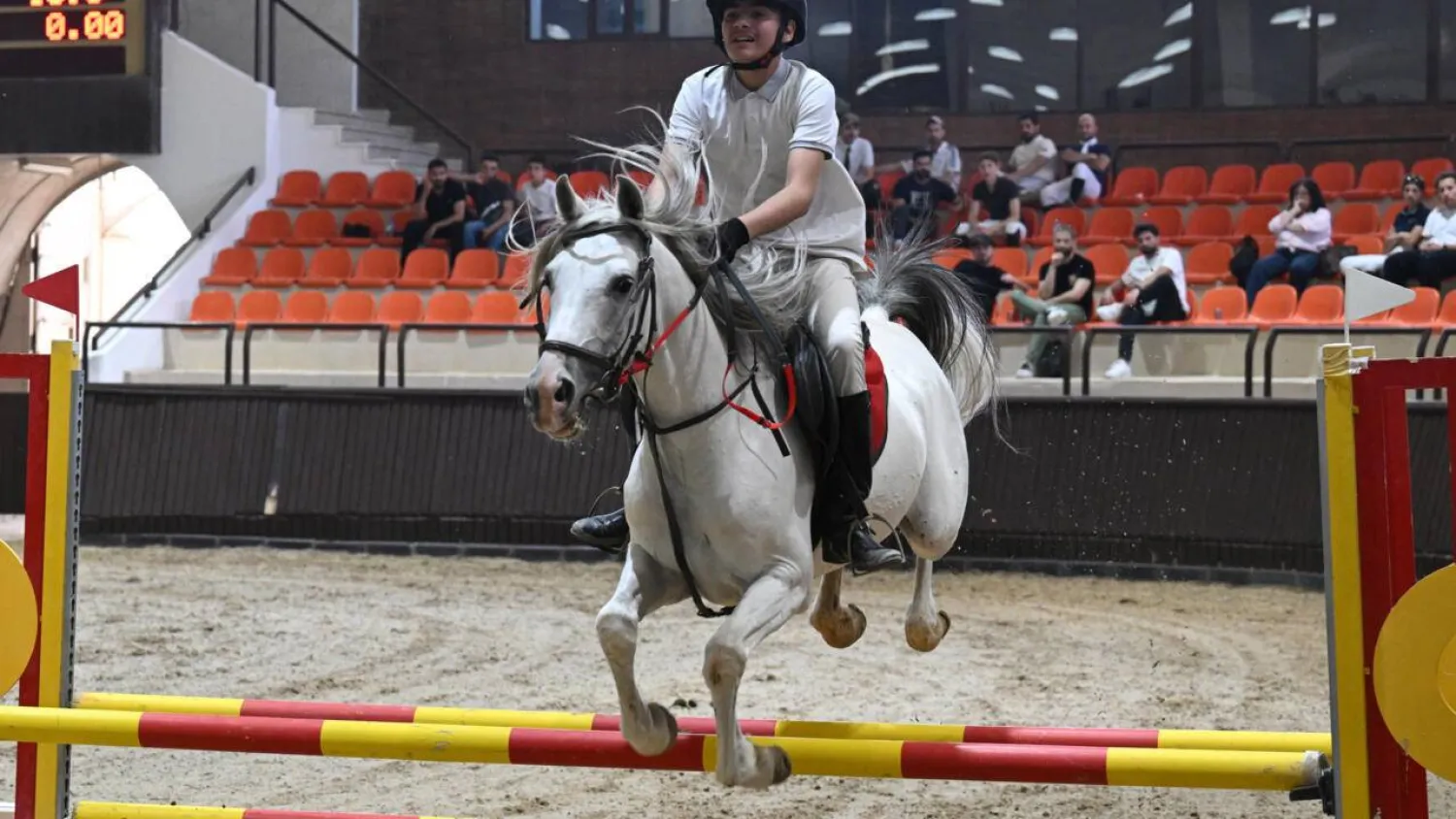
A rider competes at the Al-Nasr Equestrian Show Jumping Championship in Dimas, northwest of Damascus. LOUAI BESHARA / AFP
TT

Syrians Chase Equestrian Glory in Sport Once Dominated by Assads

A rider competes at the Al-Nasr Equestrian Show Jumping Championship in Dimas, northwest of Damascus. LOUAI BESHARA / AFP

For weeks, Ziad Abu al-Dahab has been training for gold at an equestrian tournament near Damascus -- in a sport once dominated by Syria's Assad family and their inner circle.

"Results used to be decided in advance, always favoring those close to the government," the 25-year-old rider said.

"My greatest ambition was to reach third place, but today, I can aim for first and do well with my new horse."

For decades, former president Bashar al-Assad, his relatives and allies enjoyed wide-ranging privileges before his overthrow in a lightning offensive in December.

Equestrian sports surged in the 1990s under Assad's late brother Bassel, who was being groomed to succeed their father Hafez before dying in a car crash in 1994. Bashar took over and became president in 2000.

Bassel used to take part in tournaments at home and abroad and styled himself as Syria's "first rider".

His profile helped shine a spotlight on the sport, which came to symbolize elite status under the Assads.

Abu al-Dahab said those close to the family had European horses, which far outperformed the local ones of other competitors.

"It was impossible to compete with the ruling family," he said while walking his horse on the sand.

Impossible competition

Outside the Dimas equestrian club near Damascus, a statue of Bassel still stands, his face now hidden by the new Syrian flag.

The family's grip on the sport passed to the next generation, including Sham, daughter of Bashar's brother Maher.

Sham used to compete in Syria and at international tournaments, often placing high.

The attention she received in the media stirred controversy, with critics seeing it as propaganda.

That grip on the sport kept some away. Munana Shaker, 26, said her father banned her from competing until the Assads were gone.

"My father forbade me from practicing due to fear (of the ruling family), and he always told me that competition with them was impossible," she said as she stroked her white mare, Mariana.

"He didn't want us associating with the Assad family at all. He told me the story of the equestrian who was jailed after beating Bassel al-Assad, and did not want to put me in danger."

She was referring to Adnan Qassar, a prominent rider who outperformed Bassel before being imprisoned without trial in 1993, accused of plotting to kill him.

Many believe his sporting success was the real reason for his arrest. Qassar was freed 21 years later under a presidential pardon.

"I have long stayed away from this sport, but it is now time to come back strong. I am from the Shaker family, not the Assad family," she said.

'Dream come true'

Shadi Abu al-Dahab, 48, oversees about 240 horses -- including some of the Assads' former European ones.

"Around 40 horses were set aside for the Assad family. No one else was allowed to get near them," he said.

But today, he's seeing new faces and growing interest in the sport.

"We have new skills that we discover daily, and enthusiastic children... We now have a large number of riders aspiring to compete and get titles," he said.

Fellow trainer Salah al-Ahmad, 52, was beaming as his son took the mare Topsy for a spin -- once ridden by Sham al-Assad.

"He used to dream of touching her or patting her head," Ahmad said. "Now in this new era, the mare is with him, and he has won two tournaments.

"It's a dream come true."


Saudi Red Sea Authority Appoints Dr. Maryam Ali Ficociello as CEO

The Saudi Red Sea Authority (SRSA) logo
TT

Saudi Red Sea Authority Appoints Dr. Maryam Ali Ficociello as CEO

The Saudi Red Sea Authority (SRSA) logo

The Saudi Red Sea Authority (SRSA) has appointed Dr. Maryam Ali Ficociello as Chief Executive Officer effective March 22.

“Ficociello brings more than two decades of leadership experience spanning governance, risk management, resilience, and compliance across public and private sectors, including state-owned entities. She has also represented the Kingdom at various international forums,” SRSA said in a statement on Thursday.

Commenting on her appointment, Ficociello said: “It is an honor to join the Saudi Red Sea Authority at this pivotal stage in its journey. SRSA has a critical role in enabling a world-class coastal tourism sector that is safe, well-governed, and investment-ready, while protecting the Red Sea’s unique marine ecosystems.”

“I look forward to working with our stakeholders across government and industry to strengthen regulatory excellence, embed sustainability and resilience across the sector, and advance the Kingdom’s ambitions for responsible coastal tourism and the blue economy,” she added.


Tourism on Hold as Middle East War Casts Uncertainty

Tourism to the Middle East has boomed in recent years but war now threatens that success. Ryan Lim / AFP
TT

Tourism on Hold as Middle East War Casts Uncertainty

Tourism to the Middle East has boomed in recent years but war now threatens that success. Ryan Lim / AFP

Cancelled flights, postponed trips and a great deal of uncertainty: the war in the Middle East is casting a long shadow over the tourism outlook for a region that has become a prized destination for travelers worldwide.

"My last group of tourists left three days ago, and all the other groups planned for March have been cancelled," said Nazih Rawashdeh, a tour guide near Irbid, in northern Jordan.

"This is the start of the high season here. It's catastrophic," he told AFP.

"And yet there's no problem in Jordan. It's perfectly safe."

Across the world, tour operators are scrambling to find solutions for clients stranded in the region or who had trips planned there.

"The priority is getting those already there back home," said Alain Capestan, president of the French tour operator Comptoir des Voyages.

He said however that the war is also affecting customers who have travelled to other parts of the world, as the Gulf region is home to several major aviation hubs.

Like other companies, the German tour operators surveyed by AFP -- Alltours, Dertour, Schauinsland-Reisen -- announced they would cover the cost of extra nights for clients stranded in the Middle East. They also cancelled trips to the UAE and Oman until at least March 7.

The British travel industry association ABTA said agencies "would not be sending customers to the region for as long as the British Foreign Office advises against all non-essential travel".

Customers whose holidays were cancelled in recent days will be able to rebook or receive a refund, it said.

- Economic impact -

The war is disrupting a sector that had been booming in the region.

According to UN Tourism, in 2025 around 100 million tourists visited the Middle East -- nearly seven percent of all international tourists recorded worldwide. That figure had grown three percent year-on-year and 39 percent compared to the pre-pandemic period.

Depending on the destination, Europeans make up a large share of visitors, followed by tourists from South Asia, the Americas, and other Middle Eastern countries.

For example, nearby markets accounted for 26 percent of total visitors to Dubai in 2025, according to its Ministry of Tourism and Economy.

Against this backdrop analysts Oxford Economics warns that "a decline in tourist flows to the region will deal a more severe economic blow than in the past, as tourism's share of GDP has grown, as has employment in the sector".

"We estimate inbound arrivals to the Middle East could decline 11-27 percent year-on-year in 2026 due to the conflict, compared to our December forecast that projected 13 percent growth," said Director of Global Forecasting Helen McDermott.

That would translate, according to the firm, to between 23 and 38 million fewer international visitors compared to the prior scenario, and a loss of $34 to $56 billion in tourist spending.

After Covid and then the conflict in Gaza, tourists had been coming back, said Rawashdeh, the Jordanian tour guide.

"For the past six months, people working in tourism here had hope. And now there's a war. This is going to be terrible for the economy," he said.

"We've definitely noticed an understandable slowdown in new bookings from our partners right now, but we fully expect that to bounce back as soon as things settle down and travelers feel more confident," said Ibrahim Mohamed, marketing director of Middle East Travel Alliance, which offers direct tours to American and British operators.

He remains optimistic: "The Middle East has always been an incredibly resilient market, and demand always bounces back fast once stability returns."


Punch the Orphan Macaque is Outgrowing his Plushie and Making Friends

Punch, a Japanese macaque born on July 26, 2025, climbs on the back of another in the monkeys' playground at the Ichikawa city zoo in Tokyo's eastward neighboring city, Tuesday, March 3, 2026. (AP Photo/Hiro Komae)
TT

Punch the Orphan Macaque is Outgrowing his Plushie and Making Friends

Punch, a Japanese macaque born on July 26, 2025, climbs on the back of another in the monkeys' playground at the Ichikawa city zoo in Tokyo's eastward neighboring city, Tuesday, March 3, 2026. (AP Photo/Hiro Komae)

Punch the baby orphan macaque is outgrowing the orangutan plushie that comforted him through early rejection from his mother and other monkeys.

Images of Punch dragging around the toy bigger than him drew attention to the residents of a zoo near Tokyo. When other monkeys shooed the baby away, Punch rushed back to the toy orangutan, hugging it for comfort.

But he's been using the toy less. On a recent day, Punch was seen climbing on the back of another monkey, sitting with adults and sometimes getting groomed or hugged, The Associated Press reported.

“It was good to see him grow, and I’m reassured,” said Sanae Izumi, a 61-year-old Punch fan from Osaka who came to the zoo because she was worried about the baby monkey. “He is adorable!”

Punch was abandoned by his mother after his birth, presumably because of exhaustion. Zookeepers nursed him and gave him the toy to train him to cling, an ability newborn macaques need to survive.

“Helping Punch learn the rules of monkey society and being accepted as a member is our most important task,” said Kosuke Kano, a 24-year-old zookeeper.

Punch was so popular after images of him and his toy showed up online last month, the zoo had to set rules to make visitors be quiet and to limit viewing to 10 minutes to reduce stress for the more than 50 other monkeys.

Punch eschewing the toy most of the time now is a good thing.

“When he grows out of the plush toy that encourages his independence, and that’s what we are hoping for,” zoo director Shigekazu Mizushina said.

Punch still sleeps with his toy every night, but Mizushina said the next thing keepers want to see is Punch bunched up with other monkeys to sleep.